As digital threats grow more advanced and relentless, cybersecurity stands as a cornerstone for safeguarding organizational assets. Businesses today require professionals who can do more than just respond—they must anticipate, prevent, and neutralize threats before damage occurs. Earning a specialized credential like the CertNexus CyberSec First Responder (CFR) certification validates those capabilities, signaling your readiness to lead the charge in cyber defense and giving you a distinct edge in a highly competitive field.
The CertNexus CyberSec First Responder (CFR) certification is more than just a credential; it’s a testament to a professional’s ability to handle the complexities of cybersecurity incidents, from prevention and detection to response and recovery. For individuals passionate about safeguarding digital assets, the CFR certification signifies a commitment to excellence and a readiness to face the challenges of a dynamic threat landscape head-on.
Why CertNexus CyberSec First Responder (CFR) Certification is Essential for Cybersecurity Professionals
The demand for qualified cybersecurity professionals continues to outpace the supply. Reports consistently highlight a significant skills gap, with millions of cybersecurity positions remaining unfilled globally. For instance, Cybersecurity Ventures projected 3.5 million unfilled cybersecurity jobs in 2021, a number that continues to grow. In this landscape, the CertNexus CyberSec First Responder Certification emerges as a crucial differentiator, offering a robust set of skills that directly address the needs of modern organizations.
Comprehensive Coverage of Key Skills
The CFR certification curriculum is meticulously designed to cover the entire incident response lifecycle. It equips professionals with the knowledge and practical skills needed to:
- Protect: Implement security controls and best practices to prevent incidents.
- Detect: Identify and analyze potential security breaches using various tools and techniques.
- Respond: Execute effective incident response procedures, including containment, eradication, and recovery.
- Restore: Bring systems back to operational status after an incident.
- Audit: Conduct post-incident reviews to identify lessons learned and improve future security posture.
This comprehensive approach ensures that CFR-certified individuals are well-rounded and prepared for a variety of real-world scenarios.
Vendor-Neutral Approach
Unlike some certifications tied to specific technologies or vendors, the CertNexus CyberSec First Responder Certification adopts a vendor-neutral stance. This means the skills and knowledge gained are universally applicable across diverse technological environments and organizational structures. This broad applicability makes CFR-certified professionals highly versatile and valuable to a wider range of employers, as they can adapt to different platforms and tools without extensive retraining.
Who Should Pursue the CertNexus CFR Certification?
The CyberSec First Responder Certification is tailored for a specific demographic within the cybersecurity realm, aiming to enhance the capabilities of those directly involved in incident handling and security operations. It is ideally suited for:
- Individuals with between 3 and 5 years of experience working in a computing environment as part of a Computer Emergency Response Team (CERT), Computer Security Incident Response Team (CSIRT), or Security Operations Center (SOC).
- Professionals who are responsible for protecting critical information systems before, during, and after an incident.
- Security analysts, incident responders, forensic analysts, and other IT professionals looking to validate and advance their incident response skills.
If you find yourself in a role where you are constantly vigilant against threats, analyzing alerts, and ready to spring into action when an incident occurs, the CyberSec First Responder (CFR) certification is a logical next step in your career progression.
CertNexus CyberSec First Responder Certification: A Boon for Employers
For organizations, the presence of Certified First Responder Certification holders within their teams translates directly into tangible benefits, strengthening their overall security posture and operational efficiency.
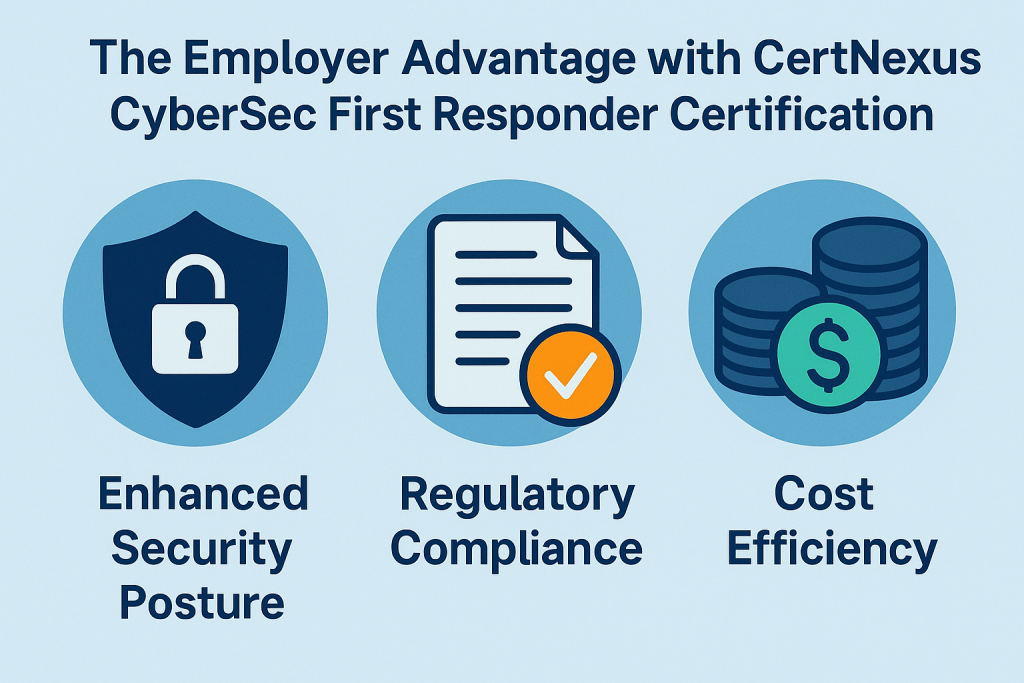
Enhanced Security Posture
- Proactive Defense: CFR-certified professionals are trained to identify vulnerabilities and implement preventative measures, significantly reducing the likelihood of successful attacks.
- Rapid Incident Response: Their expertise in incident handling minimizes the impact of breaches, leading to faster recovery times and less disruption to business operations.
- Reduced Risk: By having a team equipped to effectively manage and mitigate cyber threats, organizations can drastically lower their overall cybersecurity risk profile.
Regulatory Compliance
In today’s highly regulated environment, organizations face stringent requirements to protect sensitive data. The skills acquired through the CertNexus CyberSec First Responder certification directly contribute to meeting various compliance mandates, such as GDPR, HIPAA, and PCI DSS. CFR professionals understand the importance of data privacy and security best practices, helping organizations avoid costly penalties and reputational damage.
Cost Efficiency
- Minimized Breach Costs: Effective incident response can significantly reduce the financial fallout of a cyberattack, which can include data recovery costs, legal fees, regulatory fines, and reputational damage.
- Optimized Resource Allocation: By having a well-trained incident response team, organizations can avoid the need for expensive external consultants during crises, optimizing their security budget.
- Improved Operational Resilience: A strong security posture built on the expertise of CFR-certified professionals ensures business continuity and minimizes downtime.
CertNexus CyberSec First Responder Exam Overview
Understanding the structure and format of the CertNexus CFR Exam cost and content is crucial for effective preparation. The exam, specifically the CFR 410 Questions, assesses a candidate’s practical knowledge and problem-solving abilities in incident response.
- Number of Questions: 80
- Question Type: Multiple Choice/Multiple Response
- Exam Codes: CFR-410. This is the current exam version you should focus on.
- Passing Score: 70% or 73% depending on exam form. It’s vital to aim for a score well above the minimum to ensure a comfortable pass.
- Exam Cost: $367.50 (USD). It’s advisable to check the official CertNexus website or your chosen testing provider for the most up-to-date pricing.
Steps to Prepare for the CertNexus CFR-410 Certification
Embarking on the journey to earn your CertNexus CyberSec First Responder Certification requires a structured and dedicated approach. For many, the thought of an upcoming exam can be daunting, bringing with it the stress of preparation and the desire to perform well. This is where reliable resources and strategic preparation become invaluable, transforming anxiety into confidence. Platforms like Edusum can significantly alleviate this stress by providing targeted, high-quality preparation materials.
1. Understand the Exam Objectives
The first and most critical step is to thoroughly review the official exam objectives for CFR-410. These objectives, readily available on the CertNexus website, outline the specific knowledge domains and skills that will be tested. This forms your roadmap for study, ensuring you focus on relevant areas. Key objectives include in CFR-410 exam are:
- Identify (22%)
- Protect (24%)
- Detect (18%)
- Respond (19%)
- Recover (17%)
2. Utilize Quality Study Materials
High-quality study materials are the bedrock of successful exam preparation. Consider:
- Official CertNexus Resources: The official study guide and training courses often provide the most accurate and in-depth content.
- Reputable Third-Party Materials: Look for books, online courses, and video tutorials from well-known cybersecurity training providers.
3. Gain Hands-On Experience
Theory alone is not enough for the Cybersec First Responder Certification. Practical experience is paramount.
- Virtual Labs: Set up virtual environments to practice incident response techniques, forensic analysis, and security tool usage.
- Simulated Attacks: Participate in exercises that simulate real-world cyberattacks to hone your detection and response skills.
- Work Experience: Leverage your existing professional experience in a SOC, CERT, or CSIRT setting to reinforce your understanding of the concepts.
4. Join Study Groups
Collaborating with peers can be incredibly beneficial.
- Share Knowledge: Discuss challenging topics, clarify doubts, and gain different perspectives.
- Motivate Each Other: A study group can provide accountability and encouragement, especially during challenging phases of preparation.
- Practice Teaching: Explaining concepts to others solidifies your own understanding.
5. Take CFR 410 Practice Test
Perhaps the most crucial step in solidifying your preparation is taking Certnexus Cybersec First Responder practice exams. This is where platforms like Edusum truly shine.
- Assess Your Knowledge: Practice tests identify your strengths and weaknesses, allowing you to focus your remaining study time effectively.
- Familiarize with Exam Format: Repeated exposure to the exam’s question types and interface reduces anxiety on the actual test day.
- Time Management: Practice tests help you develop effective time management strategies to complete the exam within the allotted time.
Edusum offers highly relevant and realistic online practice exams for the CFR-410. These practice tests are designed to mimic the actual exam experience, helping you build confidence and identify areas for improvement. One can also refer to the CertNexus CyberSec First Responder Exam (CFR-410) Ultimate Preparation Guide for a comprehensive study plan.
CertNexus CFR vs. Other Cybersecurity Certifications
The cybersecurity certification landscape is vast, with numerous options available. While certifications like CompTIA Security+, Certified Ethical Hacker (CEH), and (ISC)² CISSP are highly respected, the CertNexus CyberSec First Responder (CFR) carves out its unique niche by focusing specifically on the critical domain of incident response.
Focused Incident Response Training
Many general cybersecurity certifications provide a broad overview of security concepts. While valuable, they may not delve into the granular details of incident detection, analysis, containment, eradication, and recovery to the same extent as the CFR. The CFR Certification is explicitly designed to equip professionals with the specialized skills needed to be effective “first responders” in the event of a cyber incident, making it a highly targeted and practical credential.
Industry Recognition
CertNexus is gaining significant traction in the industry for its practical and job-role-aligned certifications. Employers increasingly recognize the value of certifications that demonstrate hands-on abilities and direct applicability to specific cybersecurity roles. The Certified First Responder Certification is steadily becoming a benchmark for professionals involved in incident response, especially within SOCs and CSIRTs.
Cost-Effectiveness
Compared to some higher-tier or more generalized certifications, the CFR Certification Cost is often more accessible, offering excellent value for the specialized knowledge and career advancement it provides. This makes it an attractive option for individuals and organizations looking for a focused and efficient way to upskill in incident response.
Future Prospects for CertNexus CyberSec First Responder
The future for professionals holding the CertNexus CyberSec First Responder certification is bright and full of opportunity. As cyber threats continue to proliferate, the demand for skilled incident responders will only intensify.
- Growing Demand: The global cybersecurity market is projected to grow significantly, driven by increasing cybercrime and the need for robust defenses. This growth directly translates to a high demand for incident response specialists.
- Attractive Salaries: Professionals with specialized incident response skills command competitive salaries. While Cybersec First Responder salary figures can vary based on experience, location, and specific role, holding the CFR certification often leads to higher earning potential. According to various industry reports, the average salary for an incident responder can range from $80,000 to $120,000 or more, with certified professionals often at the higher end of this spectrum.
- Career Advancement: The CFR certification serves as a strong foundation for career progression within cybersecurity. It can open doors to roles such as:
- Senior Incident Responder
- Cybersecurity Analyst Lead
- SOC Manager
- Security Consultant
- Threat Hunter
- Continuous Learning: The dynamic nature of cybersecurity necessitates continuous learning. The principles and practices learned during CFR certification provide a strong framework for adapting to new threats and technologies.
Conclusion
In the relentless battle against cybercrime, the CertNexus CyberSec First Responder certification stands out as a vital credential for anyone serious about a career in incident response. It offers a comprehensive, vendor-neutral, and practically focused pathway to mastering the essential skills needed to protect, detect, respond to, and recover from cybersecurity incidents.
For individuals, earning the CyberSec First Responder Certification validates your expertise, enhances your career prospects, and positions you as a highly sought-after professional in a critical field. For employers, a workforce equipped with CFR-certified individuals translates directly into a stronger security posture, enhanced regulatory compliance, and significant cost efficiencies.
As the digital world continues to evolve, the need for agile and effective cyber first responders will only intensify. By pursuing the CertNexus CyberSec First Responder (CFR) certification, you are not just investing in a piece of paper; you are investing in a future where you play a pivotal role in safeguarding our digital infrastructure. Take the step, prepare diligently with resources like Edusum, and become the cybersecurity professional employers are actively seeking. Your journey to becoming a certified CyberSec First Responder starts now.
FAQs
1. What is the CertNexus CyberSec First Responder (CFR) certification?
- The CertNexus CyberSec First Responder (CFR) certification is a vendor-neutral credential that validates a professional’s ability to handle cybersecurity incidents, from prevention and detection to response and recovery. It focuses on the practical skills required for incident responders in a Security Operations Center (SOC) or Computer Security Incident Response Team (CSIRT) environment.
2. What are the primary skills covered by the CertNexus CFR certification?
- The CFR certification covers a comprehensive range of skills, including identifying and analyzing threats, understanding common attack vectors, implementing preventative security controls, performing incident detection and analysis, containing and eradicating threats, recovering systems, and conducting post-incident reviews.
3. Who should consider pursuing the CertNexus CFR certification?
- The CFR certification is ideal for cybersecurity professionals with 3-5 years of experience in a computing environment, especially those working in CERT/CSIRT/SOC teams. Roles such as security analysts, incident responders, forensic analysts, and other IT professionals responsible for protecting critical information systems will find this certification highly beneficial.
4. What is the exam code for the CertNexus CyberSec First Responder?
- The current exam code for the CertNexus CyberSec First Responder is CFR-410.
5. How many questions are on the CFR-410 exam, and what is the passing score?
- The CFR-410 exam consists of 80 multiple-choice/multiple-response questions. The passing score typically ranges from 70% to 73%, depending on the specific exam form.
6. How much does the CyberSec First Responder exam cost?
- The CyberSec First Responder Exam cost is $367.50 (USD).
7. What are the best ways to prepare for the CertNexus CFR-410 exam?
- Effective preparation involves understanding the exam objectives, utilizing quality study materials, gaining hands-on experience through labs and simulations, joining study groups, and critically, taking CFR 410 practice test exam.
8. What kind of salary can I expect with a CertNexus CyberSec First Responder certification?
- The Cybersec First Responder salary can vary based on experience, location, and job role. However, professionals with this certification generally command competitive salaries due to the high demand for incident response skills. Average salaries for incident responders often range from $80,000 to $120,000 annually or more, with certified professionals often achieving higher compensation.


