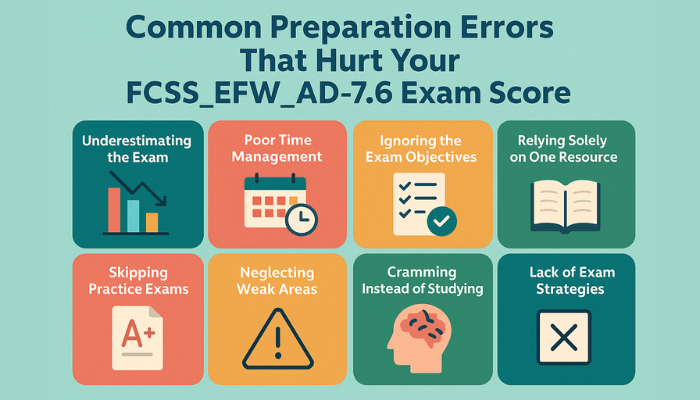
Many skilled security professionals underestimate how demanding the FCSS_EFW_AD-7.6 exam is until their preparation derails under pressure. Some put in long hours yet still score below expectations. Others fail to focus on the right topics. Most fall into predictable traps that could have been avoided with the right preparation strategy.
This guide explains the most common mistakes candidates make when studying for the Enterprise Firewall Administrator exam and how to avoid them so your attempt leads to a stronger result.
Before diving into the mistakes, remember that the exam is designed to verify deep expertise in advanced Fortinet firewall administration, secure networking, and enterprise-level technologies.
The more closely your preparation aligns with these expectations, the stronger your performance.
Stop These FCSS_EFW_AD-7.6 Study Traps
1. Studying Without a Structured Plan
One of the biggest mistakes FCSS candidates make is preparing without a strategic plan. The exam covers advanced firewall features, authentication, routing, policies, high availability, threat protection, and troubleshooting. Trying to study without a documented plan leads to poorly distributed effort, missed topics, and inefficient revision.
How to avoid this:
Create a weekly breakdown based on the full exam outline. Prioritize areas where you are weakest. Include hands-on labs, revision blocks, and measured practice exam attempts. A structured plan reduces stress and keeps your preparation aligned with the actual skill domains Fortinet expects.
2. Ignoring Hands-On Practice in Real or Simulated Labs
The FCSS_EFW_AD-7.6 exam is deeply practical. Many candidates over-focus on videos or reading guides and underestimate how much the exam tests your ability to configure, maintain, and troubleshoot a FortiGate in an enterprise environment.
What happens when you skip labs:
- You understand the theory but cannot apply it under pressure.
- Commands feel unfamiliar.
- Troubleshooting scenarios become overwhelming.
Avoid this by:
Building real or virtual lab environments, replicating enterprise policies, checking logs, deploying NAT, configuring VPN, fine-tuning inspection modes, and validating the changes. The more your hands know, the more confidently you think.
3. Misunderstanding Advanced Firewall Concepts
Candidates often gloss over advanced topics such as flow-based inspection, session handling, routing interplay, dynamic objects, or deep packet inspection decisions. These are all crucial for the FCSS-level exam, and skipping them often leads to unexpected difficulty.
Avoid this mistake by:
- Studying beyond basic firewall behavior. Dive into scenario-based learning. Ask questions like:
- How does a firewall decide which policy applies?
- What happens when a session expires?
- How does HA failover change session behavior?
The exam tests applied understanding, not memorized definitions.
4. Overlooking the Official Exam Blueprint
A surprising number of FCSS candidates rely on community summaries, outdated notes, or generic firewall training. This leads to coverage gaps because the exam evolves along with FortiOS features.
The official Enterprise Firewall Administrator Exam page provides the most accurate and up-to-date blueprint. Ignoring it is one of the costliest mistakes.
Avoid this by:
- Studying directly from the official Fortinet Training Institute pages linked above.
- Review each objective and map your preparation plan to it.
Never prepare based on assumptions when official expectations are available.
5. Not Using Measured Practice Exam Attempts
Many learners wait until the final week to try a practice exam. This removes the opportunity to diagnose mistakes early, track progress, and build familiarity with the difficulty level.
Using a high-quality practice test source such as the one available at NWExam – FCSS_EFW_AD-7.6 Exam Practice Tests: allows you to measure readiness and increase your score each week.
Avoid this mistake by:
- Starting practice tests midway through your preparation.
- Reviewing each incorrect answer thoroughly.
- Tracking score improvements over time.
Practice does not just measure readiness; it improves it.
6. Studying Only from One Source
Relying solely on video courses or a single training guide limits your understanding. The FCSS exam expects you to synthesize knowledge from multiple types of resources, including documentation, labs, exercises, and administrator guides.
How to avoid this:
- Combine multiple authoritative inputs:
- Fortinet official documentation
- Hands-on FortiGate experience
- Course materials
- Expert discussions
- Practice exams
Diversifying your learning ensures stronger recall and better real-world understanding.
7. Underestimating Troubleshooting Skills
Troubleshooting is one of the most challenging aspects of the FCSS_EFW_AD-7.6 exam. Candidates often focus on configuration skills but fail to understand how to identify issues using logs, debug flow, packet capture, and system event analysis.
To avoid failure here:
- Practice diagnosing issues in labs:
- Misconfigured NAT
- Broken policy routes
- Incorrect inspection modes
- Session table anomalies
- HA failover behavior
The more problems you solve in practice, the easier the exam becomes.
8. Not Practicing Time Management During Mock Exams
Practice tests help with accuracy but also with pacing. Some FCSS candidates spend too much time on early questions, rushing through difficult ones later. Time mismanagement can reduce your score even if you know the material well.
Avoid this by:
- Timing each practice session.
- Learning when to skip and return.
- Developing intuition for question complexity.
- Using mock exams under real-time pressure.
Controlled pacing leads to controlled performance.
9. Overconfidence in Familiar Topics
Firewalls are familiar territory for many network engineers. This comfort sometimes leads to overconfidence, especially in areas such as NAT, policies, session handling, or routing.
The FCSS exam tests these topics with more depth and nuance than you may expect.
Avoid this mistake by:
- Revisiting foundational topics in detail.
- Reviewing FortiGate-specific behavior differences.
- Practicing advanced configurations instead of basic ones.
Familiarity should never replace disciplined preparation.
10. Failing to Review Log Files and Diagnostic Tools
Real-world FortiGate troubleshooting relies heavily on logs, session tables, diag commands, packet capture, and flow diagnoses. Many candidates memorize configuration steps but cannot interpret diagnostic output.
Avoid this mistake by regularly reviewing:
- Traffic logs
- Event logs
- Security logs
- diag debug flow output
- Interface and routing diagnostics
- Packet captures
Being comfortable with diagnostic outputs is essential for an FCSS administrator.
11. Cramming Too Close to the Exam Day
Cramming is a high-stress, low-retention strategy. Candidates who attempt last-minute memorization often enter the exam mentally overloaded and unable to recall what they studied.
Avoid this by:
- Completing major preparation one week before the exam.
- Using the final days only for light review of weak areas.
- Taking practice tests rather than learning new material.
Effective preparation requires spaced learning, not compressed panic.
12. Neglecting Practice Tests That Simulate Real Difficulty
Some candidates use overly simple or outdated question banks, which creates unrealistic confidence. Real FCSS-level questions require problem-solving ability, scenario understanding, and advanced reasoning.
Avoid this by:
- Choosing updated and exam-aligned practice tests.
- Practicing regularly, not just once.
- Reviewing explanations thoroughly.
Good practice exams help you identify blind spots before the real exam does.
Benefits of Avoiding These Mistakes
Once you remove these preparation pitfalls, your study quality improves dramatically. You gain stronger confidence, clarity in complex topics, and mastery of advanced enterprise firewall administration techniques. Most importantly, your chances of passing the FCSS_EFW_AD-7.6 exam on the first attempt rise significantly.
You also become better prepared for real-world enterprise firewall responsibilities, which directly enhances your career value.
Conclusion: Your Best FCSS_EFW_AD-7.6 Attempt Starts by Avoiding These Mistakes
Preparing for the FCSS_EFW_AD-7.6 exam is a serious commitment, and success depends heavily on avoiding the mistakes discussed in this guide. By structuring your study efforts, practicing deeply, focusing on diagnostic skills, and using high-quality practice tests, you greatly increase your chances of scoring well.
FAQs:
1. What is the FCSS_EFW_AD-7.6 certification?
It is the Fortinet Enterprise Firewall Administrator certification validating advanced skills in firewall configuration, secure networking, and enterprise-level troubleshooting.
2. Is the FCSS_EFW_AD-7.6 exam difficult?
Yes. The exam is challenging and requires in-depth hands-on expertise, strong troubleshooting skills, and broad knowledge of FortiGate capabilities.
3. How should I prepare for the FCSS_EFW_AD-7.6 exam?
Use a combination of official training materials, FortiGate labs, mock exams, and the official exam blueprint. A structured study plan boosts success.
4. Are practice tests necessary for this exam?
Absolutely. Practice tests help simulate real difficulty levels, identify weak areas, and improve exam pacing. Use updated sources such as NWExam.
5. What are the most common preparation mistakes?
Skipping hands-on labs, ignoring the official blueprint, relying on one study source, weak troubleshooting skills, and poor time management.
6. How long should I study before attempting the exam?
Most candidates require 4 to 8 weeks depending on experience, complexity, and mastery of advanced firewall features.


