Navigating the complex landscape of artificial intelligence security is paramount for modern professionals. As AI systems become more integrated into critical business operations, the demand for experts capable of securing these advanced technologies grows exponentially. This comprehensive guide addresses common aaism questions and offers insights into the ISACA Advanced in AI Security Management (AAISM) certification.
The AAISM certification, offered by ISACA, is meticulously designed to validate a professional’s expertise in governing, managing, and securing AI systems, frameworks, and applications. It is tailored for individuals seeking to demonstrate a deep understanding of AI security principles and their practical application in organizational settings, making it a crucial credential for anyone looking to specialize in this cutting-edge field.
For a detailed step-by-step strategy to succeed in the ISACA AISM certification, check out this comprehensive guide: ISACA AISM Certification: Step-by-Step Strategy for Success.
Understanding the ISACA AAISM Certification’s Core Purpose
The ISACA AAISM certification serves as a beacon for professionals aiming to solidify their role in the rapidly evolving domain of AI security. It goes beyond theoretical knowledge, focusing on the practical application of security controls and governance frameworks within AI environments. This credential acknowledges an individual’s proficiency in mitigating AI-specific risks and ensuring the ethical and secure deployment of AI solutions.
Achieving the AAISM certification signifies a commitment to excellence and a proactive stance in safeguarding organizational assets against emerging AI threats, positioning certified professionals as invaluable assets to their employers.
The certification aims to equip practitioners with the skills to address a broad spectrum of AI security challenges, from data privacy in machine learning models to the integrity of AI algorithms. It is a testament to the holder’s ability to:
- Develop and implement robust AI governance strategies that align with organizational objectives and regulatory requirements.
- Identify, assess, and manage unique risks associated with AI technologies, including bias, transparency, and explain ability.
- Design and deploy security controls specifically tailored for AI systems and their underlying infrastructure.
- Contribute to the secure adoption and ethical use of AI within enterprises, fostering trust and innovation.
- Interpret and apply relevant laws, regulations, and industry standards pertaining to AI security and data protection.
By focusing on these critical areas, the AAISM certification empowers professionals to lead initiatives that integrate security into the entire AI lifecycle, from conception and development to deployment and ongoing maintenance. This holistic approach ensures that AI systems are not only effective but also resilient and trustworthy. ISACA’s operations-side credential takes a very different route, and the ISACA CCOA exam guide shows where its marks actually sit.
Key Information for Your AAISM Journey
Embarking on the ISACA AAISM certification path requires a clear understanding of its structure and requirements. The Advanced in AI Security Management (AAISM) exam is rigorously designed to assess a candidate’s comprehensive knowledge across various critical domains. Preparing adequately involves familiarizing oneself with the exam’s format, pricing, duration, and scoring mechanism, all of which are pivotal for a successful outcome. This structured approach helps candidates plan their study regimen effectively and manage their expectations. ISACA pairs it with an audit-side counterpart, and the ISACA AI audit credential covers the assurance route through comparable AI material.
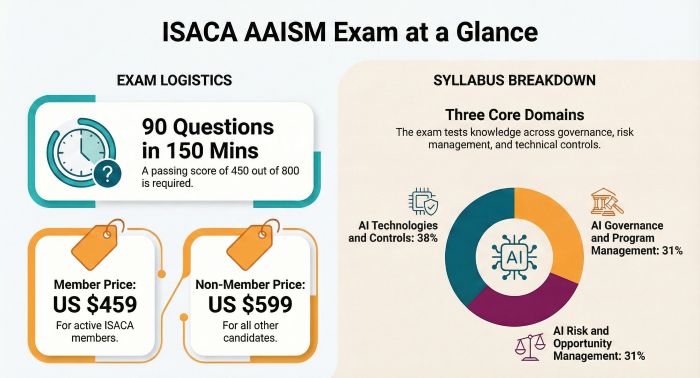
The specifics of the AAISM exam are detailed as follows:
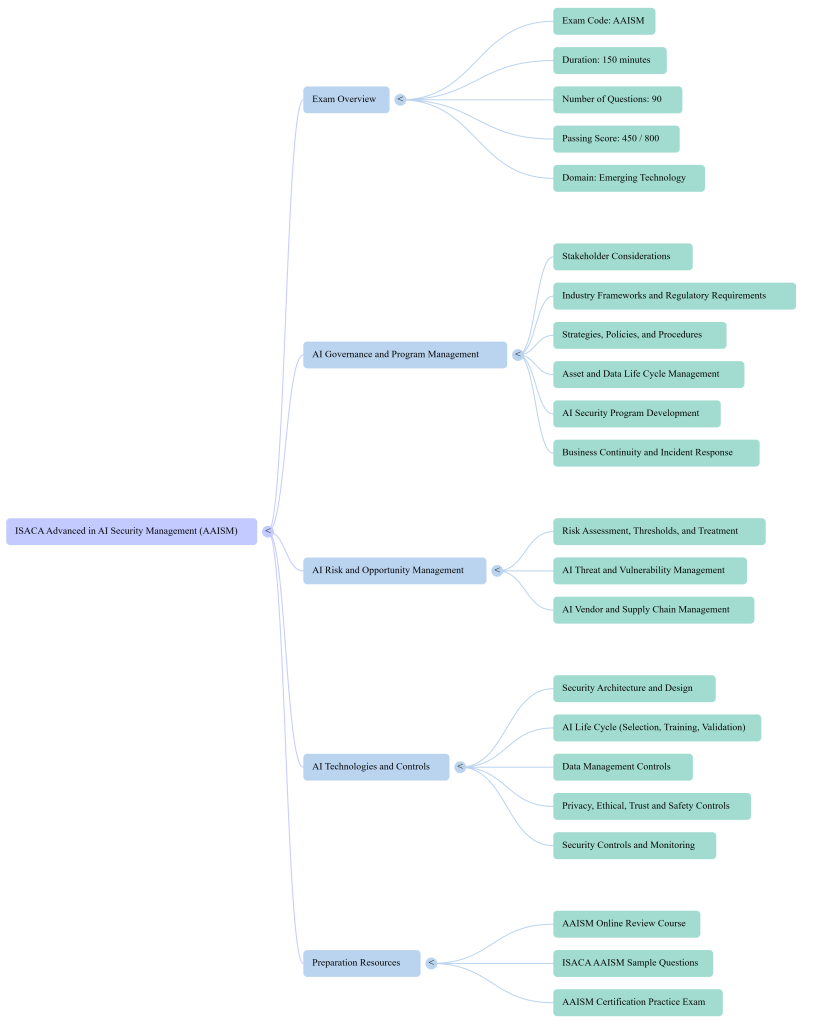
- Exam Name: ISACA Advanced in AI Security Management (AAISM)
- Exam Code: AAISM
- Exam Price:
- ISACA Member: US $459 (USD)
- ISACA Nonmember: US $599 (USD)
- Duration: 150 minutes
- Number of Questions: 90 multiple-choice questions
- Passing Score: 450 out of a scaled score of 800
Understanding these elements is the first step towards a focused and strategic preparation. The scaled score mechanism ensures fairness across different exam versions, emphasizing that consistent performance across all domains is more important than simply hitting a raw score. Candidates can also review official resources for more details on exam policies and procedures, such as the AAISM Exam Candidate Guide, which provides invaluable insights.
Navigating the AAISM Exam Syllabus Topics
A thorough understanding of the ISACA AAISM exam syllabus is fundamental to effective preparation. The syllabus is meticulously structured into three distinct domains, each carrying a specific weightage, reflecting their importance in the field of AI security management. Candidates must allocate their study time proportionally to these domains to ensure comprehensive coverage and mastery of the required competencies. This detailed breakdown allows for a targeted approach to learning, ensuring that all critical areas are addressed before attempting the exam.
The three core domains of the AAISM syllabus are:
1. AI Governance and Program Management (31%)
This domain emphasizes the foundational aspects of establishing and maintaining robust governance frameworks for AI. It covers strategic planning, policy development, ethical considerations, and the integration of AI security into overall enterprise governance. Professionals are expected to understand how to manage AI security programs effectively, ensuring alignment with organizational objectives and regulatory compliance. This involves defining roles, responsibilities, and accountability for AI security initiatives, as well as developing metrics to monitor their effectiveness. It’s about building the organizational muscle to control and direct AI safely.
2. AI Risk and Opportunity Management (31%)
Focusing on the identification, assessment, and treatment of risks unique to AI systems, this domain is crucial for proactive security management. It includes understanding potential vulnerabilities in AI models, data privacy concerns, algorithmic bias, and adversarial attacks.
Candidates will learn to evaluate the impact of these risks and formulate strategies to mitigate them, while also recognizing and leveraging opportunities that arise from secure and ethical AI deployment. This domain integrates risk management principles with the specific challenges presented by AI, enabling professionals to make informed decisions that balance innovation with security.
3. AI Technologies and Controls (38%)
As the most heavily weighted domain, this section delves into the technical underpinnings of AI systems and the specific security controls applicable to them. It covers various AI technologies, including machine learning, deep learning, and natural language processing, exploring their architectural components and potential attack surfaces.
Furthermore, it focuses on the implementation of technical and administrative controls to secure AI data, algorithms, infrastructure, and applications. This includes topics like secure development lifecycles for AI, data anonymization techniques, model explainability, and continuous monitoring of AI systems for anomalies. Proficiency in this domain is essential for practically securing AI environments.
Each domain presents a unique set of challenges and knowledge requirements, demanding a well-rounded study plan. For additional strategic tips on preparing for this certification, candidates can explore resources such as ISACA AAISM certification strategy for success. By meticulously studying these areas, candidates can build a strong foundation for managing and securing AI systems effectively.
Mastering AAISM Questions Through Effective Preparation
To truly master the ISACA AAISM certification, a candidate must adopt a strategic and comprehensive preparation approach that goes beyond rote memorization. Effectively addressing aaism questions on the exam requires a deep understanding of the underlying concepts and their practical implications in real-world AI security scenarios.
Success hinges on a combination of theoretical study, practical application, and rigorous self-assessment. This multi-faceted strategy ensures that candidates are not only familiar with the material but can also apply their knowledge under exam conditions.
Effective preparation for the AAISM exam includes:
• Official Study Materials: Begin with ISACA’s official resources, including the AAISM Review Manual and any supplementary guides. These materials are specifically designed to align with the exam objectives and provide the most accurate and relevant information.
• Concept Reinforcement: Focus on understanding the “why” behind each concept, rather than just the “what.” AI security often involves nuanced decision-making, so a strong grasp of principles will better prepare you for complex scenario-based questions.
• Practice Questions and Mock Exams: Regularly engage with ISACA AAISM practice questions and full-length AAISM certification practice exams. This is crucial for familiarizing yourself with the question format, identifying knowledge gaps, and improving time management.
Platforms like Edusum offer ISACA AAISM sample questions that can be an invaluable tool for self-assessment.
• Ethical Preparation: Always discourage the use of “exam dumps.” Relying on memorized answers from dumps undermines the integrity of the certification and does not foster genuine understanding or skill development. True mastery comes from diligent study and ethical practice.
• Industry Insights: Stay updated with current trends and developments in AI security. This can involve reading industry reports, attending webinars, or following reputable thought leaders on platforms like LinkedIn. For example, discussions around AI security often feature on professional networking sites, offering real-world perspectives.
• Peer Discussion: Engage with study groups or online forums to discuss challenging topics and gain different perspectives. Explaining concepts to others can solidify your own understanding.
By integrating these components into a structured study plan, candidates can build the confidence and competence required to successfully pass the AAISM exam. The objective is not just to pass, but to truly become an expert capable of managing and securing AI systems in a professional capacity.
Addressing Core Responsibilities in AI Security Management
The ISACA AAISM certification directly addresses the core responsibilities faced by professionals tasked with managing and securing artificial intelligence deployments within an organization. Certified individuals are expected to assume a pivotal role in ensuring that AI initiatives are not only innovative and efficient but also secure, compliant, and ethical.
This involves a comprehensive understanding of the entire AI lifecycle and the specific security considerations at each stage. Professionals with this credential become central figures in developing and executing strategies that protect against AI-specific vulnerabilities and broader cyber threats affecting AI systems.
Key responsibilities typically include:
- Risk Assessment and Mitigation: Conducting thorough risk assessments for AI projects, identifying potential points of failure, data breaches, and algorithmic biases. Developing and implementing mitigation strategies to minimize these risks.
- Governance and Compliance: Establishing and enforcing governance frameworks that ensure AI systems comply with internal policies, industry standards, and regulatory requirements such as GDPR, HIPAA, or emerging AI-specific regulations.
- Security Control Implementation: Designing, implementing, and monitoring security controls tailored to AI architectures, including securing data pipelines, machine learning models, and deployment environments.
- Ethical AI Oversight: Ensuring that AI systems are developed and used ethically, addressing concerns related to privacy, fairness, transparency, and accountability. This often involves collaborating with legal and ethical committees.
- Incident Response Planning: Developing and testing incident response plans specifically for AI-related security incidents, including data poisoning, model evasion, or unexpected algorithmic behavior.
- Stakeholder Communication: Communicating AI security risks, strategies, and compliance status to senior management, technical teams, and other stakeholders, translating complex technical information into actionable insights.
These responsibilities highlight the multifaceted nature of AI security management, requiring a blend of technical expertise, governance acumen, and ethical awareness. An AAISM-certified professional is uniquely positioned to lead these efforts, safeguarding organizational integrity and fostering trust in AI technologies.
Enhancing Career Growth with ISACA Advanced in AI Security Management
Achieving the ISACA Advanced in AI Security Management (AAISM) certification is a significant catalyst for career growth in the burgeoning field of artificial intelligence and cybersecurity. This credential signals to employers a specialized skill set that is in high demand, positioning certified professionals for advanced roles and increased earning potential. As organizations increasingly adopt AI, the need for individuals who can effectively govern, secure, and manage these complex systems will only intensify. The AAISM certification provides a competitive edge, validating expertise that is critical for the secure digital transformation journey.
The benefits of holding the AAISM certification extend to:
- Specialized Expertise Recognition: The AAISM formally recognizes your proficiency in a niche, high-demand area, differentiating you from other cybersecurity professionals.
- Advanced Career Opportunities: Opens doors to leadership roles such as AI Security Architect, AI Risk Manager, AI Governance Lead, or AI Compliance Officer within various industries.
- Increased Earning Potential: Professionals with specialized certifications typically command higher salaries due to their unique and valuable skill sets in critical domains.
- Credibility and Trust: Demonstrates a commitment to professional development and adherence to ISACA’s globally recognized standards for information systems security, enhancing your professional credibility.
- Strategic Contribution: Enables you to play a more strategic role in an organization’s AI adoption, advising on best practices for secure development, deployment, and operation of AI systems.
- Networking Opportunities: Connects you with a global community of ISACA professionals, fostering knowledge exchange and collaborative opportunities within the AI security space.
The strategic value of the AAISM credential is not just about securing AI today but about building a resilient foundation for future innovations. By obtaining this certification, professionals equip themselves to tackle the next generation of AI security challenges and contribute significantly to their organizations’ long-term success. It represents an investment in one’s future, aligning personal career objectives with the urgent global need for secure AI solutions.
Overcoming Challenges in AI Security Implementation
Implementing effective security measures for AI systems presents a unique set of challenges that go beyond traditional cybersecurity paradigms. Unlike conventional IT systems, AI models introduce complexities such as data poisoning, adversarial attacks, model interpretability, and the ethical implications of autonomous decision-making. Overcoming these hurdles requires a nuanced understanding of AI technologies and the development of specialized security frameworks. Professionals pursuing the ISACA AAISM certification are specifically prepared to confront these intricate issues, ensuring that AI deployments are resilient against both known and unforeseen threats. This involves a continuous learning curve and an adaptive approach to security.
Key challenges in AI security implementation often include:
- Data Integrity and Privacy: Ensuring the quality and confidentiality of training data, as corrupted or biased data can lead to security vulnerabilities and ethical dilemmas. Protecting sensitive information used by AI models throughout their lifecycle.
- Model Vulnerabilities: Defending against adversarial attacks designed to manipulate AI model outputs or degrade their performance. This also involves securing models against intellectual property theft and unauthorized access.
- Lack of Transparency (Black Box): Addressing the challenge of understanding how certain complex AI models arrive at their decisions, which can hinder forensic analysis during security incidents and raise compliance concerns regarding explainability.
- Rapid Evolution of AI Threats: Keeping pace with the fast-evolving landscape of AI technologies and the corresponding emergence of new attack vectors and exploitation techniques.
- Integration with Existing Security Infrastructure: Seamlessly integrating AI security controls with existing cybersecurity frameworks and tools, often requiring significant architectural adjustments and interoperability solutions.
- Talent Gap: The scarcity of professionals with combined expertise in AI, cybersecurity, and governance, making it difficult for organizations to build and maintain effective AI security teams.
The ISACA AAISM certification equips individuals with the methodologies and insights needed to navigate these formidable challenges. By developing a comprehensive understanding of AI risks and controls, certified professionals can implement robust defenses and foster an environment where AI innovation can thrive securely and responsibly.
More information on the official program can be found on the ISACA AAISM official page.
Frequently Asked Questions
Q1: What does the ISACA AAISM certification validate?
- The ISACA AAISM certification validates a professional’s advanced knowledge and skills in governing, managing, and securing artificial intelligence systems, frameworks, and applications within an enterprise context. It covers AI governance, risk management, and specific security controls for AI technologies.
Q2: Who should consider pursuing the AAISM certification?
- This certification is ideal for cybersecurity professionals, AI/ML engineers, data scientists, IT auditors, risk managers, and governance professionals who are involved in designing, implementing, or overseeing AI systems and their security.
Q3: How many questions are on the ISACA AAISM exam, and what is the passing score?
- The ISACA AAISM exam consists of 90 multiple-choice questions. To pass, candidates must achieve a scaled score of 450 out of 800.
Q4: Are there any prerequisites for the ISACA AAISM exam?
- While ISACA does not list formal prerequisites for taking the AAISM exam, it recommends candidates have at least three years of experience in AI, cybersecurity, IT governance, or related fields to successfully comprehend the advanced topics covered.
Q5: What are the main domains covered by the AAISM exam syllabus?
- The AAISM exam syllabus is structured around three main domains: AI Governance and Program Management (31%), AI Risk and Opportunity Management (31%), and AI Technologies and Controls (38%).
Conclusion
The ISACA Advanced in AI Security Management (AAISM) certification is not merely a credential; it is a critical asset for professionals looking to lead in the domain of artificial intelligence security. By addressing key AAISM questions related to governance, risk management, and technical controls, this certification prepares individuals to navigate the complex challenges posed by AI. It validates a deep commitment to ethical AI deployment and robust security practices, ensuring that certified professionals are at the forefront of protecting evolving technological landscapes. This journey culminates in a distinguished recognition that enhances career prospects and organizational resilience.
To further solidify your expertise and advance your career in the dynamic field of AI security, consider taking the next step towards certification. Investing in your professional development through the ISACA AAISM program will provide you with the knowledge and recognition needed to excel.
Begin your comprehensive preparation today and explore a range of valuable resources, including study guides PDF and practice exams.