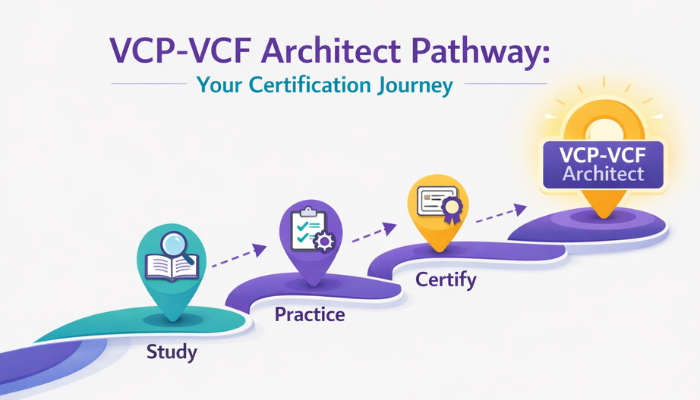
Embarking on the journey to become a certified VMware Cloud Foundation (VCF) Architect demands a strategic approach and a deep understanding of complex virtualized environments. The VCP-VCF Architect certification signifies a candidate’s expertise in designing and optimizing VMware Cloud Foundation solutions, a critical skill set in modern data centers. This comprehensive guide outlines the optimal game plan for passing the VMware 2V0-13.25 exam, equipping you with the practical insights and confidence needed to succeed.
Understanding the VCP-VCF Architect Certification’s Purpose
The VMware VCP-VCF Architect certification validates an individual’s ability to architect sophisticated VMware Cloud Foundation solutions. This credential specifically targets professionals responsible for designing, implementing, and managing robust Software-Defined Data Center (SDDC) environments. Achieving this certification demonstrates a high level of proficiency in integrating various VMware technologies into a cohesive and performant cloud infrastructure.
Key responsibilities and skills emphasized by this certification include:
- Translating business requirements into technical VCF designs.
- Ensuring high availability, scalability, and security within the VCF stack.
- Optimizing VCF deployments for performance and cost-efficiency.
- Understanding the interoperability of vSphere, vSAN, NSX-T, and vRealize Suite components.
- Providing expert guidance on VCF architecture design principles to stakeholders.
Navigating the 2V0-13.25 Exam Details
Success on the VMware 2V0-13.25 exam, officially known as the VMware Cloud Foundation 9.0 Architect, requires a clear understanding of its structure and requirements. This examination serves as the gateway to earning the VCP-VCF Architect certification, testing candidates on their foundational and advanced knowledge of VCF architectural concepts.
The exam details are as follows:
- Exam Name: VMware Cloud Foundation 9.0 Architect (VCP-VCF Architect)
- Exam Code: 2V0-13.25
- Exam Price: $250 USD
- Duration: 135 minutes
- Number of Questions: 60
- Passing Score: 300 out of 500
Candidates should budget their time effectively during the exam, ensuring they address each question thoughtfully without rushing, given the allocated duration.
Core Competencies: Deconstructing the 2V0-13.25 Syllabus
A thorough understanding of the 2V0-13.25 exam syllabus is paramount for effective preparation, guiding your study efforts toward critical knowledge areas. The syllabus outlines the specific domains and topics that candidates are expected to master, reflecting the comprehensive nature of VMware Cloud Foundation architecture. For a detailed breakdown of the curriculum, refer to the VMware VCP-VCF Architect syllabus.
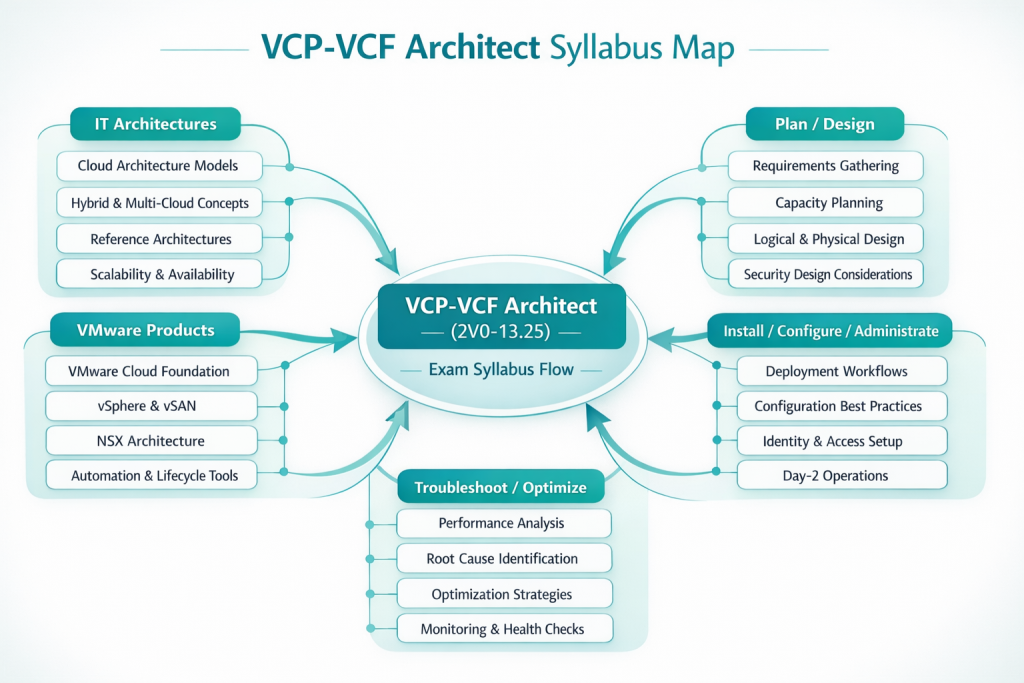
The core topics covered include:
- IT Architectures, Technologies, Standards: This section emphasizes foundational knowledge relevant to modern IT infrastructure, including networking, storage, and security standards applicable to a cloud environment.
- VMware Products and Solutions: Candidates must demonstrate expertise in the various components that comprise VMware Cloud Foundation, such as vSphere, vSAN, NSX-T Data Center, and the vRealize Suite, understanding their functions and interdependencies.
- Plan and Design the VMware Solution: A significant portion of the exam focuses on the ability to translate business needs into technical designs, considering factors like scalability, performance, availability, and recoverability within a VCF context. This includes understanding appropriate sizing, resource allocation, and logical/physical design choices.
- Install, Configure, Administrate the VMware Solution: Practical knowledge of deploying, configuring, and day-to-day administration of VMware Cloud Foundation is assessed. This involves understanding SDDC Manager operations, lifecycle management, and initial setup procedures.
- Troubleshoot and Optimize the VMware Solution: The ability to identify, diagnose, and resolve issues within a VCF environment, alongside optimizing its performance and resource utilization, is crucial. This covers understanding common problems and applying best practices for efficiency.
Each of these areas contributes to the holistic understanding required of a VCP-VCF Architect, ensuring certified professionals are well-rounded in both design and operational aspects.
Crafting Your VMware Cloud Foundation Preparation Strategy
Developing a robust preparation strategy is essential for mastering the VMware 2V0-13.25 exam and solidifying your understanding of VMware Cloud Foundation. An effective game plan extends beyond rote memorization, focusing on practical application and conceptual depth. It’s crucial to align your study methods with the how to prepare for VMware VCP-VCF Architect exam guidelines, maximizing your learning efficiency.
Consider the following strategic pillars for your study journey:
- Official Training and Documentation: VMware’s official resources are your primary source of truth. Dive deep into product documentation for vSphere, vSAN, NSX-T, and SDDC Manager. Broadcom’s VMware learning offerings provide structured courses designed to prepare you for architect-level challenges.
- Hands-on Experience: Theoretical knowledge must be complemented with practical application. Build a lab environment, whether physical or virtualized (e.g., using VMware Workstation or a cloud-based lab), to deploy and manage a mini Cloud Foundation stack. Experiment with different configurations, troubleshoot common issues, and perform lifecycle management operations.
- Study Groups and Community Engagement: Collaborate with peers preparing for the same certification. Discussing complex topics, sharing insights, and explaining concepts to others can significantly deepen your understanding. Online communities offer invaluable support and diverse perspectives.
- Practice Questions and Self-Assessment: Regularly test your knowledge with practice questions. While it is vital to avoid exam dumps, legitimate practice tests from reputable providers like VMExam can help you identify weak areas and familiarize yourself with the exam format. Focus on understanding the explanations for both correct and incorrect answers to reinforce learning.
- Reviewing Design Scenarios: The VCP-VCF Architect exam heavily emphasizes design principles. Work through various hypothetical design scenarios, considering different business requirements, constraints, and operational challenges. This helps you apply VMware Cloud Foundation architecture design principles effectively.
Remember, ethical preparation is key to long-term success and true mastery. Relying on unauthorized materials or exam dumps undermines your learning and the value of your certification.
Deep Diving into Cloud Foundation Architecture Design
The ability to design robust, scalable, and secure VMware Cloud Foundation solutions is at the heart of the VCP-VCF Architect role. This section explores the fundamental concepts and methodologies involved in architecting successful VCF deployments. A strong command of VMware Cloud Foundation architecture design principles is indispensable for passing the 2V0-13.25 exam, as it forms the bedrock of an architect’s daily responsibilities.
Key design considerations include:
- Workload Domain Design: Understanding how to structure workload domains (management, VI, and consolidated) to meet specific performance, security, and operational requirements. This involves decisions on vSAN datastore types, network segmentation, and resource allocation.
- Network Architecture: Designing the underlying physical and virtual network infrastructure, including NSX-T Data Center deployment, segment configuration, routing, firewall rules, and load balancing for various VCF components and workloads.
- Storage Strategy: Implementing vSAN policies for performance, capacity, and data protection, and integrating external storage solutions where necessary. The design must account for VMware SDDC design best practices VCF for storage efficiency and resilience.
- Security Posture: Architecting security from the ground up, incorporating principles of least privilege, micro-segmentation with NSX-T, data encryption, and integration with existing security frameworks.
- Operational Design: Planning for day-2 operations, including monitoring, logging, backup and recovery, and disaster recovery strategies using solutions like VMware Site Recovery Manager.
A proficient VCP-VCF Architect leverages a holistic view to ensure that all design choices contribute to a resilient, efficient, and easily manageable Cloud Foundation environment. Further insights into the certification can be found on the official VCP-VCF Architect certification page.
Mastering Deployment and Optimization
Beyond the theoretical design, the VCP-VCF Architect must also possess a strong grasp of the practical aspects of VMware Cloud Foundation deployment and management, ensuring architectural visions translate into functional realities. This involves both the initial setup and the ongoing fine-tuning of the VCF environment for peak performance and stability. The exam will test your understanding of how to implement and maintain the solutions you design, focusing on efficiency and problem-solving.
Core areas in deployment and optimization include:
- SDDC Manager Operations: Utilizing SDDC Manager for automated deployment of workload domains, patching, upgrading, and overall lifecycle management of the VCF stack. Understanding its capabilities and limitations is critical.
- Network Configuration: Deploying and configuring NSX-T components, including NSX-T Managers, Edge Nodes, and Transport Zones, to establish the necessary network overlay and underlay for VCF. This extends to setting up logical segments, gateways, and distributed firewalls.
- Storage Optimization: Implementing vSAN cluster configurations, storage policies, and capacity management techniques to ensure optimal performance and resource utilization for workloads. Understanding how to scale vSAN and address common performance bottlenecks is essential.
- Resource Allocation and Monitoring: Configuring vSphere clusters, resource pools, and DRS (Distributed Resource Scheduler) to ensure workloads receive adequate resources. Implementing robust monitoring solutions, often part of the vRealize Suite, to proactively identify and address performance issues.
- Troubleshooting Methodologies: Developing systematic approaches to Troubleshoot and Optimize the VMware Solution across all layers of the VCF stack, from physical hardware to virtual machines and network services. This includes log analysis, performance metric interpretation, and component-specific troubleshooting.
An architect’s ability to not only design but also oversee the successful deployment and continuous optimization of VCF environments is a key differentiator, demonstrating practical expertise alongside strategic planning.
Advancing Your Career with VCP-VCF Architect
Earning the VCP-VCF Architect certification offers significant advantages for professionals aiming to elevate their careers within the cloud infrastructure domain. This credential is a powerful indicator of advanced skills and strategic thinking, opening doors to new opportunities and career progression. The benefits of VMware VCP-VCF Architect certification extend beyond technical validation, impacting professional standing and earning potential.
Key career impacts include:
- Enhanced Credibility: The VCP-VCF Architect title signals a proven ability to design and manage complex VMware environments, setting you apart as a subject matter expert.
- Increased Earning Potential: Professionals holding architect-level certifications often command higher salaries, reflecting the specialized knowledge and strategic value they bring. Discussions around VMware VCF architect salary expectations frequently highlight this upward trend.
- Broader Career Opportunities: The certification qualifies you for roles such as Cloud Architect, Solutions Architect, Senior Infrastructure Engineer, and SDDC Consultant, in high demand across various industries.
- Strategic Influence: Certified architects are often involved in high-level decision-making processes, shaping the future of an organization’s cloud strategy and technology adoption.
- Community Recognition: Engaging with the broader VMware community, like the Broadcom Community, becomes more impactful, allowing you to share expertise and learn from peers at a similar level.
Investing in the VCP-VCF Architect certification is an investment in your future, solidifying your position as a valuable asset in the evolving landscape of cloud computing.
Securing Your Exam Voucher and Next Steps
Once you’ve diligently prepared for the VMware 2V0-13.25 exam, the final practical steps involve securing your exam voucher and understanding the registration process. This ensures a smooth transition from study to certification, covering aspects like VCP-VCF Architect exam cost and necessary VMware Cloud Foundation certification requirements.
Follow these steps to complete your certification journey:
- Confirm Prerequisites: Verify that you meet all necessary prerequisites for the VCP-VCF Architect certification. This might include holding a foundational certification or having specific experience, though details should always be checked on the official certification page.
- Purchase Your Exam Voucher: Exam vouchers can be purchased directly from the VMware Certification Marketplace. Visit the exam vouchers page to secure your access to the test.
- Schedule Your Exam: After acquiring your voucher, schedule your 2V0-13.25 exam through the designated testing provider. Choose a date and time that allows for final review and minimizes stress.
- Review Exam Day Procedures: Familiarize yourself with the rules and procedures for the testing center or online proctoring to avoid any surprises on exam day.
- Consider Upgrading to VMware VCP-VCF Architect: If you hold previous VMware certifications, understand the upgrade paths available. Sometimes, certain existing credentials can streamline the path to this advanced architect certification.
By systematically addressing these administrative steps, you can focus entirely on showcasing your expertise during the examination, culminating in your VCP-VCF Architect certification.
Conclusion
The VCP-VCF Architect certification and its associated 2V0-13.25 exam represent a significant milestone for professionals dedicated to mastering VMware Cloud Foundation. Through diligent preparation, hands-on experience, and a strategic study plan, you can confidently approach the examination, validating your expertise in designing and managing sophisticated SDDC environments.
Embrace the challenge, leverage the available resources, and commit to a thorough understanding of the syllabus. Success in this certification not only signifies technical prowess but also positions you as a strategic leader capable of driving transformative cloud initiatives. Take the leap, enhance your career trajectory, and become a certified VMware Cloud Foundation Architect. For more insights and resources on advancing your expertise, explore VMware certifications.
Start your advanced preparation today and deepen your knowledge across a wide range of VMware credentials. Visit VMware certifications to find comprehensive study materials and guides to accelerate your professional growth.
Frequently Asked Questions
1. What is the VCP-VCF Architect certification?
The VCP-VCF Architect is a VMware certification that validates an individual’s expertise in designing and implementing VMware Cloud Foundation (VCF) solutions, focusing on architecture principles and best practices for SDDC environments.
2. What is the cost of the VMware 2V0-13.25 exam?
The VMware 2V0-13.25 exam, also known as the VMware Cloud Foundation 9.0 Architect exam, costs $250 USD.
3. How many questions are on the 2V0-13.25 exam and what is the passing score?
The 2V0-13.25 exam consists of 60 questions and requires a passing score of 300 out of 500.
4. What are the key syllabus topics for the VCP-VCF Architect exam?
Key syllabus topics include IT Architectures, VMware Products and Solutions, Planning and Designing the VMware Solution, Installation and Administration, and Troubleshooting and Optimization of VMware Solutions.
5. How can I best prepare for the VMware 2V0-13.25 exam?
Effective preparation involves utilizing official VMware documentation and training, gaining hands-on experience with VCF, engaging in study groups, and practicing with legitimate sample questions to identify and strengthen weak areas.


