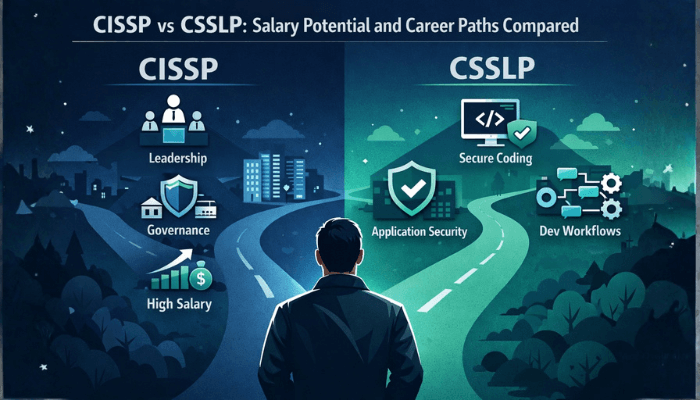
The cybersecurity landscape in 2026 is no longer just about “defending the perimeter”; it is about building resilience into the very DNA of digital products. If you are standing at a career crossroads, you’ve likely asked yourself: Should I go broad with the CISSP or deep with the CSSLP? While both are prestigious credentials from ISC2, they serve vastly different masters.
The CISSP (Certified Information Systems Security Professional) is the undisputed heavyweight champion for security management. Conversely, the CSSLP (Certified Secure Software Lifecycle Professional) has emerged as the “specialist’s secret weapon” for those securing the Software Development Lifecycle (SDLC).
To help you decide, we have analyzed the latest 2026 market trends, salary data, and exam requirements to ensure your next certification investment pays the highest dividends.
Quick Comparison: CSSLP vs CISSP At a Glance
What is the CISSP? The “Gold Standard” for Security Leadership
The CISSP certification is designed for experienced security practitioners who want to prove they can design, implement, and manage a best-in-class cybersecurity program. It covers eight wide-ranging domains, from Risk Management to Communication and Network Security.
CISSP Requirements & Difficulty
Passing the CISSP is often described as “a mile wide and an inch deep,” but don’t let that fool you. The exam uses Computerized Adaptive Testing (CAT), meaning the test adjusts its difficulty based on your previous answers.
- Experience: 5 years of cumulative, paid work experience.
- Waivers: A 4-year degree or a regional equivalent can waive 1 year of experience.
- Difficulty: High. It requires a “managerial mindset” rather than just technical knowledge.
Salary & Career Impact
In 2026, CISSP holders remain the most sought-after professionals for senior leadership.
- Average Salary: Approximately $147,757 in North America.
- Top Roles: Chief Information Security Officer (CISO), Security Director, IT Auditor.
Key Takeaway: The CISSP acts as a “passport” to global security roles, providing a broad foundation that is recognized by HR departments worldwide.
What is the CSSLP? The Specialist’s Edge in DevSecOps
While the CISSP looks at the whole building, the CSSLP certification looks at how the bricks are made. It focuses exclusively on integrating security into every phase of the software lifecycle from requirements and design to testing and deployment.
CSSLP Requirements & Difficulty
The CSSLP is arguably more technical for those coming from a development background but less “abstract” than the CISSP.
- Experience: 4 years of professional SDLC experience.
- Waivers: 1 year for a relevant degree.
Difficulty: Moderate to High. It requires a deep understanding of software vulnerabilities (like those in the OWASP Top 10) and secure coding standards.
Salary & Career Impact
As “Shift Left” security becomes the industry standard, CSSLP salaries have reached parity with the CISSP.
- Average Salary: Approximately $147,375 in North America, with specialists in Europe earning up to €138,242.
- Top Roles: Application Security Specialist, Software Architect, DevSecOps Engineer.
Key Takeaway: The CSSLP is a niche certification with fewer than 10,000 holders globally, making it a powerful differentiator in a crowded job market.
CSSLP vs CISSP Difficulty: Which Exam is Harder?
When comparing ISC2 CSSLP vs CISSP difficulty, most candidates find the CISSP more “exhausting” due to the adaptive nature of the test and the sheer breadth of topics. The CSSLP is a linear exam (125 questions, 3 hours) and stays strictly within the software realm.
- CISSP: Tests your ability to make executive decisions under pressure.
- CSSLP: Tests your ability to identify security flaws in software architecture and code.
Exam Cost Comparison
- CISSP Exam Cost: $749
- CSSLP Exam Cost: $599
Steps to Pass Your ISC2 Exam
- Audit Your Experience: Ensure you meet the 4-5 year requirement or prepare to become an “Associate of ISC2.”
- Review the CBK: Download the Official ISC2 Exam Outline.
- Take a Diagnostic Test: Use platforms like Edusum to identify your weak domains.
- Study for 3-6 Months: Focus on the “ISC2 mindset” (think like a manager/consultant).
- Schedule the Exam: Book via Pearson VUE at least 6 weeks in advance.
Why You Might Need Both
Many high-level architects choose to earn the CISSP first for its broad marketability and then add the CSSLP to showcase specialized technical depth. In 2026, having both certifications signals that you can manage a security team and speak the language of developers fluently.
FAQs
Q1: Should I take CSSLP or CISSP first if I am a developer? If you are a developer, start with the CSSLP. It aligns more closely with your daily work and requires only 4 years of experience, making it a faster path to a salary boost.
Q2: Is the CISSP still the best certification in 2026? Yes, the CISSP remains the most globally recognized security certification for management and general security practitioners.
Q3: Can I get CSSLP without a degree? Yes. While a degree can waive one year of the four-year experience requirement, you can still qualify with four years of documented SDLC experience.
Q4: Does CSSLP cover cloud security? While CSSLP focuses on software, it touches on cloud-based deployment and secure architecture. For deep cloud expertise, ISC2’s CCSP is the better fit.
Q5: What is the CISSP salary for entry-level roles? The CISSP is not an entry-level cert. However, “Associates of ISC2” who have passed the exam can often command salaries starting around $90,000 – $100,000 even before they have full experience.
Q6: How much does it cost to maintain these certifications? Both require an Annual Maintenance Fee (AMF) of $135 and a specific number of Continuing Professional Education (CPE) credits every three years.


