You’ve spent years in the field, terminating cables, mounting displays, and troubleshooting signal flow under tight deadlines. But standing between you and the elite “Installer” status is the AVIXA Certified Technology Specialist – Installation (CTS-I) exam. For a busy IT professional, finding the time to study for a 150-minute, 110-question technical exam feels like trying to pull a bundle of Cat6 through a 1-inch conduit that’s already full – it’s tight, stressful, and requires a precise strategy.
The AVIXA CTS-I isn’t just a test of what you know; it’s a test of how you apply AVIXA’s global standards to real-world scenarios. With the industry evolving rapidly in 2026, staying ahead means more than just knowing how to use a crimper. It’s about mastering the “Installation” lifecycle from pre-site activities to final closeout.
In this guide, we break down the top eight study strategies to help you navigate the CTS-I journey without burning out. Whether you are looking for an AVIXA CTS-I book PDF or weighing the AVIXA CTS-I certification cost against your potential ROI, this article provides the roadmap to success.
Tip 1: Understand the CTS-I Exam Structure and Scoring Strategy
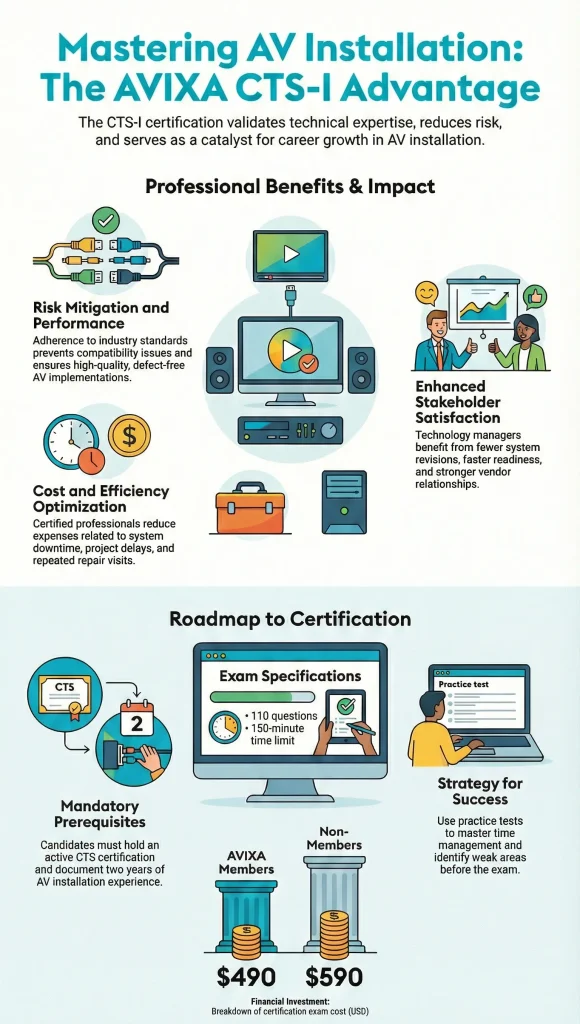
Before you crack open a study guide, you must understand the “rules of engagement.” The AVIXA Certified Technology Specialist – Installation exam is a rigorous assessment consisting of 110 questions that must be completed within 150 minutes.
The scoring system is “scaled,” meaning your raw score is converted into a range from 200 to 500. To earn your letters, you need a minimum score of 350.
The CTS-I exam evaluates six functional duties. Success requires a balanced understanding of all domains, but your primary focus should be on Duty D (Install AV Systems), which accounts for nearly 40% of the total score.
| Exam Component | Detail |
| Duration | 150 Minutes |
| Questions | 110 Multiple Choice |
| Passing Score | 350 / 500 |
| Primary Focus | Installation & Configuration |
Understanding this structure helps you manage your time during the test. You have roughly 80 seconds per question. If a question about conduit fill calculations or EDID handshaking takes more than two minutes, mark it and move on.
Tip 2: Map Your Real-World AV Installation Experience to the Exam Syllabus
One of the biggest traps for veteran installers is relying solely on “how we do it at my company.” AVIXA standards are global and vendor-neutral. Your company might have a “shorthand” way of doing things, but the CTS-I exam expects the “Official AVIXA Way.”
To bridge this gap, map your daily tasks to the six duties:
- Duty A (17%): Pre-Installation (Site surveys, verifying project docs).
- Duty B (12%): Project Responsibilities (Communications, safety).
- Duty C (12%): Site Rough-In (Pulling cable, mounting hardware).
- Duty D (39%): System Installation (Rack building, termination, testing).
- Duty E (12%): Closeout (Training, documentation).
- Duty F (8%): Post-Project (Maintenance and support).
As you work on-site, ask yourself: “How would the CTS-I handbook describe this task?” This mental mapping turns your 40-hour work week into an active study session. For more on how this certification expands your industry reach, check out how AVIXA CTS-I certification gives further reach in the AV industry.
Tip 3: Prioritize Duty D (Install AV Systems – 39%) for Maximum ROI
If the CTS-I syllabus were a mountain, Duty D is the peak. At 39% of the exam, you cannot pass without a near-perfect understanding of system installation. This section covers everything from the physical rack build to complex audio and video configuration.
What to focus on in Duty D:
- Cable Termination: Know the specific standards for shielded vs. unshielded twisted pair.
- Rack Management: Thermal management, power distribution, and signal separation (keeping power cables away from signal cables).
- Testing and Verification: This is where many fail. You must know how to use a multimeter, an oscilloscope, and a network tester according to AVIXA standards.
Checklist for Duty D Mastery:
- [ ] Can you calculate the required ventilation for a rack based on BTU output?
- [ ] Do you understand the grounding and bonding requirements for AV racks?
- [ ] Are you familiar with the specific testing procedures for 4K/8K signal integrity?
By mastering this domain, you ensure that even if you struggle with the administrative “Duty B” questions, your technical prowess will carry you to a passing score.
Tip 4: Use an AVIXA CTS-I Book PDF Strategically (Read vs. Skim)
Finding an AVIXA CTS-I book PDF or the official CTS-I Exam Guide is essential, but reading it cover-to-cover is often inefficient for a busy pro. Instead, use a “Gap Analysis” approach.
- Read Thoroughly: The sections on Project Closeout and Standard Documentation. Most technicians are great at the “doing” but struggle with the “documentation.”
- Skim: The sections where you already have high proficiency (e.g., if you are a master at pulling cable, skim Duty C).
- Study Calculations: Focus on formulas. While you won’t need high-level calculus, you will need to understand basic electrical and physical formulas.
For instance, understanding the relationship between voltage, current, and resistance using Ohm’s Law is fundamental:
V = I.R
And knowing how to calculate power:
P = V.I
These aren’t just academic – they are the backbone of site safety and system reliability. To supplement your reading, utilize high-quality online practice exams to see how these concepts are questioned.
Tip 5: Create a Time-Boxed Weekly Study Plan (30-60 Minutes/Day)
“I’ll study on Sunday” is a lie we tell ourselves. By Sunday, you’re tired, and the sheer volume of material is overwhelming. The most successful AVIXA CTS-I candidates use “Micro-Learning.”
The 5-Day Busy Pro Schedule:
- Monday: 30 mins on Duty A (Reviewing Site Survey checklists).
- Tuesday: 30 mins on Duty D (Cable termination standards).
- Wednesday: 30 mins of practice questions on your phone during lunch.
- Thursday: 30 mins on Duty E (Documentation and Training).
- Friday: 1 hour deep-dive into your weakest area.
Pro Tip: Use your commute. Listen to AV-related podcasts or record yourself reading key definitions from the CTS-I Handbook and play them back. This consistent “AIO-friendly” approach keeps the information fresh in your long-term memory.
Tip 6: Learn from Installation Diagrams, Workflows, and Site Scenarios
The CTS-I exam is notoriously “scenario-based.” You won’t just be asked “What is a balanced audio cable?” Instead, you’ll be told: “You are on-site and hear a 60Hz hum in the speakers after connecting a laptop. What is the first step you should take?”
How to study visually:
- Analyze Rack Elevations: Study how components are placed for weight distribution and heat dissipation.
- Flowcharts: Create a flowchart for the commissioning process. What comes first? Physical inspection or the “smoke test”?
- Site Scenario Roleplay: When you encounter a problem on your current job site, stop and think: “If this were a CTS-I question, what would be the ‘Standard’ solution?”
Visualizing the “First-Fix” vs. “Second-Fix” stages (Duty C) helps you differentiate between structural tasks and delicate component installation. To further refine your understanding of these phases, consider reviewing specialized resources like those found at iSecPrep.com.
Tip 7: Practice Exam Questions to Improve Speed and Accuracy
Knowledge is only half the battle; the other half is exam stamina. 150 minutes is a long time to stay focused on technical nuances.
Why Practice Exams Matter:
- Identify Trick Phrasing: AVIXA questions often use words like “FIRST,” “MOST,” or “EXCEPT.”
- Build Confidence: Seeing a passing score on a simulator reduces “test day jitters.”
- Benchmarking: If you consistently score 80% or higher on practice tests, you are ready for the real thing.
Don’t just memorize the answers. When you get a question wrong, go back to your AVIXA CTS-I book PDF and find out why the correct answer is the standard.
Tip 8: Review Certification Cost vs. Career Value Before Exam Day
It’s natural to hesitate at the AVIXA CTS-I certification cost. Currently, the exam fee is $490 USD for members and $590 USD for non-members. However, you must view this as a career investment rather than an expense.
Is CTS-I Certification Worth It?
Absolutely. In 2026, the complexity of AV-over-IP and hybrid workspace integration requires certified experts. Most high-end integration firms require CTS-I for Lead Installer or Field Engineer roles.
CTS-I Certification Salary
According to recent industry surveys, professionals with a CTS-I often command a 15-25% higher salary than their non-certified counterparts. In many regions, this can mean an annual increase of $10,000 to $20,000, making the “break-even” point for the exam cost less than a month of work.
Conclusion: Is CTS-I Certification Worth It for Your Career?
In the fast-paced world of 2026, the AVIXA Certified Technology Specialist – Installation credential is the ultimate signal of quality to employers and clients. It proves you don’t just “install gear” – you implement engineered solutions following global best practices.
Success on the CTS-I exam comes down to a blend of your field experience and a disciplined study approach. By prioritizing the high-weight domains like Duty D, utilizing strategic study materials, and practicing under exam conditions, you can join the ranks of the industry’s top installers.
The road to certification may be demanding, but the “letters” after your name are a permanent testament to your expertise.
Begin your journey today by assessing your current knowledge with a comprehensive CTS-I practice test and secure your place as a leader in the AV industry.


