Cisco AI Technical Practitioner (AITECH) certification, identified by exam code 810-110, equips IT professionals with the foundational skills to integrate and manage artificial intelligence solutions within enterprise environments. This critical certification directly addresses the rapidly expanding demand for AI competencies, focusing on practical application rather than purely theoretical knowledge. As organizations worldwide accelerate their adoption of AI technologies, a significant gap in skilled professionals capable of deploying, optimizing, and maintaining these systems has emerged. The Cisco AITECH certification is strategically designed to bridge this crucial enterprise AI skill gap, ensuring IT practitioners possess the expertise to harness AI’s transformative power effectively. It validates expertise across vital AI domains, from generative models to ethical considerations and workflow automation.
Navigating the Cisco 810-110 AITECH Certification Exam
Aspiring AI Technical Practitioners must successfully pass the 810-110 AITECH exam to earn their certification. This assessment measures a candidate’s practical understanding and ability to apply AI concepts in real-world scenarios. The exam’s structure is designed to be comprehensive, covering a breadth of topics essential for any professional working with enterprise AI solutions. Candidates should prepare for a focused testing experience that emphasizes both knowledge recall and problem-solving. Understanding the administrative details of the exam is the first step toward effective preparation, setting clear expectations for the certification journey. For precise and current information, candidates are encouraged to visit the official Cisco AITECH page directly.
The Cisco 810-110 AITECH exam presents the following key specifications:
- Exam Name: Cisco AI Technical Practitioner
- Exam Code: 810-110 AITECH
- Exam Price: $150 USD
- Duration: 60 minutes
- Number of Questions: 40-60 questions
- Passing Score: Variable (approximately 750-850 out of 1000)
These details provide a framework for candidates to plan their study schedule and resource allocation effectively. The variable passing score underscores the adaptive nature of some certification exams, where the difficulty of questions can influence the exact score required.
Mastering Core AI Domains: Cisco 810-110 Exam Topics
The Cisco 810-110 exam topics are meticulously structured to cover the essential knowledge areas required for an AI Technical Practitioner. Each topic carries a specific weight, indicating its relative importance on the exam and guiding candidates on where to focus their study efforts. A deep understanding of these domains is crucial for anyone looking to build, deploy, or manage AI systems effectively within an enterprise. These topics reflect the evolving landscape of AI, emphasizing both foundational concepts and emerging technologies. For a complete outline of the curriculum, candidates can access the detailed AITECH exam topics.
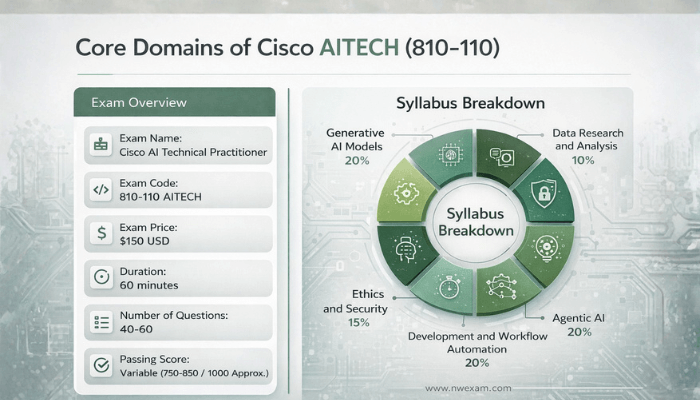
These diverse topics prepare candidates not just for the exam, but for a practical role in shaping the future of AI within their organizations.
Empowering Enterprise Transformation with AI Skills
Achieving the Cisco AI Technical Practitioner certification significantly enhances a professional’s capacity to drive digital transformation within their organization. This credential signifies a recognized ability to work with advanced AI technologies, moving beyond theoretical knowledge to practical application. The skills validated by the 810-110 AITECH exam are directly applicable to the strategic goals of modern enterprises, which increasingly rely on AI to gain competitive advantages and streamline operations. Professionals holding this certification are uniquely positioned to bridge the gap between complex AI concepts and actionable business outcomes.
Driving Innovation and Efficiency
Certified individuals possess the expertise to introduce and integrate innovative AI solutions that can profoundly impact an enterprise’s efficiency and capabilities. By understanding generative AI, prompt engineering, and workflow automation, they can identify opportunities to leverage AI for process optimization, predictive analytics, and enhanced decision-making. This capability is vital in an era where businesses are constantly seeking new ways to innovate and stay ahead of market trends. The certification validates an individual’s ability to not just understand AI, but to actively apply it for tangible business improvements.
Validating Essential Practitioner Capabilities
The Cisco AITECH certification serves as a robust validation of practical AI skills, assuring employers that a candidate can perform critical tasks. It confirms a professional’s proficiency in areas such as:
- AI Model Interpretation: Understanding the outputs and behaviors of complex AI models, particularly generative AI.
- Ethical Deployment: Ensuring AI systems are implemented responsibly, addressing privacy, fairness, and transparency.
- System Integration: Connecting AI services with existing enterprise infrastructure and applications.
- Workflow Automation: Designing and implementing AI-driven automation for various business processes.
- Problem Solving: Utilizing AI tools and methodologies to address specific business challenges and opportunities.
These validated capabilities are indispensable for any organization embarking on or scaling its AI initiatives.
Crafting a Robust Cisco AI Technical Practitioner Study Plan
A systematic and comprehensive study plan is paramount for success in the Cisco 810-110 AITECH exam. Given the breadth and depth of the topics covered, candidates need to allocate their time and resources judiciously. Effective preparation extends beyond memorization; it involves a deep engagement with the material, practical application of concepts, and regular self-assessment. A well-structured approach not only improves retention but also builds confidence, reducing exam-day anxiety.
Leveraging Official Training Resources
Cisco provides a range of official training materials specifically designed to prepare candidates for the AITECH exam. These resources are invaluable as they directly align with the exam blueprint and offer authoritative content. Such materials often include study guides, documentation, and online courses that delve into each syllabus topic in detail. Engaging with these resources ensures that candidates are learning from the most accurate and relevant sources, covering all the required skills tested in Cisco 810-110 AITECH. Supplementing these official guides with further reading on emerging AI trends can further deepen understanding. Accessing Cisco AI Technical Practitioner details can provide additional preparation materials, including practice tests.
The Role of Practice Exams and Self-Assessment
Integrating practice exams into the study routine is a critical component of preparation. These simulated tests help candidates become familiar with the exam format, question types, and time constraints. Regular self-assessment allows individuals to identify their strengths and weaknesses, enabling them to refine their study plan and focus on areas requiring more attention. Analyzing performance on practice questions, particularly understanding the rationale behind correct and incorrect answers, solidifies comprehension and builds test-taking strategies. Practice tests also help in gauging exam readiness and reducing surprises on the actual exam day.
Strategic Application of Generative AI and Prompt Engineering
The Cisco AITECH certification places a significant emphasis on practical application, especially within the rapidly evolving fields of Generative AI and Prompt Engineering. These areas represent some of the most powerful and transformative aspects of current AI technology, offering unprecedented capabilities for content creation, problem-solving, and interaction. Professionals who master these skills are equipped to unlock new levels of innovation and efficiency within their organizations, driving business value through intelligent automation and personalized experiences.
Understanding Generative AI Models
Generative AI models are at the forefront of creating novel content, from generating human-like text to crafting realistic images and complex code. The certification requires an understanding of various generative architectures, such as Large Language Models (LLMs) and Diffusion Models, and their potential applications in enterprise settings. This involves:
- Model Architectures: Grasping the fundamental differences and strengths of key generative models.
- Deployment Scenarios: Identifying appropriate business use cases for generative AI, like automated report generation or creative content drafting.
- Limitations and Biases: Recognizing the inherent constraints and potential ethical pitfalls associated with generative outputs.
- Evaluation Metrics: Assessing the quality and relevance of generated content using appropriate metrics.
A nuanced understanding allows practitioners to harness these models effectively while mitigating risks.
Advanced Prompt Engineering Techniques
Prompt engineering is the craft of optimizing inputs (prompts) to achieve desired outputs from AI models, particularly generative ones. This skill is critical for maximizing the utility and accuracy of AI applications, transforming vague inquiries into precise instructions. The exam delves into methods such as:
- Contextual Prompting: Providing relevant background information to guide the AI’s response.
- Few-Shot Learning: Demonstrating desired output patterns with a few examples in the prompt.
- Chaining Prompts: Breaking down complex tasks into a series of smaller, sequential prompts.
- Iterative Refinement: Adjusting prompts based on initial AI outputs to achieve better results.
- Prompt Management: Strategies for organizing, versioning, and reusing effective prompts.
Proficiency in these techniques empowers practitioners to extract maximum value from AI models, making them indispensable in an AI-driven workforce.
Upholding Ethical AI Standards and Data Security
The integration of AI into enterprise operations necessitates a robust framework for ethics and security. The Cisco AI Technical Practitioner certification explicitly addresses these critical concerns, acknowledging that technological advancement must go hand-in-hand with responsible deployment. Ensuring that AI systems are fair, transparent, and secure is not just a regulatory requirement but a fundamental aspect of building trust and preventing adverse outcomes. Certified professionals play a pivotal role in establishing and maintaining these standards within their organizations.
Adhering to Responsible AI Principles
Ethical considerations in AI involve safeguarding against bias, ensuring accountability, and protecting user privacy. The certification covers various aspects of responsible AI, including:
- Bias Detection and Mitigation: Techniques to identify and reduce algorithmic bias in training data and model outputs.
- Transparency and Explainability: Methods to make AI decisions understandable and interpretable, crucial for auditing and trust.
- Privacy-Preserving AI: Implementing techniques like federated learning or differential privacy to protect sensitive data used by AI models.
- Fairness and Equity: Designing AI systems that treat all individuals and groups equitably, avoiding discriminatory outcomes.
These principles guide practitioners in building AI solutions that are not only effective but also socially responsible and compliant.
Securing AI Deployments
AI systems introduce new attack vectors and vulnerabilities that require specialized security measures. The 810-110 AITECH exam covers strategies for securing AI environments, protecting both the models and the data they process. This includes:
- Data Security: Implementing robust measures for securing training data, including encryption, access control, and data anonymization.
- Model Integrity: Protecting AI models from adversarial attacks, such as poisoning or evasion, that could compromise their performance or integrity.
- API Security: Securing the interfaces through which AI models interact with other applications and users.
- Compliance: Understanding relevant data protection regulations (e.g., GDPR, CCPA) and ensuring AI deployments adhere to them.
A secure AI infrastructure is fundamental to reliable and trustworthy enterprise AI adoption, making this a crucial skill set.
Automating Workflows with Agentic AI and Development Practices
The future of enterprise automation increasingly involves Agentic AI, where intelligent agents autonomously execute tasks and collaborate within complex workflows. The Cisco AI Technical Practitioner certification equips professionals with the expertise to design, develop, and deploy these sophisticated AI systems, thereby revolutionizing operational efficiency. This domain bridges advanced AI concepts with practical software development and integration strategies, enabling organizations to build highly responsive and adaptive intelligent systems.
Exploring Agentic AI Frameworks
Agentic AI systems are designed to perform a series of actions to achieve a goal, often by leveraging multiple AI models, tools, and real-world data. The certification delves into the core components and principles behind these intelligent agents, including:
- Agent Architectures: Understanding how different agent types (e.g., reactive, deliberative, hybrid) are structured and operate.
- Planning and Reasoning: How agents formulate plans, make decisions, and adapt to changing environments.
- Tool Use: Integrating external tools and APIs, enabling agents to interact with the broader digital ecosystem.
- Memory and Learning: How agents retain information and improve their performance over time.
Mastery of Agentic AI allows for the creation of truly autonomous and intelligent automation solutions.
Integrating AI into Development Workflows
Beyond understanding Agentic AI, practitioners need to know how to embed these capabilities into existing development and operational workflows. This involves practical aspects of MLOps (Machine Learning Operations) and seamless integration, ensuring AI solutions are scalable, maintainable, and reliable. The certification covers:
- AI Development Lifecycle: Managing the entire process from data collection and model training to deployment and monitoring.
- API Integration: Connecting AI services, including Agentic AI components, with enterprise applications using robust APIs.
- Version Control for AI Assets: Managing different versions of models, data, and code to ensure reproducibility and traceability.
- Containerization and Orchestration: Deploying AI applications using technologies like Docker and Kubernetes for scalability and efficient resource utilization.
This practical application knowledge is essential for transforming theoretical AI concepts into functional, enterprise-grade solutions. Individuals can further explore relevant learning paths through the Cisco AI learning path, which provides curated resources for developing these advanced skills.
Unlocking Career Growth: Roles for Cisco AITECH Certified Professionals
The Cisco AI Technical Practitioner certification opens doors to a diverse array of career opportunities in the burgeoning field of artificial intelligence. As industries increasingly adopt AI solutions, the demand for professionals capable of implementing and managing these technologies continues to surge. This certification not only validates a specialized skill set but also positions individuals as forward-thinking experts, ready to contribute significantly to their organizations’ AI strategies.
Diverse Opportunities in AI-Driven Sectors
Certified professionals are well-suited for various roles that demand both technical acumen and an understanding of AI’s strategic implications. Some of the prominent job roles include:
- AI Technical Practitioner: Directly responsible for deploying, monitoring, and maintaining AI applications.
- AI Solutions Integrator: Focuses on integrating AI components into existing IT infrastructure and business processes.
- Data Scientist (with AI focus): Works with data to build and refine AI models, ensuring data quality and model performance.
- AI/ML Engineer: Specializes in the development and deployment of machine learning models and AI systems.
- Business Analyst (AI): Bridges the gap between business needs and AI capabilities, identifying opportunities for AI adoption.
- Prompt Engineer: Specializes in crafting and optimizing prompts for large language models to achieve specific outcomes.
These roles are critical across various sectors, including finance, healthcare, manufacturing, and technology, all of which are leveraging AI for innovation and competitive advantage.
Enhancing Professional Credibility
The Cisco AITECH certification serves as a powerful testament to a professional’s expertise in a highly specialized and in-demand field. It signals to employers a commitment to staying current with cutting-edge technologies and validates a specific skill set that is essential for modern IT infrastructure. This enhanced credibility can lead to greater career mobility, increased earning potential, and opportunities to lead significant AI initiatives within an organization. It also demonstrates proactive engagement with industry trends, marking the certified individual as a valuable asset in any AI-focused team.
Overcoming Preparation Challenges and Ensuring Exam Success
Preparing for a challenging certification like the Cisco 810-110 AITECH exam can present several hurdles, but with strategic planning and perseverance, these can be effectively managed. Candidates often face difficulties such as balancing study with work, navigating complex technical concepts, or overcoming exam anxiety. Recognizing these potential challenges early allows for the development of targeted strategies to mitigate their impact, ensuring a smoother and more effective preparation journey.
Managing Study Time and Resources
One of the primary challenges is effectively managing the significant time commitment required for comprehensive study. Many candidates balance full-time jobs and personal commitments, making consistent study difficult. To address this, it is crucial to:
- Create a Realistic Schedule: Allocate dedicated study blocks and adhere to them consistently. Even short, focused sessions are more effective than sporadic long ones.
- Prioritize Topics: Based on the exam blueprint and personal knowledge gaps, prioritize study topics to ensure maximum efficiency.
- Utilize Diverse Resources: Combine official Cisco materials with supplementary books, online courses, and community forums to gain varied perspectives.
- Active Learning: Engage with the material through hands-on labs, coding exercises, and real-world case studies to deepen understanding.
Efficient resource allocation and consistent effort are key to mastering the diverse skills tested in Cisco 810-110 AITECH.
Strategies for Exam Day Readiness
Beyond content mastery, effective strategies for exam day are crucial for optimal performance. This involves mental and logistical preparation to ensure candidates can perform at their best.
- Simulate Exam Conditions: Take full-length practice exams under timed conditions to build stamina and manage stress.
- Review Weak Areas: In the days leading up to the exam, revisit challenging topics identified during practice sessions.
- Rest and Nutrition: Ensure adequate sleep and a balanced meal before the exam to maintain focus and cognitive function.
- Read Questions Carefully: On exam day, take time to fully understand each question before selecting an answer, paying attention to keywords and details.
- Manage Time Wisely: Allocate time per question and avoid dwelling too long on a single difficult question; mark it for review if necessary.
These strategies contribute significantly to successfully navigating the exam and achieving the passing score.
The Cisco AI Technical Practitioner certification (810-110 AITECH) stands as a pivotal credential for professionals aiming to excel in the rapidly evolving AI landscape. By bridging the critical skill gap in enterprise AI, it empowers individuals to drive innovation, optimize workflows, and uphold ethical standards in the deployment of intelligent systems. This certification not only validates a comprehensive set of technical abilities but also positions its holders as strategic assets capable of transforming organizations through the intelligent application of AI.
To seize the opportunities presented by this transformative certification, proactive engagement with quality study materials and dedicated preparation are indispensable. Earning this credential signifies readiness to tackle complex AI challenges and contribute meaningfully to the next wave of technological advancement. Embark on your journey to validate your expertise and launch your AI career today.
Frequently Asked Questions
1. What is Cisco AI Technical Practitioner certification?
The Cisco AI Technical Practitioner (AITECH) certification validates an individual’s skills in deploying, managing, and optimizing artificial intelligence solutions within enterprise environments, focusing on practical application of AI concepts.
2. What is the exam code for Cisco AITECH certification?
The exam code for the Cisco AI Technical Practitioner certification is 810-110 AITECH.
3. What are the key skills tested in the Cisco 810-110 AITECH exam?
The exam tests skills across Generative AI Models, Prompt Engineering, Ethics and Security, Data Research and Analysis, Development and Workflow Automation, and Agentic AI.
4. How much does the Cisco 810-110 certification cost?
The Cisco 810-110 AITECH exam costs $150 USD. This price is subject to change, so always verify on the official Cisco website.
5. What job roles benefit from Cisco AITECH certification?
Professionals in roles such as AI Technical Practitioner, AI Solutions Integrator, AI/ML Engineer, Data Scientist (with AI focus), and Prompt Engineer can significantly benefit from this certification.


