The OMG-Certified Systems Modeling Professional – Intermediate (OMG-OCSMP-MBI300) certification validates a professional’s robust understanding and practical application of SysML for model-based systems engineering. Achieving this certification signifies a deep proficiency in building intricate behavioral, structural, parametric, and requirements models. However, facing a retake after an initial attempt can be disheartening, prompting a critical examination of previous preparation methods and underlying knowledge gaps. This article is designed to guide you through pinpointing common pitfalls and equipping you with actionable strategies to conquer your next OMG-OCSMP-MBI300 attempt with confidence.
Decoding the OMG-OCSMP-MBI300 Exam Blueprint
Successfully navigating the OMG-OCSMP-MBI300 exam requires a thorough understanding of its structure, objectives, and the specific areas of SysML it assesses. This intermediate-level certification builds upon foundational SysML knowledge, diving deeper into advanced modeling constructs and their practical application. A clear grasp of the exam’s parameters is the first step in formulating an effective retake strategy, ensuring your study efforts are precisely targeted.
Understanding the Exam Details
The OMG-OCSMP-MBI300 exam evaluates a candidate’s ability to proficiently apply SysML for complex system modeling tasks. This assessment is designed to be comprehensive, testing both theoretical knowledge and practical comprehension of modeling constructs. Knowing the logistical parameters helps in strategically managing your time and expectations during the exam itself.
- Exam Name: OMG-Certified Systems Modeling Professional – Intermediate
- Code: OMG-OCSMP-MBI300
- Price: USD $350
- Duration: 105 Minutes (Residents of English-speaking Countries), 135 Minutes (All others)
- Number of Questions: 90
- Passing Score: 55 / 90
Targeting Key Syllabus Domains
The OMG-OCSMP-MBI300 syllabus is meticulously structured to cover various facets of SysML application, with specific weightages assigned to each domain. A detailed review of these topics is crucial for identifying areas where your previous preparation might have fallen short. The official exam blueprint provides invaluable insights into the specific skills and knowledge required for success. For a comprehensive overview, consulting the OMG SysML certification guide is highly recommended to align your study focus.
1. Building a Behavioral Model (33%): This significant portion focuses on interaction, state machine, and activity diagrams. Candidates must demonstrate competence in representing system behavior, understanding sequence flows, and capturing system states.
2. Building a Structural Model (29%): Emphasizes block definition and internal block diagrams. Proficiency in defining system architecture, composing blocks, and representing structural relationships is paramount.
3. Building a Parametric Model (11%): Involves understanding how to define and use parametric diagrams for quantitative analysis. This includes specifying constraints and evaluating system performance.
4. Building a Requirements Model (10%): Covers the use of requirements diagrams to capture, analyze, and manage system requirements. Linking requirements to design elements is a key skill.
5. Model Concepts (6%): Foundational understanding of core SysML concepts, diagrams, and their interrelationships.
6. Organizing a System Model (6%): Focuses on package diagrams and managing the overall structure of a large system model effectively.
7. Defining Stereotypes, Properties, and Constraints (5%): Understanding how to extend SysML for specific domain needs, including custom elements and rules.
Unpacking Common Missteps in Model Builder Certification
Many candidates encounter difficulties with the OMG-OCSMP-MBI300 certification not due to a lack of effort, but rather misdirected preparation. Identifying these common pitfalls is vital for transforming a retake into a successful certification journey. Overlooking fundamental aspects of SysML application or misinterpreting exam objectives can significantly hinder performance.
Overlooking Practical Application Scenarios
A significant challenge for many is focusing too heavily on theoretical knowledge without sufficient practical application. The OMG-OCSMP-MBI300 exam heavily emphasizes the ability to apply SysML constructs correctly in real-world scenarios, not just recall definitions.
- Insufficient Hands-On Modeling: Merely reading about SysML diagrams isn’t enough. Candidates often struggle because they haven’t spent adequate time actively building models using a SysML tool, leading to a disconnect between theory and practice.
- Ignoring Inter-Diagram Consistency: SysML models are interconnected. A common mistake is failing to understand how changes in one diagram (e.g., a Block Definition Diagram) impact others (e.g., an Internal Block Diagram or a Requirements Diagram). The exam often tests this holistic understanding.
- Misinterpreting Diagram Purpose: Each SysML diagram serves a specific purpose. Candidates sometimes confuse when to use a State Machine Diagram versus an Activity Diagram, or apply incorrect notation for particular modeling objectives.
Inadequate Depth in Specific Domain Areas
The weighted distribution of syllabus topics means some areas are more critical than others. A common error is spreading study time too evenly across all topics, rather than dedicating proportional effort to high-percentage domains like behavioral and structural modeling.
- Underestimating Behavioral Modeling Complexity: With 33% weight, behavioral modeling requires deep understanding. Many candidates find difficulty with advanced aspects of activity partitions, control flows, and state transitions, particularly in complex scenarios.
- Surface-Level Structural Understanding: While basic block diagrams might seem straightforward, the intricacies of ports, flows, item flows, and part property multiplicity can be challenging. A superficial understanding often leads to errors in structural model questions.
- Neglecting Lower-Weighted but Foundational Topics: Even topics with smaller percentages like “Model Concepts” (6%) or “Defining Stereotypes” (5%) are foundational. Weakness here can ripple through understanding of more complex constructs.
Strengthening Your SysML Application Proficiency
To successfully pass the OMG-OCSMP-MBI300, a candidate must demonstrate not just knowledge of SysML, but the capability to apply it correctly and efficiently. This requires moving beyond rote memorization to a deeper, more intuitive understanding of modeling principles. Developing a robust SysML application proficiency involves dedicated practice and critical self-assessment.
Developing Intuitive Modeling Skills
True proficiency in SysML emerges from repeatedly applying its constructs to various problem sets, allowing you to develop an intuitive sense for correct modeling practices. This involves understanding the nuances of each diagram type and when best to employ them.
- Systematic Diagram Creation: Practice creating each type of SysML diagram from scratch for diverse scenarios. Focus on accuracy of notation, consistency across diagrams, and adhering to SysML rules.
- Reviewing Best Practices: Familiarize yourself with industry best practices for SysML modeling. Understand common patterns and anti-patterns to avoid mistakes and develop efficient modeling habits.
- Interpreting Existing Models: Beyond creation, practice reading and interpreting complex SysML models. This helps in understanding how different elements contribute to the overall system description and how to identify potential errors or ambiguities.
Validating Model Correctness and Consistency
The OMG-OCSMP-MBI300 exam often includes questions that require identifying errors in a given model or choosing the most accurate representation. This demands a keen eye for detail and a solid understanding of SysML semantics.
- Cross-Referencing Elements: Ensure that elements defined in one diagram are consistently used and referenced in others. For instance, properties defined in a Block Definition Diagram should be correctly represented in an Internal Block Diagram.
- Adhering to SysML Rules: Pay close attention to the specific rules governing each diagram type, such as connection rules for ports, flow directionality, or the correct syntax for constraints in parametric diagrams.
- Utilizing Model Validation Features: If using a SysML tool, leverage its model validation features to automatically check for common errors. Understanding these automated checks can highlight areas of conceptual misunderstanding.
Optimizing Exam Performance and Strategic Pacing
The OMG-OCSMP-MBI300 certification is not just a test of knowledge, but also of strategic thinking under pressure. Many retake candidates struggle with time management, question interpretation, and maintaining composure throughout the exam. Optimizing your performance involves honing these practical test-taking skills alongside your technical expertise.
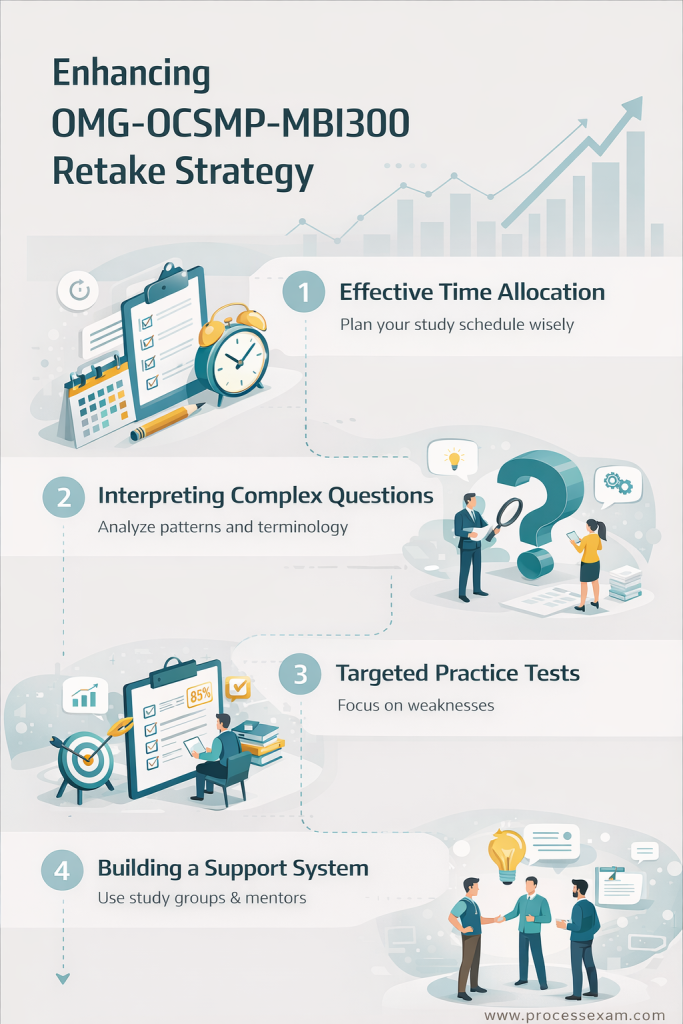
Effective Time Allocation During the Exam
With 90 questions to answer within a limited timeframe, efficient time management is crucial. Rushing through questions or getting stuck on a single difficult item can severely impact your overall score.
1. Practice Pacing: During your practice sessions, simulate the actual exam duration. Aim to answer questions within the allotted time per question (roughly 1 minute 10 seconds for English speakers).
2. First Pass Strategy: Go through all questions, answering those you are confident about immediately. Mark difficult questions for review. This ensures you secure points from easier questions first and don’t run out of time on them.
3. Educated Guessing: For questions you are unsure of, eliminate obviously incorrect options. Making an educated guess is often better than leaving a question blank, especially if there’s no penalty for incorrect answers (check official exam rules).
Interpreting Complex Questions Accurately
The OMG-OCSMP-MBI300 exam often features scenario-based or diagram-based questions that require careful interpretation. Misreading a prompt or overlooking a critical detail can lead to incorrect answers even if you possess the underlying knowledge.
1. Read Carefully: Always read the entire question and all answer choices before selecting. Pay attention to keywords such as “most appropriate,” “least likely,” “primary purpose,” or “correctly represents.”
2. Analyze Diagrams Thoroughly: For diagram-based questions, take a moment to understand the context, elements, relationships, and any associated notes or constraints within the diagram before looking at the options.
3. Break Down Scenarios: If a question presents a complex scenario, break it down into smaller, manageable parts. Identify the core problem or requirement being addressed before attempting to match it with a SysML solution.
Selecting Effective OMG-OCSMP-MBI300 Study Aids
A structured retake strategy necessitates leveraging high-quality study materials that align closely with the OMG-OCSMP-MBI300 exam objectives. The right resources can bridge knowledge gaps, provide targeted practice, and enhance overall readiness. Avoid generic study materials and instead seek out comprehensive, SysML-specific content.
Utilizing Official and Recommended Resources
The most reliable information for the OMG-OCSMP-MBI300 exam comes directly from the OMG organization and established SysML experts. These resources ensure accuracy and alignment with the current exam standard.
- Official SysML Specification: While dense, the core SysML specification document is the ultimate reference. Familiarity with its structure and key definitions can resolve ambiguities found in other materials.
- Authorized Training Courses: If available, OMG-accredited training courses offer structured learning paths with expert instructors. These can provide invaluable insights and hands-on guidance.
- Recommended Textbooks: Several authoritative books on SysML and Model-Based Systems Engineering provide in-depth explanations and practical examples, which are excellent for foundational reinforcement.
Boosting Readiness with Practice Questions and Simulations
Practice tests are indispensable for an OMG-OCSMP-MBI300 retake. They not only help you gauge your preparedness but also familiarize you with the exam format, question types, and time constraints. Engaging with a variety of practice questions from reliable sources can significantly improve your performance. For instance, exploring specialized resources with mock exams can refine your test-taking skills and expose you to diverse question formulations. You can find comprehensive OMG Model Builder Intermediate practice questions online to aid your preparation.
- Targeted Practice Tests: Focus on practice tests that offer detailed explanations for both correct and incorrect answers. This helps in understanding the underlying SysML principles and avoiding similar mistakes in the future.
- Full-Length Simulations: Take at least one or two full-length practice exams under timed conditions. This simulates the actual exam environment, helps in managing stress, and builds stamina for the duration of the test.
- Reviewing Weak Areas: After each practice test, meticulously review your performance. Identify recurring errors or consistently weak areas, then dedicate extra study time to those specific syllabus topics.
Integrating Model-Based Systems Engineering Workflows
The OMG-OCSMP-MBI300 certification validates a professional’s capacity to apply SysML within the broader context of Model-Based Systems Engineering (MBSE). Understanding how SysML constructs fit into a complete MBSE workflow from requirements definition to system verification is crucial for exam success. This perspective ensures that your SysML knowledge is not isolated but integrated into practical engineering processes.
Connecting SysML to the MBSE Lifecycle
SysML is a modeling language, but its power lies in its application throughout the systems engineering lifecycle. The exam expects candidates to understand these connections.
- Requirements Traceability: Understand how SysML models help in tracing requirements from initial definition through design, implementation, and verification.
- System Architecture Definition: Recognize how structural and behavioral models contribute to defining and refining the overall system architecture, identifying interfaces and interactions.
- Performance and Cost Analysis: Learn how parametric models enable early-stage analysis of system performance, resource consumption, and other quantitative aspects, informing design decisions.
Adopting a Holistic Systems View
A common pitfall is viewing SysML diagrams in isolation. The OMG-OCSMP-MBI300 assesses a candidate’s ability to maintain a holistic systems view, where all model elements contribute to a coherent system description.
- Model Integration: Understand how different diagram types are integrated to describe a system comprehensively, from multiple perspectives (e.g., requirements, structure, behavior, parametrics).
- Stakeholder Communication: Recognize how well-formed SysML models serve as a common language for communication among diverse stakeholders, reducing ambiguity and improving collaboration.
- Iterative Refinement: Appreciate the iterative nature of MBSE, where models are continuously refined and validated throughout the system development process, reflecting evolving understanding and design choices.
Advancing Your Career Through Professional Engagement
Earning the OMG-OCSMP-MBI300 certification significantly enhances your professional credibility in the field of systems engineering. Beyond the personal achievement, active engagement with the wider SysML and MBSE community offers invaluable opportunities for continuous learning, networking, and career advancement. This commitment to ongoing development reinforces the value of your certification.
Networking with Fellow Professionals
Connecting with other certified professionals and those working in MBSE environments can provide new perspectives and support. Such interactions deepen your understanding and expose you to diverse applications of SysML.
- Industry Forums and Groups: Participate in online forums, LinkedIn groups, or local meetups focused on SysML, MBSE, or systems engineering. Sharing experiences and asking questions can be highly beneficial.
- Attending Webinars and Conferences: Keep an eye on webinars and virtual or in-person conferences related to OMG standards and systems modeling. These events often feature expert presentations and networking sessions.
Gaining Deeper Insights from OMG Resources
The Object Management Group (OMG) is not only the vendor for this certification but also a hub for industry standards and advancements in modeling. Exploring their broader offerings can provide a competitive edge. The OMG communities serve as excellent platforms for engaging with these advancements.
- Accessing Whitepapers and Case Studies: The OMG website often publishes whitepapers, case studies, and articles on the latest trends and successful implementations of their standards, including SysML.
- Contributing to Standards: For experienced professionals, involvement in OMG working groups can be a powerful way to shape the future of modeling standards and showcase expertise.
Formulating Your Targeted Retake Action Plan
A retake of the OMG-OCSMP-MBI300 certification isn’t a setback but an opportunity to refine your approach and solidify your understanding. A well-structured action plan, built upon identified weaknesses and focused study, will significantly increase your chances of success. This plan should be adaptive, allowing for adjustments as you progress. For further context on industry relevance and updates, the OMG insights section offers valuable articles.
Creating a Personalized Study Schedule
Generic study plans rarely address individual needs. Your retake action plan should be highly personalized, emphasizing the syllabus areas where you previously struggled.
- Diagnostic Assessment: Begin with a thorough self-assessment or diagnostic test to pinpoint your exact weak areas within the SysML syllabus. Allocate more study time to these domains.
- Micro-Learning Sessions: Break down complex topics into smaller, manageable learning chunks. Consistent, focused micro-learning sessions are often more effective than infrequent, long study blocks.
- Regular Review and Reinforcement: Schedule regular review sessions to reinforce concepts. Spaced repetition techniques can be highly effective for long-term retention of SysML principles.
Building a Support System and Staying Motivated
Preparing for a retake can be mentally challenging. Cultivating a supportive environment and employing motivation strategies are just as important as the technical study itself.
- Find a Study Buddy: Collaborating with a peer who is also studying for the OMG-OCSMP-MBI300 can provide mutual support, opportunities for discussion, and shared problem-solving.
- Track Progress: Monitor your study progress and celebrate small victories. Seeing tangible improvement can be a powerful motivator.
- Prioritize Well-being: Ensure you maintain a healthy balance between study, rest, and personal activities. Burnout can be counterproductive, so prioritize your mental and physical health.
Navigating a retake for your OMG-OCSMP-MBI300 certification is a testament to your commitment to excellence in systems modeling. By meticulously analyzing past performance, addressing specific knowledge gaps, and strategically utilizing comprehensive resources, you can transform previous challenges into stepping stones for success. Remember that mastering SysML for Model-Based Systems Engineering is an ongoing journey of learning and application.
Embrace this opportunity for deeper engagement with the SysML constructs and their real-world application. With renewed focus and a refined study strategy, your next attempt at the OMG-OCSMP-MBI300 certification will undoubtedly reflect your enhanced expertise. For those seeking advanced certification resources and further guidance to elevate their professional profile, exploring dedicated platforms can provide invaluable support in your continued professional development.
Frequently Asked Questions
1. What does a failed OMG-OCSMP-MBI300 attempt typically indicate?
A failed attempt at the OMG-OCSMP-MBI300 typically points to a gap in either conceptual understanding of advanced SysML constructs or insufficient practical experience in applying them within modeling scenarios. It could also highlight issues with exam strategy, such as time management or question interpretation.
2. How should I prioritize study areas for my OMG-OCSMP-MBI300 retake?
Prioritize study areas based on the syllabus weightage and your previous performance. Focus most heavily on “Building a Behavioral Model” (33%) and “Building a Structural Model” (29%). Review your exam feedback, if available, to pinpoint specific domains where you scored lower and dedicate extra time to those.
3. Are official OMG resources sufficient for OMG-OCSMP-MBI300 preparation?
Official OMG resources, such as the SysML specification and recommended guides, are foundational and highly authoritative. While they provide the definitive knowledge base, supplementing them with hands-on tool practice, comprehensive textbooks, and quality practice questions can significantly enhance your preparation and application skills.
4. How can I improve my time management for the OMG-OCSMP-MBI300 exam?
Improve time management by taking full-length timed practice exams. Develop a strategy for quickly answering known questions and flagging difficult ones for later review. Practice breaking down complex scenario-based questions to allocate time efficiently per item.
5. What are the benefits of passing the OMG-OCSMP-MBI300 certification?
Passing the OMG-OCSMP-MBI300 certification validates your intermediate-level expertise in SysML and Model-Based Systems Engineering, enhancing your credibility and career prospects. It demonstrates your ability to design and analyze complex systems using industry-standard modeling techniques, opening doors to more advanced roles and projects.


