Passing the PRMIA ORM Certificate exam requires more than reading the ORM Handbook cover to cover. Candidates who score well understand how the nine syllabus topics are weighted, what question formats to expect, and how to allocate study time where the exam rewards it most. This guide focuses on PRMIA ORM practice questions, domain prioritization, and a structured preparation plan so you can walk into the Pearson VUE testing environment ready to hit that 60% threshold on your first attempt.
The ORM Certificate is a globally recognized operational risk credential that validates applied knowledge — not memorized theory. The exam draws on real-world scenarios involving risk governance, control frameworks, regulatory compliance, and resilience planning. Understanding that distinction changes how you prepare.
What Does the PRMIA ORM Certificate Exam Test?
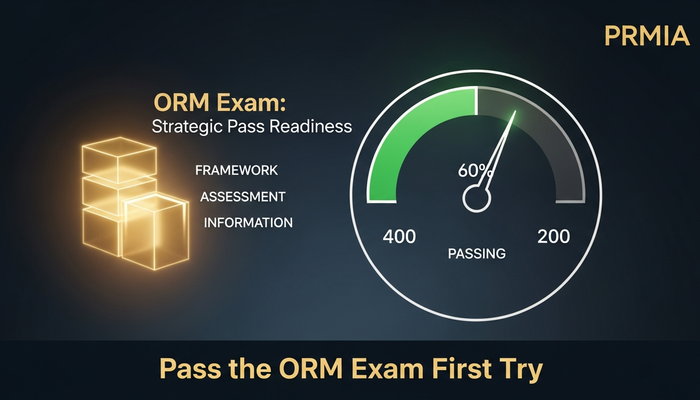
The PRMIA ORM Certificate exam tests applied knowledge of operational risk management across nine syllabus topics, delivered as 60 multiple-choice questions over 120 minutes through Pearson VUE. Candidates must answer at least 60% correctly (36 of 60) to pass. The nine topics range from foundational governance concepts to quantitative risk measurement and regulatory resilience frameworks — each carrying a defined percentage weight that directly determines how much time you should spend studying it.
Unlike theory-only assessments, the ORM exam emphasizes scenario application. You will read a situation — a bank’s risk reporting failure, a board governance gap, a capital calculation scenario — and select the most appropriate operational risk response from four options. This applied format rewards candidates who understand the why behind operational risk concepts, not just their definitions.
Governance and Compliance Topics
Risk Governance (10%) covers board-level accountability structures, the three lines of defense, and how risk culture is established across an organization. Compliance Risk (10%) addresses how firms identify, monitor, and manage obligations arising from laws, regulations, and internal codes of conduct. Introduction (3%) provides context for the ORM field and carries the lightest weighting in the exam.
Core Risk Management Topics
Risk Management Framework (17%), Risk Assessment (17%), and Risk Information (17%) are the three heaviest-weighted topics in the syllabus, together making up 51% of the exam. Risk Management Framework covers the design, implementation, and oversight of an organization’s ORM structure. Risk Assessment addresses identification, analysis, and evaluation of operational risk exposures — including RCSA methodology. Risk Information focuses on how risk data is collected, aggregated, and reported to support decision-making.
The Basel Committee on Banking Supervision has consistently noted that risk data aggregation and reporting capabilities remain a critical gap in large bank operations. The 2023 BCBS 239 progress report confirmed that many globally systemically important banks still fall short of the risk data aggregation principles set out more than a decade ago — making the Risk Information domain directly connected to live regulatory pressure.
Applied and Capital Topics
Operational Risk Capital (10%) covers measurement approaches under Basel III, loss distribution modeling, and the Standardized Measurement Approach (SMA). Operational Resilience (6%) focuses on recovery time objectives, business continuity, and the regulatory requirements emerging from DORA and Basel operational resilience principles. Case Studies (10%) tests the ability to apply ORM concepts to realistic multi-variable scenarios.
Which Exam Domains Should You Prioritize in Your Study Plan?
With 51% of the PRMIA ORM Certificate exam concentrated in three topics — Risk Management Framework, Risk Assessment, and Risk Information at 17% each — your highest return-on-study-time comes from mastering these three areas first. A candidate who fully understands just these three topics already has a theoretical path to passing without answering a single question correctly in any other section.
That said, the 10% domains (Risk Governance, Compliance Risk, Operational Risk Capital, Case Studies) collectively contribute another 40%. Neglecting them means risking a narrow margin on exam day. The table below maps every topic to a recommended study priority.
| Syllabus Topic | Exam Weight | Questions (approx.) | Study Priority |
|---|---|---|---|
| Risk Management Framework | 17% | 10 | High — master first |
| Risk Assessment | 17% | 10 | High — master first |
| Risk Information | 17% | 10 | High — master first |
| Risk Governance | 10% | 6 | Medium |
| Compliance Risk | 10% | 6 | Medium |
| Operational Risk Capital | 10% | 6 | Medium |
| Case Studies | 10% | 6 | Medium — practice-heavy |
| Operational Resilience | 6% | 4 | Lower — review only |
| Introduction | 3% | 2 | Minimal — read once |
Operational Resilience (6%) and Introduction (3%) together represent only 9% of the exam — roughly 5-6 questions. Read these sections in the ORM Handbook, understand the regulatory context, then move on. The returns from over-investing here are low.
Case Studies deserves a different kind of attention. At 10%, it is weighted equally with the medium-priority domains — but its preparation method is different. Case Study questions test your ability to synthesize multiple ORM concepts simultaneously. The best preparation for this section is completing timed practice sessions under realistic exam conditions rather than additional reading.
What Types of Questions Appear on the PRMIA ORM Exam?
PRMIA ORM Certificate questions are all multiple-choice, but they fall into three distinct formats: scenario-based applied questions, conceptual definition questions, and regulatory framework application questions. Understanding these formats before your first practice session helps you recognize what each question is actually asking — which is different from simply knowing the content.
Scenario-Based Applied Questions
This is the most common format on the ORM exam. You are presented with a realistic situation — a bank process failure, an incident reporting gap, a governance breakdown — and asked to identify the specific risk management issue, the appropriate control response, or the correct classification of the event. These questions reward practical understanding over textbook recall.
An example from the ProcessExam sample question bank illustrates the format: “A financial institution’s operational risk team identifies that employees frequently fail to report minor operational incidents because they fear disciplinary consequences. Which risk management issue does this situation most clearly indicate?” The correct answer requires understanding risk culture, psychological safety, and the PRMIA three lines of defense model — not just incident reporting procedures. Reviewing PRMIA ORM sample questions helps calibrate what applied reasoning looks like before exam day.
Conceptual and Definition Questions
These questions test whether you can distinguish between similar but distinct ORM concepts — residual risk versus inherent risk, key risk indicators versus key performance indicators, or the difference between risk appetite and risk tolerance. They appear frequently in the Risk Governance and Risk Management Framework sections.
Conceptual questions tend to have one clearly correct answer and two plausible distractors. Studying definitions in pairs (what is this concept and how does it differ from the adjacent concept?) is more effective than reading definitions in isolation.
Regulatory and Framework Application Questions
These questions test whether you understand how specific regulatory requirements and frameworks apply to operational risk management. You may be asked how a firm should respond to a DORA compliance requirement, how Basel III capital rules affect a bank’s operational risk framework, or how a board should structure its oversight of third-party operational risk. Questions in this format draw on the Compliance Risk, Operational Risk Capital, and Operational Resilience sections.
How Should You Structure Your ORM Exam Preparation?
Most candidates preparing for the PRMIA ORM Certificate exam study for six to eight weeks. A three-phase structure — foundation, core domains, then integration and practice — aligns your study time with where the exam weights fall and ensures you approach practice questions after building conceptual understanding rather than before it.
Phase 1 — Foundation (Weeks 1–2)
Start by reading the ORM Handbook (included in the exam fee) in full without taking notes. This gives you a schema for how the nine topics connect. Then return to the Introduction and Risk Governance sections for a focused second read. Risk Governance introduces the three lines of defense, board-level risk structures, and risk culture frameworks that underpin almost every subsequent topic. A weak foundation here creates confusion in the core domains.
By the end of Phase 1, you should be able to explain the three lines of defense clearly and describe how risk governance structures differ across small and large financial institutions. You do not need to memorize regulatory articles at this stage.
Phase 2 — Core Domains (Weeks 3–5)
Focus the majority of your study time on the three 17% topics: Risk Management Framework, Risk Assessment, and Risk Information. Work through each chapter of the ORM Handbook for these sections, taking structured notes on key concepts, methodologies, and regulatory references.
Risk Assessment warrants particular attention to RCSA (Risk and Control Self-Assessment) methodology, KRI design, and the distinction between inherent and residual risk. Risk Information should be studied alongside the Basel Committee’s principles for risk data aggregation — specifically how firms collect, validate, and aggregate operational risk data for management and regulatory reporting. Compliance Risk and Operational Risk Capital fit naturally into this phase: Compliance Risk connects to your Risk Governance foundation, while Operational Risk Capital builds on your Risk Assessment understanding of loss data and exposure measurement.
Phase 3 — Integration and Practice (Weeks 6–8)
Shift from reading to doing. Work through practice questions in timed conditions — 60 questions in 120 minutes. After each session, review every incorrect answer and identify whether your error was conceptual (wrong understanding of a topic), applied (misread the scenario), or eliminative (failed to narrow down between two plausible options).
Cover the Operational Resilience and Case Studies sections in this phase. Operational Resilience (6%) requires understanding DORA requirements, business continuity planning, and recovery time objectives. Case Studies (10%) integrates knowledge from all other domains — so this section only makes sense to study once you have covered the rest. Aim to complete at least two full timed practice sets before your exam date, targeting 75%+ on practice questions before you schedule your Pearson VUE appointment.
How Do You Register for the PRMIA ORM Exam Through Pearson VUE?
Registering for the PRMIA ORM Certificate exam is a two-step process: purchasing exam authorization from PRMIA, then scheduling your testing appointment through Pearson VUE. PRMIA membership is not required to take the exam, but Sustaining Members pay $549 versus the Non-member price of $599 — a $50 saving that makes membership worthwhile if you plan to sit any other PRMIA exam.
Follow these steps to register:
- Purchase exam authorization on prmia.org. Log in to your PRMIA account (create one if needed). Purchase the ORM Certificate exam — price reflects your membership tier ($549/$572/$599). You receive exam authorization valid for 12 months from purchase date.
- Receive your authorization code. PRMIA emails an authorization code that you use to schedule through Pearson VUE. You also receive digital access to the ORM Handbook at this stage.
- Schedule at Pearson VUE. Visit Pearson VUE’s PRMIA exam page to book your appointment. Choose between a test center (5,500+ locations in 165+ countries) or OnVUE online proctoring from your home or office.
- Complete the exam. On exam day, arrive 30 minutes early for a test center appointment or complete the OnVUE system check 30 minutes before your online session. The exam is 60 questions over 120 minutes — you will receive your result immediately after completing it.
If you do not pass, PRMIA requires a 90-day waiting period before retaking the exam. Your authorization remains valid for 12 months from the original purchase, so you have time to retake without purchasing a new authorization.
Financial risk credentials like the FINRA Series 82 require employer sponsorship and regulatory approval — the PRMIA ORM Certificate has no such prerequisites. Any professional with an active PRMIA account can purchase and sit the exam.
Is the PRMIA ORM Certificate Exam Difficult to Pass?
The PRMIA ORM Certificate exam is moderately challenging. The 60% passing threshold — requiring 36 correct answers out of 60 — is attainable with structured preparation, but the scenario-based question format means surface-level reading of the ORM Handbook is rarely sufficient. Most candidates who prepare seriously for six to eight weeks pass on their first attempt.
The primary difficulty is the applied nature of the questions. The ORM exam does not ask you to recall a definition — it places you inside a situation and asks what a competent operational risk professional would do next. This format tests whether you can apply ORM frameworks under realistic conditions, not whether you can reproduce memorized content.
A second challenge is the breadth of the syllabus. With nine topics covering governance, quantitative measurement, regulatory frameworks, and applied case studies, the ORM exam rewards generalists who understand how these disciplines connect, not specialists who deeply know one area while neglecting others.
“Operational resilience assumes that disruptions will inevitably occur.”
This regulatory mindset — preparing for disruption rather than preventing it — is embedded throughout the ORM exam’s Operational Resilience and Case Study sections. Candidates who approach the exam with the same forward-looking stance that operational risk professionals apply in practice consistently outperform those who treat it as a compliance exercise.
If you are scoring consistently above 75% on full timed practice sets, you are well-positioned to pass. If you are scoring between 60–70%, focus your remaining study time on the specific question types and domains where you are losing the most points — not on re-reading content you already understand.
What Career Value Does ORM Certification Deliver in 2026?
Holding the PRMIA ORM Certificate signals formal competency in operational risk management at a time when demand for this expertise is accelerating across the financial services sector. Operational Risk Managers report average annual salaries of $120,706 in the United States, with senior roles reaching $165,000 or higher, according to ZipRecruiter’s 2026 salary data.
The market context in 2026 strengthens that demand significantly. The Digital Operational Resilience Act (DORA), which entered full force across the European Union on January 17, 2025, creates compliance obligations for approximately 22,000 financial entities — generating direct demand for professionals who understand operational resilience governance. Basel III’s Standardized Measurement Approach for operational risk capital continues to reshape how banks calculate and report capital requirements. The OCC reported in 2024 that over half of large US banks demonstrated weaknesses in operational risk and control frameworks — a finding that accelerates hiring in the discipline.
Roles that benefit directly from ORM certification include Operational Risk Manager, Risk and Control Officer, Chief Risk Officer (in mid-sized institutions), Compliance and Operational Risk Analyst, Internal Audit Manager (financial services), and Second Line of Defense Risk Advisor. The credential is recognized globally by financial institutions, regulators, and consulting firms operating in banking, insurance, and asset management.
The ORM Certificate is also a natural stepping stone. After passing, many holders progress to the ORM Designation — a two-part credential that adds a Case Study Practicum and requires demonstrated operational risk work experience. The Designation signals senior-level competency and is typically pursued by professionals with five or more years in operational risk roles.
Frequently Asked Questions About the PRMIA ORM Exam
How many questions are on the PRMIA ORM Certificate exam?
The PRMIA ORM Certificate exam contains 60 multiple-choice questions, completed in a 120-minute sitting administered through Pearson VUE at test centers worldwide or via online proctoring.
What is the passing score for the PRMIA ORM exam?
The passing score is 60%, meaning you need to answer at least 36 of the 60 questions correctly. Your result is displayed immediately after you complete the exam at the Pearson VUE testing terminal.
How long should I study for the PRMIA ORM exam?
Most candidates need six to eight weeks of structured preparation. Candidates with existing operational risk experience often require less time; those entering from adjacent fields like audit or compliance may need closer to ten weeks for the quantitative domains.
What resources are included in the PRMIA ORM exam fee?
The exam fee includes 12 months of exam authorization and digital access to the ORM Handbook. PRMIA’s ORM Handbook is the primary study resource and covers all nine syllabus topics aligned to the exam blueprint.
How much does the PRMIA ORM Certificate exam cost?
The exam fee depends on your PRMIA membership tier: $549 for Sustaining Members, $572 for Contributing Members, and $599 for Non-members. All tiers include the digital ORM Handbook and 12-month exam authorization.
Can I take the PRMIA ORM exam online from home?
Yes. PRMIA ORM exams are available through Pearson VUE’s OnVUE online proctoring system, which allows you to test from a home or office environment using a webcam-enabled computer. Alternatively, you can sit the exam at any of Pearson VUE’s 5,500+ testing centers in more than 165 countries.
What percentage of the PRMIA ORM exam covers Risk Assessment?
Risk Assessment carries 17% of the exam — approximately 10 questions out of 60. It is one of three topics (alongside Risk Management Framework and Risk Information, also at 17% each) that together represent 51% of the full exam, making these the highest-priority areas for focused study.
Is the PRMIA ORM Certificate exam harder than other financial risk certifications?
The ORM Certificate is generally considered moderately challenging compared to designations like the FRM or PRM. Its 60% passing threshold is lower than many professional designations, but the applied scenario format is more demanding than straightforward definition-recall exams. Most well-prepared candidates pass on their first attempt.
How does the PRMIA ORM Certificate differ from the ORM Designation?
The ORM Certificate is a single exam: 60 multiple-choice questions, available on demand, no experience prerequisite. The ORM Designation is a two-part credential — it adds a Case Study Practicum to the exam and requires verified operational risk work experience. The Designation is the senior-level credential; the Certificate is the entry or mid-career pathway.
If I fail the PRMIA ORM exam, how soon can I retake it?
PRMIA requires a 90-day waiting period before retaking the ORM Certificate exam. Your original exam authorization remains valid for 12 months from purchase, so in most cases you can retake within the same authorization window without purchasing a new one.
The PRMIA ORM Certificate exam rewards candidates who study strategically, not exhaustively. Focus your preparation on the three 17% domains — Risk Management Framework, Risk Assessment, and Risk Information — which together account for more than half the exam. Build your foundation in weeks one and two, deepen your core domain knowledge through week five, then shift entirely to timed practice in the final phase.
Scenario-based practice questions are the most effective preparation tool for the ORM exam’s applied format. Reviewing how sample questions connect governance concepts to real-world risk situations reveals the applied reasoning pattern that the exam rewards. Work through available PRMIA ORM practice questions before scheduling your Pearson VUE appointment to confirm you are ready.
The ORM Certificate is a globally recognized credential with genuine career value in a regulatory environment that continues to raise operational risk expectations across financial services. Prepare thoroughly, practice under timed conditions, and use the 60% threshold as a clear, achievable target.


