Text and images make up most of what an organisation stores and almost none of what it analyses. Closing that gap is what the SAS A00-408 exam measures, formally the SAS Viya Natural Language Processing and Computer Vision certification, which brings together two of the most in-demand AI skill sets in analytics today. Offered by SAS and earning the SAS Certified Specialist – Natural Language Processing and Computer Vision Using SAS Viya credential, it asks you to prove real fluency in turning raw text and images into models that make decisions. This guide breaks down exactly what the exam measures, how each domain is weighted, and how to build the hands-on skills that separate a pass from a near miss. If you work with unstructured data in SAS Viya, this credential signals that you can operationalise it, not just describe it.
Table of Contents
- What Does the SAS A00-408 Certification Actually Validate?
- How Is the SAS A00-408 Exam Structured?
- Which Skills Does the Loading and Exploring Data Domain Test?
- How Do You Master Natural Language Processing Techniques for A00-408?
- What Computer Vision Skills Does A00-408 Require?
- Who Should Pursue the SAS Natural Language and Computer Vision Credential?
- What Career Paths Open Up After A00-408?
- How Should You Prepare for the SAS A00-408 Exam?
- Frequently Asked Questions About the SAS A00-408 Exam
- Turning A00-408 Preparation Into Real SAS Viya Expertise
What Does the SAS A00-408 Certification Actually Validate?
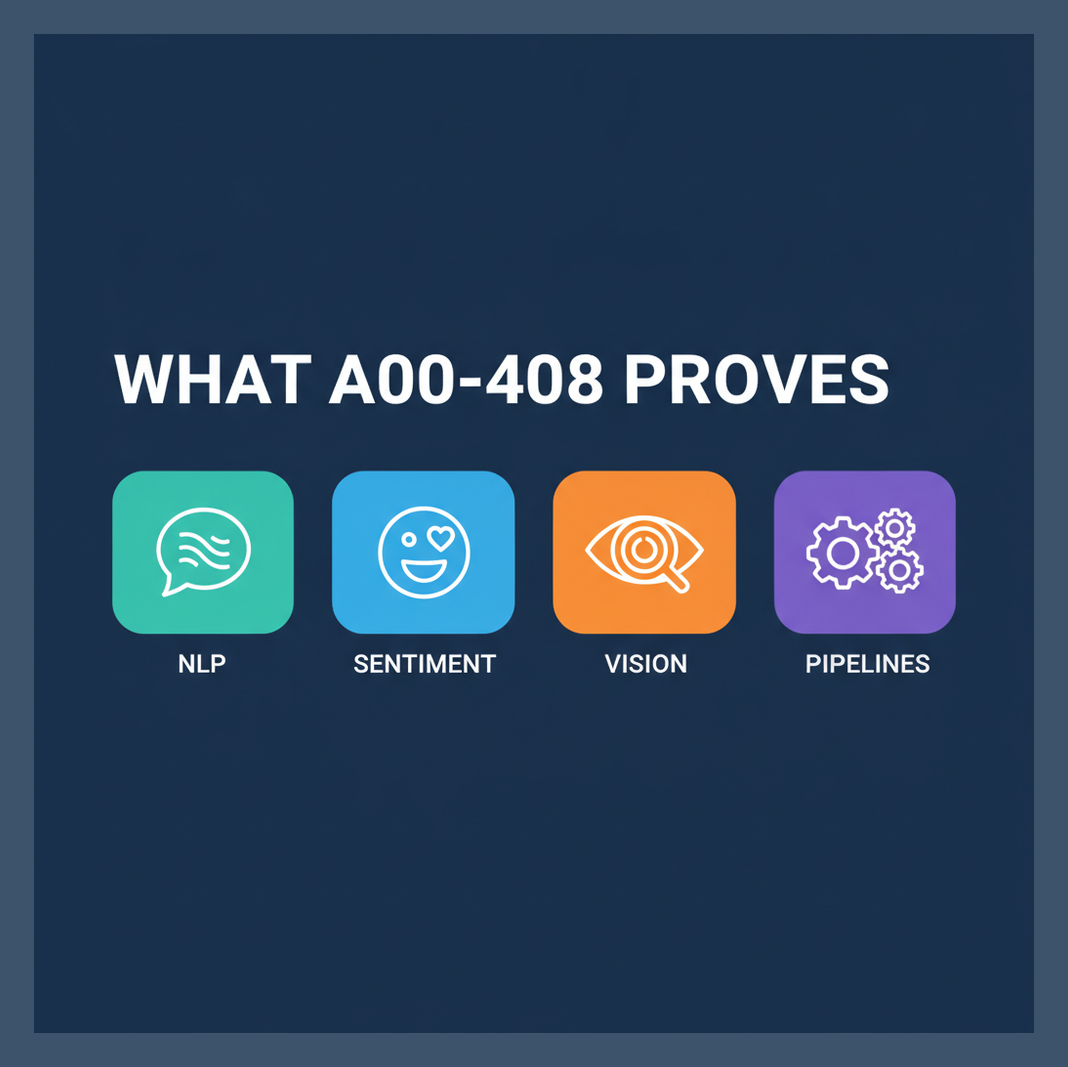
The SAS A00-408 certification validates your ability to build natural language processing and computer vision models inside SAS Viya. It confirms you can import and prepare unstructured text and image data, extract patterns using SAS Visual Text Analytics, write concept and category rules, and design neural networks for both language and images. The credential proves applied skill, not theory alone.
SAS positions this exam for practitioners who already work with SAS Viya and want to specialise in unstructured data. Because roughly 80 percent of enterprise data is unstructured, employers increasingly value people who can turn documents, reviews, and images into scored predictions. That practical framing shapes every question you will face.
Unlike a broad analytics exam, A00-408 stays tightly focused. You will not be tested on general statistics or reporting. Instead, the questions probe how well you handle text parsing, sentiment, topic extraction, and deep learning architectures such as recurrent and convolutional neural networks within the SAS environment.
How Is the SAS A00-408 Exam Structured?
The SAS A00-408 exam contains 60 questions and gives you 110 minutes to complete them. You need a score of 70 percent to pass, and the exam costs 180 US dollars. It is delivered through Pearson VUE and leads to the SAS Certified Specialist – Natural Language Processing and Computer Vision Using SAS Viya credential. Knowing these numbers early helps you plan pacing and budget.
With 60 questions across 110 minutes, you have a little under two minutes per item. That is comfortable for recall questions but tight for scenario items that ask you to reason through a pipeline or a rule. Building speed on applied questions matters more than memorising definitions.
| Exam Attribute | Detail |
|---|---|
| Exam name | SAS Viya Natural Language Processing and Computer Vision |
| Exam code | A00-408 |
| Credential earned | SAS Certified Specialist – Natural Language Processing and Computer Vision Using SAS Viya |
| Number of questions | 60 |
| Exam duration | 110 minutes |
| Passing score | 70% |
| Exam price | $180 (USD) |
| Delivery partner | Pearson VUE |
The exam draws from three weighted domains. Text processing carries the heaviest weight, followed closely by computer vision, with data loading rounding out the blueprint. The table below shows how the marks are distributed, which tells you where to spend your study hours.
| Exam Domain | Weight |
|---|---|
| Loading and Exploring Data | 18-22% |
| Identifying Text Patterns Using Natural Language Processing Techniques | 40-45% |
| Identifying Image Patterns Using Computer Vision Techniques | 35-40% |
Which Skills Does the Loading and Exploring Data Domain Test?
The Loading and Exploring Data domain carries 18 to 22 percent of the SAS A00-408 exam and covers how you get text and image data ready for analysis. You must import documents, prepare them for parsing, resolve encoding problems, set up a project in SAS Visual Text Analytics, and load labelled image data. It is the foundation every later model depends on.
Text preparation questions often centre on encoding. You should be able to troubleshoot ASCII and UTF-8 issues and convert proprietary document formats into SAS supported formats with minimal loss of information. Getting this wrong corrupts every downstream term and concept, so the exam treats it as a core competency.
The image side of this domain focuses on getting picture data model-ready. Expect items on the following tasks:
- Loading labelled image data using functions such as labelLevels and loadImages
- Augmenting image data to expand a training set
- Preparing image data for modelling
- Exploring the Documents Table and defining key features of the term table
- Assigning text and category roles correctly for a given scenario
You should also know how to export score code so a trained project can score new data sets. That single skill connects the exploration phase to production use, and it appears in scenario questions throughout the blueprint.
How Do You Master Natural Language Processing Techniques for A00-408?
Natural language processing is the largest domain on the SAS A00-408 exam at 40 to 45 percent. To master it, you need to work fluently with the Concepts, Text Parsing, Topics, and Categories nodes in SAS Visual Text Analytics, write LITI and Boolean rules, and build recurrent neural networks. This is where most of your study time should go, because it decides the outcome of the exam.
Working With Concepts, Terms, and Topics
Start with term handling. You must use start, stop, and synonym lists to include, exclude, or combine terms, explain why predefined and custom concepts are useful, and read a term map and its similarity scores. The Topics node adds machine-generated topics, where you adjust term and document density, then split, merge, or promote topics into categories.
Writing LITI and Category Rules
Rule writing is the technical heart of this domain. You should be able to write LITI rules using elements such as CLASSIFIER, CONCEPT, C_CONCEPT, CONCEPT_RULE, PREDICATE_RULE, and REGEX, then explain how each rule influences document scoring and the term table. Boolean category rules follow the same logic for classifying documents, and you must diagnose common syntax errors quickly. Reviewing worked examples and a bank of realistic A00-408 practice questions is the fastest way to internalise this syntax.
Measuring Categorisation and Using RNNs
You also interpret categorisation results using F-measure, precision, recall, and misclassification counts, and explain sentiment level scoring. Finally, the domain expects you to build recurrent neural networks, including basic, bi-directional, and specialised GRU and LSTM variants, to recognise sequence patterns in text. Understanding when each RNN type fits a problem is a frequent scenario theme.
What Computer Vision Skills Does A00-408 Require?
The Identifying Image Patterns Using Computer Vision Techniques domain accounts for 35 to 40 percent of the SAS A00-408 exam. It is built almost entirely around convolutional neural networks. You must understand how convolutional, padding, pooling, fully connected, and output layers work together, tune hyperparameters, score new images, and apply architectural and regularisation techniques that improve generalisation.
Building the CNN Layer by Layer
Expect detailed questions on convolutional layers, including kernel filters, feature map size calculations, equivariance to translation, and hyperparameters such as width, height, and stride. Padding questions test how you preserve feature map size and accommodate skip-layer connections. Pooling items ask about invariance, summary functions, and when pooling is appropriate for a given goal.
Output Layers, Scoring, and Tuning
Fully connected layers bring their own detail: ordering them correctly, defining activation functions, and counting trainable and estimated parameters. For output layers, you specify the activation function and choose error functions. You also tune a deep learning model using the Hyperband method and score new image data with trained weights, where batch size relevance is a common test point.
Architecture and Regularisation
The most advanced items cover architectural design and regularisation. You should be able to apply the techniques below and explain the effect of each:
- Residual and concatenation connections, plus requirements for skip-layer connections
- One-by-one convolutions and spatial exploration techniques
- Blocks and cardinality techniques within the network structure
- Batch normalisation to improve generalisation and learning
- Dropout to reduce overfitting
SAS builds these capabilities on its deep learning actions. Understanding how residual connections and batch normalisation stabilise deeper networks is often the difference between a model that trains smoothly and one that stalls, so give this section deliberate hands-on practice.
Who Should Pursue the SAS Natural Language and Computer Vision Credential?
The SAS A00-408 credential suits data scientists, machine learning engineers, and analysts who already use SAS Viya and want formal proof of unstructured data skills. It fits professionals moving from traditional statistical modelling into AI, and teams standardising on SAS for text and image analytics. A working knowledge of SAS Viya and neural network basics makes the exam far more approachable.
This is not an entry-level credential. Candidates who succeed usually have hands-on exposure to SAS Visual Text Analytics or SAS deep learning actions. If your background is only in base programming, strengthening your SAS Viya foundations first pays off. Our guide to the SAS Viya programming fundamentals is a sensible earlier step.
The credential also appeals to consultants who deliver AI projects for clients. Being able to show a recognised SAS specialism helps win text mining and image classification engagements, where clients want assurance that the delivery team knows the platform deeply.
What Career Paths Open Up After A00-408?
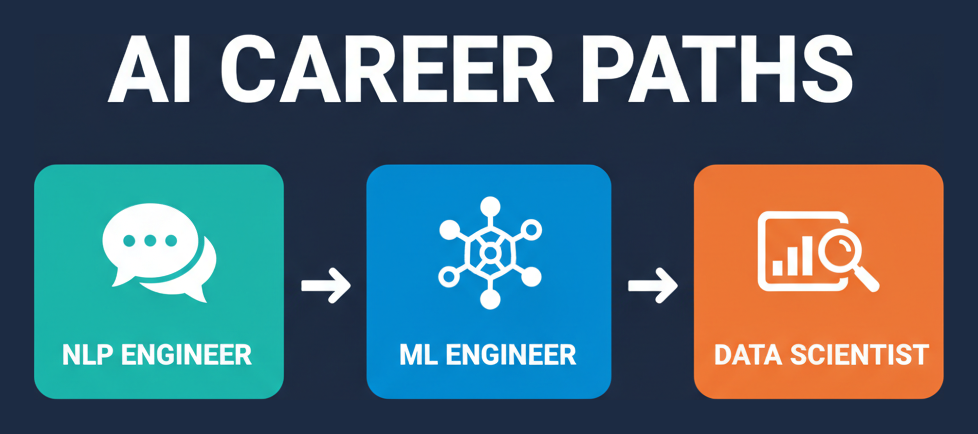
Passing SAS A00-408 strengthens your position for roles in applied AI, text mining, and computer vision engineering. Typical titles include data scientist, machine learning engineer, NLP engineer, and analytics consultant. Because the credential proves platform-specific delivery skill, it is especially valuable inside organisations that run SAS Viya for regulated or large-scale analytics.
Compensation for these roles is strong. Machine learning and NLP specialists consistently rank among the better paid analytics professionals, with senior practitioners commanding six-figure salaries in many markets. A recognised, platform-specific specialism can push you toward the top of those bands and shorten the path to lead roles.
The skills also transfer well. Once you can design CNNs and write concept rules in SAS Viya, the underlying concepts carry into broader AI work. Many certified specialists pair this credential with wider modelling experience, such as the ground covered in the SAS Viya machine learning pipelines exam, to present a rounded profile.
How Should You Prepare for the SAS A00-408 Exam?
Effective SAS A00-408 preparation combines official training, hands-on practice in SAS Viya, and repeated testing against the blueprint. Because the exam rewards applied skill, reading alone will not carry you. Build a study plan that mirrors the three domain weights, then spend the most time on natural language processing and computer vision, where nearly 80 percent of the marks sit.
A structured sequence keeps your preparation focused:
- Study the official SAS courses, including SAS Visual Text Analytics in SAS Viya and Deep Learning Using SAS Software, to cover the syllabus systematically.
- Rebuild each pipeline yourself in SAS Viya so you can perform, not just recognise, every task.
- Practise writing LITI and Boolean rules until syntax errors become obvious to you at a glance.
- Design and tune small CNN and RNN models, paying attention to hyperparameters and regularisation.
- Take timed practice questions to build pacing and expose weak areas before exam day.
Explore the official SAS Visual Text Analytics product pages and enrol in the vendor’s deep learning training for hands-on labs. Schedule your exam through Pearson VUE only once your practice scores sit comfortably above the 70 percent line, and make sure you are solid on convolutional neural networks before you book.
Frequently Asked Questions About the SAS A00-408 Exam
How many questions are on the SAS A00-408 exam?
The SAS A00-408 exam has 60 questions. You are given 110 minutes to complete them, which works out to just under two minutes per question. Scenario items take longer, so building speed on applied questions during practice is important.
What score do you need to pass A00-408?
You need 70 percent to pass the SAS A00-408 exam. The credential earned is the SAS Certified Specialist – Natural Language Processing and Computer Vision Using SAS Viya. Aim for practice scores well above 70 percent before booking to leave a safety margin.
How much does the SAS A00-408 exam cost?
The SAS A00-408 exam costs 180 US dollars. You register and sit the exam through Pearson VUE. Factor in any optional official training courses separately, as those are priced independently of the exam fee.
Which domain carries the most marks on A00-408?
Identifying Text Patterns Using Natural Language Processing Techniques carries the most marks, at 40 to 45 percent. Computer vision follows at 35 to 40 percent, and data loading accounts for 18 to 22 percent. Weight your study time accordingly.
Do you need coding experience for the SAS A00-408 exam?
Yes, practical familiarity with SAS Viya helps significantly. The exam tests rule writing, pipeline building, and neural network design, all of which are hands-on tasks. Candidates with only theoretical knowledge tend to struggle with the scenario questions.
What tools does A00-408 focus on?
The exam centres on SAS Visual Text Analytics for language work and SAS deep learning actions for computer vision. You should know the Concepts, Text Parsing, Topics, and Categories nodes, plus how to build recurrent and convolutional neural networks in SAS Viya.
Is SAS A00-408 suitable for beginners?
No, A00-408 is a specialist credential rather than a beginner one. It assumes working knowledge of SAS Viya and neural network fundamentals. Newcomers should build SAS Viya programming skills first, then move into this text and image specialism.
How long does it take to prepare for A00-408?
Most candidates with SAS Viya experience need several weeks of focused study. The exact time depends on your comfort with rule writing and deep learning. Allocating extra hours to the two largest domains usually produces the best return.
What is the difference between A00-408 and other SAS Viya exams?
A00-408 focuses specifically on unstructured data, meaning text and images, while other SAS Viya exams cover programming, forecasting, or model management. It is the natural choice for professionals who want to specialise in natural language processing and computer vision.
Turning A00-408 Preparation Into Real SAS Viya Expertise
The SAS A00-408 certification rewards genuine, hands-on capability with unstructured data. Its blueprint is clear: load and explore text and image data, extract language patterns with concept and category rules, and design neural networks that classify both words and pictures. Master those three domains in the correct proportions and you will not just pass, you will be able to deliver real projects in SAS Viya.
Treat every practice question as a chance to rebuild a pipeline rather than recall a fact. When your timed scores sit comfortably above 70 percent and you can write a clean LITI rule or tune a CNN without hesitation, you are ready. Start mapping your study plan to the domain weights today and take the next step toward the SAS Certified Specialist credential.


