
Employers use this certification as shorthand for a specific promise: this person can install ES on a search head, wire in the right data, tune correlation searches, and manage the notable events that analysts triage every day. Those are messy, high-stakes tasks, and they are exactly what the twelve syllabus domains measure.
This article breaks down the role, the exam format, and every domain weighting, then maps out the hands-on skills and a study path that fits real ES work. Whether you already run a Splunk deployment or you are moving from analyst to admin, you will finish with a clear picture of what SPLK-3001 asks and how to prepare for it efficiently.
Table of Contents
- What Does a Splunk Enterprise Security Admin Do?
- What Is the SPLK-3001 Exam Format?
- Which Domains Does the SPLK-3001 Syllabus Cover?
- How Do You Install and Configure Splunk Enterprise Security?
- How Do Correlation Searches and Notable Events Work in ES?
- Which Hands-On Skills Should You Build for ES Administration?
- How Should You Prepare for the SPLK-3001 Exam?
- Is the SPLK-3001 Certification Worth It?
- Frequently Asked Questions
- Conclusion
What Does a Splunk Enterprise Security Admin Do?
A Splunk Enterprise Security admin owns the health and accuracy of the ES application inside a security operations centre. The SPLK-3001 role covers installing ES on a search head, validating security data sources, tuning detections, and maintaining the workflows that analysts rely on. In short, this person makes sure the SIEM produces trustworthy notable events instead of noise.
The job sits between raw data and human analysts. On one side, you plan indexing, add technology add-ons, and confirm that firewall, endpoint, and identity logs map cleanly into ES data models. On the other side, you support the incident review workflow, manage glass tables, and keep dashboards fast and relevant.
Day-to-day responsibilities usually include:
- Configuring correlation searches and adaptive response actions
- Reducing false positives through sensitivity and threshold tuning
- Managing asset and identity lookups so events carry business context
- Onboarding new threat intelligence feeds
- Setting navigation and dashboard permissions for different roles
Feeds are only useful once their indicators map to recognised adversary behaviour, which is why ES correlation content is commonly aligned to the MITRE ATT&CK framework.
Because the ES admin decides what analysts see first, the role blends platform engineering with security judgement. That combination is what makes the credential valuable, and it explains why the exam leans heavily on configuration and tuning rather than theory. You can review the broader Splunk ES career roles this skill set unlocks.
What Is the SPLK-3001 Exam Format?
The SPLK-3001 exam contains 48 questions and gives you 60 minutes to complete them. It costs $130 USD, is delivered through Pearson VUE, and requires a scaled passing score of 700 out of 1000. The Splunk Enterprise Security Certified Admin exam is scenario-driven, so most items test how you would configure or troubleshoot ES rather than simple recall.
With roughly 75 seconds per question, pacing matters. Questions frequently describe a deployment problem, a broken data input, or a misfiring correlation search and ask for the correct fix. Reading each scenario carefully is worth more than rushing, because the wrong-answer options often look plausible on the surface.
Here are the confirmed exam specifications:
| Specification | Detail |
|---|---|
| Exam name | Splunk Enterprise Security Certified Admin |
| Exam code | SPLK-3001 |
| Number of questions | 48 |
| Duration | 60 minutes |
| Passing score | 700 / 1000 |
| Exam price | $130 (USD) |
| Delivery | Pearson VUE |
Splunk recommends the Enterprise Security Certified Admin learning path and real hands-on time before you sit the test. Practising with realistic SPLK-3001 practice questions helps you calibrate both your knowledge and your timing before exam day.
Which Domains Does the SPLK-3001 Syllabus Cover?
The SPLK-3001 syllabus is organised into twelve weighted domains that together sum to 100%. Installation and Configuration carries the single largest weight at 15%, and five domains covering monitoring, forensics, deployment, data validation, and both correlation-search topics each contribute 10%. The Splunk Enterprise Security Certified Admin blueprint clearly rewards deployment and detection engineering over introductory theory.
Use the weightings to steer your study hours. The domains worth 10% to 15% deserve the most hands-on practice, while the 5% domains still need coverage because a handful of questions can decide a borderline pass.
| Domain | Weight |
|---|---|
| ES Introduction | 5% |
| Monitoring and Investigation | 10% |
| Security Intelligence | 5% |
| Forensics, Glass Tables, and Navigation Control | 10% |
| ES Deployment | 10% |
| Installation and Configuration | 15% |
| Validating ES Data | 10% |
| Custom Add-ons | 5% |
| Tuning Correlation Searches | 10% |
| Creating Correlation Searches | 10% |
| Lookups and Identity Management | 5% |
| Threat Intelligence Framework | 5% |
Notice how detection work dominates. Between Tuning Correlation Searches, Creating Correlation Searches, and Monitoring and Investigation, a third of the exam sits around the notable-event lifecycle. Data readiness through ES Deployment and Validating ES Data adds another large block, confirming that the exam wants an admin who can both stand up ES and keep its detections meaningful.
How Do You Install and Configure Splunk Enterprise Security?
Installing Splunk Enterprise Security means preparing a dedicated search head, downloading the ES app, and running a structured set of post-install tasks. In the SPLK-3001 blueprint this is the heaviest domain at 15%, combined with ES Deployment at 10%, so a strong grasp of topology and setup order directly protects your score.
ES is not a simple app install. It changes indexing behaviour, adds data models, and expects specific user roles. The exam checks whether you understand that sequence and can recognise when a step has been skipped or misconfigured.
Deployment planning
Before installation, you decide where ES lives. That means choosing between a single search head and a search head cluster, sizing indexers, and confirming the indexing strategy that ES data models depend on. The deployment checklist and topology choices are explicit syllabus items, so study them as decisions, not trivia.
Post-install configuration
After the app is on the search head, the real work begins. Typical steps include:
- Prepare the Splunk environment and confirm prerequisites
- Download and install ES on the search head
- Configure ES-specific user accounts and roles
- Complete post-install configuration tasks and validate data models
Understanding roles matters here because ES separates what an analyst can do from what an admin can change. The Enterprise Security documentation walks through each install and configuration step, and mirroring those steps in a lab is the fastest way to make them stick.
How Do Correlation Searches and Notable Events Work in ES?
Correlation searches are the detection engine of Splunk Enterprise Security, and they generate the notable events analysts investigate. The SPLK-3001 exam devotes 10% to tuning existing correlation searches and another 10% to creating new ones, making detection engineering the largest theme across the whole blueprint. Getting this right is central to passing.
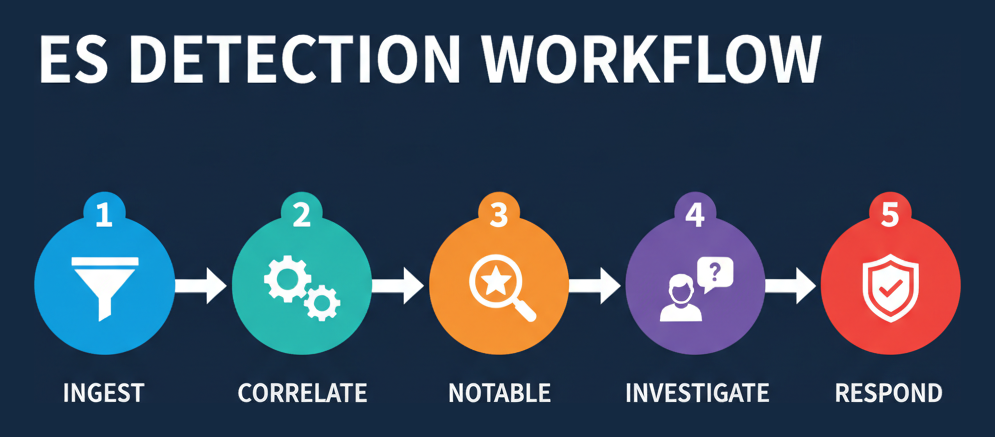
A correlation search runs on a schedule, evaluates incoming data against a rule, and raises a notable event when conditions match. Too sensitive, and analysts drown in false positives. Too loose, and real threats slip past. The admin’s job is to find that balance.
Tuning existing searches
Tuning covers scheduling, thresholds, and sensitivity. You adjust how often a search runs, how many results trigger an alert, and which fields carry weight. Good tuning removes noise without hiding genuine incidents, and the exam expects you to reason through those trade-offs in context.
Creating new searches
Building a custom correlation search means writing the search logic, configuring adaptive response actions, and handling search export and import between environments. Adaptive responses can trigger notable events, run scripts, or send data to other systems, which turns a passive alert into an automated action. Pair this study with the notable-event workflow in Monitoring and Investigation so the detection and triage sides connect naturally.
Which Hands-On Skills Should You Build for ES Administration?
Splunk Enterprise Security administration rewards hands-on fluency far more than memorisation. Beyond installation and correlation searches, the SPLK-3001 syllabus tests data onboarding, custom add-ons, lookups, glass tables, and the threat intelligence framework. Each of these maps to a real task an ES admin performs, so building them in a lab is the most reliable route to the credential.
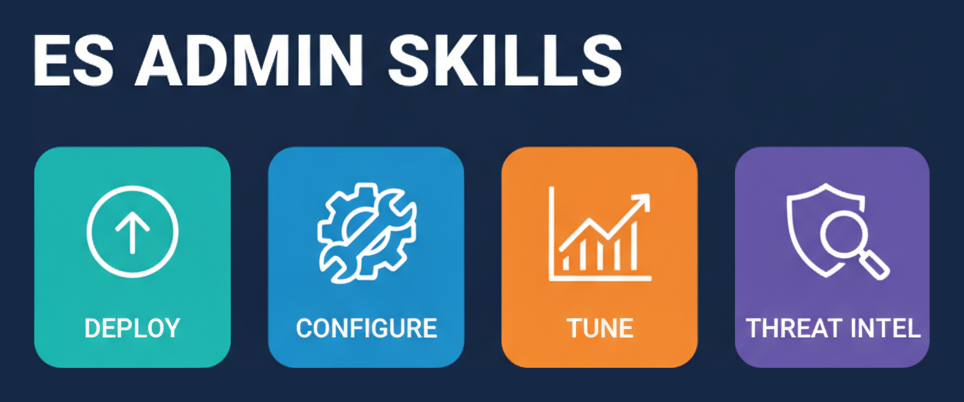
Group your practice around the supporting domains that fill out the rest of the exam:
- Validating ES Data: plan ES inputs and configure technology add-ons so sources map into the correct data models.
- Custom Add-ons: use the Add-on Builder to design a new add-on for custom data that ES does not support out of the box.
- Lookups and Identity Management: configure asset and identity lookup lists so events gain business context.
- Threat Intelligence Framework: configure threat intelligence feeds and user activity analysis.
- Forensics, Glass Tables, and Navigation Control: explore forensics dashboards, build glass tables, and set navigation and dashboard permissions.
These skills also define the underlying platform. Splunk Enterprise Security is Splunk’s security analytics and SIEM product, and Gartner has repeatedly recognised it as a Leader in the SIEM market. Studying the Splunk Enterprise Security platform directly gives you the product context the exam assumes you already have.
How Should You Prepare for the SPLK-3001 Exam?
Effective SPLK-3001 preparation combines the official Splunk learning path, a working ES lab, and repeated practice tests. Because the Splunk Enterprise Security Certified Admin exam is scenario-based, reading alone is not enough. You need to configure, break, and fix ES so the questions feel familiar rather than abstract on exam day.
A focused four-step plan works well for most candidates:
- Complete the Enterprise Security Certified Admin learning path to cover every domain in order.
- Build a lab: install ES on a search head, onboard sample data, and create at least one custom correlation search.
- Weight your hours toward the 10% to 15% domains, especially installation, deployment, and both correlation-search topics.
- Take timed practice exams until you consistently clear the 700 out of 1000 threshold with time to spare.
Register early through the schedule through Pearson VUE portal so you can lock in a date and work backward. If you want a step-by-step framework, the walkthrough of SPLK-3001 certification steps pairs well with a hands-on lab routine.
Is the SPLK-3001 Certification Worth It?
For working security professionals, SPLK-3001 is worth it when your role touches Splunk Enterprise Security directly. The Splunk Enterprise Security Certified Admin credential signals that you can run a real SIEM deployment, which is a scarce and well-paid skill. Its value is highest for SOC engineers, security analysts moving into platform work, and consultants who deploy ES for clients.
Splunk skills consistently rank among the higher-paying security specialisms, and ES expertise sits at the premium end because the product is enterprise-focused. The certification does not replace experience, but it validates the exact configuration and tuning abilities hiring managers struggle to verify in an interview.
Consider the credential a strong fit if you can answer yes to most of these:
- You already work with Splunk or a SIEM platform
- Your team runs, or plans to run, Splunk Enterprise Security
- You want to move from alert triage into detection engineering
- You need a recognised credential to support a promotion or consulting rate
To see how the credential fits the wider Splunk track and confirm your path, review the official Splunk certification program before committing your study time.
Frequently Asked Questions
What is the SPLK-3001 certification?
SPLK-3001 is the Splunk Enterprise Security Certified Admin exam. It validates that you can install, configure, and manage Splunk Enterprise Security, including data onboarding, correlation search tuning, and notable event workflows within a security operations environment.
How many questions are on the SPLK-3001 exam?
The exam has 48 questions and a 60-minute time limit. That gives you about 75 seconds per question, so steady pacing and careful scenario reading matter more than rushing through the items.
What score do you need to pass SPLK-3001?
You need a scaled score of 700 out of 1000 to pass. The exam uses scaled scoring, so focus on mastering the higher-weighted domains rather than trying to predict an exact percentage of correct answers.
How much does the SPLK-3001 exam cost?
The SPLK-3001 exam costs $130 USD and is delivered through Pearson VUE. You can schedule it online or at a test centre after registering, and Splunk recommends completing the official learning path first.
Which domain has the highest weight on SPLK-3001?
Installation and Configuration carries the largest weight at 15%. Combined with ES Deployment at 10%, setup and topology skills form a major share of the exam, so lab practice on installing ES pays off directly.
Do you need prior Splunk experience for SPLK-3001?
Hands-on Splunk experience is strongly recommended. The exam is scenario-based and assumes familiarity with Splunk searching and administration, so candidates usually hold foundational Splunk knowledge before attempting the ES admin credential.
What is a correlation search in Splunk ES?
A correlation search runs on a schedule and evaluates data against detection logic, raising a notable event when conditions match. Admins tune sensitivity and thresholds to reduce false positives while still catching genuine security incidents.
How long should you study for the SPLK-3001 exam?
Most candidates prepare over four to eight weeks, depending on prior ES exposure. Combining the official learning path with a working lab and timed practice tests is the most reliable way to reach the passing threshold confidently.
Is Splunk Enterprise Security a SIEM?
Yes. Splunk Enterprise Security is Splunk’s security analytics and SIEM application. It layers correlation searches, notable events, risk-based alerting, and threat intelligence on top of the core Splunk platform to support security operations.
Conclusion
SPLK-3001 measures a focused, practical skill: running Splunk Enterprise Security well enough that analysts can trust what it shows them. The exam rewards admins who can install ES, validate data, and engineer correlation searches, with installation, deployment, and detection tuning carrying the heaviest weight across its twelve domains.
Build your preparation around a real ES lab, weight your hours toward the 10% to 15% domains, and confirm your readiness with timed practice. When you can install ES cleanly and tune a correlation search without hesitation, you are ready to sit the exam. Work through realistic SPLK-3001 practice questions to close the gap between study and exam day, then schedule your test with confidence.


