Most certifications ask whether you can operate a product. The TOGAF Foundation certification asks something stranger: whether you can speak a language precisely. OGEA-101 puts 40 multiple choice questions in front of you in 60 minutes, and a large share of them turn on whether you know exactly what a term means inside the TOGAF Standard rather than what it means loosely in office conversation. Candidates who treat it as a general enterprise architecture quiz tend to fail. Candidates who treat it as a vocabulary and method exam tend to pass comfortably.
That distinction shapes everything about how you should prepare. This guide walks through what the Level 1 exam actually certifies, how the eight syllabus topics divide the material, why the Architecture Development Method dominates so much of the question pool, and where Foundation sits in the wider certification program.
Table of Contents
- What Does the TOGAF Foundation Exam Actually Certify?
- How Is OGEA-101 Structured on Exam Day?
- Which Syllabus Topics Does OGEA-101 Cover?
- Why Does the ADM Sit at the Centre of the Exam?
- What Do the ADM Techniques Ask You to Recall?
- How Does Architecture Governance Appear in Questions?
- What Does Architecture Content Expect You to Name?
- How Should You Prepare for a Vocabulary-Heavy Exam?
- Where Does Part 1 Sit in the TOGAF Certification Program?
- Who Gets Real Value from TOGAF Foundation?
- Frequently Asked Questions About OGEA-101
- Conclusion
What Does the TOGAF Foundation Exam Actually Certify?
OGEA-101 certifies that you understand the terminology, structure, and core concepts of the TOGAF Standard well enough to work inside an architecture team without misreading its documents. It is a knowledge level credential. It does not claim you can lead a transformation programme or design a target architecture, and it deliberately stops short of asking you to apply the method to a scenario. Candidates who clear Level 1 usually look next at the TOGAF Enterprise Architect route, which combines both levels in one sitting.
That scope is the source of most disappointment and most relief. Practitioners with years of design experience sometimes stumble because their working vocabulary has drifted from the standard’s definitions. Analysts and project managers with no design background often do well because they studied the text as written.
Knowledge Recall Rather Than Applied Judgement
Level 1 questions have one defensible answer that traces back to a specific statement in the body of knowledge. There is no partial credit, no scenario to weigh, and no room for the hedging that dominates real architecture work. Reserve that judgement for Part 2, where scenario questions carry graded answers.
A Living Standard, Not a Frozen Textbook
The TOGAF Standard, 10th Edition reorganised the material into Fundamental Content and a set of Series Guides, expanding the practical guidance and making the framework easier to configure for agile teams and digital transformation work. The Open Group frames this evolution as a feature of the standard rather than a disruption to it.
“The fact that the TOGAF Standard is a living body of knowledge is one of its great advantages.”
How Is OGEA-101 Structured on Exam Day?
OGEA-101 runs for 60 minutes and presents 40 multiple choice questions, with a passing score of 60 percent. That means 24 correct answers clear the bar and you have roughly 90 seconds per question. The exam fee is USD $405, and delivery is handled through Pearson VUE at test centres and through online proctoring.
| Specification | Detail |
|---|---|
| Exam name | The Open Group TOGAF Enterprise Architecture Part 1 |
| Exam code | OGEA-101 |
| Number of questions | 40 |
| Duration | 60 minutes |
| Passing score | 60 percent |
| Question format | Multiple choice |
| Exam fee | USD $405 |
| Delivery | Pearson VUE |
What the Timing Really Demands
Ninety seconds is generous for a definition question and tight for a question that lists four plausible phase outputs. The practical tactic is to answer every recall question immediately, flag anything requiring you to reconstruct a sequence, and return with the time you banked. Most candidates who run short on time did so by re-reading questions they already knew.
Which Syllabus Topics Does OGEA-101 Cover?
The OGEA-101 syllabus is published as eight topics. They are not equally sized in practice, because three of them concern the Architecture Development Method directly and two more concern the vocabulary that the method is written in. No public weighting is attached to the topics, so treat coverage rather than percentages as your planning unit.
| Syllabus topic | What it asks you to hold |
|---|---|
| Concepts | The framework’s underlying ideas and how its parts relate |
| Definitions | Precise meanings of standard terms, tested literally |
| Introduction to the ADM | Purpose, structure, and sequence of the development cycle |
| Introduction to ADM Techniques | Supporting techniques used across phases |
| Introduction to Applying the ADM | How the method is adapted rather than followed blindly |
| Introduction to Architecture Governance | Oversight structures and their responsibilities |
| Architecture Content | Deliverables, artifacts, and building blocks |
| TOGAF Certification Program | How the credential levels are structured |
Working through OGEA-101 sample questions is the fastest way to see how literally the Definitions topic is examined, because the wording of the options is usually where the trap sits.
Why Does the ADM Sit at the Centre of the Exam?
The Architecture Development Method is the engine of the TOGAF Standard, and three of the eight OGEA-101 syllabus topics point directly at it. If you can name every phase, state its objective in one sentence, and say what enters and leaves it, you have covered a substantial share of the question pool before touching anything else.
The Cycle You Must Be Able to Recite
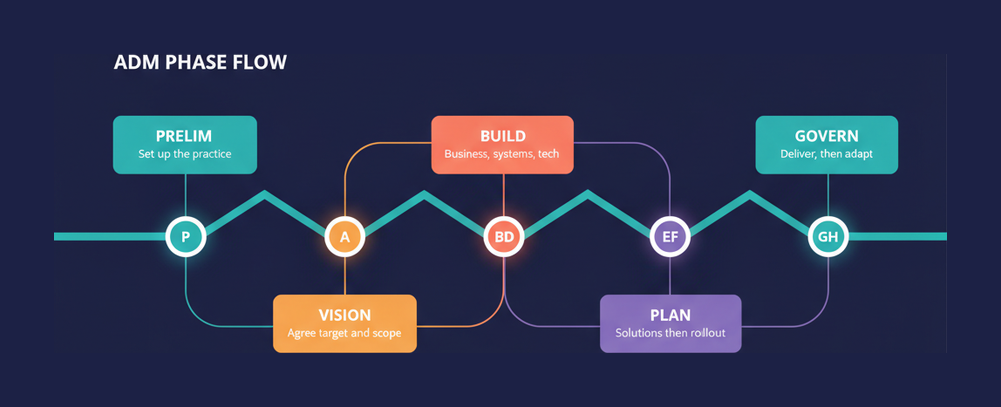
The method runs as a cycle. A Preliminary Phase establishes the architecture capability and principles. Phase A sets the Architecture Vision. Phases B, C, and D develop the Business, Information Systems, and Technology Architectures. Phase E identifies opportunities and solutions, Phase F plans migration, Phase G governs implementation, and Phase H manages architecture change. Requirements Management sits at the centre and touches every phase rather than occupying a slot in the sequence.
The Detail That Separates Passes from Failures
Knowing the phase letters is table stakes. The questions that decide outcomes ask which phase produces a specific deliverable, or which phase a named activity belongs to. Candidates who study the published ADM documentation alongside a summary tend to answer these correctly, because the summaries compress exactly the detail that gets tested.
What Do the ADM Techniques Ask You to Recall?
The ADM Techniques topic covers the supporting methods that make the OGEA-101 cycle workable in a real organisation. These are not separate phases. They are tools applied within phases, and the exam expects you to match each technique to its purpose rather than describe how to run it.
- Architecture Principles that constrain decisions before options are compared
- Stakeholder Management that identifies who must be satisfied and who must merely be informed
- Architecture Patterns that carry reusable structure between engagements
- Gap Analysis that exposes the distance between baseline and target
- Migration Planning Techniques that sequence change into deliverable increments
- Risk Management that classifies and tracks architectural exposure
- Business Scenarios that anchor requirements in observable business problems
A common error is treating Gap Analysis as a Phase E activity because that is where migration thinking becomes visible. In the standard it is a technique applied across the architecture phases, and questions are written to catch exactly that assumption.
How Does Architecture Governance Appear in Questions?
Architecture Governance is its own OGEA-101 syllabus topic, and it is the area where candidates from delivery backgrounds most often lose marks. The exam treats governance as a permanent organisational function with defined bodies and processes, not as a review meeting that happens when a project is in trouble.
The Architecture Board and Its Remit
You should be able to state what an Architecture Board is responsible for, who typically sits on it, and how it differs from a project steering group. Compliance, dispensations, and the handling of deviations are all fair game, and they are tested as definitions rather than as judgement calls.
Contracts, Compliance, and Capability
Architecture Contracts formalise obligations between the architecture function and implementation teams. Architecture Compliance assessments check delivered work against the agreed architecture. Both terms carry specific meanings in the standard, and both are frequently offered as distractors for one another.
“The next decade of technology and business pressures will require organizations to be more agile, resilient, and adaptable than ever, and that will make a clear approach to architecture more important than ever.”
What Does Architecture Content Expect You to Name?
The Architecture Content topic covers what an OGEA-101 candidate produces and consumes: the deliverables, artifacts, and building blocks that make an architecture description tangible. The distinction between these three terms is one of the most reliably examined points in the entire syllabus.
| Content item | How the standard treats it |
|---|---|
| Deliverable | A contractually specified work product, reviewed and signed off |
| Artifact | A finer grained description of an architecture, such as a catalog, matrix, or diagram |
| Building block | A reusable component of capability, either architecture or solution level |
Catalogs list things, matrices show relationships between things, and diagrams present things visually. Questions that ask you to classify a named artifact are testing that three way split, so rehearse examples of each rather than memorising the definitions alone.
How Should You Prepare for a Vocabulary-Heavy Exam?
Preparation for OGEA-101 works best when it mirrors the exam’s own character. Because the questions test recall against a fixed text, repetition and self-testing outperform project experience. Most candidates who prepare deliberately report needing a few focused weeks rather than months.
A Sequence That Works
- Read the structure first. Learn how Fundamental Content and the Series Guides relate before reading any phase in depth.
- Draw the ADM cycle from memory. Repeat until you can place every phase, its objective, and Requirements Management at the centre without prompting.
- Build a definitions list. Write the standard’s wording, not your own paraphrase, for every term you meet.
- Drill the confusable pairs. Deliverable against artifact, contract against compliance, principle against requirement.
- Test under time. Practise at 90 seconds per question so pacing becomes automatic.
- Review only what you miss. Re-reading material you already know is the most common wasted study hour.
Candidates who want a broader set of tactics before committing to a study plan often find these TOGAF exam tips a useful complement, and a walkthrough of an earlier OGEA-101 preparation approach shows how others have sequenced the same material.
Where Does Part 1 Sit in the TOGAF Certification Program?
The TOGAF Certification Program is itself an OGEA-101 syllabus topic, which is unusual and worth noticing. Part 1 delivers Foundation level certification. Part 2, examined separately as OGEA-102, delivers the practitioner level that recognises applied use of the method.
| Aspect | Part 1 (OGEA-101) | Part 2 (OGEA-102) |
|---|---|---|
| Level | Foundation | Practitioner |
| Question style | Multiple choice recall | Scenario based with graded answers |
| What it proves | You know the standard | You can apply the standard |
| Prerequisite | None | Foundation knowledge assumed |
Taking Part 1 alone is a legitimate choice. It certifies real knowledge and is often what an employer asked for. Treating it as a stepping stone is equally legitimate, and the vocabulary work you do for Foundation is precisely what makes the scenario questions in Part 2 readable.
Who Gets Real Value from TOGAF Foundation?
OGEA-101 rewards anyone who has to read, write, or challenge architecture documents, which is a much wider group than the people with architect in their job title. The credential is vendor neutral and framework specific, so its value tracks with how much your organisation actually uses TOGAF.
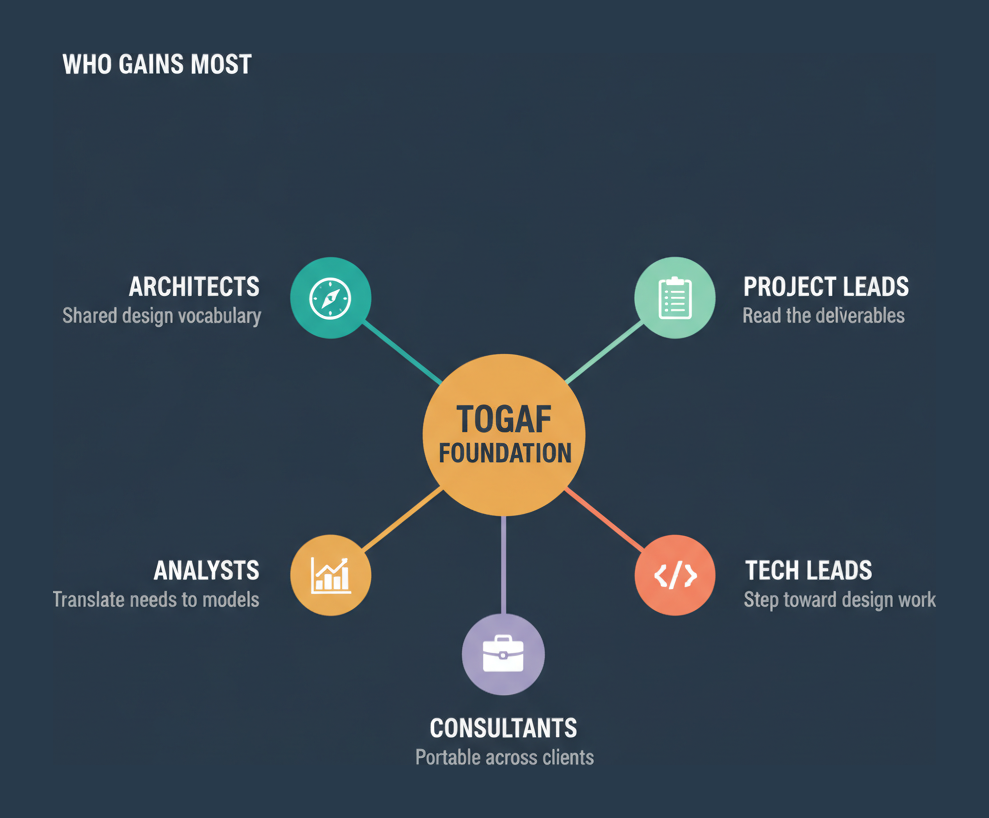
- Solution and domain architects who need shared vocabulary with an enterprise architecture function
- Business analysts who translate requirements into terms the architecture team recognises
- Programme and project managers who must interpret architecture deliverables and governance decisions
- Senior developers and technical leads moving toward design accountability
- Consultants who work across clients and need a portable frame of reference
The standard is used across commercial businesses of every size as well as government departments, public sector bodies, and defence agencies, which is why the credential travels well between sectors. Current enterprise architect salary data gives a realistic picture of where the role sits, and the full TOGAF Standard overview explains how the framework is maintained. Scheduling runs through Pearson VUE test delivery once you are ready to book.
Frequently Asked Questions About OGEA-101
How many questions are on the OGEA-101 exam?
The exam has 40 multiple choice questions and a duration of 60 minutes. The passing score is 60 percent, so you need 24 correct answers to pass. That works out to about 90 seconds per question.
Is TOGAF Foundation worth taking without Part 2?
Yes, in many situations. Foundation certifies that you understand the standard’s terminology and structure, which is often exactly what an employer or client requires. Part 2 adds applied practitioner recognition but is not a prerequisite for the value Foundation delivers.
How long does it take to prepare for OGEA-101?
Most candidates prepare in a few focused weeks rather than months. Because the exam tests recall against a fixed body of knowledge, consistent short study sessions with self-testing outperform long unstructured reading spread over a longer period.
Do I need enterprise architecture experience to pass?
No. OGEA-101 is a knowledge level exam with no experience prerequisite. Practitioners sometimes find it harder than expected because their working vocabulary has drifted from the standard’s precise definitions, which the exam tests literally.
What is the difference between a deliverable and an artifact?
A deliverable is a contractually specified work product that is formally reviewed and signed off. An artifact is a finer grained architectural description such as a catalog, matrix, or diagram. Deliverables typically contain artifacts, and the exam tests this distinction often.
How much does the OGEA-101 exam cost?
The exam fee is USD $405. Pricing can vary by region and by whether the exam is bundled with accredited training, so confirm the current figure when you book your session through the scheduling provider.
Which ADM phase is Requirements Management part of?
Requirements Management is not a phase in the sequence. It sits at the centre of the ADM cycle and interacts with every phase continuously. Questions frequently offer it as if it were a sequential phase, so this is worth rehearsing.
Can I take the exam online instead of at a test centre?
Yes. The exam is delivered through Pearson VUE, which supports both test centre delivery and online proctored sessions. Online delivery requires a compliant workspace, a supported system check, and identity verification before the session starts.
What does the TOGAF Standard 10th Edition change for candidates?
The 10th Edition divides the material into Fundamental Content and Series Guides and expands the practical guidance. Candidates should study the current edition, because preparation built on older editions misses both structure questions and updated terminology.
Who is the TOGAF Standard actually used by?
The standard is used by small, medium, and large commercial businesses as well as government departments, non-government public organisations, and defence agencies. That breadth is why the credential transfers well between sectors and industries.
Conclusion
OGEA-101 is a precise exam about a precise text. Forty questions, sixty minutes, and a 60 percent bar reward candidates who learned the standard’s own wording rather than a comfortable approximation of it. The eight syllabus topics concentrate heavily on the Architecture Development Method, its supporting techniques, and the governance structures that keep architecture decisions accountable, so a study plan built around drawing the ADM cycle and drilling confusable definitions covers most of what you will face.
Decide early whether Foundation is your destination or your first step. Either answer is defensible, and both are served by the same preparation. Build your definitions list, rehearse the cycle until it is automatic, practise at exam pace, and book the session while the material is fresh.


