What Is Oracle AI Vector Search?
It is Oracle Database’s ability to query data by meaning instead of by matching text. Oracle’s documentation puts it directly: AI Vector Search is designed for AI workloads and allows you to query data based on semantics rather than keywords. Rather than bolting on a separate vector database, Oracle stores embeddings in the same tables as the business data they describe.
That design decision is the reason this exam exists, and it shapes almost every question on it. When embeddings live beside the rows they came from, a semantic search is just a query, subject to the same transactions, the same security, and the same backup story as everything else in the database.
The practical shape of it is simple enough to state. Unstructured content, whether documents, images, or audio, is converted into a numeric representation. Similar meanings produce numerically close representations. Searching then means finding the closest vectors rather than the matching strings.
What Does the 1Z0-184-25 Exam Cover?
1Z0-184-25 is a 50 question exam with 90 minutes on the clock and a 68% pass mark, which works out at 34 correct answers. It costs $245 USD, though Oracle notes pricing varies by country and local currency. The syllabus splits into six weighted sections, and building a RAG application is the largest at 25%. Working through 1Z0-184-25 sample questions early is the fastest way to see which of the six your background already covers.
Format, cost, and scoring
| Attribute | Detail |
|---|---|
| Exam code | 1Z0-184-25 |
| Certification | Oracle AI Vector Search Professional |
| Questions | 50 |
| Duration | 90 minutes |
| Passing score | 68% |
| Cost | $245 USD, varying by country |
| Scheduling | Managed by Oracle through MyLearn for English delivery |
How the six sections are weighted
| Section | Weight |
|---|---|
| Building a RAG Application | 25% |
| Understand Vector Fundamentals | 20% |
| Using Vector Indexes | 15% |
| Performing Similarity Search | 15% |
| Using Vector Embeddings | 15% |
| Leveraging Related AI Capabilities | 10% |
A 68% pass mark is demanding for a 50 question paper. You can lose sixteen questions, and the three fifteen percent sections are close enough in weight that neglecting any one of them puts real pressure on the rest.
Registration is worth a note. Although Oracle exams appear on Pearson VUE, the Pearson VUE Oracle page states that English-language Oracle exams are managed directly by Oracle through MyLearn, so that is where scheduling actually happens.
How Does the VECTOR Data Type Work?
The VECTOR data type stores an embedding as a first-class database column, so a table can hold the original text and its numeric representation side by side. Vector fundamentals is worth 20% of 1Z0-184-25 and covers the data type itself, distance functions and metrics, and both DML and DDL operations on vectors.
Distance is the whole idea
A vector on its own means nothing. It only becomes useful when compared against another vector, which is what distance functions do. Oracle supports several metrics, with cosine as the default, and the exam expects you to know that the metric you search with should match the one the embedding model was designed around.
Vectors behave like data
Because vectors are ordinary columns, the usual operations apply. You can insert, update, and delete them, and you can define and alter tables that contain them. The Oracle AI Vector Search guide shows how plainly this works, with a vector column declared alongside a document identifier and its text.
Candidates from a pure machine learning background often underestimate this section, because handling vectors as ordinary relational data is exactly the part their usual tooling hides from them. The same is true in reverse on the Oracle data science certification, where modelling is a small share and the platform around it carries most of the questions.
Why Is Building a RAG Application 25% of the Exam?
Because retrieval-augmented generation is the reason most organisations want vector search in the first place. At 25%, building a RAG application is the largest section of 1Z0-184-25, and it requires you to do it two ways: in PL/SQL and in Python. Concepts alone will not carry this section.
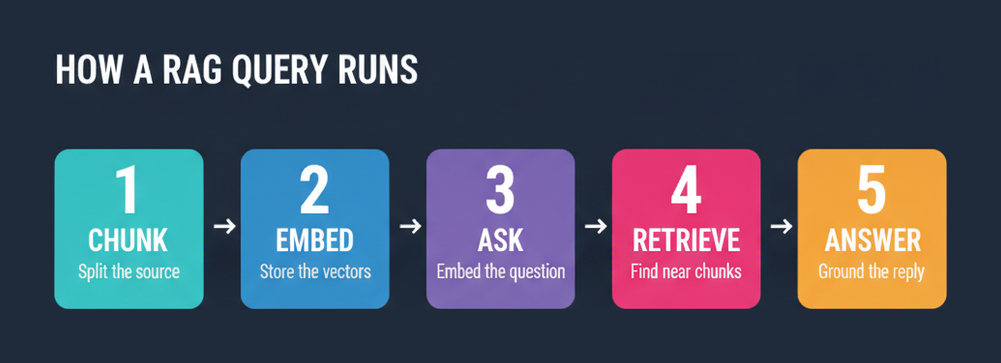
RAG is a technique for grounding a language model’s answer in retrieved documents rather than relying only on what the model absorbed during training, which reduces invented answers and lets responses cite a source. The pattern the exam cares about runs in a predictable order:
- Split source content into chunks small enough to retrieve meaningfully
- Generate an embedding for each chunk and store it in the database
- Embed the user’s question using the same model
- Run a similarity search to retrieve the closest chunks
- Pass those chunks to the language model as context alongside the question
Two things reliably separate candidates here. The first is understanding why the question and the documents must be embedded with the same model. The second is being genuinely comfortable in both languages, since a PL/SQL specialist and a Python developer each tend to have prepared only half of what this section asks. If you want a broader sense of the concept beyond Oracle’s implementation, the retrieval-augmented generation overview is a reasonable starting point.
HNSW or IVF: Which Vector Index Does the Exam Expect?
Both, and knowing when each applies. Using vector indexes is worth 15% and performing similarity search another 15%, so together they are 30% of the paper. The two index types answer the same question with different trade-offs, and Oracle documents them as distinct categories.
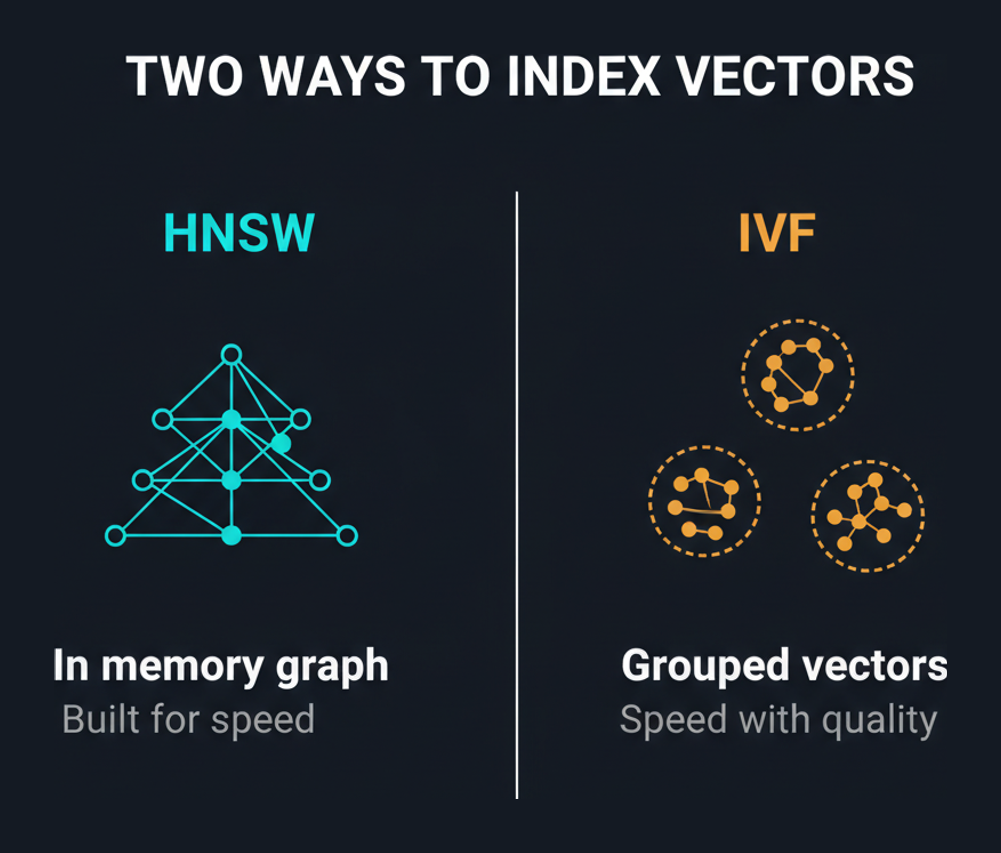
| Aspect | HNSW | IVF |
|---|---|---|
| Index category | In-memory neighbour graph | Neighbour partition |
| Structure | Layered graph of connections | Vectors grouped into clusters |
| Search behaviour | Navigates between graph layers | Restricts the search to nearby clusters |
| Optimised for | Speed of approximate search | Balancing search quality with speed |
The similarity search section then covers exact search, approximate search using those indexes, and multi-vector search across several documents. The distinction that matters is that an exact search visits every vector, while an approximate search deliberately looks at fewer in exchange for speed.
One detail from the vector index documentation is worth memorising: if you query using a different distance function from the one the index was built with, the database falls back to an exact search instead. That is precisely the kind of behaviour an exam question is built around.
Where Should Vector Embeddings Be Generated?
Either inside the database or outside it, and the exam covers both. Using vector embeddings is worth 15% of 1Z0-184-25 and splits three ways: generating embeddings outside Oracle, generating them inside Oracle, and storing them in the database. The choice is an architectural one with real consequences.
Generating embeddings inside the database keeps data where it already sits, which matters when the content is sensitive or when moving it would be slow. Generating them outside gives access to a wider range of models and offloads the compute. The exam expects you to recognise which situation favours which approach.
The constant across both routes is consistency. Whatever produces the embeddings for your stored content must also produce the embedding for the incoming query, because vectors from different models are not comparable. That single rule explains a surprising number of exam answers.
How Should a DBA and a Developer Prepare Differently?
They should start at opposite ends of the syllabus. A database administrator already understands the data type, DDL and DML, and index behaviour, so their gap is the 25% RAG section and the Python half of it. A Python developer usually knows embeddings and RAG well but has never created a vector index or written the PL/SQL version.
A sequence that suits both, adjusted for where you start:
- Build one small end-to-end RAG application first, since it is the largest section and it touches five of the six others
- Write it a second time in the language you are weaker in, PL/SQL or Python
- Create both an HNSW and an IVF index over the same data and compare the behaviour
- Run an exact search and an approximate search over that data and note the difference
- Generate embeddings both inside and outside the database so the trade-off is concrete
- Read through the related AI capabilities once, aiming for recognition rather than depth
If your background is administration rather than AI, the Oracle performance tuning material covers adjacent database ground, while the OCI networking professional route shows how Oracle structures its other professional-level exams.
Frequently Asked Questions
How many questions are on the 1Z0-184-25 exam?
The exam has 50 questions with a 90 minute limit, giving you a little under two minutes each. The pressure comes from the breadth of the six sections rather than from the clock itself.
What is the passing score for Oracle AI Vector Search Professional?
You need 68%, which is 34 correct answers out of 50. That is a relatively high bar, and because four sections carry 15% or more, neglecting any one of them makes the target considerably harder to reach. Developers building on OCI often pair this with the OCI DevOps credential, which covers pipelines and observability.
How much does the exam cost?
The exam costs $245 USD, and Oracle notes that pricing may vary by country or in localised currency. Check the price in your own region when you book rather than assuming the dollar figure applies. Oracle prices most of its specialist exams in the same band, and the 1Z0-1142 exam details sets out the fee and format for the financial crime and compliance track.
Which section carries the most weight?
Building a RAG application, at 25%. It covers RAG concepts plus creating an application in both PL/SQL and Python, which makes it the largest and, for many database specialists, the least familiar part of the exam. Teams putting sensitive data behind vector search should also read the database security exam breakdown.
Do you need to know Python for this certification?
Yes. The syllabus explicitly requires creating a RAG application using Python as well as PL/SQL. A candidate comfortable in only one of the two languages has a genuine gap in the exam’s largest section.
What is the difference between HNSW and IVF indexes?
HNSW is an in-memory neighbour graph index that navigates layered connections and is optimised for speed. IVF is a partition index that groups vectors into clusters and restricts searching to the nearest ones, balancing quality against speed.
When does Oracle fall back to an exact search?
If you query using a different distance function from the one the vector index was created with, the database performs an exact match search instead of using the index. Matching the metric to the index is therefore essential for performance.
Should embeddings be generated inside or outside the database?
Both approaches are examinable. Generating inside keeps sensitive or bulky data in place, while generating outside opens up a wider choice of models. What matters is using the same model for stored content and incoming queries.
Are there prerequisites for 1Z0-184-25?
No prerequisites are published. The exam does assume working familiarity with Oracle Database alongside basic Python and AI concepts, so candidates strong in only one of those areas should plan extra preparation time.
Where do you schedule the exam?
Although Oracle exams appear in Pearson VUE’s catalogue, Pearson VUE states that Oracle exams delivered in English are managed directly by Oracle. Scheduling therefore runs through Oracle MyLearn rather than the Pearson VUE portal.
Conclusion
1Z0-184-25 certifies something genuinely new: the ability to run semantic search and a grounded generative application inside the database rather than alongside it. With RAG at 25% and vector fundamentals at 20%, the exam splits its weight between applied AI work and classic Oracle data handling, which is why candidates from either background have real preparation to do.
Build one RAG application end to end before anything else, then write it again in whichever of PL/SQL or Python you find harder. Create both index types over the same data so the HNSW and IVF trade-off is something you have seen rather than read. Then work timed questions across all six sections until the 68% pass mark stops looking tight.


