What Is HashiCorp Vault, and Why Certify on It?
HashiCorp Vault is a secrets management platform. It stores credentials, API keys, certificates and encryption keys centrally, hands them out only to identities that policy allows, and expires them automatically. The Vault Associate exam certifies that you understand that model well enough to operate it safely rather than merely to use it. For the Kubernetes side of the same discipline, the policy as code credential covers admission policy rather than secrets.
HashiCorp describes the product’s purpose in its own documentation.
“Centralize secret management, rotate old credentials, generate credentials on demand, audit client interactions, and support regulatory compliance.”
Every clause in that sentence maps onto an exam objective. Centralised management is the secrets engines material. Rotation and on-demand generation are dynamic secrets and leases. Auditing sits under architecture. That is a useful way to hold the blueprint in your head.
Why the credential is worth an hour
Vault fails quietly when it is misconfigured. A policy that grants a path too broadly, a root token left alive, a lease nobody revokes: none of these throw an error, and all of them undo the point of running Vault at all. The associate exam is essentially a check that you will not make those mistakes, which is why organisations adopting Vault often ask for it early. Full product reference sits in the Vault documentation.
What Is on the Vault Associate Exam?
The Vault Associate exam presents 57 questions in 60 minutes and is graded pass or fail, with the threshold sitting at roughly 70%. It costs $70.50 USD, is delivered online proctored, and is scheduled through HashiCorp’s certification portal. There are no published percentage weightings for its nine objective areas.
| Exam detail | Value |
|---|---|
| Exam name | HashiCorp Certified Vault Associate |
| Version | 003 |
| Questions | 57 |
| Duration | 60 minutes |
| Passing score | Pass or fail, approximately 70% |
| Price | $70.50 USD |
| Delivery | Online proctored |
| Validity | Two years |
The absence of weightings is the planning problem. With no domain worth more than another on paper, you cannot triage, and 57 questions in 60 minutes leaves roughly 63 seconds each. The nine areas are listed below in the order the blueprint uses, which is also roughly the order in which they build on each other.
| Objective area | What it asks |
|---|---|
| Authentication methods | Choosing a method by use case, human versus system auth, identities and groups, configuring via API, CLI and UI |
| Vault policies | Path and capabilities syntax, choosing a policy from stated requirements, configuring via UI and CLI |
| Vault tokens | Service versus batch tokens, root token lifecycle, accessors, time-to-live, orphaned tokens |
| Vault leases | Lease IDs, renewal and revocation |
| Secrets engines | Choosing an engine, dynamic versus static secrets, transit engine, response wrapping, short-lived credentials |
| Encryption as a service | Encrypting and decrypting secrets, rotating the encryption key |
| Vault architecture fundamentals | How Vault encrypts data, sealing and unsealing, environment variables |
| Vault deployment architecture | Cluster strategy, storage backends, Shamir secret sharing, disaster recovery and performance replication |
| Access management architecture | Vault Agent and the Vault Secrets Operator |
Because nothing is weighted, calibrating against real phrasing matters more than usual, and the Vault Associate practice questions are the fastest way to find out which of the nine areas you are actually weak in.
Why Does Version 003 and Vault 1.19 Matter?
The 003 exam is built against Vault 1.19 specifically, and that is more consequential than a version number usually is. Vault has added and renamed capabilities steadily, so a candidate studying against an older release can answer correctly for their environment and still be marked wrong. HashiCorp version stamps its other associate papers the same way, and the Terraform Associate 004 exam is pinned to Terraform 1.12.
The clearest example is the access management area. The Vault Secrets Operator is a comparatively recent addition, sitting alongside the older Vault Agent, and older study material simply does not mention it. Cluster strategy is another: the blueprint now distinguishes self-managed clusters from HashiCorp-managed ones, which reflects the platform’s move toward a managed offering.
What to do about it
- Check your own Vault version before you start studying, and note where it differs from 1.19.
- Treat any resource that does not name version 003 as background rather than as a syllabus.
- Read the changelog between your version and 1.19 rather than the whole release history.
Where this exam sits against the rest of the vendor’s programme is covered across our HashiCorp certification hub.
The current objective list and version statement live on the HashiCorp certification page, and the source itself is public in the Vault project repository if you want to confirm when a feature landed.
How Do Auth Methods, Policies and Tokens Fit Together?
These three objective areas are one mechanism described in three parts, and the exam tests whether you see that. An auth method proves who you are. A policy states what that identity may do, expressed as paths and capabilities. A token is the artefact you carry afterwards, carrying those policies and an expiry.
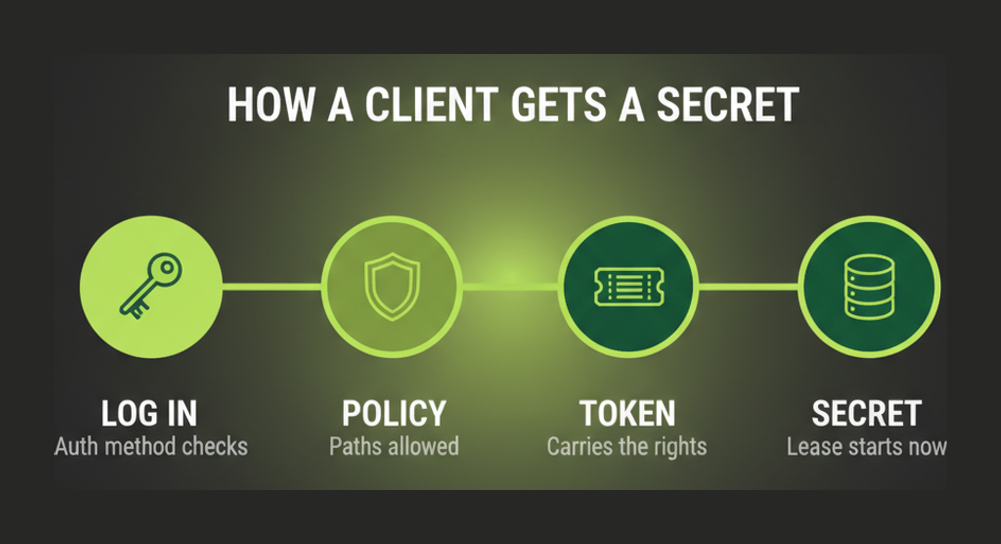
Candidates who study them separately tend to fail scenario questions, because the questions describe an outcome and ask which of the three you would change. If an application can read a path it should not, the answer is a policy change, not a new auth method. If a credential outlives its usefulness, the answer is token time-to-live, not policy.
The details that get tested
- Human versus system authentication, and which methods suit each.
- Service tokens against batch tokens, and specifically what batch tokens give up in exchange for scale.
- Token accessors, which let you manage a token without holding it.
- Orphaned tokens, and why a token that outlives its parent is sometimes exactly what you want.
- The root token’s lifecycle, which in practice means knowing it should not have one.
Policy syntax deserves hands-on time rather than reading. Write a policy, apply it, and try to break it. Path matching and capability sets are far easier to remember once you have been denied by your own rule.
What Do Secrets Engines and Leases Actually Test?
The secrets engine objectives are about choosing correctly, not about configuring everything. The exam asks which engine suits a stated use case, and above all whether a secret should be static or dynamic. Leases are the mechanism that makes dynamic secrets meaningful, which is why the two areas are usually studied together.
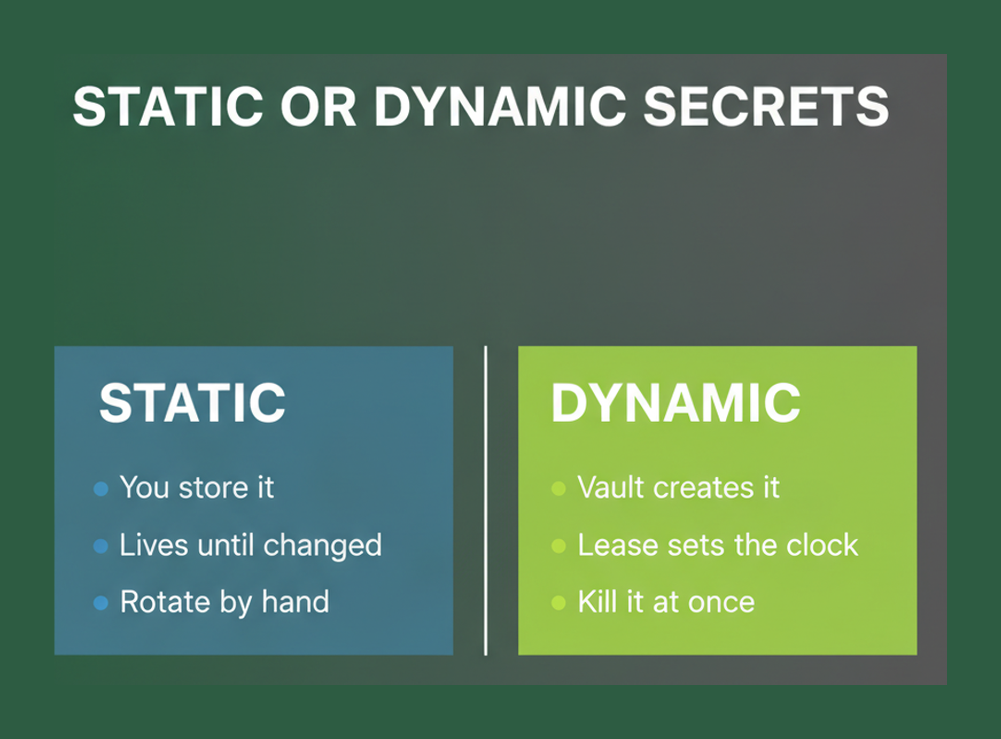
A static secret is something you put into Vault. A dynamic secret is something Vault creates on request, with its own lifetime, and destroys when the lease ends. That difference is the single most examinable idea in this part of the blueprint, because it is also the one that changes how an organisation operates.
Leases in practice
Every dynamic secret carries a lease ID. You can renew it, which extends the credential, or revoke it, which destroys the credential immediately even if nothing has expired. Revocation is the operational answer to a compromised credential and the exam treats it as such.
Response wrapping is the other item worth real attention. It lets you hand a secret to a consumer through an intermediary without the intermediary ever seeing the value, and it is one of those features candidates skip because it sounds niche and then meet in a scenario question.
What Is Encryption as a Service on This Exam?
Encryption as a service is the transit secrets engine, and it is the smallest objective area with two stated tasks: encrypting and decrypting secrets, and rotating the encryption key. The idea behind it is that applications should not hold encryption keys at all. They send data to Vault, Vault returns ciphertext, and the key never leaves.
Key rotation is where the exam has something to test. Rotating a transit key does not invalidate data encrypted with the previous version, because ciphertext carries the key version with it. Understanding that is what separates a candidate who has read about the feature from one who has used it.
The broader discipline behind the objective is standard key management practice, set out in NIST key management guidance, which explains why rotation periods exist rather than just how to trigger one.
How Much Architecture Does the Associate Exam Expect?
Less than the name suggests, but not none. Three of the nine objective areas cover architecture, and all three sit at the level of explaining rather than building. You need to describe how Vault encrypts data, what sealing and unsealing mean, why Shamir secret sharing exists, and what a storage backend does.
Sealing is the concept to get right first. A sealed Vault holds its data but cannot read it, because the master key is not in memory. Unsealing reconstructs that key from shares, which is what Shamir secret sharing provides, and it is the reason an unseal ceremony involves several people rather than one.
Deployment and access management
Deployment architecture adds cluster strategy, disaster recovery replication and performance replication, and the distinction between running Vault yourself and consuming a HashiCorp-managed cluster. Access management architecture is narrower still: the Vault Agent, which handles authentication and secret retrieval on an application’s behalf, and the Vault Secrets Operator, which does the equivalent inside Kubernetes.
Candidates aiming higher should note that this is exactly where the next exam picks up. The Vault Operations Professional guide covers the lab-based credential HashiCorp now lists as Vault Operations Advanced, which turns each of these topics into an operational requirement rather than a definition.
How Should You Prepare for a One Hour Exam?
Preparation for Vault Associate should be short and hands-on. Two to four weeks is realistic for an engineer with any Vault exposure, and the binding constraint is CLI practice rather than reading. The sequence below builds each objective area on the one before it, which is how the blueprint is ordered.
- Run a development Vault server locally on the first day, because every objective in the blueprint is easier to learn against a live instance than from documentation, and the exam asks about behaviour rather than syntax.
- Work through authentication, policies and tokens as a single block, writing a policy, applying it to a token, and then deliberately hitting a path the policy denies so the capability model becomes concrete.
- Enable a secrets engine and generate a dynamic secret, then watch its lease expire, renew another and revoke a third, so the difference between static and dynamic stops being abstract.
- Use the transit engine to encrypt and decrypt a value, then rotate the key and confirm that data encrypted under the old key version still decrypts.
- Seal and unseal your instance by hand so the Shamir share mechanism and the master key concept are experienced rather than memorised.
- Finish with timed practice at roughly 63 seconds per question, reviewing every wrong answer against the objective area it came from, since nothing is weighted and any area can cost you the pass.
Where candidates lose the pass
Two patterns dominate. The first is studying policies from documentation without ever writing one, which leaves path matching hazy under time pressure. The second is skipping the architecture areas because they feel theoretical, when they are the easiest marks on the paper for anyone who has sealed a Vault once.
Frequently Asked Questions
How many questions are on the Vault Associate exam?
The exam has 57 questions and a 60 minute limit, which works out to roughly 63 seconds each. That is tight for scenario-style items, so practise reading a scenario and identifying the mechanism at issue quickly.
How much does the HashiCorp Vault certification cost?
The fee is $70.50 USD plus locally applicable taxes. That is unusually low for a security credential, which makes the exam a low-risk way to validate skills you already use at work.
What score do you need to pass Vault Associate?
The exam is reported as pass or fail rather than as a score, with the threshold sitting at approximately 70%. Because no domain weightings are published, no objective area can safely be skipped.
Which Vault version is the 003 exam based on?
Vault 1.19. If you administer an older release, check version-sensitive behaviour before exam day, particularly around the Vault Secrets Operator and the self-managed versus HashiCorp-managed cluster distinction.
Are there prerequisites for the Vault Associate exam?
No formal prerequisites. HashiCorp recommends basic terminal skills, an understanding of on-premises and cloud architecture, and a grounding in security concepts, which is a practical bar rather than a booking requirement.
How long is the Vault Associate certification valid?
Two years. Recertification means passing the current version of the Vault Associate exam, which can be done from six months before expiry, or passing the Vault Operations Advanced exam, so the credential tracks the product rather than sitting still.
Is the exam proctored online or at a test centre?
Online proctored, scheduled through HashiCorp’s certification portal. There is no test-centre option, so a quiet room and a stable connection are part of the preparation.
What is the difference between service and batch tokens?
Service tokens are stored and can be renewed, revoked and tracked. Batch tokens are lightweight and encrypted rather than persisted, which makes them cheap at scale but means they cannot be renewed or listed.
Do you need Kubernetes knowledge for this exam?
Only lightly. The Vault Secrets Operator appears in the access management objectives, so you should know what it does and where it runs, but the exam does not test Kubernetes administration itself.
What comes after Vault Associate?
The Vault Operations Advanced exam, the lab-based credential HashiCorp previously called Vault Operations Professional. It takes the same architecture topics and tests them as operational tasks rather than definitions, and passing it also extends an unexpired Associate credential.
Conclusion
Vault Associate is the rare security credential where the cost of attempting is genuinely low and the content is genuinely useful. An hour, 57 questions, $70.50, and nine objective areas that map almost one to one onto the mistakes people make when they first run Vault in production.
Prepare for it at a keyboard rather than in a book. Run a development server, write a policy that denies you something, watch a lease expire, rotate a transit key, and seal and unseal by hand. Confirm your version against 1.19 before you trust any resource, and finish on timed questions because nothing on this paper is weighted and every objective area can cost you the pass.


