TAPISCD is the Qlik Talend API Services Developer exam, and it is the point where Talend stops being a data integration tool and starts being an application integration platform. Fifty-five questions, ninety minutes, seventy percent to pass. The Talend API services developer certification is unusual in one specific way: Qlik publishes eleven objective areas for it and attaches a weighting to none of them. There is no 40 percent domain to prioritise and no 9 percent domain to skim, which changes how you have to prepare. The eleven areas run from SOAP and REST development through API Designer, API Tester, microservice deployment, versioning and the API Portal, and they finish with Routes, which are Apache Camel underneath and behave nothing like the Jobs most Talend developers already know. This article works through what each area really asks, what the exam costs, and where a Job-experienced developer’s confidence is misplaced. Candidates weighing the administration route instead should compare it with the Talend administrator certification, which covers platform operation rather than development.
What Does the Talend API Services Developer Certification Cover?
TAPISCD covers eleven objective areas: an overview of Talend API Services, SOAP development, API Designer, REST development, REST data types, API Tester, deployment, Routes, versioning, the API Portal and Route debugging. Qlik publishes no percentage weighting for any of them, so no area can be safely treated as optional.
| Objective area | What it asks for |
|---|---|
| Overview of Talend API Services | How application integration differs from data integration, services against Routes, SOAP against REST, and the role of Talend Runtime and the Artifact Repository |
| Developing SOAP web services | WSDL files, creating a SOAP service in Studio, implementing operations, building a consumer Job and throwing a SOAP fault |
| Defining a new API using API Designer | Contract first against code first, defining data types, resources and operations, importing and exporting definitions, generating documentation |
| Developing REST services | REST URIs, endpoints and URI patterns, definition metadata, implementing GET, PUT, POST and DELETE, and building a consumer Job |
| REST data types | Creating JSON and XML structures, building a mapping, streaming data in REST components |
| Using API Tester | Generating a test project from a Studio REST service, building scenarios with dynamic expressions, assertions and automatic mocking |
| Deploying API Services | Microservices as a concept, and publishing a microservice against an OSGI bundle |
| Creating Routes | Components against processors, connection types, CAMEL messages and exchanges, SIMPLE language, message headers, Apache CXF, cSOAP and cREST, endpoints |
| Creating API versioning | Minor against major versioning, managing multiple versions, working with version control |
| Defining an API Portal | Creating and publishing a portal, and publishing service documentation to it |
| Debugging Routes | Breakpoints, controlling debug flow, and monitoring a running debug session |
The absence of weightings is worth taking seriously rather than shrugging at. On a weighted exam you can trade a small domain for a large one. Here, eleven areas of unknown size means the safest assumption is that they are roughly equal, and the cheapest failure is skipping the two smallest-looking ones.
What Are Routes, and Why Do They Behave Differently From Jobs?
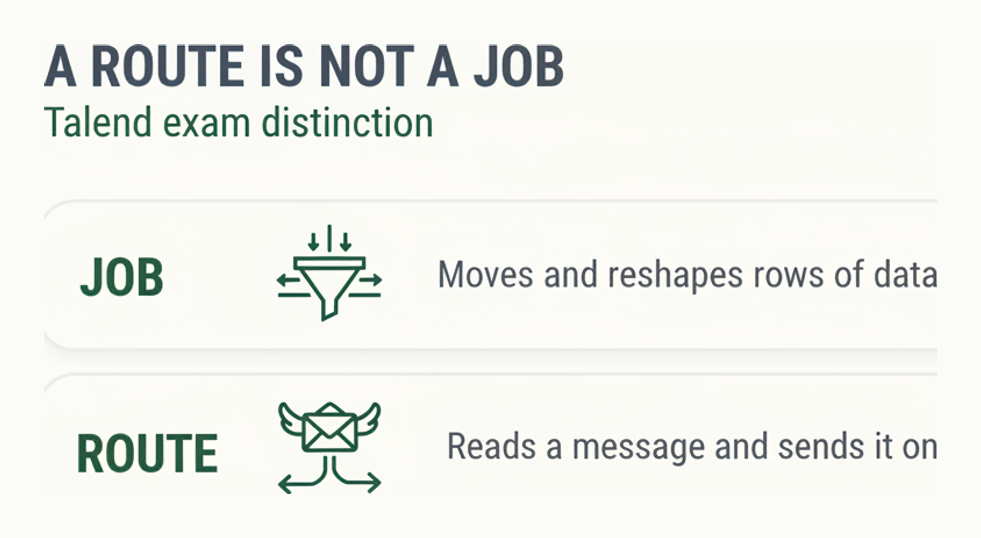
A Route is a message-mediation flow, not a data-processing flow. Where a Job moves and transforms rows, a Route receives a message, inspects it, decides where it goes and hands it on. The objectives make the distinction explicit, asking candidates to separate components from processors and to compare connection types in Routes against those in Jobs.
Underneath, Routes are Apache Camel. The syllabus says so in its own vocabulary, naming CAMEL messages, exchanges and the SIMPLE language, and requiring you to implement services in Routes using Apache CXF components. Once you know that, most of the area stops being Talend trivia and becomes a well-documented integration framework.
“A request message and its corresponding reply or exception message is represented in Camel using the Exchange interface.”
What trips up Job developers
Three things, consistently. Connections in a Route are not the same as the row-flow links in a Job. Message headers and exchange properties are two different stores with different lifetimes. And a processor is not a component, which sounds pedantic until a question depends on it.
The Apache Camel exchange model is the single best free reference for this area, because Talend does not re-document what Camel already explains.
How Much SOAP Does the Exam Still Expect?
More than most candidates expect in 2026. SOAP has its own objective area in TAPISCD, requiring you to define what a WSDL file is, create one in Talend Studio, build a SOAP web service, implement its operations, develop a consumer Job and throw a SOAP fault. It is not a legacy footnote in this syllabus.
The reason is straightforward. Talend’s customer base is enterprise, and enterprises still run SOAP services in finance, insurance, telecoms and government supply chains. An integration developer who cannot read a WSDL is limited in exactly those environments.
- WSDL structure and what each part declares
- Generating a service from a contract in Studio
- Implementing each declared operation
- Consuming an external SOAP service from a Job
- Raising a fault rather than returning a malformed response
Throwing a SOAP fault is the objective candidates most often skip, and it is the one that separates someone who has built a service from someone who has only called one. The W3C SOAP specification defines the fault structure the exam assumes you recognise.
Where Does API Designer Fit Against Talend Studio?
API Designer is where the contract is written; Studio is where it is implemented. The objectives ask you to explain what API Designer is, to distinguish contract first from code first development, to define data types, resources and operations in it, to import and export definitions, and to generate documentation from them.
That contract-first idea is the conceptual centre of the whole exam. If the API definition exists before any implementation, then the definition is the source of truth, and Studio’s job is to satisfy it. Questions in this area often present a change and ask where it should be made.
Import and export matter more than they look
Definitions move between environments and between teams, which is why import and export sit in the objectives alongside the design activities themselves. A definition that cannot be exported cannot be reviewed, versioned or handed over.
Documentation generation is the third piece. Because the contract already describes the resources and operations, the documentation is a by-product rather than a separate writing task, and the exam expects you to know that relationship rather than to write documentation yourself.
How Is API Tester Examined?
Functionally, not conceptually. The objectives require you to generate a test project in API Tester from a Talend Studio REST service, create test scenarios including dynamic expressions, use assertions to validate responses, and understand automatic API mocking. These are activities, and the questions read like activities.
API Tester is also the strongest search term in this whole product area, which suggests it is what developers actually reach for day to day. That is useful, because familiarity earned at work maps almost directly onto marks here.
Mocking is the objective worth rehearsing
Automatic mocking lets a consumer be developed before the provider exists, which is the practical pay-off of contract-first design. Candidates who have only used API Tester to fire manual requests will not have met it, and it is explicitly named in the syllabus.
Dynamic expressions deserve the same attention. A scenario that hard-codes an identifier passes once; one that carries a value forward from a previous response is what the objective is describing.
What Happens When You Deploy an API Service?
You choose between publishing a microservice and publishing an OSGI bundle, and TAPISCD asks you to know the difference. A microservice is self-contained and runs on its own; an OSGI bundle is deployed into a shared runtime container. The objective area is small in wording and consequential in practice.
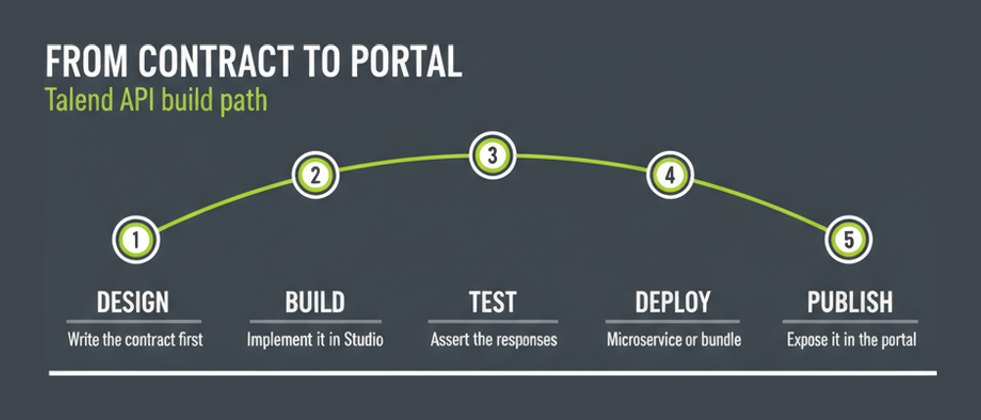
That single decision changes how the service is versioned, how it scales and how it is monitored. A self-contained microservice carries its dependencies with it, which makes deployment simpler and the artefact larger. A bundle shares the runtime, which keeps artefacts small and couples their lifecycles together.
Versioning then follows directly. The syllabus asks you to distinguish minor from major versions, manage several versions at once and interact with version control, and the API Portal exists so that consumers can find whichever version they are entitled to use. The Qlik certification programme lists where this exam sits among the other Talend credentials.
What Does TAPISCD Cost and How Long Is It?
TAPISCD costs $250 and gives you 90 minutes for 55 questions, with a pass mark of 70 percent. That is a little over ninety seconds per question. Passing earns the Talend API Services Developer Certified badge, which Qlik issues through Credly.
| Item | Detail |
|---|---|
| Exam code | TAPISCD |
| Questions | 55 |
| Duration | 90 minutes |
| Passing score | 70 percent |
| Fee | $250 USD |
| Objective areas | 11, with no published weightings |
A 70 percent bar on 55 questions means roughly sixteen wrong answers is the limit. Spread across eleven unweighted areas, that is thin cover: being weak in two whole areas can be enough to fail even if everything else is solid.
Qlik also states that exam content is refreshed periodically and that the number and difficulty of questions can change, so the format figures are worth re-checking on the Qlik exam details page close to your booking date.
How Should a Job Developer Prepare for a Services Exam?
Start where your existing experience does not transfer. Years of building Jobs prepare you for the consumer objectives and for REST data types, and prepare you for almost nothing in Routes. The efficient plan front-loads Routes and API Designer, then treats the familiar areas as revision rather than learning.
- Build one Route end to end in Talend Studio before reading anything else, so the difference between a Route and a Job becomes concrete rather than theoretical.
- Read the Apache Camel material on exchanges, messages and headers, because the syllabus borrows that vocabulary directly and Talend does not redefine it.
- Define a small API contract in API Designer first and implement it in Studio afterwards, which is the contract-first sequence the exam keeps returning to.
- Generate a test project in API Tester from that service and add assertions and a dynamic expression, since both are named objectives rather than optional extras.
- Publish the same service twice, once as a microservice and once as an OSGI bundle, so the deployment comparison comes from experience rather than memory.
- Finish with SOAP, treating WSDL creation and fault handling as the two objectives most likely to be skipped and therefore most likely to cost marks.
Once that groundwork exists, timed practice is what exposes pacing problems. A realistic set of TAPISCD sample questions will show quickly whether any of the eleven areas is still soft.
iSecPrep’s own TAPISCD exam page is a useful checklist alongside a study plan, and the wider Qlik certification hub covers the neighbouring Talend credentials if you are mapping a longer route through the programme.
Frequently Asked Questions
How many questions are on the TAPISCD exam?
Fifty-five questions in 90 minutes. That gives you a little over ninety seconds each, which is comfortable for recall and tight for anything that needs working out.
What is the passing score for TAPISCD?
Seventy percent. On 55 questions that leaves room for roughly sixteen wrong answers across eleven objective areas, so weakness in two whole areas can be fatal.
How much does the exam cost?
Two hundred and fifty US dollars. Passing earns the Talend API Services Developer Certified badge, which Qlik issues through Credly rather than as a paper certificate.
Are the objective areas weighted?
No. Qlik publishes eleven areas with no percentages attached, which removes the usual shortcut of studying the largest domain first and makes even coverage the safer strategy.
Do you need to know Apache Camel?
Effectively yes. Routes are Camel underneath, and the syllabus names CAMEL messages, exchanges, the SIMPLE language and Apache CXF components directly in its objectives.
Is SOAP really still on the exam?
Yes, with its own objective area. WSDL creation, service implementation, consumer Jobs and throwing a SOAP fault are all named, which reflects Talend’s enterprise customer base.
What is the difference between a microservice and an OSGI bundle here?
A microservice is self-contained and runs on its own. An OSGI bundle is deployed into a shared runtime, keeping artefacts small but coupling their lifecycles together.
Does Talend Studio experience transfer to this exam?
Partly. Consumer Jobs and REST data types will feel familiar, while Routes, API Designer and deployment choices are genuinely new ground for most data integration developers.
What does API Tester get used for in the exam?
Generating a test project from a Studio REST service, building scenarios with dynamic expressions, validating responses with assertions, and automatic API mocking.
Which area should you study first?
Routes. It is the least like anything a Job developer has already built, and its vocabulary appears in the overview and debugging areas as well as its own.
Conclusion
TAPISCD is defined by what Qlik does not publish. Eleven objective areas with no weightings means there is no safe area to skip, and 70 percent on 55 questions leaves little slack. The good news is that the hardest area is also the best documented elsewhere: once you know Routes are Apache Camel, a large part of the syllabus has decades of public documentation behind it.
Treat the Talend API services developer certification as a contract-first exam rather than a tool exam. Design an API, implement it, test it, deploy it both ways, and only then start rehearsing against timed practice material.


