That distinction decides whether this exam is a comfortable afternoon or a wasted $245. If you implement Oracle Financial Services applications for a living, most of the syllabus describes your job. If your background is compliance analysis rather than platform work, you are looking at an installation exam wearing a compliance title. This guide groups the ten topics into what they actually are, sets out what the Oracle FCCM certification costs and what score you need, and gives a preparation sequence that works even though Oracle publishes no weightings for it.
What Is the Oracle FCCM Certification?
1Z0-1142 leads to the Oracle Financial Crime and Compliance Management Certified Applications Professional credential. It tests the installation and configuration of Oracle’s financial crime platform across ten topics, covering Behaviour Detection, Enterprise Case Management, Know Your Customer, Sanctions, Enterprise Data Quality, Scenario Manager and Compliance Regulatory Reporting. The paper runs 50 questions in 90 minutes at 68 percent to pass.
Oracle sells financial crime and compliance as a portfolio rather than a single product. Transaction monitoring, customer screening, KYC, case management and regulatory reporting are separate applications sitting on a shared platform, and the Oracle financial crime portfolio is documented that way. The exam mirrors that structure exactly, which is why four of its topics are separate installation exercises rather than one.
What the credential signals to an employer is narrow and useful: this person can stand the platform up and wire it together. It says nothing about whether they can write a suspicious activity report, and it does not pretend to.
Is 1Z0-1142 an AML Exam or an Installation Exam?
It is an installation and configuration exam. Seven of the ten topics are named Installing or Configuring something, and the objectives underneath them describe file-level work: setting up XML files, executing them, running the schema-creator utility, defining EDQ parameters and configuring application servers. Anti-money-laundering concepts appear only as the context those components operate in.
Read a single objective and the point lands. Under Installing Sanctions, the four tasks are explaining the prerequisites, setting up XML and other Sanctions files, executing the Sanctions files, and executing the schema-creator utility. There is nothing there about sanctions policy, list quality or false-positive tuning as a compliance discipline. It is deployment.
This has a blunt consequence for study planning. Reading about typologies will not move your score. Standing up an FCCM environment, breaking it, and standing it up again will.
Where the compliance knowledge does matter
It matters for comprehension rather than for marks. You cannot configure Scenario Manager sensibly without knowing what a scenario is meant to detect, and you cannot define KYC batches without understanding why customer risk is periodically re-scored. Domain knowledge makes the configuration make sense, but the questions are about the configuration. A working grasp of the regulatory idea behind customer due diligence is enough context for the KYC topic.
What Do the Four Installation Topics Cover?
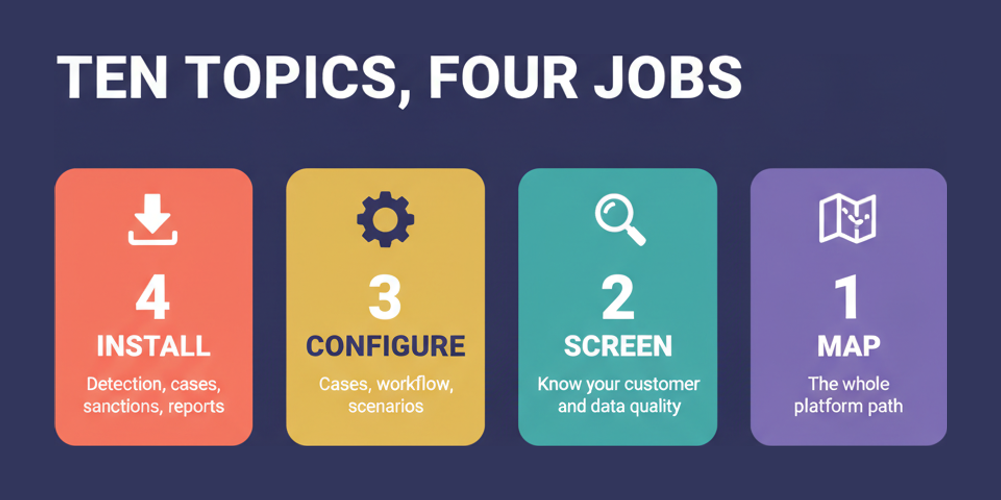
Four of the ten topics are installation work: Behaviour Detection, Enterprise Case Management and Sanctions, which are titled Installing, plus Compliance Regulatory Reporting, which is titled Configuring but runs through the same file-level steps. All four follow an identical four-step shape, which is the single most useful pattern in the whole syllabus. Learn the shape once and three quarters of the installation content becomes recognition rather than memory.
The pattern runs: explain the prerequisites, set up the XML and other component files, execute those files, then configure the application and server. Behaviour Detection, Enterprise Case Management and Compliance Regulatory Reporting all state it in those words. Sanctions varies the last step, replacing server configuration with executing the schema-creator utility.
- Behaviour Detection is the transaction monitoring engine, so its prerequisites are the heaviest of the four
- Enterprise Case Management appears twice in the syllabus, once as an installation and again as a configuration topic, which is a strong signal about where the questions concentrate
- Sanctions is the odd one out because of the schema-creator step, and that difference is exactly the kind of detail a 50-question paper likes
- Compliance Regulatory Reporting closes the loop, turning cases into filings
If you have installed one of these on a real environment, you have effectively rehearsed all four. If you have installed none of them, no amount of reading will substitute, because the questions ask about prerequisites and execution order rather than about concepts.
How Much of the Exam Is Configuration Rather Than Installation?
Three topics are pure configuration: Configuring Enterprise Case Management, the Process Monitoring Framework, and Configuring Scenario Manager. Together with the configuration steps inside the installation topics and the EDQ topic, configuration work accounts for more of the syllabus than installation does. It is also where the exam gets genuinely difficult.
Enterprise Case Management gets a second topic to itself
Configuring ECM has just two objectives, explaining the prerequisites and configuring the application and server, but the fact that Oracle gave it a separate topic rather than folding it into the installation tells you it carries weight. Treat the two ECM topics as one large block when you plan.
The Process Monitoring Framework is the workflow topic
This is the most conceptually distinct topic on the paper. Its three objectives are defining statuses and user actions at the backend, defining human tasks, sequences, statuses and rules within Process Modeller, and connecting human tasks for actions on transaction lines. That is case workflow design, and it is the only place the syllabus asks you to model how people work rather than how data moves.
Scenario Manager is where detection logic is built
Two objectives, both dense: creating data source and rule based scenarios, and configuring threshold linking, creating jobs and executing scenarios. Threshold linking in particular is the mechanism that lets one scenario be tuned differently for different customer segments, and it is the sort of specific named feature that makes good exam material.
What Does the KYC Topic Actually Ask For?
Setting up Know Your Customer is the largest single topic by objective count, with six tasks: explaining the prerequisites, configuring Data Ingestion, managing Security Attribute Configuration, using Excel Upload, configuring the KYC application and server, and defining KYC Batches. None of them is about customer risk methodology. All six are platform tasks.
Two of those objectives are worth flagging because candidates routinely skip them. Security Attribute Configuration governs which users can see which customer records, and it is the control that keeps a KYC deployment compliant with internal information barriers. Excel Upload sounds trivial and is not; it is the supported route for bulk reference data, and knowing when it is appropriate rather than Data Ingestion is a real distinction.
KYC Batches close the topic. Periodic re-screening is batch work, and defining those batches correctly is what makes the difference between a KYC deployment that re-scores customers on schedule and one that quietly stops.
Why Does Sanctions Screening Depend on Enterprise Data Quality?
Because sanctions screening is a name-matching problem, and name matching is a data quality problem. Oracle splits this across two topics: Installing Sanctions, and Configuring Enterprise Data Quality for Sanctions. The EDQ topic has three objectives: setting up EDQ integration for customer screening and transaction filtering, defining the EDQ parameters, and executing EDQ jobs.
The phrase to notice is “customer screening and transaction filtering”. Those are two different screening jobs against the same lists, one running over the customer base and one running over payment traffic, and EDQ is the component doing the matching in both. Understand that split and the topic stops feeling like an unrelated bolt-on.
EDQ parameters are where tuning happens. Matching thresholds decide how much transliteration, abbreviation and spelling variance a screening engine tolerates, and that setting is the difference between missing a hit and drowning an operations team in false positives. Oracle’s FCCM documentation library is organised per application, which makes it the practical reference while you work through this topic.
What Does Understanding the FCCM Architecture Mean in Practice?
Topic ten asks you to explain the architecture prerequisites, ingest data, configure staging and data quality, configure the compliance engine and event generation, and integrate third party systems and case creation. Read in order, those five objectives describe the path a single transaction takes through the platform from arrival to a case landing on an analyst’s desk.
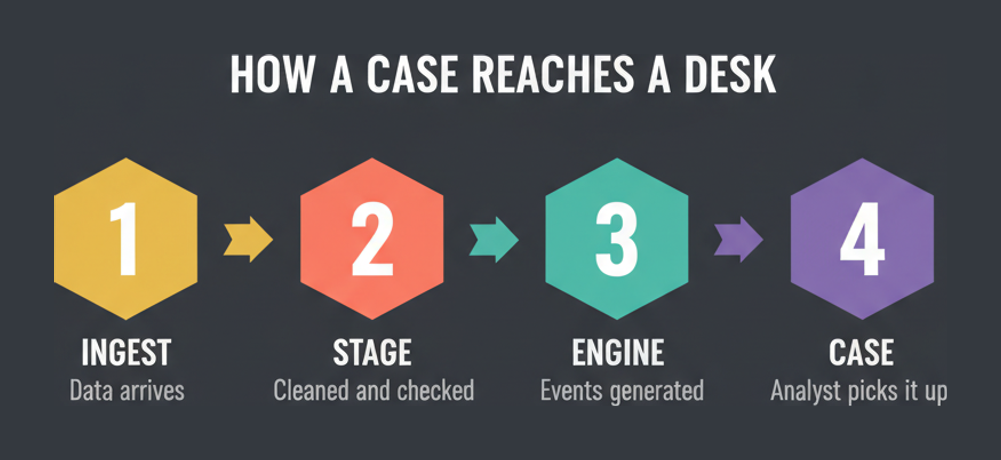
That path is the mental model the rest of the syllabus hangs from. Data arrives and is ingested. It lands in staging and is cleaned. The compliance engine evaluates it and generates events. Events, plus anything arriving from third party systems, become cases. Everything you installed in topics one to nine sits somewhere on that line.
Candidates who learn this topic last usually find the earlier ones harder than they needed to be. Learning it first turns ten disconnected installations into one system with parts. It is the cheapest reordering available in this syllabus.
What Does 1Z0-1142 Cost and What Score Do You Need?
1Z0-1142 costs USD $245 and requires 68 percent to pass, which is 34 correct answers out of 50. The paper runs for 90 minutes, giving you an average of 108 seconds per question. Oracle notes that pricing may vary by country or by localized currency, so check the figure for your region at booking.
| Detail | Value |
|---|---|
| Exam code | 1Z0-1142 |
| Credential | Oracle Financial Crime and Compliance Management Certified Applications Professional |
| Questions | 50 |
| Duration | 90 minutes |
| Passing score | 68% |
| Cost | USD $245 |
| Syllabus topics | 10, no published weightings |
The absence of weightings is the unusual part and it changes how you plan. On most Oracle exams you can rank topics by percentage and allocate study time accordingly. Here you cannot, so the only sensible proxy is objective count: KYC has six, the FCCM architecture and the four installation topics have four or five each, and Configuring ECM, EDQ, Scenario Manager and the Process Monitoring Framework have two or three.
Treat that as a rough guide rather than a blueprint. Ten topics across 50 questions averages five questions per topic, and a topic with two objectives can still produce a question you have never thought about.
Who Should Take This Certification?
1Z0-1142 fits people who deploy and configure Oracle Financial Services applications: implementation consultants, OFSAA platform engineers, and the internal administrators who keep a bank’s AML stack running. It does not fit compliance analysts, investigators or reporting officers, whose work the exam never touches.
The clearest test is a single question. Have you ever opened an FCCM configuration file? If yes, this credential validates something you already do and the preparation is mostly systematisation. If no, you would be learning a large platform from scratch in order to sit an exam about it, which is a poor trade unless the platform is arriving in your organisation anyway.
On career value, the credential sits in a narrow but well-paid corner. Compliance platform work pays above general application administration because the domain is regulated and the talent pool is small, and current benchmarks for compliance role compensation give a reasonable floor to reason from before adding a platform speciality on top.
For a sense of how Oracle structures its other implementation professional credentials, the Narrative Reporting implementation track follows a similar install-and-configure pattern in the reporting space, and the wider Oracle certification archive covers the rest of the family.
How Should You Prepare Without a Weighted Blueprint?
Without weightings, sequence beats allocation. Start with the architecture topic so the other nine have somewhere to attach, then work the installation topics as one pattern rather than four separate exercises, then spend the bulk of your remaining time on configuration, which is both larger and harder than the installs.
- Start with Understanding the FCCM Architecture, tracing a single transaction from ingestion through staging, the compliance engine and event generation to case creation, because every other topic sits somewhere on that path.
- Learn the four-step installation pattern once, using Behaviour Detection as the worked example, then confirm that Enterprise Case Management and Compliance Regulatory Reporting follow the same shape.
- Note the one exception deliberately, since Installing Sanctions replaces server configuration with the schema-creator utility and that difference is exactly the sort of detail a short paper tests.
- Move to Setting up Know Your Customer next, treating its six objectives as the largest single block on the syllabus and paying particular attention to Security Attribute Configuration and KYC Batches.
- Take the configuration topics together, working Configuring Enterprise Case Management, the Process Monitoring Framework and Configuring Scenario Manager in one continuous block so the workflow and detection logic reinforce each other.
- Cover Configuring Enterprise Data Quality for Sanctions immediately after Scenario Manager, because both are about tuning thresholds and the mental model transfers directly.
- Finish by sitting timed papers at 50 questions in 90 minutes, keeping any single question under two minutes so an unfamiliar prerequisite cannot cost you the ones you know.
One warning about resources. Oracle’s own certification pages are frequently unavailable to anything other than a signed-in browser, so build your preparation around the product documentation and a live environment rather than around a catalogue page you may not be able to open. Testing yourself against a realistic 1Z0-1142 sample question set is the fastest way to find out whether your grasp of the install order is real or remembered.
Frequently Asked Questions
How many questions are on the 1Z0-1142 exam?
The exam contains 50 questions and runs for 90 minutes. That works out at roughly 108 seconds per question, which is generous for a recall item and tight for one that asks about installation prerequisites in order.
What score do you need to pass 1Z0-1142?
The passing score is 68 percent, meaning 34 correct answers out of 50. With ten topics and no published weightings, you cannot safely write off any single topic and still reach that mark.
How much does the Oracle FCCM certification cost?
USD $245. Oracle notes that pricing may vary by country or by localized currency, so confirm the figure for your region before booking rather than assuming the dollar price applies.
Is 1Z0-1142 about anti-money-laundering theory?
No. Seven of the ten topics are named Installing or Configuring, and the objectives describe XML file setup, executing component files, running the schema-creator utility and configuring application servers. AML concepts are context, not content.
Which topic has the most objectives?
Setting up Know Your Customer, with six: prerequisites, Data Ingestion, Security Attribute Configuration, Excel Upload, application and server configuration, and defining KYC Batches. Objective count is the closest thing to a weighting this syllabus offers.
Does the exam publish domain weightings?
No. The syllabus lists ten topics with their objectives but assigns no percentages. Plan by sequence and objective count instead, and do not assume any topic is small enough to skip.
What is the Process Monitoring Framework topic about?
Case workflow. It asks you to define statuses and user actions at the backend, define human tasks, sequences, statuses and rules in Process Modeller, and connect human tasks to actions on transaction lines. It is the only topic that models how people work.
Why is Enterprise Data Quality part of a financial crime exam?
Because sanctions screening is name matching, and name matching depends on data quality. EDQ performs the matching for both customer screening and transaction filtering, and its parameters set how much spelling and transliteration variance the platform tolerates.
Who is this certification aimed at?
Implementation consultants, OFSAA platform engineers and internal administrators who deploy and configure Oracle Financial Services applications. Compliance analysts and investigators will find that the syllabus never reaches their work.
Can you pass without hands-on FCCM experience?
It would be difficult. The questions concentrate on prerequisites, execution order and configuration specifics, which are exactly the details that stick from doing the work and slide off when only read about.
Conclusion
Read the title of this credential and you expect a compliance exam. Read the syllabus and you find a deployment exam with ten topics, seven of which name installation or configuration outright. That single correction is worth more than any study schedule, because it tells you whether the $245 buys validation of work you already do or an expensive introduction to a platform you have never touched. Learn the architecture first so the other nine topics have somewhere to sit, treat the four installations as one repeated pattern, and give the configuration topics the time their difficulty deserves. Then test your recall of the install order against realistic questions before you book.


