
Nothing in A00-440 asks you to choose an algorithm. SAS Managing the Model Life Cycle using ModelOps, the exam behind the SAS Certified ModelOps Specialist credential, runs 65 questions in 110 minutes, costs $180 through Pearson VUE, and asks for 65 percent to pass. What it examines is everything that happens to a model after the maths is settled.
You will not be asked to choose between a gradient boosting model and a random forest. You will be asked who signs off before a model reaches production, what happens when its accuracy drifts, and how a Go or No-Go decision gets recorded. Roughly half the paper sits in proposal, governance, and review work. This article walks the five weighted domains, explains why the balance falls where it does, and sets out a study order that follows the marks rather than the syllabus order.
What Does the SAS Certified ModelOps Specialist Prove?
It proves you can run an analytical model as a managed business asset rather than a project. A00-440 examines the full life cycle: defining the operating framework, proposing a model against a business objective, developing and registering it, deploying it into a scoring environment, and monitoring it in production until it is recalibrated, retrained, rebuilt, or retired.
That framing matters because it changes who the exam is for. A data scientist who can build an accurate model but has never negotiated an approval process will find the paper harder than they expect. An analytics manager who has shepherded models through review boards will recognise most of it immediately.
The four verbs the syllabus keeps returning to
Read the objectives closely and the same actions repeat: define, review, deploy, monitor. Almost nothing asks you to compute. Even the development domain frames model building as a tournament between candidates followed by a peer review and a business review, not as a modelling technique.
The credential sits inside the wider SAS Global Certification programme, alongside the Viya programming and administration tracks. It is the one that speaks to governance rather than syntax.
Is ModelOps Just Another Word for MLOps?
They overlap, but they are not interchangeable, and the exam takes the narrower reading. MLOps generally describes the engineering practice of automating machine learning pipelines. ModelOps as A00-440 defines it is broader on governance and narrower on tooling: it covers any analytical model, and it puts stakeholders, approvals, and audit trails at the centre.
The practical difference shows up in the syllabus. A pure engineering syllabus would spend its weight on CI/CD pipelines and container orchestration. A00-440 mentions CI/CD and Git once, inside a domain that is otherwise about collaboration channels, handoffs, and role definition.
If the distinction is new to you, the MLOps reference definition is a useful starting point, but read it as background rather than as exam content. The exam follows the SAS framing throughout.
Why the governance emphasis is not padding
Models that fail in production rarely fail because the algorithm was wrong. They fail because nobody agreed what success looked like, nobody owned the monitoring, or the input data quietly changed shape. Those are exactly the failure modes the five domains are arranged around.
How Are the 65 Questions Weighted Across Five Domains?
A00-440 publishes weightings as ranges rather than fixed percentages. Two domains, Develop Model Proposal and Model Development and Management, are tied at the top on 23 to 28 percent each. Framework and Deployment sit level below them on 18 to 22 percent. Production is the smallest at 9 to 12 percent.
| Domain | Weight | Approximate questions | What it is really about |
|---|---|---|---|
| Define the ModelOps Framework | 18 – 22% | 12 – 14 | Stakeholders, workflow, approvals, peer and business review |
| Develop Model Proposal | 23 – 28% | 15 – 18 | Business objective, target variable, cost and benefit, monitoring metrics |
| Model Development and Management | 23 – 28% | 15 – 18 | Model tournament, champion selection, registration, publishing |
| Model Deployment | 18 – 22% | 12 – 14 | Ingestion pipelines, production jobs, compliance checks, testing |
| Production | 9 – 12% | 6 – 8 | Scoring execution, drift diagnosis, alerts, model update decisions |
Add the two heaviest together and you are looking at somewhere between 46 and 56 percent of the paper. Neither of them is about algorithm selection. That single fact should reshape how you allocate study time, and it is the clearest reason to work through SAS ModelOps sample questions before you decide the exam looks straightforward.
What Does the ModelOps Framework Domain Actually Ask?
It asks how the work is organised before any model exists. The objectives cover determining relevant stakeholders from the desired business outcome, defining the process workflow with its feedback loops and handoffs, establishing an approval process, and building two distinct review gates: a peer review and a business review.
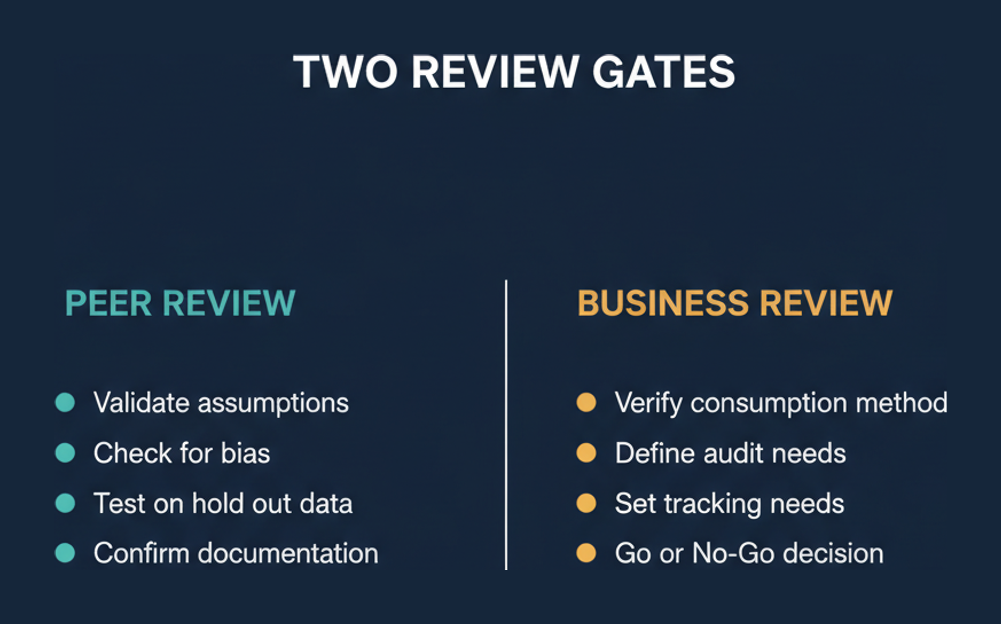
Those two reviews are not the same thing, and the exam expects you to know why. A peer review validates assumptions, checks for potential bias, tests against hold out data, and confirms the process is documented. A business review verifies the consumption method, defines audit and tracking needs, and produces a Go or No-Go decision.
Consumption patterns and scoring environments
The same domain asks you to distinguish batch, on demand, and streaming consumption, and to place a model in the right scoring environment. The syllabus names five: cloud, on premises, containers, in database, and edge. Each has different latency and data-movement consequences, which is exactly the sort of trade-off a scenario question will present.
- Supervised and unsupervised model types, and what each implies for validation
- Standard channels of communication between the roles involved
- Third party integration points identified before build, not after
- Workflow templates that let the process repeat rather than being rebuilt each time
Bias review and compliance adherence appear here as explicit objectives. If you have not worked inside a formal model governance function, reading the NIST AI Risk Management Framework gives you the vocabulary the domain assumes you already have.
Why Does a Model Proposal Carry as Much Weight as Model Development?
Because the proposal is where a model earns the right to exist. This domain, worth 23 to 28 percent, covers defining the business objective, explicitly defining the target variable, assessing business impact, and confirming alignment with corporate strategy before any modelling begins. Get the target variable wrong and everything downstream is wasted effort.
The financial objectives are more specific than candidates expect. A proposal must carry a cost and benefit analysis, a statement of optimal business value, an estimated time to return on investment, an assessment of the level of risk, and its caveats and assumptions written down. It must also be evaluated against alternative uses of the same resources.
Monitoring metrics are set here, not later
One objective catches people out repeatedly: establishing monitoring assessment metrics belongs to the proposal, not to production. Before the model is built, you are expected to have agreed the business outcome metrics, the optimal model accuracy fit statistics, the monitoring frequency and evaluation criteria, and the operational performance metrics.
Read that as the exam’s central argument. If the success criteria are only defined once a model is live, there is no honest way to judge whether it is still working.
What Happens Between a Model Tournament and a Registered Model?
A tournament evaluates and compares multiple candidate models against the fit statistics agreed in the proposal, balancing goodness of fit against interpretability, and checking alignment with corporate ethics and data privacy standards. One candidate is selected as champion. Only then do peer review and business review run, followed by score code export, model registration, and publishing.
Registration is a concrete step with concrete contents, and the syllabus lists them. Metadata covers input and output variables and model properties. Artifacts cover the score code, any pre or post processing code, and the associated external files and documentation.
What registration looks like in the SAS estate
In practice this is the work that SAS Model Manager exists to carry: a versioned repository of registered models with their metadata, artifacts, and performance history. Knowing the product is not required to pass, but it makes the abstract objectives considerably easier to picture.
Setting up the monitoring process
The last block of this domain builds the monitoring apparatus itself. You create data extracts for the input data, define model metrics, business metrics, and system metrics, set thresholds and alerts, develop the monitoring reports, and document the process and its parameters. New or rebuilt development, pre processing, training, post processing, and third party integration all sit at the front of the same domain.
What Does Deployment Cover That Development Does Not?
Deployment is where the model meets production infrastructure. Worth 18 to 22 percent, it covers building the data ingestion pipeline, defining production jobs, running an IT compliance check, and completing pre production testing. Development produces a registered model; deployment produces a running service with data flowing into it and reports flowing out.
The ingestion work is more prosaic than it sounds, and the exam treats it that way. You confirm naming conventions and standards, review adherence to architecture standards, raise a request for any additional data source needed, and build the extract that will feed monitoring.
Production jobs and the decisioning layer
Defining production jobs means creating the consumption applications, on demand or streaming, integrating with the decisioning process, setting up scoring including its pre and post processing, and setting up both performance data creation and performance monitoring reports across model accuracy and business outcome. Alerts are embedded here, with follow up actions defined for each: a model update driven by performance monitoring, a business decision, or an escalation.
Three test types are named explicitly for the pre production stage, and each answers a different question.
- Unit testing, which checks that individual components behave as specified
- Regression testing, which checks that nothing previously working has broken
- Performance testing, which checks that the service holds up under real load
The compliance check that runs alongside them validates regulatory compliance and cross checks the deployment against standards and policy. It is a gate, not a formality.
Why Is Production Worth Only About a Tenth of the Paper?
Because by the time a model reaches production, the decisions that A00-440 cares about have already been made. Production is worth 9 to 12 percent and covers execution and response: run preprocessing, run scoring and decisioning, run post processing, execute the business actions attached to each score, and monitor performance.
The monitoring half is where the domain earns its place. Evaluation means diagnosing data drift, assessing model accuracy, and reading both business outcomes and operational impact. Alerts fire against the thresholds set two domains earlier.
Four ways a model life cycle ends
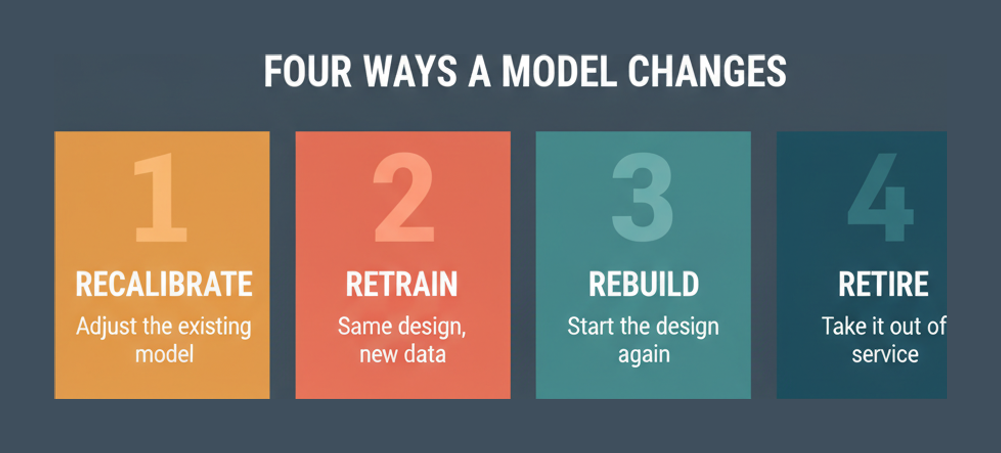
The syllabus closes with a single objective that names four possible model updates, and it is worth memorising as a set: recalibrate, retrain, rebuild, or retire. They are ordered by increasing effort, and choosing between them is a judgement about why performance moved, not simply that it moved.
Candidates who have already worked through iSecPrep’s earlier ModelOps specialist overview will find this domain the most familiar, because it is the part of the life cycle that shows up in day to day analytics work.
What Is the A00-440 Exam Format and Cost?
A00-440 is a 65 question exam with a 110 minute limit, a 65 percent pass mark, and a $180 fee. It is delivered through Pearson VUE. That works out at roughly 100 seconds per question, which is comfortable for recall items and tight for the longer scenario questions the governance domains tend to produce.
| Specification | Detail |
|---|---|
| Exam name | SAS Managing the Model Life Cycle using ModelOps |
| Exam code | A00-440 |
| Credential awarded | SAS Certified ModelOps Specialist |
| Questions | 65 |
| Duration | 110 minutes |
| Passing score | 65% |
| Price | $180 USD |
| Registration | Pearson VUE |
Booking runs through the Pearson VUE SAS programme, which handles both test centre and online proctored delivery for SAS credentials. There is no prerequisite certification, so A00-440 can be attempted directly.
How Should You Sequence Your Preparation?
Follow the weightings, not the syllabus order. The proposal and development domains together decide up to 56 percent of the outcome, so they deserve the first and the largest blocks of study time. Framework and deployment come next. Production, at under 12 percent, is the last thing to work on and the easiest to absorb late.
- Start with Develop Model Proposal, because it defines the vocabulary every later domain reuses, and drill the financial objectives until cost and benefit, return on investment, and level of risk are automatic.
- Move to Model Development and Management next, treating the tournament, champion selection, registration, and publishing sequence as one continuous chain rather than five separate facts.
- Take Define the ModelOps Framework third, and concentrate on the difference between a peer review and a business review, since scenario questions frequently hinge on which gate a given check belongs to.
- Work Model Deployment after that, learning the three pre production test types and the compliance check as a single block, because they are the most testable part of the domain.
- Finish with Production, memorising recalibrate, retrain, rebuild, and retire as an ordered set, then rehearse which drift signal points to which response.
Around this, budget time for the vocabulary itself. The five scoring environments, the three consumption patterns, and the three metric families are all short lists that reward flat memorisation, and they appear across several domains rather than in just one.
Candidates working through the wider SAS ladder will find the rest of the catalogue mapped out on the SAS certification hub, which is useful for deciding what to take before or after this one.
Frequently Asked Questions
How many questions are on the A00-440 exam?
65 questions, with a 110 minute time limit. That gives you a little over 100 seconds per question on average, though the scenario items in the governance domains take noticeably longer than the recall items.
What score do you need to pass A00-440?
65 percent. There is no separate per domain minimum published, so a weak domain can be offset by strength elsewhere, which is another reason to prioritise the two heaviest domains.
How much does the SAS ModelOps exam cost?
$180 USD, booked through Pearson VUE. That is the exam fee alone and does not include any training course or practice material.
Which domain carries the most marks?
Two are tied at the top. Develop Model Proposal and Model Development and Management are each weighted at 23 to 28 percent, so together they can account for up to 56 percent of the paper.
Do you need to know machine learning algorithms for A00-440?
Not in any depth. The exam treats model building as a tournament between candidates judged on agreed fit statistics. It never asks you to select or tune a specific algorithm, which is what makes it unusual among analytics credentials.
Is there a prerequisite for the ModelOps specialist certification?
No. A00-440 can be booked directly with no prior SAS credential required. Practical exposure to model governance or deployment work makes the material far easier, but it is not a formal requirement.
What is the difference between a peer review and a business review?
A peer review validates assumptions, checks for bias, tests against hold out data, and confirms documentation. A business review verifies the consumption method, defines audit and tracking needs, and makes the Go or No-Go decision.
Which scoring environments does the syllabus name?
Five: cloud, on premises, containers, in database, and edge. Expect scenario questions that ask which one suits a given latency, data volume, or data residency constraint.
When are monitoring metrics supposed to be defined?
During the model proposal, before development starts. The syllabus places business outcome metrics, accuracy fit statistics, monitoring frequency, and operational performance metrics inside the proposal domain rather than in production.
What are the four possible outcomes of performance monitoring?
Recalibrate, retrain, rebuild, or retire. They sit at the end of the Production domain and are ordered by increasing effort, so choosing between them depends on diagnosing why performance moved.
Conclusion
A00-440 is a governance exam wearing an analytics badge. Its two heaviest domains are about framing a model against a business objective and steering it through review, and together they can decide more than half the paper. The technical domains matter, but they are not where the marks concentrate.
That makes it an unusually transferable credential. The discipline it examines, agreeing success criteria up front, reviewing for bias, monitoring against thresholds, and knowing when to retire something, applies whichever platform your organisation runs. Work the weightings in order, learn the short lists cold, and test yourself against real question formats before you book.


