Most risk certifications spend their weight on finding risk. The ABA Certified Enterprise Risk Professional does not. On CERP, Risk Identification is worth 15 percent and Risk Responses is worth 18, which makes deciding what to do about a risk the single largest domain on a 200-question paper. Nobody expects that going in.
The rest of the exam is arranged around the same instinct. Two sections, eight weighted domains, and a 62 to 38 split in favour of running the risk process over governing it. Four hours, 200 questions, $815, and a result reported as pass or fail with no score attached. This article walks all eight domains with the question arithmetic worked out, explains the external frameworks the syllabus names but never defines, and sets out how to prepare for a paper long enough that pacing is a real skill.
What Does the CERP Certification Actually Prove?
It proves you can run an enterprise risk function inside a bank rather than describe one. CERP covers governance, policies and limits, management information, the control framework, and then the working cycle of identifying, measuring, responding to and monitoring risk. Every domain is written from the point of view of someone in the second line of defence with a job to do.
That is the framing to hold onto. This is not an academic risk qualification and it is not a technology exam. It assumes a regulated institution, a board that has to be informed, a risk appetite that has been agreed, and a first line that has to be challenged. Read every objective as a task rather than a topic and the syllabus becomes much easier to plan against.
Why the credential exists at all
Because most risk programmes do not actually influence decisions. COSO’s own 2026 research put a number on it: more than half of respondents said their enterprise risk management programme is still viewed primarily as a compliance or assurance function, and only seven percent said it is fully integrated into strategy decisions.
“Organizations today face unprecedented complexity, and ERM must evolve to keep pace.”
CERP is aimed squarely at the gap that number describes. Its heaviest domains are the ones that turn analysis into an agreed action, which is precisely what the seven percent figure says is missing.
How Are the Eight CERP Domains Weighted?
Two sections and eight domains, and the weightings sum cleanly to 100 percent. Risk Governance takes 38 percent across four domains, and Risk Management takes 62 percent across four more. On a 200-question paper each percentage point is two questions, which makes the arithmetic unusually easy to act on.
| Section | Domain | Weight | Approximate questions |
|---|---|---|---|
| Risk Governance | Board and Senior Management Oversight | 8% | 16 |
| Risk Governance | Policies, Procedures and Limits | 12% | 24 |
| Risk Governance | Management Information Systems | 11% | 22 |
| Risk Governance | Control Framework | 7% | 14 |
| Risk Management | Risk Identification | 15% | 30 |
| Risk Management | Risk Measurement and Evaluation | 13% | 26 |
| Risk Management | Risk Responses | 18% | 36 |
| Risk Management | Risk Monitoring | 16% | 32 |
Two numbers matter more than the rest. Risk Responses at 36 questions is the largest single block on the paper, and Control Framework at 14 is the smallest, despite naming more external frameworks than any other domain. Getting the balance right between those two is most of what good preparation looks like here, and the CERP sample questions are the quickest way to see how differently the two are asked.
Why Is Risk Responses the Single Biggest Domain?
Because responding is the part of the risk cycle where judgement is actually exercised, and it is the part most easily got wrong. The domain carries 18 percent, or roughly 36 questions, and asks you to evaluate whether management’s response and its documentation align with the agreed risk appetite, and to develop and recommend responses of your own.
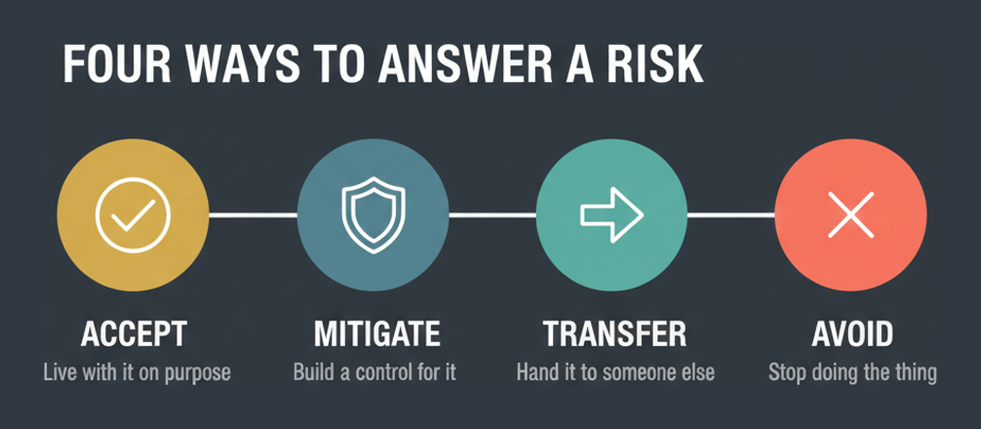
The four response types are named explicitly and you will be asked to choose between them: accept, mitigate, transfer and avoid. Knowing the definitions is the easy half. The examinable half is when each is appropriate, which is a function of the risk’s size against appetite, the cost of the control, and whether the risk is one the institution is in business to take.
The response has to match the appetite, not the fear
The domain’s opening objective is about alignment, and that word is doing real work. A response that is more conservative than the risk appetite is as much a finding as one that is less conservative, because it means capital or capability is being spent on something the board already agreed to tolerate. Scenario questions in this domain frequently hinge on that direction of travel.
Maintenance of the risk and control self-assessment sits here too, which ties the domain back to measurement. An RCSA that is never updated after a response is implemented leaves the residual risk permanently overstated, and the syllabus treats keeping it current as part of responding rather than as a separate exercise.
What Does the Risk Governance Section Expect From You?
Thirty eight percent across four domains: informing the board and senior management, setting policies and limits, running the management information that feeds both, and assessing whether the control framework fits the institution. It is the half of the exam that assumes you are talking upwards rather than working across.
Board and Senior Management Oversight, at eight percent, is about supply and championing. Supply relevant, timely and accurate information to the board and risk committees, and champion policies, risk appetite and risk culture across the organisation. The syllabus names credible challenge and the education of all three lines, so this is not a reporting objective, it is an influence objective.
Policies and limits carry the section
At 12 percent, Policies, Procedures and Limits is the largest governance domain and roughly 24 questions. It covers establishing and maintaining the policy set and the risk appetite framework, running a governance process for policy limits, and managing exceptions and breaches. Expect concrete examples, since the syllabus itself uses a loan-to-value exception and a data privacy breach as its illustrations.
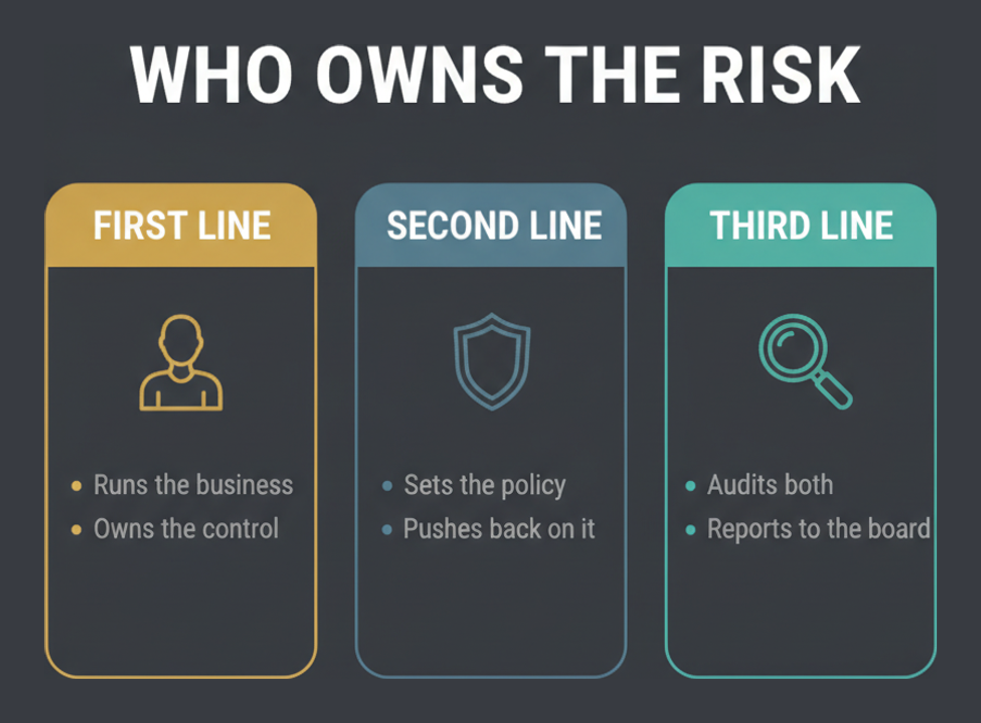
Control Framework is the smallest domain at seven percent and the densest in named external material. It expects the three lines of defence, the internal control system, the COSO Integrated Control Framework, Sarbanes-Oxley, Heightened Standards, and the distinction between preventative and detective and between manual and automated controls. None of that is explained inside the syllabus, so it has to be learned elsewhere: the COSO risk framework and the Institute of Internal Auditors’ three lines model are the two primary sources.
Management Information Systems at 11 percent sits between them and is easy to underestimate at 22 questions. It is the domain about whether the data behind every report is actually good enough to make a decision on.
What Do Risk Identification and Measurement Cover?
Twenty eight percent between them, or roughly 56 questions. Identification, at 15 percent, is about monitoring the internal and external environment for emerging risk and placing what you find into the right risk category. Measurement and Evaluation, at 13 percent, is about turning that into something scored, prioritised and comparable against appetite.
The measurement domain is the most technical part of the syllabus, and it is precise about vocabulary. Risk and control self-assessments are named. So are the four assessment factors: likelihood, impact, direction and velocity. Velocity is the one candidates miss, and it means how fast a risk would materialise rather than how large it would be.
Inherent, control, residual
The chain the domain keeps returning to is inherent risk, then the control environment, then residual risk. If you can explain what changes between the first and the third, and why a strong control environment does not reduce inherent risk, you have understood the domain’s central mechanic. Scoring and prioritisation follow from it, and so does the evaluation of risk against appetite and tolerance.
Identification is broader and shallower. Risk categories such as operational and credit risk, the survey of internal and external environments, and emerging risk. It is the domain where general risk experience transfers most easily, which is why it is worth revising quickly and moving on despite being worth 30 questions.
Risk Monitoring Is Where the Second Line Proves Its Worth
Sixteen percent, roughly 32 questions, and four objectives that together describe an entire reporting practice: define key indicators, design and produce reporting, monitor those indicators for emerging risk, and evaluate the first line’s performance through control monitoring. It is the second heaviest domain on the paper.
The indicator objective is unusually concrete and worth learning as three lists. Key credit measures: debt to income ratio, net credit losses, percentage of nonperforming assets. Key financial measures: net interest income, tier 1 capital ratio, current ratio. Key non-financial measures: operational losses, system downtime, employee turnover, efficiency ratio. The syllabus also asks for the distinction between a performance indicator and a risk indicator, which is exactly the kind of one-word difference a question can turn on.
Reporting is examined as a craft
Report design gets its own objective, and it names the components: timeline, scoping, time horizon, level of aggregation and segmentation, plus the communication techniques of colour coding, heat mapping and dashboards. Escalation and the proper level of distribution come up repeatedly. This is not filler. Getting a risk in front of the right committee at the right time is the thing that makes the rest of the function useful.
The wider expectations behind all of this are set outside the syllabus by supervisors. The Basel Committee’s Basel governance principles are the reference point for what a board is supposed to receive and how the risk function is supposed to be positioned, and reading them makes several governance objectives read as obvious rather than arbitrary.
What Are the CERP Exam Format and Cost?
Two hundred questions in 240 minutes for $815, reported as pass or fail with no numeric score, and booked through an exam application rather than a straightforward online checkout. It is the longest and most expensive credential covered here by a wide margin, and the application step means you cannot decide to sit it tomorrow.
| Field | Value |
|---|---|
| Exam name | ABA Certified Enterprise Risk Professional |
| Exam code | CERP |
| Questions | 200 |
| Duration | 240 minutes |
| Result | Pass or fail, no numeric score |
| Price | $815 USD |
| Scheduling | By exam application |
| Preparation | CERP Exam Online Prep |
Seventy two seconds per question is the working budget, and that is the tightest ratio in any exam of this length. It rules out lingering. The practical consequence is that CERP rewards recognition over reasoning: if a question needs a full derivation you are already behind, so the material has to be familiar enough to answer at reading speed.
Four hours is also a physical problem. Plan the sitting the way you would plan a long drive, including where your two natural attention troughs will fall, because a domain answered badly at the three hour mark costs exactly as much as one answered badly at the start.
Who Takes CERP, and What Is It Worth?
Second-line risk analysts and managers in banks, internal audit professionals moving across into risk, compliance officers broadening beyond regulation, and governance specialists from outside financial services who need the sector’s vocabulary. The syllabus assumes a regulated institution throughout, so it is a poor fit for anyone whose risk work sits outside that world.
On value, be concrete rather than aspirational. Enterprise risk roles in banking sit in a well-established pay band, and current risk manager pay data gives a realistic range to weigh the $815 against. The credential is not going to move a salary on its own, but it is a recognised signal in an industry that takes credentials seriously, and it maps to a job description rather than to a tool.
Where it sits against the rest of the ABA set
ABA runs a family of credentials that split by function rather than by seniority: regulatory compliance, trust and fiduciary advice, anti-money laundering and fraud, financial marketing, and IRA services alongside enterprise risk. CERP is the one that spans the whole institution rather than one product line, which is why it suits people who already work across desks. The ABA certification hub sets the full set out side by side.
How Should You Prepare for a Four Hour Paper?
Work outward from Risk Responses, because it is 36 questions and the one domain where being merely familiar is not enough. Then close the external-framework gap early, since COSO, the three lines and Sarbanes-Oxley are all assumed rather than taught. Leave the domains your day job already covers until last.
- Start with the four risk responses, writing out for each of accept, mitigate, transfer and avoid a real situation from your own institution where it was the right answer and one where it would have been the wrong one.
- Learn the alignment test next, practising on real decisions whether a response was more conservative or less conservative than the stated risk appetite, because the exam treats over-response as a finding too.
- Close the external framework gap by reading the COSO material and the three lines model directly, since the syllabus names both without explaining either and neither takes more than an evening.
- Memorise the three indicator lists as lists, credit measures, financial measures and non-financial measures, and be able to say for any given metric which of the three it belongs to and whether it is a performance or a risk indicator.
- Trace the inherent risk to control environment to residual risk chain on a real risk register entry, then explain aloud why a strong control does not change the inherent figure.
- Finish with two timed half-length runs at 72 seconds a question, deliberately placed at the time of day you will actually sit the exam, so that the four hour stamina problem is rehearsed rather than discovered.
If you want a sense of the question style before committing to that plan, the CERP practice tests collected for this exam are a reasonable first calibration.
Frequently Asked Questions
How many questions are on the CERP exam?
Two hundred questions in 240 minutes. That is 72 seconds per question on average, the tightest ratio of any exam of this length, so the material has to be familiar enough to answer at reading speed.
What is the passing score for CERP?
The result is reported as pass or fail with no numeric score. You will not receive a percentage, so there is no published margin to plan around and no way to identify a weak domain after the fact.
How much does the CERP certification cost?
$815 USD. It is booked through an exam application rather than a direct online checkout, so allow lead time between deciding to sit it and actually sitting it.
Which CERP domain carries the most marks?
Risk Responses, at 18 percent or roughly 36 questions. Risk Monitoring is second at 16 percent, and Risk Identification third at 15 percent, so the Risk Management section as a whole outweighs Risk Governance by 62 to 38.
What are the four risk responses the exam names?
Accept, mitigate, transfer and avoid. The exam expects you to choose between them in scenarios rather than simply define them, and to judge whether the chosen response aligns with the institution’s stated risk appetite.
Does CERP require knowledge of COSO and the three lines of defence?
Yes. Both are named directly in the Control Framework domain, along with Sarbanes-Oxley and Heightened Standards, and none of them is explained inside the syllabus. They have to be learned from their own sources.
What is risk velocity?
One of the four risk assessment factors, alongside likelihood, impact and direction. It describes how quickly a risk would materialise rather than how large it would be, and it is the factor candidates most often overlook.
Is CERP only useful in banking?
Largely, yes. The syllabus assumes a regulated financial institution throughout, names bank-specific metrics such as the tier 1 capital ratio and nonperforming assets, and frames governance around banking supervision. The principles travel, but the exam does not.
How long should you allow to prepare?
For someone already working in a second-line risk function, a focused month is realistic. For someone moving in from audit or compliance, allow longer, mostly to close the external framework gap that the syllabus assumes rather than teaches.
What is the difference between a key risk indicator and a key performance indicator?
A performance indicator measures how something is doing now, while a risk indicator gives early warning of exposure changing. The syllabus asks for the distinction explicitly inside the Risk Monitoring domain, so expect a question that hinges on it.
Conclusion
CERP is a working risk manager’s exam rather than a theory paper. Eight weighted domains, a 62 to 38 tilt toward doing the work over governing it, and a largest domain that is about deciding what to do rather than about spotting the problem. Two hundred questions, four hours, $815, and a pass or fail verdict with no score attached.
Prepare in that order. Master the four responses and the alignment test first, close the COSO and three lines gap next, memorise the indicator lists, then rehearse the timing until 72 seconds a question feels ordinary. The domains your day job already covers can wait until the final week. Then submit the application, because on this exam the lead time is part of the plan.


