GCX-ARC is the Genesys Cloud CX Architect Certification, and it is the credential that separates people who can operate a contact centre from people who can design one. Sixty questions, 120 minutes, $580, and a 65 percent pass mark, booked through Kryterion Webassessor. On paper it looks like a flow-building exam.
Read the syllabus properly and that reading falls apart. The exam publishes four sections. Only the first is about building flows. The other three ask you to connect Genesys Cloud to Salesforce, AWS and external databases, to reason about who is allowed to touch a flow, and to diagnose a call that routed somewhere nobody expected. This article walks all four sections, explains where the weight really sits when no percentages are published, and sets out a study order that follows the difficulty rather than the syllabus order.
What Does the Genesys Cloud Architect Certification Actually Certify?
GCX-ARC certifies that you can design a customer interaction end to end inside Genesys Cloud CX, not just configure one screen of it. The syllabus covers flow and IVR design, integration with external systems through data actions and APIs, access control over what you have built, and the diagnosis of routing and transfer faults once it is live.
That scope is what makes the credential a design qualification rather than an administration one. An administrator keeps queues, users and skills healthy. An Architect decides what happens in the three seconds after a caller stops speaking: which prompt plays, which system gets queried, which queue receives the interaction, and what the fallback is when the query times out.
The single tool the whole exam orbits
Architect is the flow design environment inside Genesys Cloud, and it handles far more than voice. Genesys documentation describes it as covering calls, emails, chats, messages and surveys, in both inbound and outbound directions, with distinct flow types for in-queue treatment, secure payment handling, voicemail, and reusable common modules. The full set of Architect flow types is worth reading before you sit the exam, because the syllabus names only three of them and the questions do not restrict themselves that politely.
Two platform behaviours underpin almost every scenario question. Flows are versioned, so a change is not live until it is published, and a published flow can be rolled back. Flows are also dependency tracked, so changing a prompt, a queue or a common module tells you what else it will affect. If you have never used either feature in anger, they are the two most valuable hours of hands-on practice you can book.
How Do the Four GCX-ARC Sections Divide the Work?
GCX-ARC is published as four sections with no percentage weightings attached, which is unusual and worth stating plainly rather than guessing around. What the syllabus does publish is the objective list, and the objectives are distributed very unevenly: five sit under flow design, three under integrations, one under security, and two under troubleshooting.
| Section | Objectives published | What it is really testing |
|---|---|---|
| Architect Flows and IVR Development | 5 | Designing inbound, outbound and secure flows, prompts, transfers, speech recognition, text to speech, versioning and deployment |
| Data Actions and Integrations | 3 | Genesys Cloud APIs, web services and data actions, and integration with Salesforce, AWS and external databases |
| Security Considerations | 1 | Access control and permissions over what you have built |
| Troubleshooting and Best Practices | 2 | Analysing call routing and transfer faults, and applying Architect optimisation practice |
Do not read the objective count as a mark count. Objectives are not equal in size, and the three integration objectives are each broader than any single flow objective: “integrate with Salesforce, Amazon Web Services, and external databases” is three distinct skill areas compressed into one line. Treating the sections as roughly balanced is a safer working assumption than treating flow design as five ninths of the paper.
Because no weightings exist to steer you, question rehearsal does more work here than it usually would. Timed scenario practice such as the GCX-ARC practice exam is the fastest way to discover which of the four sections is actually costing you marks, since the syllabus itself will not tell you.
What Sits Inside Architect Flows and IVR Development?
This section carries five objectives: navigating the Architect interface, designing inbound, outbound and secure call flows, implementing prompts and transfers, configuring speech recognition and text to speech, and understanding flow versioning and deployment. It is the largest section by objective count and the one most candidates already have some exposure to, because almost every contact centre runs some form of interactive voice response at its front door.
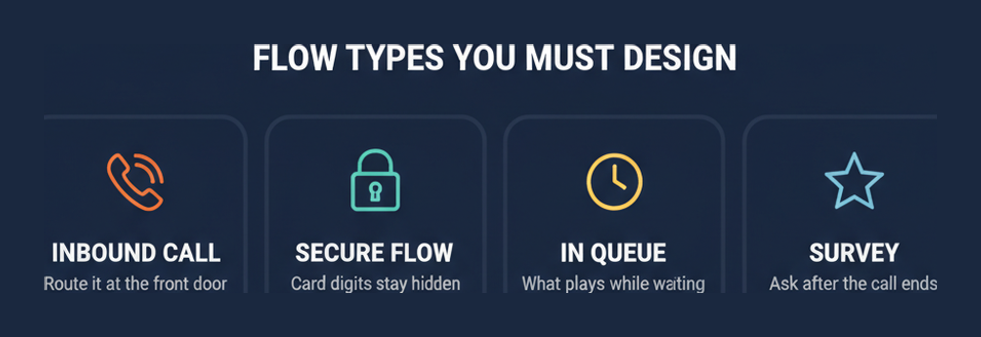
The word “secure” in that objective list is the one to slow down on. A secure call flow is a separate flow type built for handling payment card data, where the caller enters digits that must not reach an agent or a recording. Designing one is not the same exercise as designing a normal inbound flow, and confusing the two is an easy mark to lose.
Prompts, speech recognition and text to speech
Prompts are where flow design meets language. Genesys Cloud supports both recorded audio prompts and synthesised text to speech, and Architect lets you mix them inside one flow. The exam expects you to know when synthesis is appropriate, which is a design judgement rather than a configuration step: dynamic values such as an account balance or a callback time have to be synthesised, while brand-critical greetings usually should not be.
Transfers are a routing decision, not a button
Transfers appear in this section and again in troubleshooting, which tells you something. A transfer moves an interaction between flows, queues, users, external numbers or voicemail, and each destination behaves differently when it fails. Genesys Cloud voice runs on the SIP session protocol underneath, and the vocabulary of consult, blind and secure transfers maps onto that layer. You are not examined on the protocol itself, but knowing what is happening beneath the canvas makes the failure scenarios far easier to reason about.
The versioning objective closes the section. A flow you have edited is not a flow you have deployed. Know the difference between saving, publishing and activating a version, and know how to get back to the previous one at two in the morning.
Why Does Data Actions and Integrations Catch People Out?
Because three lines of syllabus hide three separate technology stacks. This section asks you to work with Genesys Cloud APIs, configure web services and data actions, and integrate with Salesforce, Amazon Web Services and external databases. Nothing in the flow-design section prepares you for it, and it is the part of GCX-ARC most likely to be unfamiliar territory.
A data action is the mechanism by which a flow asks a question of something outside Genesys Cloud and uses the answer to route. The caller’s number goes out, a customer tier comes back, and the flow branches on it. That means the exam can legitimately ask about request and response contracts, about what a flow should do when the external system is slow or returns nothing, and about which credentials the integration runs under.
“Organizations are struggling to deliver seamless experiences as customer requests bounce between siloed systems like CRM, service platforms and back-office tools.”
That is the problem this section exists to solve, and it is why Genesys has been pushing hard on connected CX workflows across CRM and back-office systems. An Architect who cannot pull a record from Salesforce is designing a contact centre that asks every caller who they are.
Three named targets, three different problems
Salesforce integration is largely about identity and context: matching an inbound interaction to a record and surfacing it. AWS integration is more often about invoking a function or reading from a managed service, which brings authentication and region into scope. An external database is the rawest of the three, and the one where query cost and timeout behaviour matter most to the flow design.
The practical exam advice is unglamorous. Build one data action of each kind in a development organisation, deliberately break each one, and watch what the flow does when the response never arrives.
Security Considerations: One Objective, Wide Consequences
Security is the smallest section in GCX-ARC, carrying a single published objective: review access control and permissions. Its size is misleading. Permissions in Genesys Cloud decide who may open a flow, who may publish one, and which data actions a flow is entitled to invoke, so the objective reaches into both of the sections before it.
Think of it as three questions the exam can ask in scenario form. Who is allowed to edit this flow. Who is allowed to make an edited flow live. What is the integration itself permitted to do once it authenticates. The first two are role and division questions. The third is a credential question, and it is the one people forget, because a data action that works for an administrator can fail for everyone else.
Secure call flows tie the section back to flow design. If you can explain why a secure flow exists in terms of who is permitted to see what, you have understood this section properly.
What Does Troubleshooting Expect You to Diagnose?
Two objectives: analyse call routing and transfer issues, and follow Architect best practices and optimisation tips. In practice this is the section that turns the other three into scenario questions. You are given a symptom, usually a call that ended up in the wrong place, and asked which layer is at fault.
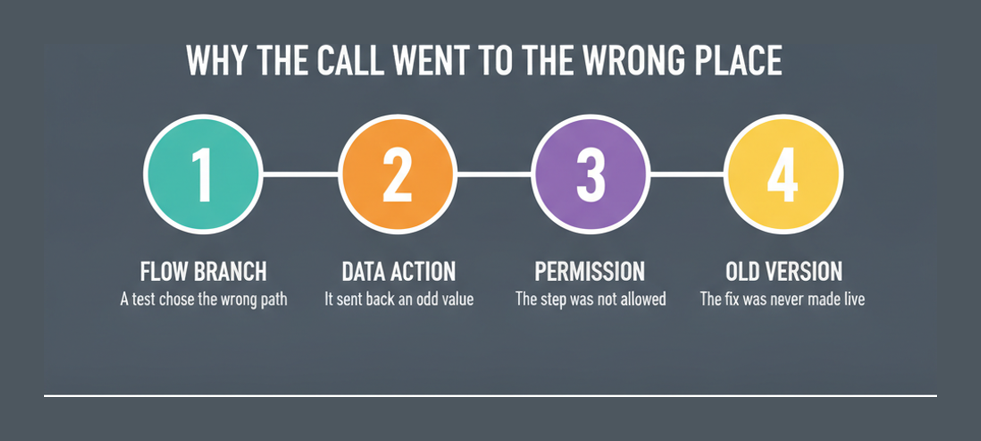
The useful discipline is to work outward from the flow rather than inward from the queue. A call that reached the wrong agent might have been misrouted by a flow branch, sent to the wrong queue by a data action returning an unexpected value, blocked by a permissions failure, or handled correctly by a flow version that was never published. Those are four different fixes and only one of them is in the canvas.
Best practice is a testable topic here
Optimisation in Architect has concrete, examinable content: reusing logic through common modules instead of copying it, keeping expressions simple enough to validate at design time, and using dependency tracking before changing anything shared. The Genesys platform architecture is a distributed cloud service with public APIs at its centre, which is precisely why so many faults turn out to be integration faults rather than flow faults.
What Is the GCX-ARC Exam Format and Cost?
GCX-ARC runs 60 questions in 120 minutes, costs $580 USD, and requires 65 percent to pass. It is scheduled through Kryterion Webassessor, and the recommended preparation course named on the syllabus is Genesys Cloud: Architect. That works out at two minutes per question, which is comfortable for recall items and tight for long scenario items.
| Field | Value |
|---|---|
| Exam code | GCX-ARC |
| Full name | Genesys Cloud CX Architect Certification |
| Questions | 60 |
| Duration | 120 minutes |
| Passing score | 65 percent |
| Price | $580 USD |
| Scheduling | Kryterion Webassessor |
| Recommended training | Genesys Cloud: Architect |
Sixty five percent means 39 correct answers out of 60, so you can lose 21 questions and still pass. You can afford to be weak in one section and still clear the bar, provided you are not weak in two. There is no published bundled retake, so a failed attempt is a second full $580 fee, which alone justifies rehearsing under a clock before booking.
Architect and the Rest of the Genesys Cloud CX Ladder
Genesys publishes eight Genesys Cloud CX credentials, and Architect is one of the specialised ones rather than the broad entry point. Professional, Developer, Architect, Scripting, Quality Management, Workforce Management, Outbound and the AI credential each take a different slice of the platform, so the sensible question is not which is hardest but which matches the work you do.
Most people arrive at Architect from the Professional exam, which covers the platform broadly and is the natural first credential for an administrator. If you have not taken it, the Genesys Cloud CX Professional exam is the better starting point, because Architect assumes you already know how queues, skills and divisions behave.
The distinction against Developer is the one worth getting right. Developer is about writing against the platform’s APIs. Architect is about designing the flow that calls them. There is overlap in the data actions section, which is exactly why that section feels harder to administrators and easier to developers.
Who this credential is genuinely for
Contact centre solution designers, senior Genesys Cloud administrators moving into design work, and consultants at partners who deliver Genesys implementations. If your job is to sit with a client, understand what should happen when a customer calls, and then build it, this is the credential that describes what you do.
How Should You Sequence Your Preparation?
Follow the difficulty, not the syllabus order. The syllabus opens with flow design because it is the largest section, but for most candidates it is also the most familiar, which makes it the wrong place to spend the first two weeks. Start where the gap is widest and finish where you are already strong.
- Start with data actions and integrations, because it is the section least likely to overlap with your day job, and build one working data action against a web service before reading anything else about it.
- Extend that work to the three named targets, connecting to Salesforce for record context, to an AWS service for a server side operation, and to an external database for a direct query, so that each authentication model becomes familiar.
- Move to secure call flows next, treating them as a separate discipline from ordinary inbound design and paying attention to which participants are prevented from seeing the collected digits.
- Work through prompts, speech recognition and text to speech together, building one menu that collects speech rather than digits so the confirmation and reprompt decisions become concrete.
- Cover access control and permissions after the integrations are working, since the permission questions only make sense once you have something built that a permission can block.
- Rehearse routing and transfer faults last, deliberately breaking each flow you have built and tracing the failure back to the flow, the data action, the permission or the unpublished version.
Two weeks of that sequence beats a month of reading, mainly because four of the six steps are impossible to fake. You either built the data action or you did not.
Frequently Asked Questions
How many questions are on the GCX-ARC exam?
Sixty questions in 120 minutes. That gives you two minutes per question on average, which is generous for definition-style items and tight for the longer routing scenarios, so pace yourself against the clock during practice.
What score do you need to pass the Genesys Cloud CX Architect certification?
Sixty five percent, which is 39 correct answers out of 60. You can lose 21 questions and still pass, so a single weak section is survivable provided the other three are solid.
How much does GCX-ARC cost?
$580 USD. There is no published bundled retake, so a failed attempt means paying the full fee again. That is the strongest practical argument for rehearsing under timed conditions before you book a seat.
Where do you book the Genesys Cloud CX Architect exam?
Through Kryterion Webassessor, which is the scheduling platform named on the exam specification. The recommended preparation course listed alongside it is Genesys Cloud: Architect.
Are the GCX-ARC domains weighted?
No percentage weightings are published for this exam. The specification lists four sections and their objectives only, so the safest assumption is that the sections are broadly comparable in value rather than proportional to their objective counts.
Do you need the Genesys Cloud CX Professional certification first?
It is not stated as a formal prerequisite, but it is the natural precursor. Architect assumes working knowledge of queues, skills, divisions and routing behaviour, all of which the Professional exam covers directly.
What is the difference between the Architect and Developer certifications?
Developer is about writing code against the Genesys Cloud APIs. Architect is about designing the flow that calls those APIs through data actions. The two overlap in the integrations section and diverge everywhere else.
How much of GCX-ARC is about integrations rather than flows?
Three of the fourteen published objectives sit in the integrations section, but they are unusually broad ones. Salesforce, AWS and external databases are three separate skill areas compressed into a single line, so the section is larger in practice than the objective count suggests.
What is a secure call flow and why does it matter for the exam?
It is a dedicated flow type for handling payment data, designed so that the digits a caller enters never reach an agent or a recording. It appears in the flow design objectives and connects directly to the access control objective.
Is hands-on Architect experience necessary to pass?
It is not formally required, but the troubleshooting section is built from symptoms you can only recognise if you have caused them. Building and deliberately breaking a few flows in a development organisation is the highest-value preparation available.
Conclusion
GCX-ARC is a design credential wearing a flow-builder’s clothes. Four sections, fourteen objectives, no published weightings, and a genuine centre of gravity in the integration work rather than in the canvas everybody expects. Sixty questions, 120 minutes, $580, 65 percent to pass, booked through Kryterion Webassessor.
Treat it accordingly. Build data actions before you polish menus, learn secure call flows as their own discipline, understand permissions as the thing that decides whether any of it runs, and rehearse failures until you can name the layer at fault from the symptom alone. If you are still mapping out which Genesys credential fits your role, the Genesys certification hub lays the options out side by side. Then book the seat, and give the integration section the fortnight it deserves.


