If you last looked at the Pega System Architect exam before the Pega Platform ’25 release, a tenth of the paper is now about something that was not on it. Pega GenAI is a weighted area in its own right on PEGACPSA25V1, sitting alongside Case Management and Security, and it asks about Blueprint, Knowledge Buddy, Autopilot and Coach by name.
That is the decision facing anyone with an old study plan: revise the blueprint you remember, or the one Pega actually publishes now. The Certified Pega System Architect exam runs 60 questions in 90 minutes, costs $190 USD, and needs 65 percent to pass. Eight areas carry published weightings, and this guide works through all of them, what each genuinely tests, and where the ’25 version moved the ground. Pega is not the only automation vendor rewriting its blueprint around AI, and UiPath has done the same with its agentic automation professional credential.
Where Do the Marks Sit Across the Eight Areas?
Case Management dominates at 25 percent. Data and Integration follows at 20, then Application Development at 15. Security, User Experience and Pega GenAI each carry 10 percent, and DevOps and Insights close the list at 5 percent apiece. Eight areas, all weighted, which makes this one of the more transparent blueprints in enterprise software certification.
| Area | Weight | Approximate questions |
|---|---|---|
| Case Management | 25% | 15 |
| Data and Integration | 20% | 12 |
| Application Development | 15% | 9 |
| Security | 10% | 6 |
| User Experience | 10% | 6 |
| Pega GenAI | 10% | 6 |
| DevOps | 5% | 3 |
| Insights | 5% | 3 |
Add the top three and you have 60 percent of the paper before touching anything else. Since the pass mark is 65 percent, those three areas plus one of the 10 percent blocks is the shortest arithmetic route to a pass. That is a study plan, not a gamble.
What Is the Pega System Architect Exam Format?
Sixty multiple choice questions in 90 minutes, a 65 percent passing score, $190 USD, delivered through Pearson VUE. That is 90 seconds per question. Thirty-nine correct answers pass, which means you can drop 21. The exam version is PEGACPSA25V1 and it applies to Pega Platform ’25.
| Specification | Value |
|---|---|
| Credential | Certified Pega System Architect |
| Exam version | PEGACPSA25V1 |
| Applies to | Pega Platform ’25 |
| Questions | 60 |
| Duration | 90 minutes |
| Passing score | 65% |
| Fee | USD $190 |
| Languages | English, Japanese, Spanish, French, German, Portuguese-Brazilian |
Six languages is unusually generous for a foundation-level developer credential, and it reflects where Pega implementation work actually happens. Pega also publishes no retirement date for this exam, so it is current with no announced end. The official exam page carries the same figures.
Ninety seconds a question sounds comfortable until you meet a Case Management scenario with four plausible routing answers. Working through the CSA sample questions early is the quickest way to calibrate how long the harder question types actually take you.
Why Is Case Management a Quarter of the Paper?
Because case management is what Pega is. The area carries fourteen separate objectives, more than any other, running from designing a case lifecycle and setting statuses through service level agreements, routing, approvals, duplicate detection, wait steps, child cases and decision tables. A quarter of the marks sit here, roughly fifteen questions.
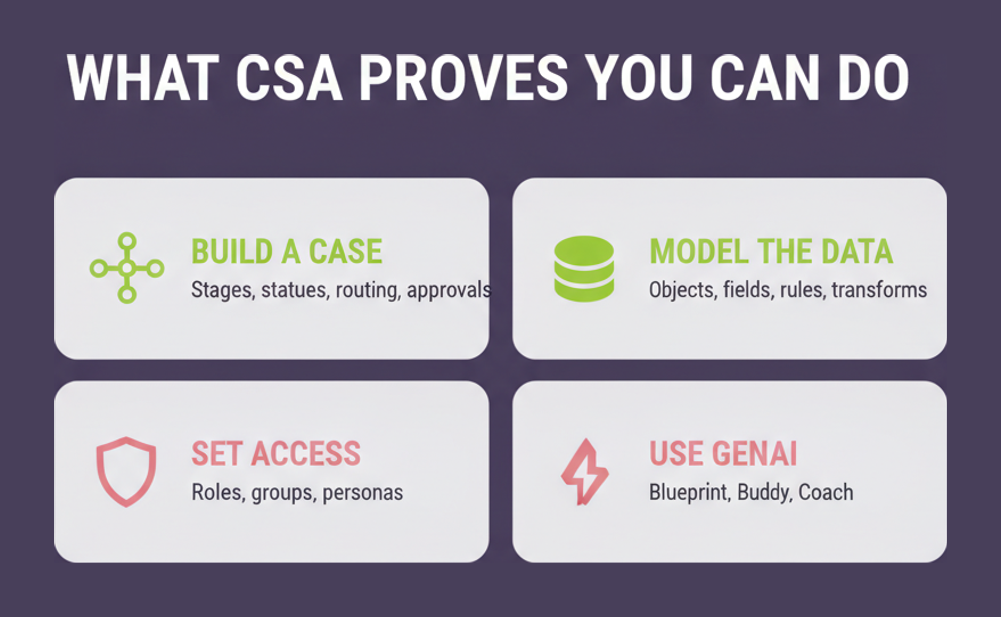
The objectives are notably verb-heavy. You design a lifecycle, add an SLA, route assignments, configure cascading approvals, identify duplicates, pause and resume processing, skip a stage, and automate decisions. Reading about these produces recognition. Building them produces the recall the exam actually rewards.
The objectives most often underestimated
- Routing to users, work groups, work queues and by business logic, because four routing targets means four ways a question can be framed
- Cascading approvals and the authority matrix, which behave differently from a simple approval step
- Decision tables against decision trees, where knowing which suits which shape of logic is the whole question
- Wait steps and pausing a case, which look interchangeable and are not
What Does the Data and Integration Area Expect?
Twenty percent, eight objectives, and a clear centre of gravity around the data model. You describe it, configure data types and objects and relationships and field types, create calculated values, build validation rules using business logic, manipulate application data through data transforms, source data into a case, and save it to a system of record.
The phrase worth noticing is “system of record”. Pega applications rarely own their data outright; they orchestrate work over data that lives elsewhere. Questions in this area often turn on where the authoritative copy sits and what the refresh strategy should be, rather than on syntax.
Sourcing and refresh
One objective names accessing sourced data in a case, refresh strategies, and populating user interface controls, all in a single line. That compression is a hint. It means the exam expects you to see data sourcing as one continuous concern from the external system through to the field a user looks at, not three separate topics.
Why Is a Tenth of a Foundation Exam About GenAI?
Because Pega has built generative AI into the platform’s design and runtime rather than bolting it on as an add-on, so a system architect now meets it in normal work. The Pega GenAI area carries 10 percent and names six capabilities directly: Knowledge Buddy, Blueprint, Autopilot, Connect Rules, Coach, and GenAI Agents with Tool Rules.
Blueprint is the one to understand first, because the objective asks you to create, import and modify one, which is a doing verb rather than a describing verb. Blueprint generates an application design from a described business problem, and the architect’s job is to judge and shape what it produces.
“Pega GenAI Blueprint enhances Pega’s design capabilities to serve as the scaffolding of a Pega-powered application. Naturally, the generative AI accelerates the design process, but more importantly, it reveals what Pega would have us do with a more complete appreciation of Pega’s capability. This opens the aperture of what is possible with Pega, what elements we may have forgotten, what efficiencies have alluded our design, what is the true scope of what we can build.”
The six capabilities, and what each objective asks
- Knowledge Buddy, for client-specific contextual knowledge and support
- Blueprint, for transforming application design, including creating, importing and modifying one
- Autopilot, analysed for its role in developing applications faster
- Connect Rules, for integrating generative AI features into an application
- Coach, for guiding users through complex processes with custom AI-powered capability
- GenAI Agents and Tool Rules, described in terms of the benefit to application users
“The incredible response to Pega GenAI Blueprint has exceeded even our own high expectations. It only takes a few minutes of blueprinting for people to realize the transformational power it brings to the app design process.”
Six capabilities across six questions means roughly one each, so breadth beats depth here. Know what each one is for and where it fits, and do not sink a week into any single feature. Pega’s platform overview is the quickest way to see how the six relate.
Do the Five Percent Areas Deserve Any Study Time?
Yes, but only a little, and the arithmetic says how much. DevOps and Insights carry 5 percent each, about three questions apiece. Between them that is six marks, and with 21 permitted errors you could drop both entirely and still pass. What makes them worth an evening is how small their objective lists are.
DevOps has two objectives: explain Pega’s continuous development, integration, delivery and deployment process, and describe the test types needed for a successful deployment. Insights has three, covering the benefits of Insights, using the Explore Data landing page, and how Insights relates to dashboards and portal landing pages. That is five objectives for six marks, which is the best return per hour on the entire paper.
The two 10 percent areas need more care
Security and User Experience each carry six questions. Security is conceptual: authentication against authorisation, the Security Checklist, the relationship between operators, access groups, access roles and personas, and role-based access control. User Experience is configuration-led, covering views and templates, default against hierarchical forms, field settings and groups, when rules, channels, and portal and landing page templates.
Where Does CSA Sit in the Pega Certification Path?
At the bottom, deliberately. Pega describes it as the first level in the System Architect certification path, giving a baseline measurement of your knowledge of Pega applications. Above it sit the Senior System Architect and then the Lead System Architect credentials, each assuming everything below is already fluent.
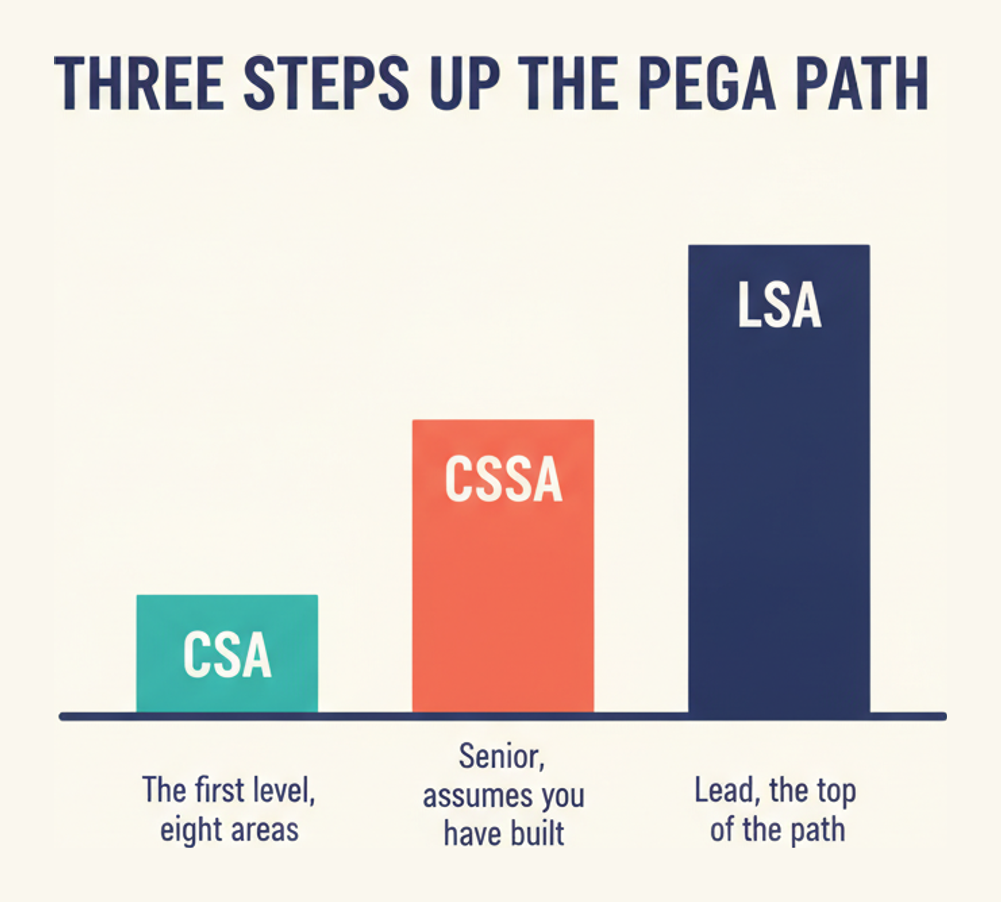
That positioning explains the blueprint’s shape. A foundation exam covers a wide surface at moderate depth, which is exactly what eight areas with no single one above 25 percent produces. The specialist tracks, decisioning and business architecture among them, branch off rather than build on it.
When to move up
Not immediately. The senior exam assumes you have built things, and CSA can be passed on structured study plus a modest amount of hands-on work. Spend time in the platform first. The Lead System Architect pitfalls guide shows how much steeper the top of that path becomes.
How Should You Prepare for a 65 Percent Cut Score?
Follow the weightings rather than your interest. Sixty percent of the paper is Case Management, Data and Integration, and Application Development, so those three take the majority of your time. The pass mark is 65 percent, so you need one more solid block on top of them, and Security or User Experience is the natural choice.
- Build a case lifecycle end to end in a personal edition, with stages, statuses, an SLA and a routed assignment, because Case Management is a quarter of the marks and entirely practical.
- Model the data next: data types, data objects, relationships, calculated values and a validation rule driven by business logic, so the 20 percent area rests on something you have configured rather than read.
- Work through Application Development by creating rules and rulesets, using branches, and deliberately breaking something so you have debugged a real error.
- Take one pass through Security and User Experience together, since both are 10 percent and both reward vocabulary more than practice.
- Spend a single evening on the six Pega GenAI capabilities, aiming to say what each is for in one sentence, because roughly one question covers each.
- Finish with DevOps and Insights, five objectives between them, drilled as flashcards rather than studied.
Pega’s product documentation is the reference for anything the objectives leave ambiguous, and it is the right place to settle a question the syllabus wording leaves open rather than guessing from a training video.
Which Roles Does the CSA Credential Open?
Pega developer, application developer and junior system architect roles inside organisations running Pega, plus consulting positions at the partner firms that implement it. Pega itself frames the credential as aimed at developers and technical staff who want to learn how to develop Pega applications, which is a fair description of who it lands for.
Pay tracks general software development rather than sitting in a separate band, and PayScale’s software developer salary data is a reasonable baseline for that comparison. The credential’s real value at this level is access rather than premium: many Pega roles list it as a requirement, so holding it puts you in the pile.
The consulting route
Partner firms hire CSA holders in volume because client projects contractually require certified staff. That makes the credential unusually portable for a foundation-level qualification, and it is worth knowing that an earlier study guide on this site covers study habits for this exam from the preparation angle rather than the blueprint angle.
Frequently Asked Questions
How many questions are on the Pega System Architect exam?
Sixty, with a 90 minute limit. That is 90 seconds per question, and 39 correct answers are needed to reach the 65 percent pass mark.
What is the passing score for Pega CSA?
Sixty-five percent. You can drop 21 of the 60 questions, which is why the three heaviest areas plus one 10 percent block is a viable study plan.
How much does the Pega CSA exam cost?
USD $190, booked through Pearson VUE. That is the fee published on the money site’s syllabus page; Pega’s own exam page does not list a price.
What is the current exam version?
PEGACPSA25V1, which applies to Pega Platform ’25. If your study material predates that version it will not cover the Pega GenAI area at all.
Which area carries the most marks?
Case Management at 25 percent, roughly 15 questions, with fourteen separate objectives covering lifecycles, service level agreements, routing, approvals and decision automation.
Is Pega GenAI really examinable?
Yes. It is a weighted area worth 10 percent and names six capabilities: Knowledge Buddy, Blueprint, Autopilot, Connect Rules, Coach, and GenAI Agents with Tool Rules.
Which languages is the exam offered in?
Six: English, Japanese, Spanish, French, German and Portuguese-Brazilian. That is broad coverage for a foundation-level developer credential.
Has Pega announced a retirement date for this exam?
No. Pega Academy lists the retirement date as not applicable, so the credential is current with no announced end. Version codes still change with each platform release.
Do you need Pega experience before taking CSA?
No formal prerequisite exists, and it is the first level in the System Architect path. Hands-on time still helps, because Case Management and Data and Integration are configuration-led rather than theoretical.
What comes after CSA?
Senior System Architect, then Lead System Architect. Specialist tracks such as decisioning and business architecture branch off separately rather than building directly on this credential.
Conclusion
The Pega System Architect exam is a broad foundation paper with an unusually honest blueprint. Eight weighted areas, 60 percent of the marks concentrated in three of them, and a 65 percent pass mark that makes the study arithmetic straightforward. The one thing an older plan will miss is the Pega GenAI area, which now carries as much weight as Security.
Build rather than read for Case Management and Data and Integration, treat the two 5 percent areas as flashcards, and give the six GenAI capabilities a single focused evening. Once the weightings are reflected in your revision rather than your instincts, test the result against the money site’s scenario questions before booking the 90 minutes.


