Thirteen. That is how many of the 55 questions on this paper are ordinary multiple choice. The other 42 arrive one option at a time, each one accepted or rejected on its own, with no list to compare and no way back to a choice you have already made.
Almost everything written about the Docker Certified Associate concentrates on that format and stops there. It is genuinely the most unusual thing about the exam, but it is not the only thing worth knowing before booking. Six weighted domains sit underneath it, a quarter of the paper is orchestration, and a surprising amount of the blueprint is not about Docker at all. This walkthrough covers the format, the weighting and what each domain actually expects you to have done.
What Is the Docker Certified Associate?
The Docker Certified Associate is the entry level container platform credential now administered by Mirantis, earned by passing a single 55 question exam in 90 minutes. It covers six weighted domains: orchestration, image creation and registry work, installation and configuration, networking, security, and storage and volumes. Mirantis positions it as the first exam in a multi tiered certification programme. Once containers are running at scale, the governing layer above them matters, and the Kyverno certified associate exam examines exactly that.
It is aimed at practitioners rather than beginners. Mirantis states the exam is designed to validate professionals with a minimum of six to twelve months of Docker experience, and the objectives read that way throughout. There is no domain that explains what a container is. The blueprint starts at the point where you already run them and asks whether you can operate a cluster of them.
The credential is valid for two years and must be updated after that, which is worth factoring into the decision. It is not a permanent badge, and the renewal clock starts the day you pass.
Why Is the DCA Question Format So Unusual?
The DCA is delivered as 13 traditional multiple choice questions and 42 discrete option multiple choice questions, a format usually abbreviated to DOMC. In a DOMC item you are shown one candidate answer at a time and asked whether it is correct. Accept or reject it, and the next one appears. You never see the full option list, and you cannot revisit a decision.
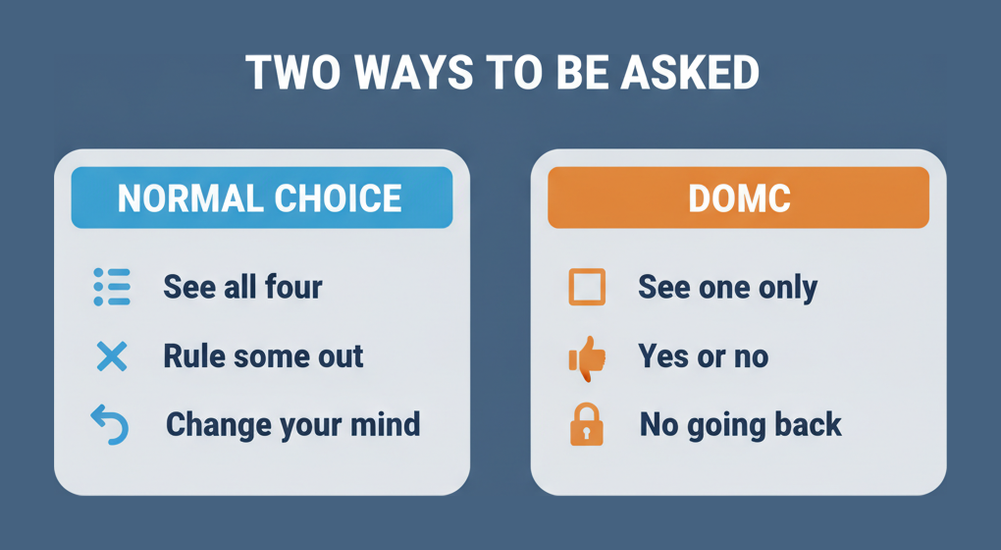
That removes the technique most candidates rely on without noticing. On a conventional item you can often reach the right answer by discarding the obviously wrong ones, so a partial understanding still scores. DOMC takes that away deliberately. Each option is judged on its own merits, so you either recognise a correct statement as correct or you do not.
The practical consequence is that half remembered knowledge scores much worse here than it does elsewhere. Knowing that one of four answers involves an overlay network is enough on a conventional paper. Being shown a single statement about overlay network behaviour and having to rule on it is a different test entirely, and it is the test you will sit 42 times.
It also changes how you should rehearse. Practising against option lists trains the wrong reflex, so working through DCA practice questions is most useful when you force yourself to judge each option in isolation rather than scanning for the best of four.
What Are the Docker Certified Associate Exam Details?
The DCA carries 55 questions in 90 minutes and costs 199 US dollars, or 200 euro when purchased online. It is remotely proctored on your own Windows or Mac computer, results are delivered immediately, and it is available globally in English. Mirantis does not publish a passing score for it.
| Field | Value |
|---|---|
| Exam name | Mirantis Docker Certified Associate (DCA) |
| Number of questions | 55, comprising 13 multiple choice and 42 DOMC |
| Duration | 90 minutes |
| Passing score | Not published by Mirantis |
| Price | 199 US dollars or 200 euro |
| Delivery | Remotely proctored on your own computer, results immediate |
| Language | English |
| Validity | Two years, then an update is required |
The missing passing score is not an oversight and it is worth reading carefully. Mirantis states on its official DCA exam page that passing scores are not published because questions and scores are both subject to change without notice. Approximate figures circulate widely on prep sites, and none of them come from the vendor.
Fifty five questions in ninety minutes is about ninety eight seconds an item, which sounds generous. It is less generous than it looks, because a DOMC item can present several options in sequence and each one needs its own judgement. Budget your time per question, not per option.
Booking runs through the Mirantis webstore as a voucher purchase rather than through a third party test centre network, which is why there is no Pearson VUE step in the process.
How Is the DCA Weighted Across Six Domains?
The DCA splits into Orchestration at 25 percent, Image Creation, Management and Registry at 20 percent, Installation and Configuration at 15 percent, Networking at 15 percent, Security at 15 percent, and Storage and Volumes at 10 percent. Orchestration alone is a quarter of the paper, and the top two domains together account for 45 percent.
| Domain | Weight | What it is really about |
|---|---|---|
| Orchestration | 25% | Running a cluster, not a container |
| Image Creation, Management, and Registry | 20% | Building, tagging, signing and shipping images |
| Installation and Configuration | 15% | Standing the platform up and backing it up |
| Networking | 15% | How traffic reaches a container |
| Security | 15% | Trust, roles, certificates and scanning |
| Storage and Volumes | 10% | Persistence and the layers underneath it |
The shape of that table tells you the exam’s opinion of the job. Building images is a fifth of it. Everything else, three quarters of the paper, is about operating the platform those images run on: clustering, installing, networking, securing and storing. This is an operations credential wearing a developer tool’s name.
The 10 percent storage domain is the one candidates consistently underweight, and it is also the one with the most unfamiliar vocabulary. Graph drivers, devicemapper, and the relationship between container storage interface drivers and volume objects are not things most engineers touch weekly.
What Does the Orchestration Domain Ask For?
Orchestration is the largest domain at 25 percent, roughly fourteen questions, and it is built around swarm mode. The objectives cover setting up clusters with manager and worker nodes, understanding quorum, converting deployments using YAML compose files, scaling replicas, placing tasks with node labels, and troubleshooting service deployments that fail.
The distinction between a container and a service is examinable in its own right, and it is the concept everything else in the domain depends on. A service is a declaration of desired state that the cluster maintains; a container is one running instance of it. Questions that look like they are about scaling are usually testing whether you hold that distinction cleanly.
Quorum gets a named objective, which tells you the exam expects you to reason about manager node counts rather than just configure them. Why an even number of managers is a bad idea, and what happens to a cluster that loses it, are the shapes those questions take. Docker’s own swarm mode documentation sets out the raft behaviour underneath that.
Replicated against global, and templates
Two smaller objectives are worth targeted revision because they are easy marks. Replicated services run a specified number of tasks across the cluster; global services run exactly one task on every eligible node. The difference decides the answer to any question about how many instances appear after a node joins. Templates used with service creation are similarly narrow: they let a service definition reference runtime values, and questions about them tend to be recognition rather than construction.
Why Does a Docker Exam Test Kubernetes?
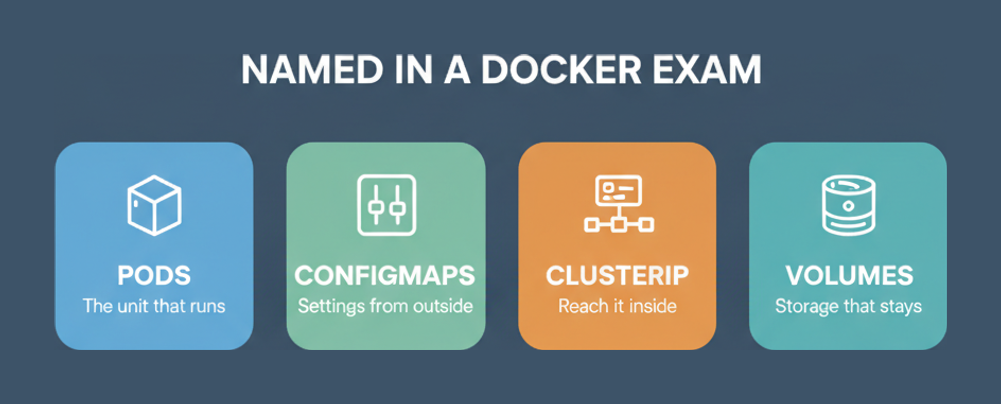
Kubernetes objects appear by name in three of the six DCA domains. Orchestration asks you to deploy containerised workloads as Kubernetes pods and deployments and to supply configuration through configMaps and secrets. Networking asks you to route traffic to pods using ClusterIP and NodePort services. Storage asks you to provision persistent storage to pods using persistentVolumes.
That is not a token mention. It reflects the platform this credential was built around, where a single control plane could schedule workloads to either orchestrator, so an administrator was expected to be fluent in both. The exam kept that shape.
For a candidate it means the preparation cannot be swarm only. You need working familiarity with the pod as the unit of scheduling, with how a deployment maintains it, and with the two service types named in the blueprint. The Kubernetes pod documentation is the authoritative description of the object the exam keeps referring to.
The storage half is the least forgiving part of it. Provisioning a persistentVolume to a pod means understanding the chain from a container storage interface driver, through a storageClass, to a persistentVolumeClaim, to the volume the pod actually mounts. The blueprint names all four objects in one line, and questions about them test whether you know which one binds to which.
How Deep Does the Image and Registry Domain Go?
Image Creation, Management and Registry is 20 percent of the paper and the only domain that is genuinely about building rather than operating. It covers Dockerfile instructions by name, creating efficient images, managing them from the command line, inspecting them with filters and formatting, tagging, working with layers, and the full set of registry operations from deployment through to signing.
The Dockerfile objective names specific instructions: add, copy, volumes, expose and entry point. Add against copy is the classic examinable pair, because they look interchangeable and are not. Expose and entry point are similar traps, since both are frequently misunderstood as doing more than they do.
Efficient image creation is listed as its own skill, which points at layer behaviour. How instructions become layers, why ordering changes cache reuse, and what actually reduces final image size are all inside scope. The image format itself is standardised by the Open Container Initiative, which is why the same layer model holds across tools.
Registry work goes further than push and pull. Deploying a registry, authenticating against it, searching it, and signing images are all named, and signing connects directly to the security domain through Docker Content Trust. The two domains are best studied together for that reason.
What Security Work Is Examinable?
Security is 15 percent of the DCA and is administrative rather than theoretical. The objectives cover image signing, default engine and swarm security, mutual TLS, roles, the difference between manager and worker nodes from a security standpoint, external certificates, security scanning, enabling Docker Content Trust, configuring role based access control, and integrating the control plane with LDAP or Active Directory.
Mutual TLS is the concept that ties the cluster together. Swarm nodes authenticate to each other with certificates by default, which is why the manager and worker distinction appears in a security domain as well as an orchestration one. Questions here often test whether you know what is secured out of the box versus what you must configure.
Docker Content Trust is the practical half of image signing, and it is a toggle with consequences. Enabling it changes which images the daemon will run, so a question describing an unexpected pull failure is often a Content Trust question wearing a registry costume.
Role based access control and directory integration round the domain out. Both are configuration tasks rather than concepts, and both reward having clicked through them once rather than having read about them.
Is the Docker Certified Associate Still Active?
Yes. The Docker Certified Associate is currently sold by Mirantis at 199 US dollars and has a live exam page describing its format, validity and recommended experience. Claims that the credential was discontinued when Mirantis acquired Docker Enterprise circulate widely and are contradicted by the vendor’s own working purchase page.
The confusion has a traceable cause. Several older Mirantis URLs that used to describe the certification now return 404, including the paths under the main marketing site, so a link followed from an old article or an aggregator lands on a missing page and looks like a retirement notice. The exam moved, it did not stop.
Two details are worth taking from that. First, verify certification claims against a vendor page that transacts, because a store page with a price on it is harder to misread than a marketing page. Second, the two year validity means anyone holding a DCA from the Docker Inc era has long since needed to renew it, which is a separate question from whether new candidates can sit it.
If you want a sense of how the paper has felt to candidates over time, our earlier piece on DCA exam difficulty covers the experience side rather than the blueprint.
How Should You Prepare for the DCA Exam?
Preparation for the Docker Certified Associate should follow the weighting rather than the blueprint order, because orchestration alone is a quarter of the paper and storage is only a tenth. Build a real swarm first, add the Kubernetes objects the blueprint names, then work outward into images, networking, security and storage.
- Stand up a multi node swarm with more than one manager, so quorum behaviour is something you have watched rather than something you have read about.
- Convert a compose file into a running stack, then scale replicas, place tasks with node labels, and deliberately break a service deployment so you have seen the failure output.
- Deploy the same workload as a Kubernetes pod and deployment, supply its configuration through configMaps and secrets, and expose it with both ClusterIP and NodePort.
- Build images by hand until add against copy, expose and entry point are automatic, then push, tag, sign and pull them through a registry you deployed yourself.
- Enable Docker Content Trust and configure role based access control, because both change platform behaviour in ways the exam asks you to predict.
- Finish with storage, working through volumes, graph drivers and the chain from a storage interface driver to a persistentVolumeClaim, since this is the least familiar vocabulary on the paper.
- Rehearse every practice item as a single accept or reject decision rather than a choice between options, so the DOMC format is not new on the day.
That last step matters more than any other piece of advice about this exam. Our older walkthrough on mastering the DCA exam collects the study resources for the domain work itself.
Frequently Asked Questions
How many questions are on the Docker Certified Associate exam?
Fifty five in 90 minutes, made up of 13 traditional multiple choice questions and 42 discrete option multiple choice questions.
What is the passing score for the DCA?
Mirantis does not publish one. Its exam page states that passing scores are not published because questions and scores are subject to change without notice, so any percentage you see quoted elsewhere is not a vendor figure.
What does DOMC mean?
Discrete option multiple choice. You are shown one candidate answer at a time and asked to accept or reject it, without seeing the full option list and without being able to go back to a decision you have made.
How much does the Docker Certified Associate cost?
199 US dollars, or 200 euro when purchased online through the Mirantis webstore.
How long is the DCA valid?
Two years. Mirantis requires the certification to be updated every two years, so the renewal clock starts the day you pass.
Which domain carries the most weight?
Orchestration at 25 percent, followed by Image Creation, Management and Registry at 20 percent. Installation and Configuration, Networking and Security carry 15 percent each, and Storage and Volumes carries 10 percent.
Does the DCA exam cover Kubernetes?
Yes, in three of the six domains. Pods, deployments, configMaps, secrets, ClusterIP and NodePort services and persistentVolumes are all named directly in the published objectives.
How much Docker experience is recommended?
Mirantis states the exam is designed to validate professionals with a minimum of six to twelve months of Docker experience. The blueprint assumes you already run containers in earnest.
Where do you sit the exam?
Remotely, proctored on your own Windows or Mac computer, with results delivered immediately. It is available globally in English.
Is the Docker Certified Associate retired?
No. Mirantis sells it at 199 US dollars and publishes a current exam page. Several older Mirantis URLs about the certification now return 404, which is the most likely source of the retirement claims that circulate.
Conclusion
The Docker Certified Associate is an operations exam with a developer tool’s name and an unusual scoring format. Fifty five questions in 90 minutes, only 13 of them conventional, 199 US dollars, remotely proctored, English only, and valid for two years. Orchestration is a quarter of it, images a fifth, and Kubernetes objects run through three separate domains.
Prepare it by weighting rather than by chapter. Build a real swarm, run the same workload as a pod, sign an image you built through a registry you deployed, and leave storage until the vocabulary is the only thing left to learn. Then practise every question as a single accept or reject decision, because that is the one part of this exam no amount of Docker experience prepares you for.


