There is no database anywhere on this exam.
That surprises people, because the code starts with 1Z0 and Oracle is still shorthand for databases in most engineering teams. But 1Z0-1109-26, the exam behind the Oracle Cloud Infrastructure DevOps Professional credential, never asks you to write a query, tune an optimiser or size a tablespace. It asks you to build a container image, push it to a registry, define infrastructure in Terraform, wire a build pipeline, run a Kubernetes cluster and keep secrets out of the artefacts. The paper is 50 questions in 90 minutes, the pass mark is 68 percent, and it costs 245 US dollars. Sixty of every hundred marks sit in just two blocks: continuous delivery and container orchestration. Everything a candidate assumes about an Oracle exam has to be set aside before the blueprint makes sense, so this guide walks the blueprint as it actually is. Engineers who also look after the hosts underneath a pipeline can pair this with the Oracle Linux 8 certification, which covers Oracle’s own Linux distribution.
What Does the OCI DevOps Professional Certification Actually Cover?
The OCI DevOps Professional certification covers the delivery toolchain on Oracle Cloud Infrastructure: containers and Docker, the OCI Registry, Terraform and OCI Resource Manager, the OCI DevOps service with its code repositories and build pipelines, Container Engine for Kubernetes, OCI Vault, and the monitoring and logging services. It validates delivery engineering, not database administration. Once a pipeline is running, the next question is how you watch it, and that is where the OCI Observability Professional exam picks up.
Oracle awards the credential Oracle Cloud Infrastructure Certified DevOps Professional on a pass. The word that matters in that name is professional. This is the second tier of the OCI ladder, above the associate level, and the blueprint assumes you have already stood up resources in a tenancy and understand compartments, policies and networking well enough that the exam does not need to test them again.
What the exam does test is whether you can take an application from source control to a running workload without touching a console by hand. That is a narrow, practical brief, and it explains why the objectives read like a pipeline rather than a syllabus. You containerise, you store the image, you declare the infrastructure, you build, you deploy, you orchestrate, you secure, you observe. Each of those verbs maps to a weighted block. Anyone weighing the credential against the cost can compare the blueprint with the practice material on the 1Z0-1109-26 exam page before committing to a booking.
The services you have to recognise by name
The blueprint names its services explicitly rather than describing capabilities in the abstract. Oracle Cloud Infrastructure Registry, Container Instances, Resource Manager, DevOps Code Repositories, Container Engine for Kubernetes, Vault, Monitoring, Logging and Events all appear by name in the objectives. A candidate who knows the concepts but not the product names will lose marks on wording alone, because the questions use Oracle’s vocabulary. For the vendor neutral half of that toolchain, Terraform Associate credential covers the provisioning layer itself.
What Are the 1Z0-1109-26 Exam Details?
1Z0-1109-26 is a 50 question multiple choice paper with a 90 minute limit and a 68 percent passing score, priced at 245 US dollars before local currency adjustment. That works out at 34 correct answers to pass, and roughly 108 seconds per question if you use the full window.
| Field | Value |
|---|---|
| Exam name | Oracle Cloud Infrastructure DevOps Professional |
| Exam code | 1Z0-1109-26 |
| Credential awarded | Oracle Cloud Infrastructure Certified DevOps Professional |
| Questions | 50 |
| Duration | 90 minutes |
| Passing score | 68 percent |
| Marks needed | 34 of 50 |
| Format | Multiple choice |
| Price | USD 245, varying by country and local currency |
Sixty eight percent is a higher bar than it looks. On a 50 question paper every single question is worth two percentage points, so the margin between a pass and a fail is sixteen questions wide in total but only one question wide at the boundary. There is no partial credit and no compensation between domains, which means a candidate who is strong on pipelines and weak on Kubernetes cannot average their way through. Both of those blocks are worth fifteen questions each.
The 90 minute window is generous for recall questions and tight for scenario questions, and this paper leans toward the second kind. Objectives phrased as evaluate and configure, rather than describe or list, tend to produce questions with a short deployment scenario attached. Reading those carefully takes longer than the average pace allows, so the practical approach is to bank time on the recognition questions early.
Why Do CI/CD and Kubernetes Take Sixty Percent of the Marks?
Because they are the two places where a delivery engineer actually spends the day. Configuring and managing continuous integration and continuous delivery carries 30 percent of 1Z0-1109-26, and managing containers using a container orchestration engine carries another 30 percent. Together they account for thirty of the fifty questions, leaving the remaining four blocks to share twenty.
| Syllabus block | What sits inside it | Weight |
|---|---|---|
| Understand DevOps principles and effectively work with containerization services | DevOps practice, microservices, Docker, OCI Registry, Container Instances | 15% |
| Understand DevOps principles and effectively work with containerization services | Infrastructure as code with Terraform on OCI, and OCI Resource Manager | 10% |
| Configuring and Managing Continuous Integration and Continuous Delivery (CI/CD) | OCI DevOps service, code repositories, artefacts, build and deployment pipelines, deployment strategies | 30% |
| Managing Containers using Container Orchestration Engine | Container Engine for Kubernetes, cluster creation and access, deployments, networking, storage, scaling, upgrades, OKE security | 30% |
| Enabling DevSecOps | DevSecOps practice, OCI Vault keys and secrets, pipeline security, container image security | 10% |
| Implementing Monitoring and Observability (O&M) | DevOps measurement, OCI Monitoring, OCI Logging, OCI Events | 5% |
The blueprint lists six weighted blocks, and the first two share a heading even though their objectives are entirely different. The 15 percent block is about containers. The 10 percent block underneath it is about declaring infrastructure in code. Read them as two separate subjects, because the questions certainly will.
That distribution has a direct consequence for study planning. A candidate who allocates time evenly across six blocks spends as long on monitoring, worth two or three questions, as on Kubernetes, worth fifteen. The honest allocation follows the weights: roughly three days of pipeline work and three days of cluster work for every one day spent on logging and metrics.
What the two big blocks have in common
Both reward hands-on repetition rather than reading. Pipelines and clusters are systems you learn by breaking, and the objectives use verbs that assume you have. Create and configure various deployment strategies is not a definition question. Neither is optimise Kubernetes clusters in the OCI environment.
How Much Docker and Container Work Does the Exam Expect?
Enough to build an image, understand why you would, and manage where it lives. The 15 percent containerisation block asks you to identify the need for containerisation, create containers using Docker, explain and implement microservices architecture, and then create and manage both Oracle Cloud Infrastructure Registry and OCI Container Instances.
The microservices objective is the one candidates underestimate. It is not asking for a definition of a microservice. It sits alongside the containerisation objectives because the exam wants to know whether you understand what breaking a monolith apart does to deployment, versioning and inter service communication. Questions in this area tend to present an architecture and ask what follows from it.
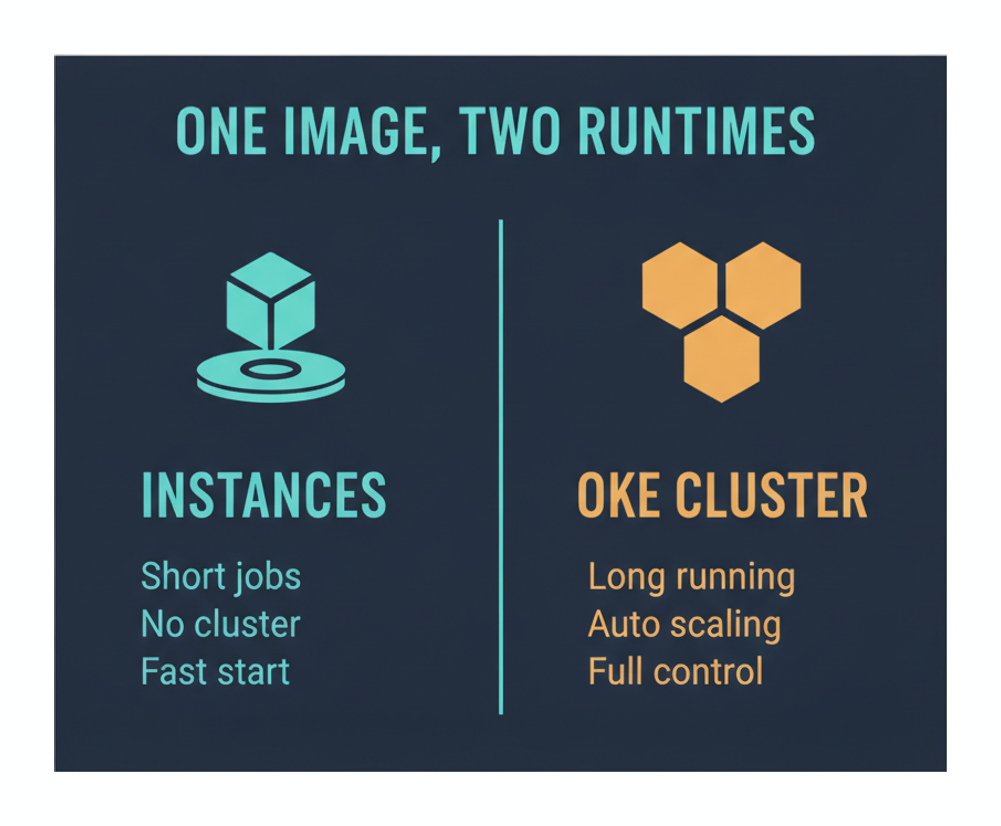
OCI Registry is the storage layer for images, and Container Instances is the option for running a container without standing up a cluster at all. That second service matters more than its share of the objectives suggests, because the exam repeatedly asks you to choose the right compute target. A short lived batch job does not need Kubernetes. Recognising when a cluster is the wrong answer is itself a tested skill.
- Build an image locally and push it to OCI Registry, then pull it from a different compartment
- Tag images deliberately, because image versioning appears in both this block and the security block
- Run the same image on Container Instances and on a cluster, and note what changes
- Know which registry operations need which policy statements
Where Does Infrastructure as Code Fit in the Blueprint?
In a 10 percent block of its own, covering two objectives: deploying infrastructure using infrastructure as code and Terraform on OCI, and streamlining infrastructure deployment and configuration with OCI Resource Manager. That is five questions, and both objectives point at the same idea from different angles.
Terraform is the language and the engine. Resource Manager is Oracle’s managed service for running it, so that state files, plan and apply runs, and stack configuration live inside the tenancy rather than on an engineer’s laptop. A candidate who has only ever run Terraform locally will recognise the syntax questions and stumble on the Resource Manager ones, because stacks, jobs and configuration sources are Oracle specific vocabulary.
Understanding the tool itself pays off beyond this exam. HashiCorp’s own introduction to what Terraform is explains the declarative model and the state file clearly, and the state file is where most exam scenarios hide their trap. Two engineers applying the same configuration against divergent state is a classic question shape.
The detail that separates the two objectives
Terraform questions test what the configuration does. Resource Manager questions test who can run it, where the state is kept, and how a stack is updated safely. Study both, and keep them mentally separate, because the answer options often mix vocabulary from each to see whether you can tell them apart.
What Does the DevSecOps Domain Ask You to Secure?
Three specific surfaces, at 10 percent of the paper. The DevSecOps block covers configuring security using DevSecOps practice on OCI, creating and managing encryption keys and secrets in OCI Vault, evaluating and configuring security inside the OCI DevOps CI/CD pipelines, and securing the container images used in OCI.
Vault is the anchor. Keys and secrets are a single objective, but they behave differently: a key is used to encrypt something, a secret is a value the pipeline needs at run time, and the exam expects you to know which one a given scenario calls for. Hard coding a credential into a build specification is the wrong answer in every question where it appears, and it appears often.
Pipeline security and image security are the other two surfaces, and they connect. An image is only as trustworthy as the pipeline that built it, and a pipeline is only as trustworthy as the identities allowed to trigger it. Oracle’s own documentation on the OCI DevOps service sets out how build and deployment stages are defined, which is the structure the security questions assume you already picture.
Ten percent is five questions, and this block is the highest return per hour of study in the whole blueprint. The material is finite, the service list is short, and the correct answers follow a consistent principle: move the secret out of the artefact, and scope the permission to the stage that needs it.
Why Is Monitoring Only Five Percent?
Because the exam treats observability as a supporting discipline rather than a delivery one. At 5 percent, monitoring and observability is the smallest block on 1Z0-1109-26, worth two or three questions, and it covers DevOps measurement concepts plus three services: OCI Monitoring for metrics, OCI Logging for logs, and OCI Events for event driven reactions.
That weighting is a deliberate scoping choice rather than a judgement about importance. Oracle publishes a separate observability track, and this exam stops at the boundary where a delivery engineer hands a running workload to whoever watches it. The questions reflect that: they ask which service you would use and what it emits, not how to design an alerting strategy.
DevOps measurement is worth a short look even so. The concepts of deployment frequency, lead time and change failure rate are the vocabulary the objective points at, and a question that asks what a shortening lead time indicates is answerable from first principles once you know the terms.
The practical advice is to study this block last and study it quickly. Two or three questions do not justify the time that the two 30 percent blocks demand, and a candidate who runs out of preparation time has lost far less here than anywhere else on the paper.
Who Should Sit This Exam, and Who Should Not?
It suits engineers who already deliver software on Oracle Cloud Infrastructure and want the professional tier credential to prove it. It does not suit Oracle database administrators looking for a natural next step, and it does not suit DevOps engineers with no OCI exposure at all, because every objective is expressed in Oracle service names.
The clearest fit is a platform or delivery engineer at an organisation that runs on OCI, who has built pipelines and operated clusters there and wants the credential on record. The second clearest is a multi cloud engineer whose Kubernetes and Terraform skills transfer directly, and who needs to learn the Oracle service equivalents rather than the underlying concepts. That candidate usually converts fastest, because the hard part is already done.
Database professionals are the group most likely to pick this exam for the wrong reason. The 1Z0 prefix implies continuity that does not exist here. Someone coming from Oracle Database certifications will find nothing familiar in the blueprint, and would be better served by a database track exam.
If you are weighing this against another OCI professional credential, the comparison worth making is with the architecture track. Our guide to the OCI Multicloud Architect exam covers a credential at the same tier with a very different centre of gravity, and reading the two blueprints side by side usually settles the question quickly.
Prior exposure that genuinely helps
- Working knowledge of compartments, policies and the OCI identity model
- Having built and pushed a container image, in any registry
- Having run at least one Kubernetes cluster in production or in a lab
- Having applied a Terraform configuration and then had to reconcile state
How Should You Prepare for 1Z0-1109-26?
By following the weights rather than the syllabus order. The blueprint lists containerisation first and monitoring last, but the marks are concentrated in CI/CD and Kubernetes, so a preparation plan that mirrors the reading order spends its best hours in the wrong places. Build the plan around the 30 percent blocks and fit everything else around them.
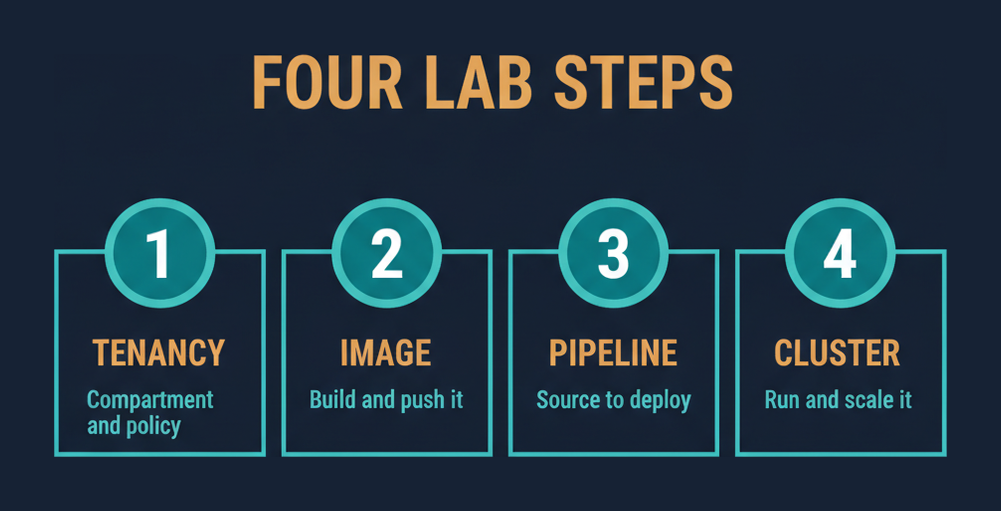
- Start by standing up a free tier tenancy and confirming you can create a compartment and a policy, because every later step assumes that access already works.
- Build a container image and push it to OCI Registry, then run the same image on Container Instances, so the difference between a registry and a runtime is concrete rather than theoretical.
- Move to the CI/CD block and build one complete pipeline in the OCI DevOps service, from a code repository through an artefact to a deployment, before you read anything further about deployment strategies.
- Rebuild that pipeline with a different deployment strategy, because the objective asks you to create and configure various strategies and the differences only become memorable once you have seen two of them run.
- Create an OKE cluster and work through deployments, networking, storage and scaling on it, giving this step as much time as the pipeline work since both blocks carry 30 percent.
- Add OCI Vault to the pipeline you already built, replacing any hard coded value with a secret reference, which covers most of the DevSecOps block in a single exercise.
- Finish with monitoring and logging, spending an afternoon rather than a week, and use the time to attach metrics and logs to the workload you have already deployed.
Kubernetes is where most candidates need the most outside reading, because OKE assumes the upstream concepts rather than teaching them. The project’s own Kubernetes concepts overview is the efficient way to fill gaps in deployments, services and scheduling, and Oracle’s Kubernetes Engine overview then maps those concepts onto cluster types, node pools and OKE specific management.
One more habit pays off disproportionately. Every time you finish an exercise, write down which Oracle service name you just used, because the exam tests recognition of those names as much as it tests the underlying engineering. Candidates preparing for an earlier release of this credential found the same thing, and the approach in our earlier OCI DevOps guide still holds where the services have not changed.
Frequently Asked Questions
How many questions are on the 1Z0-1109-26 exam?
Fifty multiple choice questions, with a 90 minute limit. At a 68 percent pass mark you need 34 correct answers, which leaves room for sixteen wrong ones across the whole paper.
What is the passing score for OCI DevOps Professional?
Sixty eight percent. Because the paper has 50 questions, each one is worth two percentage points, and there is no compensation between domains or partial credit on any item.
How much does 1Z0-1109-26 cost?
USD 245, though the amount varies by country and by the local currency it is charged in. That is the exam fee only and does not include any training or practice material.
Does the OCI DevOps Professional certification involve databases?
No. Despite the 1Z0 exam code prefix, the blueprint contains no database objectives. It covers containers, infrastructure as code, CI/CD pipelines, Kubernetes, DevSecOps and observability on Oracle Cloud Infrastructure.
Which domain carries the most marks?
Two domains tie at 30 percent each: continuous integration and continuous delivery, and managing containers using a container orchestration engine. Between them they account for thirty of the fifty questions.
How much Kubernetes do I need to know?
A substantial amount. The orchestration block asks for cluster creation and access, deployments, networking, storage, observability, scaling, admission controllers, cluster upgrades and OKE security, which is a full operational surface rather than an introduction.
Is Terraform tested on this exam?
Yes, in the 10 percent infrastructure as code block, alongside OCI Resource Manager. The objectives name Terraform on OCI directly, so configuration syntax and state behaviour both matter.
What credential do I get for passing?
Oracle Cloud Infrastructure Certified DevOps Professional. It sits at the professional tier of the OCI certification ladder, above the associate level exams.
Is monitoring worth studying for 1Z0-1109-26?
Briefly. At 5 percent it is the smallest block, worth two or three questions, covering OCI Monitoring, OCI Logging and OCI Events plus basic DevOps measurement concepts. Study it last.
Conclusion
1Z0-1109-26 is a delivery engineering exam wearing an Oracle database prefix, and reading it that way changes how you prepare for it. Fifty questions, 90 minutes, 68 percent to pass, and a blueprint where continuous delivery and Kubernetes take sixty of the hundred marks between them while observability takes five. The services are named explicitly, from OCI Registry and Resource Manager through to Vault and Events, and the questions use those names rather than generic terminology.
The preparation that works follows the weights instead of the reading order, builds one real pipeline and one real cluster rather than reading about both, and treats the DevSecOps block as the highest return per hour on the paper. Once your own lab work lines up with the blueprint, a run through a practice set is the sensible way to find out which of the six blocks still owes you time.


