
There is a certification you must already hold before JN0-637 is bookable at all, and most catalogue listings for this exam do not mention it. Juniper names JNCIS-SEC as a prerequisite on its own JNCIP-SEC certification page. Candidates who plan a study schedule without checking that lose weeks to an exam they were never eligible to sit.
Once past that, JNCIP-SEC is a genuinely advanced SRX exam: 65 questions in 90 minutes, eight objectives with no published weightings, and a syllabus that spends more time on multinode high availability and advanced IPsec than on anything a specialist level candidate has seen before.
Table of Contents
- What does JNCIP-SEC certify, and where does it sit?
- You need JNCIS-SEC before you can sit JN0-637
- How is the JN0-637 exam delivered and scored?
- Which eight objectives does the exam cover?
- Why is multinode high availability the objective that decides results?
- What does advanced actually mean in advanced IPsec VPNs?
- Layer 2 security is broader here than the name suggests
- Which Junos version is the exam written against?
- How should you prepare for JN0-637?
- Frequently Asked Questions
- Conclusion
What does JNCIP-SEC certify, and where does it sit?
JNCIP-SEC certifies advanced working knowledge of Junos OS security features on SRX Series devices, at the professional tier of Juniper’s four level security track. Juniper describes it as verifying an understanding of advanced security technologies together with the platform configuration and troubleshooting skills that go with them, which is a fair summary of a syllabus built almost entirely around scenarios.
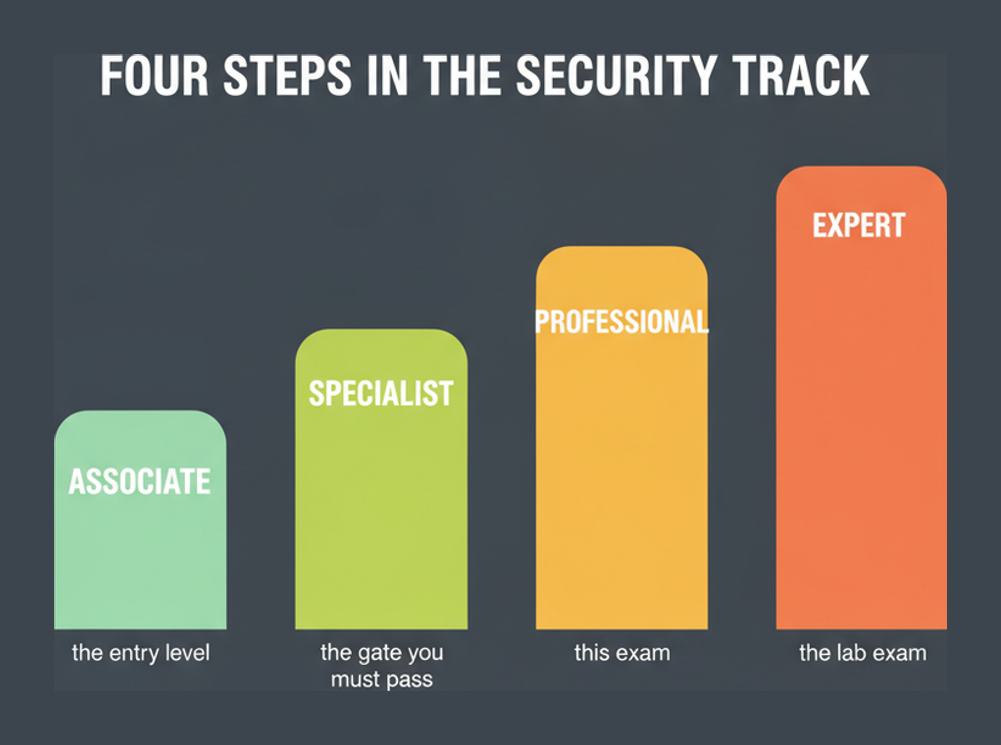
The track runs JNCIA-SEC at associate level, JNCIS-SEC at specialist, JNCIP-SEC at professional and JNCIE-SEC at expert. Professional is the point where the questions stop asking what a feature does and start asking what you would do when it is misbehaving in a specific deployment.
The credential is now branded under HPE Juniper Networking following the acquisition, but the exam code, track structure and objectives are unchanged. A resource written as Juniper rather than HPE Juniper is not out of date on that basis alone.
You need JNCIS-SEC before you can sit JN0-637
Juniper’s own exam details list a prerequisite certification for JN0-637, and it is JNCIS-SEC. This is not a recommendation in the way that recommended training is. It is a gate, and it is the single most consequential thing to know before planning a study schedule.
The money site listing for this exam does not carry it, and neither do most third party summaries, which is why candidates regularly discover it at booking. If you do not already hold JNCIS-SEC, your real timeline is two exams rather than one, and the specialist exam is the correct place to build the foundation that JNCIP-SEC then assumes. Our JN0-336 certification guide covers that specialist step in full.
There is a practical upside to the gate. Because every JNCIP-SEC candidate has already passed a specialist security exam, the professional paper can assume zones, policies, screens, basic NAT and site to site IPsec are settled knowledge, and spend its 65 questions entirely on what comes after. That is why the objective list looks so unusually advanced.
How is the JN0-637 exam delivered and scored?
JN0-637 is 65 multiple-choice questions in 90 minutes, delivered through Pearson VUE, and Juniper confirms both figures on its certification page. The result is pass or fail and is shown immediately after the exam. Juniper publishes no percentage pass mark; the money site’s syllabus page describes the threshold as variable, approximately 60 to 70 percent, which is a planning estimate rather than an official figure.
| Field | Value |
|---|---|
| Credential name | HPE Juniper Networking Security Professional (JNCIP-SEC) |
| Exam code | JN0-637 |
| Questions | 65 multiple-choice |
| Duration | 90 minutes |
| Prerequisite certification | JNCIS-SEC |
| Result | Pass or fail, shown immediately |
| Passing score | Not published by Juniper; money site estimates roughly 60 to 70 percent |
| Price | $400 USD |
| Language | English only |
| Software versions tested | Junos OS 22.2 and SD 22.1 |
| Certification validity | Three years |
| Delivery | Pearson VUE |
Sixty five questions in 90 minutes is roughly 83 seconds each, and that is tight for this syllabus. A large share of the objectives are phrased as “given a scenario, demonstrate how to configure, troubleshoot or monitor”, which in a written exam means reading configuration output and deciding what it implies. Those items take longer than a minute unless the command output is familiar. Working through a JNCIP-SEC practice test against the clock is the only reliable way to know whether your reading speed on Junos output is exam ready.
At $400 USD this is one of the more expensive professional tier network security exams, with no discounted retake, so the pacing rehearsal is worth doing properly rather than once.
Which eight objectives does the exam cover?
JN0-637 has eight objectives and Juniper publishes no weighting against any of them. That absence changes the strategy: there is no small domain to sacrifice, and an objective with a single line of description can carry as many questions as one with fifteen sub bullets.
| Objective | What it covers |
|---|---|
| Troubleshooting Security Policies and Security Zones | Given a scenario, troubleshoot or monitor security policies or security zones, using tools, logging or tracing, and other outputs |
| Logical Systems and Tenant Systems | Logical systems including administrative roles, security profiles and logical system communication; tenant systems including primary and tenant system administrators, and tenant system capacity |
| Layer 2 Security | Transparent mode, mixed mode, secure wire, MACsec, and EVPN-VXLAN security; plus configuring or monitoring Layer 2 security in a given scenario |
| Advanced Network Address Translation | Persistent NAT, DNS doctoring and IPv6 NAT; plus configuring, troubleshooting or monitoring advanced NAT scenarios |
| Advanced IPsec VPNs | Hub-and-spoke VPNs, PKI, auto discovery VPNs, routing with IPsec, overlapping IP addresses, dynamic gateways and IPsec class of service; plus configuring, troubleshooting or monitoring them |
| Advanced Policy-Based Routing | Profiles, policies, routing instances and APBR options; plus configuring or monitoring advanced policy-based routing |
| Multinode High Availability | Concepts, chassis cluster compared with multinode HA, deployment modes, services redundancy groups, the interchassis link, active/active and active/passive modes, and active node determination and enforcement |
| Automated Threat Mitigation | Third-party or multicloud integration, and Secure Enterprise |
Read the phrasing rather than the topics. Five of the eight objectives contain an explicit “given a scenario, demonstrate how to configure, troubleshoot or monitor” clause. Only Logical Systems and Automated Threat Mitigation are purely descriptive. That ratio tells you what the paper feels like far better than the topic names do.
Why is multinode high availability the objective that decides results?
Multinode HA has the longest sub bullet list of any objective on this syllabus, and it is the newest material most candidates meet. Juniper lists concepts, the comparison with chassis cluster, deployment modes, services redundancy groups, the interchassis link, active/active and active/passive modes, and active node behaviour including both determination and enforcement.
The comparison bullet is the giveaway. Chassis cluster is the older SRX high availability model and multinode HA is the newer one, and the syllabus asks explicitly for the difference. A candidate whose production experience is entirely chassis cluster will recognise every question and answer a good number of them wrongly, because the two models make different assumptions about the link between nodes and about what happens when that link fails.
The three things worth being able to state precisely
- What a services redundancy group actually groups, and what causes it to move
- How the active node is determined, and separately how that decision is enforced, since the syllabus lists those as two things
- Which deployment mode suits a stated topology, particularly where the two nodes are not adjacent
Because no weightings are published, there is no way to know how many questions this objective carries. The safe assumption on a syllabus this detailed is that the detail is there because it is examined.
What does advanced actually mean in advanced IPsec VPNs?
Advanced IPsec VPNs is the objective where specialist knowledge stops carrying you. Site to site tunnels belong to JNCIS-SEC. What JN0-637 adds is hub-and-spoke topologies, PKI, auto discovery VPNs, routing across IPsec, overlapping IP address space, dynamic gateways and class of service applied to IPsec traffic.
Those seven sub topics are not variations on one idea. Routing with IPsec is a routing problem, overlapping addresses is a NAT problem, PKI is a certificate lifecycle problem and ADVPN is a topology problem. The objective bundles them because they are what real deployments hit once the simple tunnel is working.
The vendor neutral background genuinely helps here, because Junos is implementing standards rather than inventing behaviour. The IPsec architecture in RFC 4301 and the IKEv2 negotiation described in RFC 7296 explain why a phase two proposal mismatch produces the symptom it does, which is more durable knowledge than memorising which log line appears.
Layer 2 security is broader here than the name suggests
The Layer 2 Security objective covers transparent mode, mixed mode, secure wire, MACsec and EVPN-VXLAN security. That is four distinct SRX deployment styles plus an encryption standard plus a data centre overlay, all under one heading, and it is easy to underestimate because the heading sounds elementary.
Transparent mode, mixed mode and secure wire are three different answers to the question of how an SRX sits in a Layer 2 path, and questions often describe a requirement and ask which one fits. MACsec is the IEEE 802.1AE standard for link layer encryption, so it is hop by hop rather than end to end, which is precisely the distinction a question will hinge on. EVPN-VXLAN security pulls in data centre fabric knowledge that a pure firewall engineer may not have.
If your SRX experience is entirely routed mode at a perimeter, this objective is the one most likely to contain material you have genuinely never configured.
Which Junos version is the exam written against?
Juniper states the software versions the exam targets: Junos OS 22.2 and SD 22.1. That is published alongside the exam length and question count, and it is worth reading carefully, because behaviour that changed after 22.2 is not what the exam is testing.
This matters most on multinode HA, which has developed quickly, and on the newer Layer 2 material. If your lab runs a much later release, verify how the feature behaved at 22.2 rather than assuming the current behaviour is the examinable one. The gap is usually small, but on an exam with no published pass mark and no partial credit, small matters.
Two further published details belong with the version. The exam is offered in English only, and Juniper certifications are valid for three years, after which recertification is required to keep the credential current.
How should you prepare for JN0-637?
Preparation for JN0-637 has to be lab led, because five of the eight objectives ask you to interpret configuration and output rather than recall a definition. A candidate holding JNCIS-SEC and working with SRX daily should plan six to eight weeks; anyone whose SRX exposure is limited to perimeter policy should plan considerably longer.
- Confirm you hold JNCIS-SEC first, since Juniper lists it as a prerequisite certification and everything else depends on that gate
- Build a lab at Junos OS 22.2 rather than the newest release, so the behaviour you learn is the behaviour the exam tests
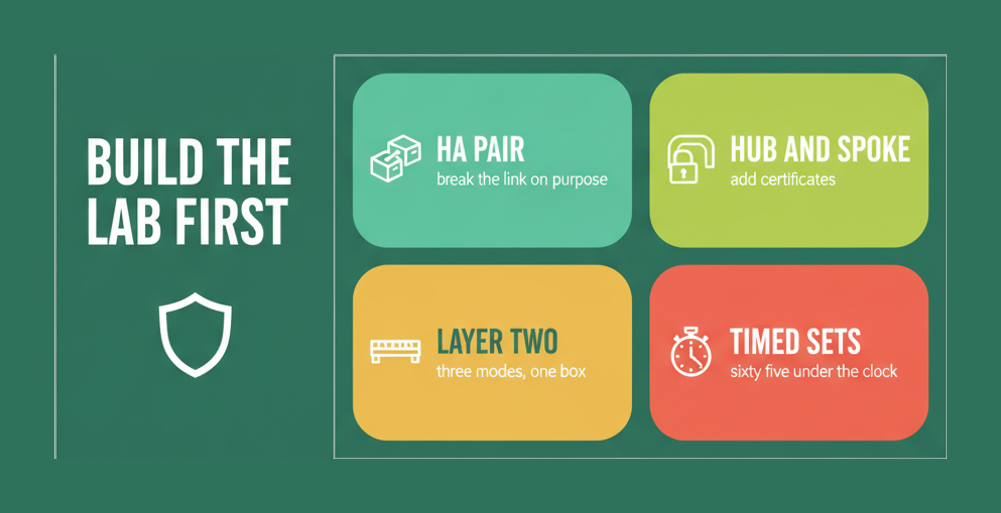
- Work through multinode HA next, configuring both an active/passive and an active/active deployment and deliberately failing the interchassis link to watch active node determination happen
- Move on to advanced IPsec, building a hub-and-spoke topology with PKI certificates and then an auto discovery VPN, and route across both
- Cover the Layer 2 objective by placing the same SRX in transparent mode, then mixed mode, then secure wire, so the differences are experiential rather than memorised
- Finish with advanced NAT, policy-based routing, logical and tenant systems, and automated threat mitigation, then sit timed sets until 65 questions inside 90 minutes leaves you time to revisit the hard ones
The single highest value exercise is deliberate breakage. Because five objectives are troubleshooting shaped, time spent creating a fault and reading what the device says about it is worth several times the same time spent reading documentation. Our JN0-637 self assessment resources are useful for finding which objectives your fault reading is weakest on before you commit the $400.
Frequently Asked Questions
Is there a prerequisite for the JN0-637 exam?
Yes. Juniper lists JNCIS-SEC as a prerequisite certification for JN0-637 on its own exam details. It is a gate rather than a recommendation, so a candidate without JNCIS-SEC is planning two exams rather than one.
How many questions are on JN0-637?
Sixty five multiple-choice questions within 90 minutes. Juniper publishes both figures, and the money site syllabus page gives the same numbers.
What is the passing score for JNCIP-SEC?
Juniper does not publish a percentage pass mark. It states only that pass or fail status is available immediately after the exam. The money site syllabus page estimates the threshold as variable, approximately 60 to 70 percent, which should be treated as a planning figure rather than an official one.
How much does the JN0-637 exam cost?
$400 USD according to the money site syllabus page. There is no discounted retake, so a second attempt is a second full fee.
How long is JNCIP-SEC valid?
Three years. Juniper states that its certifications are valid for three years, after which recertification is required to keep the credential current.
Which Junos version does the exam test?
Junos OS 22.2 and SD 22.1. Juniper publishes these alongside the exam length, so a lab running a much later release may demonstrate behaviour that is not what the exam examines.
What is the difference between chassis cluster and multinode HA?
They are two different SRX high availability models, and the syllabus asks for the comparison explicitly. Multinode HA is the newer approach and makes different assumptions about the link between nodes and about failure behaviour, which is why experience with one does not transfer cleanly to the other.
Is the exam available in languages other than English?
No. Juniper states that the exam is provided in English only.
Does JNCIP-SEC cover EVPN-VXLAN?
Yes, inside the Layer 2 Security objective, alongside transparent mode, mixed mode, secure wire and MACsec. That makes it broader than a pure firewall objective and it draws on data centre fabric knowledge.
Are the JN0-637 objectives weighted?
No. Eight objectives are published with no percentage against any of them, which means no objective can safely be treated as minor. Judge depth by how much detail each objective is given rather than by a weighting.
Conclusion
JN0-637 is a professional tier SRX exam with a hard prerequisite, a heavy troubleshooting bias and no published weightings: 65 multiple-choice questions, 90 minutes, $400 USD, English only, tested at Junos OS 22.2, and valid for three years once passed.
Check the JNCIS-SEC requirement before anything else, because it decides whether your timeline is one exam or two. After that, build the lab at the version the exam actually targets, spend disproportionate time on multinode high availability and advanced IPsec, treat the Layer 2 objective as four deployment styles rather than one topic, and break things on purpose. Five of the eight objectives ask what you would do when something is wrong, and that skill only comes from having seen it go wrong.


