
The number in brackets matters more than the name. HashiCorp’s Terraform Associate exam now sits at 004, and it is written against Terraform 1.12 rather than whatever release you last used in anger. Most preparation material still talks about the credential as though versions do not exist, which is how candidates walk in expecting one thing and meet another.
This guide covers the Terraform Associate 004 certification as HashiCorp actually delivers it today: eight objectives, 57 items, one hour, online proctored, and a credential that lapses after two years. It also covers the parts people get wrong, starting with the fact that HCP Terraform is a full objective and not a closing footnote.
Table of Contents
- Who is the Terraform Associate 004 certification for?
- What changed when HashiCorp moved to 004?
- How is the Terraform Associate 004 exam delivered and scored?
- Which eight objectives does the syllabus cover?
- How much does the exam cost, and what does the fee include?
- Why does state management decide so many questions?
- HCP Terraform is a full objective, not a footnote
- How do you keep the credential once you have it?
- What does a realistic four week preparation plan look like?
- Where the credential sits in a cloud engineering career
- Frequently Asked Questions
- Conclusion
Who is the Terraform Associate 004 certification for?
The Terraform Associate 004 certification is aimed at cloud engineers who already write Terraform configuration and understand both Terraform Community Edition and HCP Terraform. HashiCorp states two prerequisites plainly: basic terminal skills, and a basic understanding of on-premises and cloud architecture. Production experience is not mandatory, but the exam is written by people who assume you have it.
That framing matters because it rules out a common approach. Reading the documentation end to end and memorising command flags will get you part way, then stall on the objectives about drift, dependency graphs and module versioning, where the question is what you would do rather than what a flag is called. Terraform remains one of the most widely used infrastructure tools in the industry, and the Stack Overflow developer survey tracks that adoption independently of any vendor claim, which is part of why the credential carries weight in hiring conversations.
Three profiles pass comfortably:
- Engineers who have run Terraform against a real cloud account for several months, including at least one painful state problem
- Platform and DevOps engineers who maintain shared modules for other teams
- Administrators moving from click-driven provisioning to declarative configuration, provided they build a demo environment rather than reading about one
What changed when HashiCorp moved to 004?
The move to 004 changed the version of Terraform the exam is written against. HashiCorp states that Terraform Associate 004 tests on Terraform 1.12, and it publishes a version stamped preparation path specifically for 004. The eight objectives carried over in structure, so this is a refresh of the target rather than a redesign of the credential.
The practical consequence is narrow but real. Anything that behaved differently in older releases is now examinable at the newer behaviour, which affects three areas most:
- State refactoring, where the
movedblock is the current idiom rather than a sequence of CLI operations - Configuration validation, where custom conditions and checks are first class features rather than community patterns
- HCP Terraform, where workspaces, projects and governance features have moved on considerably since the earlier revisions of this exam
If your working knowledge came from a Terraform 0.x or early 1.x codebase, those three areas are where a refresher pays for itself. Everything else you already know still applies.
How is the Terraform Associate 004 exam delivered and scored?
The Terraform Associate 004 exam is an online proctored, one hour sitting of 57 questions, and the result is reported as a pass or a fail rather than a score. HashiCorp describes it as an hour long multiple choice exam and publishes no percentage cut score anywhere on its official certifications page. VMExam’s syllabus page puts the threshold at roughly 70 percent, which is a useful planning figure but not a HashiCorp number.
| Field | Value |
|---|---|
| Credential name | HashiCorp Certified Terraform Associate |
| Current version | 004, written against Terraform 1.12 |
| Questions | 57 |
| Duration | 60 minutes |
| Delivery | Online proctored |
| Result | Pass or fail, no score released |
| Price | $70.50 USD, before locally applicable taxes and fees |
| Language | English |
| Credential validity | 2 years |
| Prerequisites | Basic terminal skills; basic understanding of on-premises and cloud architecture |
Fifty seven questions in sixty minutes leaves roughly sixty three seconds each. That is comfortable for recall items and tight for anything where you have to read a configuration block and reason about what Terraform would do with it. The pacing problem is almost always the second kind, so the useful readiness signal is not whether you know the material but whether you can settle a configuration reading question in under a minute. Working through a Terraform Associate practice exam under a clock is the cheapest way to find out before you have paid the fee.
Because the result is pass or fail with no score report, there is no partial feedback to learn from. A failed attempt tells you nothing about which objective let you down, which is a strong argument for testing yourself by objective beforehand rather than in aggregate.
Which eight objectives does the syllabus cover?
The Terraform Associate 004 syllabus is divided into eight objectives, and HashiCorp publishes no weighting against any of them. That absence is worth reading carefully: with no percentages to chase, there is no thin domain to skip, and every objective can reasonably appear.
| Objective | What it covers |
|---|---|
| Infrastructure as Code (IaC) with Terraform | Explain what IaC is; describe the advantages of IaC patterns; explain how Terraform manages multi-cloud, hybrid cloud and service agnostic workflows |
| Terraform fundamentals | Install and version Terraform providers; describe how Terraform uses providers; write configuration using multiple providers; explain how Terraform uses and manages state |
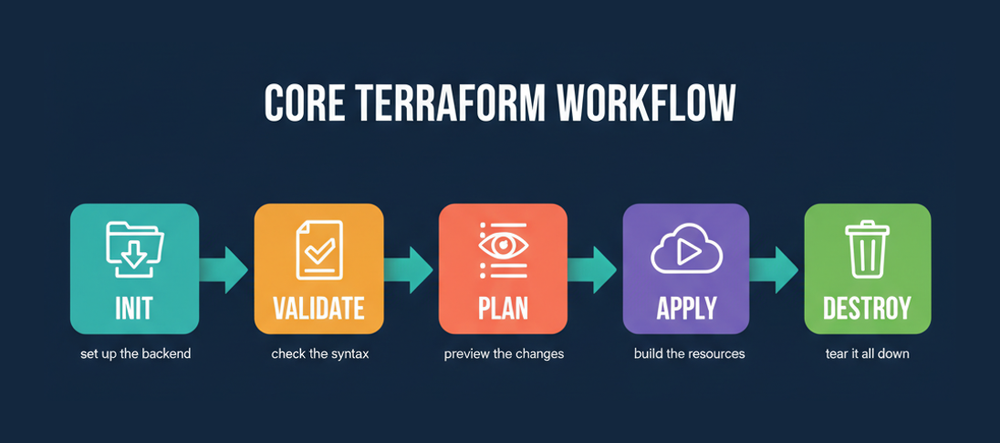
| Core Terraform workflow | Describe the workflow; initialise a working directory; validate a configuration; generate and review an execution plan; apply changes; destroy managed infrastructure; apply formatting and style adjustments |
| Terraform configuration | Use and differentiate resource and data blocks; refer to resource attributes and create cross resource references; use variables and outputs; understand complex types; write dynamic configuration using expressions and functions; define resource dependencies; validate configuration using custom conditions; manage sensitive data, including secrets management with Vault |
| Terraform modules | Explain how Terraform sources modules; describe variable scope within modules; use modules in configuration; manage module versions |
| Terraform state management | Describe the local backend; describe state locking; configure remote state using the backend block; manage resource drift and Terraform state |
| Maintain infrastructure with Terraform | Import existing infrastructure into your workspace; use the CLI to inspect state; describe when and how to use verbose logging |
| HCP Terraform | Use HCP Terraform to create infrastructure; describe collaboration and governance features; organise and use workspaces and projects; configure and use integrations |
Read across those eight and a shape appears. Three of them (fundamentals, core workflow, configuration) are the daily mechanics of writing Terraform. Two (state management, maintain infrastructure) are about what happens after the first apply, which is where most real incidents live. One is modules, one is the conceptual framing of IaC itself, and one is HCP Terraform. A candidate who only ever runs terraform apply against a personal account has genuine coverage of three objectives and thin coverage of five.
The workflow objective is the one candidates underestimate, because running the commands is easy and describing precisely what each one does to state and to the dependency graph is not. Expect to be asked which command would surface a particular problem, not which command you would type next.
How much does the exam cost, and what does the fee include?
The Terraform Associate exam costs $70.50 USD plus locally applicable taxes and fees, and HashiCorp states explicitly that a free retake is not included. That last clause is the one to plan around, because a second attempt is a second full fee rather than a discounted one.
What the fee buys is a single online proctored sitting in English, delivered through HashiCorp’s certification portal. What it does not buy is any training material, any practice content, or any score report to learn from. Budget accordingly:
- One attempt at $70.50 USD before tax, with no retake voucher
- Local tax on top, which varies by country and is added at checkout rather than quoted up front
- Whatever practice material you choose, since none is bundled
- A cloud account for hands on work, which on a free tier is usually negligible for the resource types this exam cares about
Compared with the professional tier credential in the same track, which runs four hours at $295 USD and does include a free retake, the Associate is deliberately cheap and deliberately unforgiving. HashiCorp has priced it as an entry point and left the safety net to the higher tier.
Why does state management decide so many questions?
State is the one concept that touches every other objective, which is why it earns its own objective and then keeps reappearing inside the others. Terraform’s state file maps real infrastructure to configuration, tracks metadata and speeds up planning against large estates, so nearly every question about drift, refactoring or team workflow is a state question in disguise.
The syllabus asks for four specific capabilities: describing the local backend, describing state locking, configuring remote state through the backend block, and managing resource drift. HashiCorp’s own Terraform state documentation is the right depth for all four, and it is more precise than most third party explanations of locking in particular.
The four state situations worth rehearsing
Rather than reading about state, put yourself in these four positions in a demo environment. Each maps directly onto an objective, and each is the kind of scenario an exam item is built from.
- Two engineers run apply against the same remote backend at the same time, so you see what locking actually prevents
- Someone changes a resource in the cloud console, so you see how a refresh only run reports drift and what a subsequent plan proposes
- You rename a resource in configuration, so you see the difference between a destroy and recreate plan and a clean
movedblock - You inherit infrastructure nobody wrote configuration for, so you see what importing genuinely involves
The fourth one is the maintain infrastructure objective and it is the one most candidates have never done. Importing an existing resource, inspecting the resulting state with the CLI and reconciling it against configuration takes an afternoon and covers three objectives at once.
HCP Terraform is a full objective, not a footnote
HCP Terraform carries equal billing with state management and modules in the 004 syllabus, and it is the objective candidates most often leave until the night before. The syllabus asks you to create infrastructure through HCP Terraform, describe its collaboration and governance features, organise workspaces and projects, and configure integrations. None of that is visible from the CLI alone.
This is where the version change bites hardest. Workspaces and projects, run governance, and the integration surface have all moved on since the earlier revisions of the exam, so older study notes describe a product that no longer looks like the current one. The fix is not reading: sign in to the free tier, connect a version control repository, watch a run execute remotely, and set a policy that blocks something. An hour of that covers the objective better than any summary.
The conceptual point worth carrying into the exam is the division of labour. Community Edition gives you the engine and leaves state, locking, secrets and approval to you. HCP Terraform takes those on as managed concerns. Questions in this objective are usually asking which of the two solves a stated problem, so knowing where the boundary falls answers most of them.
How do you keep the credential once you have it?
The Terraform Associate credential expires two years after you earn it, and HashiCorp states that plainly alongside the exam details. There is no continuing education route and no points scheme: keeping the credential means sitting a current version of the exam again before the two years are up.
That has two planning consequences. The first is timing. If you are certifying to support a job application or a partner requirement, the clock starts on the pass date rather than on the date anyone asks to see it. The second is version drift. Because HashiCorp version stamps the exam, a renewal two years from now will very likely be written against a later Terraform release than 004, so the renewal is a genuine refresh rather than a formality.
Candidates who hold more than one HashiCorp credential often stagger them deliberately so the renewals do not land together. If you are working through the wider programme, the Vault Associate certification guide covers the security track equivalent, which carries the same two year window and the same version stamped approach.
What does a realistic four week preparation plan look like?
A candidate already writing Terraform at work needs roughly four weeks of evenings, not four months. The plan below sequences the objectives so that state and HCP Terraform, the two most commonly underprepared areas, get real time rather than whatever is left at the end.
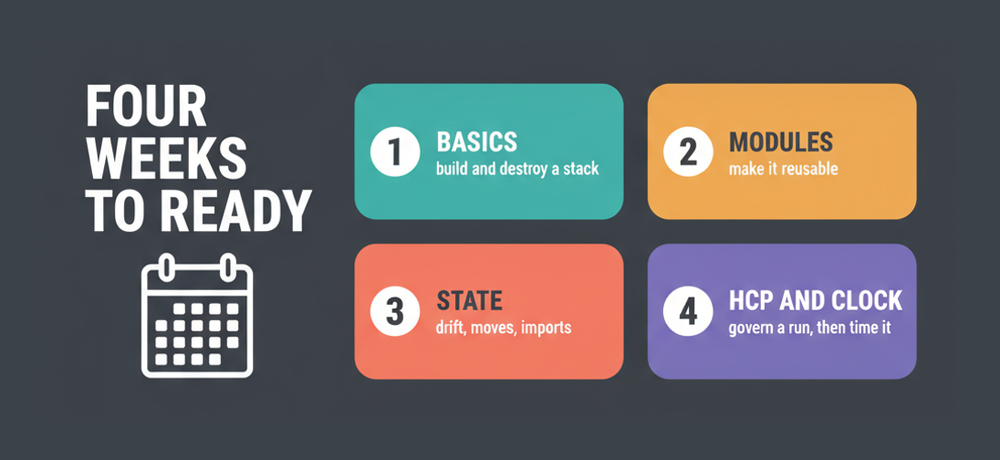
- Spend week one on fundamentals and the core workflow, building and destroying a small stack in one cloud provider until init, validate, plan, apply and destroy are muscle memory
- Spend week two on configuration and modules, converting that stack into a reusable module with input variables, outputs, complex types and a custom validation condition
- Spend week three on state and maintaining infrastructure, moving to a remote backend, forcing a drift, refactoring with a moved block and importing a resource you created by hand
- Spend week four on HCP Terraform and timed rehearsal, connecting a repository to a workspace, running a governed plan, then sitting full length timed sets until you finish inside the hour with time to spare
HashiCorp publishes a version stamped 004 preparation path containing a learning path, an exam content list mapped objective by objective, and sample questions. Use the exam content list as your checklist in weeks one to three, because it is organised by the same eight objectives the syllabus publishes.
One warning on sequencing. Do not leave the timed rehearsal to the final few days. The single most common failure pattern on a 57 item hour is running out of clock on configuration reading questions, and that is a habit problem you can only fix with several rehearsals rather than one.
Where the credential sits in a cloud engineering career
The Associate is an entry credential in HashiCorp’s infrastructure automation track, and it is usually read by employers as evidence that someone can be handed a Terraform codebase without supervision. It is rarely the reason someone is hired, and frequently the reason a shortlist gets shorter.
Cloud engineering is the role HashiCorp names as the audience, and salary data for that role is published independently by PayScale cloud engineer research if you want a benchmark that does not come from a certification vendor. The honest position is that a single Associate credential moves a hiring conversation rather than a salary band; the combination of the credential and a public module or two moves both.
Two follow on questions come up often enough to answer here. Does Terraform remain the right investment given that the Linux Foundation now hosts the OpenTofu project as a fork? For the purposes of this exam, yes: the configuration language, state model and workflow the syllabus tests are shared ground, and the objectives about HCP Terraform are the only genuinely vendor specific part. And what comes next? The professional tier in the same track, which runs four hours and is built on production scale scenarios rather than recall. The authoring and operations professional route is the usual second step once the Associate has been held for a while.
Frequently Asked Questions
What is the current version of the Terraform Associate exam?
The current version is Terraform Associate 004, and HashiCorp states that it tests on Terraform 1.12. HashiCorp also publishes a preparation path stamped specifically for 004, which is the clearest confirmation of which version you will sit.
How many questions are on the Terraform Associate 004 exam?
VMExam’s syllabus page publishes 57 questions within a 60 minute sitting. HashiCorp does not state a question count on its own certification page, describing the exam only as an hour long multiple choice assessment, so 57 is the money site figure rather than an official one.
What score do you need to pass the Terraform Associate exam?
HashiCorp reports the outcome as a pass or a fail and publishes no percentage cut score, so there is no official passing figure to quote. VMExam’s syllabus page puts the threshold at approximately 70 percent, which is reasonable for planning but should not be treated as a HashiCorp number.
How much does the Terraform Associate certification cost?
The fee is $70.50 USD plus locally applicable taxes and fees. HashiCorp states that a free retake is not included, so a second attempt costs another full fee. Tax is added at checkout rather than quoted in the headline price.
How long is the Terraform Associate certification valid?
Two years from the date you pass. There is no continuing education alternative, so renewal means sitting a current version of the exam again before the two years elapse.
Are there prerequisites for the Terraform Associate exam?
HashiCorp lists two: basic terminal skills, and a basic understanding of on-premises and cloud architecture. There is no requirement to hold another certification first and no mandatory training.
Which objective do candidates most often underprepare?
HCP Terraform. It carries equal billing with state management and modules in the eight objective syllabus, but it cannot be learned from the CLI, and older study notes describe a product that has changed considerably. An hour on the free tier covers it better than any written summary.
Is the exam weighted by objective?
No. The syllabus publishes eight objectives with no percentage against any of them, which means there is no low weight domain that can safely be skipped. Plan for all eight to appear.
Can you take the Terraform Associate exam in a language other than English?
HashiCorp lists English as the language for this exam. Candidates needing a different language or keyboard layout are directed to contact HashiCorp’s certification team rather than selecting an alternative at booking.
Does the exam test HCP Terraform or only Terraform Community Edition?
Both. Seven objectives are written around Terraform itself, and the eighth is entirely HCP Terraform, covering infrastructure creation, collaboration and governance features, workspaces, projects and integrations.
Conclusion
Terraform Associate 004 is a narrow, cheap and genuinely useful credential, provided you treat the version number as information rather than decoration. The exam is 57 items in an hour, online proctored, reported as a pass or a fail, priced at $70.50 USD before tax with no retake included, and valid for two years.
The eight objectives carry no published weightings, so the winning strategy is coverage rather than triage. Give real time to state management and HCP Terraform, because those are where a working Terraform user’s experience is usually thinnest, and rehearse against the clock early enough that pacing stops being the thing that decides the result. Build the demo environment, force the drift, import the orphan, connect the workspace, then book the sitting.


