Two Talend credentials sit beside each other in the same catalogue, and choosing between them is the first real decision a candidate makes. One is for the person who writes the Jobs. The other is for the person who keeps the platform that runs them alive, and that is the one with the exam code TDICA.
The Talend administrator certification, formally the Qlik Talend Data Integration Administrator, is a 50 question exam in 60 minutes at a 70 percent bar, built around seven topic areas of which one, Talend Administration Center, carries more objectives than the other six combined.
Table of Contents
- What is the Talend administrator certification?
- Administrator or developer: which Talend exam are you sitting?
- How is the TDICA exam delivered and scored?
- Who can actually book this exam?
- What does the syllabus cover?
- Why does Talend Administration Center dominate the paper?
- What does the deployment topic actually ask for?
- Git appears on the syllabus twice, and that is deliberate
- How should you prepare for TDICA?
- Frequently Asked Questions
- Conclusion
What is the Talend administrator certification?
The Talend administrator certification is Qlik’s credential for people who install, configure and operate a Talend Data Integration platform rather than build Jobs on it. It carries the exam code TDICA, awards the Talend Data Integration Certified Administrator badge, and covers seven topic areas spanning system architecture, the administration console, deployment, monitoring and version control.
The scope is the platform itself. Where a developer credential asks how you transform data, this one asks how the environment that runs the transformation is set up: which module talks to which, where users and roles live, how a Job reaches an execution server, and how you find out when something has stopped working.
That framing matters because it is easy to assume a Talend certification is a Talend Studio certification. This one barely touches Studio as a development tool. It touches Studio as a client that has to talk to a server, which is a different subject entirely.
Administrator or developer: which Talend exam are you sitting?
Qlik runs several Talend credentials, and the two that get confused are the administrator exam and the developer exam. TDICA is for the person who runs the platform. The Data Integration Developer credential is for the person who builds Jobs inside Talend Studio. They share a product, a vendor and a naming convention, and almost nothing else.
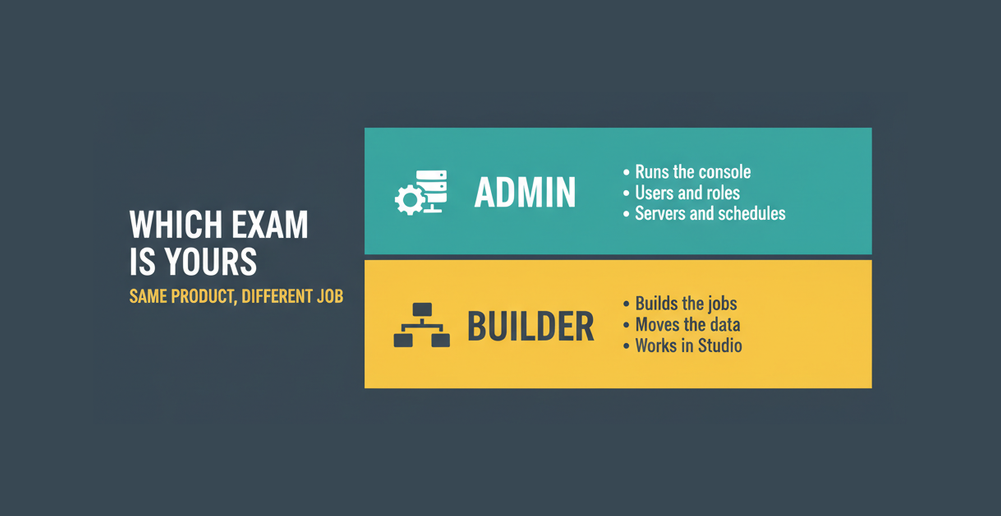
The syllabus makes the split visible. TDICA’s System Architecture topic asks you to define the developer’s role and the purpose of each module, which is a description of someone else’s job rather than your own. From there the paper moves to the administration database, authentication methods, users, roles, groups, project authorisations, and how to apply a patch. None of those are things a Job developer does.
Here is the practical test. If your week is spent deciding which component transforms which field, the developer exam is yours. If your week is spent answering why someone else’s Job did not fire at three in the morning, this is yours. Working a set of exam-style items is the fastest way to confirm it, and the sample sets on the money site’s TDICA practice exam make the administrative slant obvious within a handful of questions.
Getting this wrong is a $250 mistake plus the study time, which is reason enough to spend ten minutes on the distinction before booking.
How is the TDICA exam delivered and scored?
TDICA is 50 questions in 60 minutes with a 70 percent pass mark, priced at $250 USD and registered through Qlik. Qlik publishes the question count, duration and pass mark on its own exam-details page, and those figures match the money site’s syllabus exactly. Passing awards the Talend Data Integration Certified Administrator badge.
| Field | Value |
|---|---|
| Credential name | Talend Data Integration Certified Administrator |
| Exam code | TDICA |
| Questions | 50 |
| Duration | 60 minutes |
| Passing score | 70 percent |
| Price | $250 USD |
| Topic areas | 7 |
| Registration | Qlik |
| Recommended experience | Six months minimum with Talend products |
| Prerequisite certification | None |
Fifty questions in 60 minutes is 72 seconds each, which is brisk. It is the same per-question budget as a 75 item, 90 minute paper, but compressed into a single hour, so there is less room to recover if you stall early.
Seventy percent of 50 questions is 35 correct answers and a margin of 15. With seven topics and no published weightings, that margin is the only real guidance on how thin you can afford to be anywhere, and it is not much.
Who can actually book this exam?
Qlik states on its own exam page that the certification is available to Customers, Partners and Employees. That is an eligibility condition rather than a recommendation, and it is not stated on the money site’s syllabus page, so it is easy to miss until you try to register.
For most people reading about this exam it will not be a barrier, because anyone operating a Talend platform is by definition working for a customer or a partner. It does mean that someone studying Talend independently, with no organisational relationship, should confirm their access before building a study plan around it.
Qlik also publishes an experience expectation: a minimum of six months working with Talend products, plus knowledge of data integration architecture including advanced features such as parallelization, and hands-on exposure to installation, configuration, project management, user administration, deployment strategies and troubleshooting. That list reads almost exactly like the syllabus, which is a good sign that the exam is written to the experience rather than to a course.
The full statement sits on Qlik’s Talend administrator exam details page, which is the authoritative source for eligibility and is worth reading before you plan anything else.
What does the syllabus cover?
Seven topic areas, published as names and objectives with no percentage weightings attached to any of them. The distribution of objectives, however, is anything but even, and that is the most useful planning signal available in the absence of formal weights.
| Topic | What the objectives ask for | Objectives listed |
|---|---|---|
| Data Integration concepts | Define data integration | 1 |
| System Architecture | The developer’s role and Talend Studio, the purpose of each module, and the dependencies between modules | 3 |
| Talend Administration Center | Git repository, admin database, configuration page, authentication methods, users and roles and groups, projects and authorizations, patching | 7 |
| Talend Studio configuration | How Talend Administration Center and Talend Studio communicate | 1 |
| Deployment | JobServer and JobServer cluster, deploying a Job in the conductor, triggers, execution plans | 4 |
| Logging and Monitoring | Using logs in a TAC setup, and using the Job conductor for monitoring | 2 |
| Using Git | Configuring a repository, and using Git features from Talend Studio | 2 |
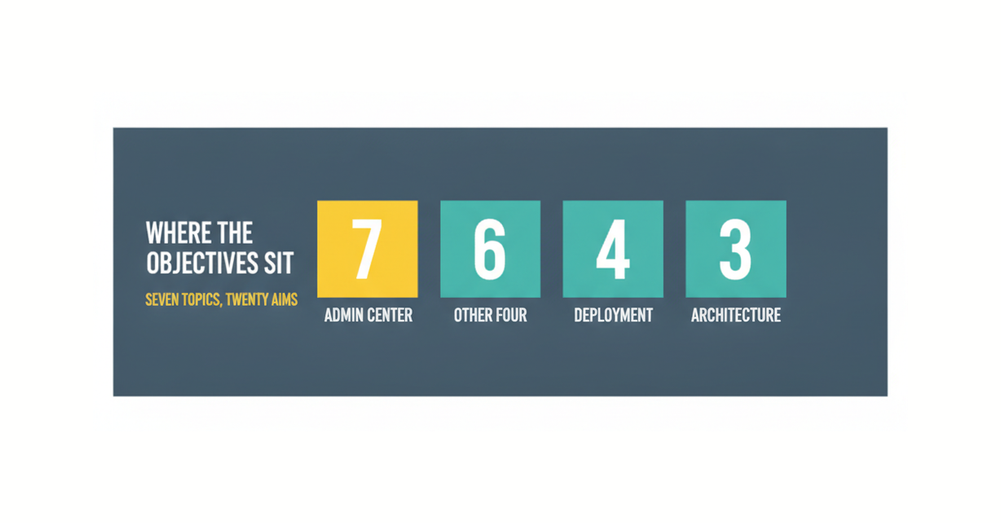
Counted that way the paper has a clear centre of gravity. Talend Administration Center holds seven of the twenty listed objectives, Deployment holds four, System Architecture three, and the remaining three topics hold six between them. A study plan that follows the objective count rather than the topic count will be aimed at the right place.
Two topics are genuinely small and should be treated as such. Data Integration concepts is one objective: define data integration. Talend Studio configuration is also one: explain how the console and the client communicate. Neither justifies a week, and both are the kind of thing you can settle in an hour. The one objective under it asks you to define data integration, which in practice means being able to place Talend against the extract transform load pattern rather than reciting a definition.
Why does Talend Administration Center dominate the paper?
Talend Administration Center is the web console from which a Talend platform is run, and it holds more exam objectives than any other topic because it is where nearly every administrative decision is actually made. Its seven objectives cover the admin database, the configuration page, authentication, users and roles and groups, project authorisations, Git repository setup, and patching.
The identity half
Three of the seven objectives are about who can do what: authentication methods, then users, roles and groups, then projects and authorizations. Those are separate objectives for a reason, because they are separate layers. Authentication decides how someone proves who they are. Roles and groups decide what kind of user they are. Project authorisations decide which work they can touch.
Questions in this area tend to describe a requirement and ask which layer solves it, so knowing the boundaries between the three is worth more than memorising any single screen.
The platform half
The other objectives are about keeping the console itself healthy: creating and configuring the administration database, working the configuration page, and applying a patch. Patching is the one candidates most often have never done, because in many organisations it happens once a year and somebody else does it.
The Talend Administration Center user guide is the reference for all of this, and it is one of the six documents the money site’s syllabus page names as recommended reading. It is worth working through rather than searching, because the exam’s objectives follow its structure closely.
What does the deployment topic actually ask for?
Deployment is the second largest topic with four objectives, and it describes the path a Job takes from being written to being run on a schedule. Configure a JobServer, configure a JobServer cluster, deploy a Job through the conductor, add triggers, and build an execution plan.
The objective wording contains a distinction worth noticing. Deploying a Job in the conductor is specified as either a compiled Job or an Artifact repository Job. Those are two different delivery models with different implications for how builds are stored and promoted, and a question that names one of them is testing whether you know the difference rather than whether you can click deploy.
Execution plans are the piece that turns individual Jobs into a pipeline. A trigger fires one thing. A plan sequences several, with dependencies between them, which is how a real nightly load is actually assembled. If you have only ever scheduled single Jobs, this is the objective to spend lab time on.
JobServer clustering is the availability story. A single JobServer is a single point of failure for every scheduled Job on the platform, and the syllabus lists the cluster as its own configuration task rather than as an advanced footnote.
Git appears on the syllabus twice, and that is deliberate
Git turns up in two separate places: once as an objective inside Talend Administration Center, where you configure the repository, and once as its own topic, where you configure a repository and use Git features from within Talend Studio. That duplication is not sloppy drafting. It is the two ends of the same connection.
On the console side, the repository is a platform setting: where project source lives, and how the server reaches it. On the Studio side, it is a developer workflow: branching, committing and pulling from inside the client. An administrator has to set up the first so that the second works, which is why the syllabus tests both.
This is also the clearest place where the administrator role touches software delivery practice rather than infrastructure. Version control for integration projects is a governance question as much as a technical one, and the discipline around it is set out in frameworks like the DAMA body of knowledge, which treats data integration as a managed function rather than a set of scripts.
Anyone who has prepared for another Talend credential will recognise the pattern of a syllabus that lists areas without weighting them. The Talend API Services Developer exam is laid out the same way, and the same planning response applies: count objectives, not topics.
How should you prepare for TDICA?
Preparation for TDICA should follow the objective count rather than the topic list, which means Talend Administration Center gets the largest share and Deployment the second. Qlik’s own recommended route is the Talend Administration Center Essentials learning path plus a dedicated preparation module, and six months of hands-on platform work underneath it.
- Confirm your eligibility first, since Qlik makes this certification available to customers, partners and employees rather than to the open public, and there is no point planning around an exam you cannot register for.
- Measure your experience against Qlik’s stated minimum of six months with Talend products, and be honest about whether you have actually administered a platform or only used one.
- Work the Talend Administration Center Essentials learning path, because it is the route Qlik names and the syllabus follows its shape closely.
- Build the identity layers separately in a lab, configuring an authentication method, then users and roles and groups, then project authorisations, so the three stay distinct in your head rather than merging into one idea.
- Stand up a JobServer and then a JobServer cluster, and deploy the same Job both as a compiled Job and through the artifact repository so the two delivery models are experiences rather than definitions.
- Build an execution plan with real dependencies between Jobs, not just a trigger on a single Job, since the plan is the objective that separates scheduling from orchestration.
- Configure Git from the console and then use it from Talend Studio, so the two halves of the version control topic connect.
- Read the Talend Administration Center User Guide end to end rather than searching it, and finish with timed sets at 50 questions in 60 minutes so the 72 second pace is familiar.
Three to five weeks is realistic for someone already running a Talend platform. Someone who has only used Talend Studio should expect longer, because most of this exam is about a console they may rarely open.
If you are building a wider Qlik profile rather than a purely Talend one, the vendor’s analytics-side credentials follow a different shape entirely, and the Qlik AI Specialist exam is a useful comparison for how much the syllabus style varies across the portfolio.
Frequently Asked Questions
How many questions are on the TDICA exam?
Fifty questions in 60 minutes, which is about 72 seconds each. Qlik publishes the same figures on its own exam-details page as the money site’s syllabus does.
What is the passing score for the Talend administrator certification?
Seventy percent, meaning 35 correct answers out of 50 and a margin of 15. Qlik does not publish a scaled score for this exam.
How much does TDICA cost?
$250 USD, registered through Qlik. The price is published on the money site’s syllabus page rather than on Qlik’s exam-details page.
What is the difference between TDICA and the Talend developer certification?
TDICA is about running the platform: the administration console, identity, deployment, monitoring and version control setup. The developer credential is about building Jobs in Talend Studio. They share a product and very little else.
Are the TDICA topics weighted?
No percentages are published for any of the seven topics. The objective counts are the next best signal: Talend Administration Center holds seven of the twenty listed objectives and Deployment holds four.
Can anyone take this exam?
Qlik states that the certification is available to Customers, Partners and Employees. Anyone operating a Talend platform in an organisation will normally qualify, but an independent learner should confirm access before planning around it.
How much experience does Qlik recommend?
A minimum of six months working with Talend products, plus knowledge of data integration architecture including advanced features such as parallelization, and hands-on exposure to installation, configuration, project management, user administration, deployment and troubleshooting.
Does the exam cover Talend Cloud?
The published syllabus is built around Talend Administration Center, the on-premises console, together with Talend Studio, JobServers and the conductor. A candidate whose estate is cloud only should know that before booking.
Is there a prerequisite certification?
None is published. Qlik sets an experience expectation rather than a certification prerequisite, and there is no required exam to sit first.
Why does Git appear twice on the syllabus?
Once as a console setting inside Talend Administration Center, where the repository is configured for the platform, and once as its own topic covering Git features used from within Talend Studio. They are the two ends of the same connection.
Conclusion
TDICA is a platform administration exam wearing a data integration name: 50 questions, 60 minutes, $250, a 70 percent bar, and seven topics whose objective counts tell you far more than their names do. Talend Administration Center holds seven of the twenty objectives, Deployment four, and three topics between them hold six.
Decide first whether you are the person who builds Jobs or the person who keeps them running, because that single question picks the exam for you. Then check your eligibility, count objectives rather than topics when you plan, and spend the bulk of your lab time in the console and on the deployment path where the paper actually lives.


