Foundation is a comforting word. It suggests a gentle introduction, an open book, and a paper designed to let you through. None of those three things is true here, and candidates who plan around the word rather than the specification are the ones who come out of the test centre surprised.
The ITIL 4 Foundation exam format is 40 multiple choice questions in 60 minutes, closed book, with a 65 percent pass mark. That works out at 26 correct answers and roughly 90 seconds per question, across a syllabus of nine topics that PeopleCert publishes without any percentage weightings at all.
Table of Contents
- What does the ITIL 4 Foundation exam actually look like?
- How many marks do you need to pass ITIL 4 Foundation?
- What does the ITIL 4 Foundation syllabus cover?
- Which topics carry the paper when nothing is weighted?
- Is ITIL 4 Foundation open book?
- What happens after you pass?
- How should you prepare for a closed-book hour?
- Frequently Asked Questions
- Conclusion
What does the ITIL 4 Foundation exam actually look like?
ITIL 4 Foundation is a 60 minute paper of 40 multiple choice questions, scheduled through PeopleCert, with a pass mark of 65 percent and a published fee of USD 463. There is no lab, no scenario simulation and no written response. Every mark on the paper comes from selecting one option out of four, and every question carries the same weight as every other.
That last point is worth pausing on, because it changes how you revise. On an exam with weighted domains you can make a calculated decision to under-prepare a 7 percent area. Here there are no weightings to trade against each other. A question about the service value chain is worth exactly what a question about service level agreements is worth, so the only sensible strategy is even coverage.
| Field | Value |
|---|---|
| Exam name | PeopleCert ITIL 4 Foundation |
| Exam code | ITIL 4 Foundation |
| Questions | 40 |
| Duration | 60 minutes |
| Passing score | 65 percent |
| Format | Multiple choice |
| Book policy | Closed book |
| Exam fee | USD 463 |
| Scheduled through | PeopleCert |
| Syllabus topics | 9, with no published weightings |
The credential itself has no alphanumeric exam code. Unlike a vendor certification that hides behind something like 1Z0-909 or MLA-C01, this one is booked and referenced by its name, which is why search results for it are crowded with training providers rather than with specification pages.
How many marks do you need to pass ITIL 4 Foundation?
Sixty-five percent of 40 marks is 26. You need 26 correct answers out of 40 to pass ITIL 4 Foundation, which means you can afford to get 14 questions wrong and still walk out certified. Expressed that way the bar sounds generous, and for a well-prepared candidate it is. The constraint is not the mark; it is the clock.
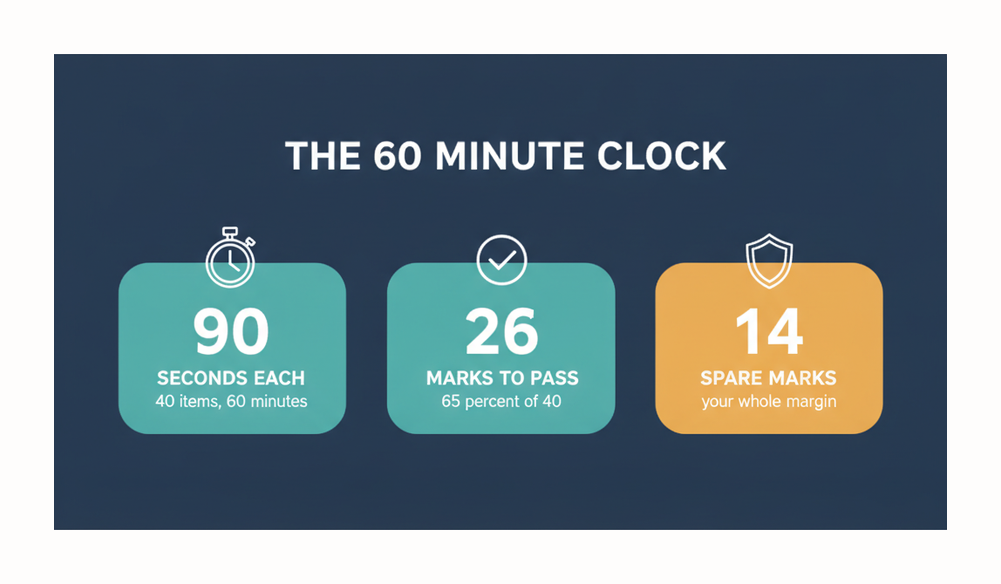
Sixty minutes across 40 questions is 90 seconds each. In practice you want to be faster than that on the recall questions so you can afford to be slower on the ones that describe a situation and ask which guiding principle applies. Those situational items are where the time goes, because they require you to read a short scenario, discard two plausible options and choose between the remaining two.
Where the 14 spare marks actually go
Candidates rarely lose marks evenly. The pattern that shows up again and again is a cluster of losses in one area the candidate skimmed, plus two or three careless errors elsewhere. Fourteen looks like a wide margin until a single under-revised topic takes eight of them on its own.
The defence is not more study hours, it is rehearsal under the clock. Working through the money site’s ITIL 4 Foundation sample questions at exam pace tells you which topic is your weak one far more honestly than rereading a chapter does, and it does it while there is still time to fix it.
There is no partial credit
Multiple choice scoring is binary. A question you half understand scores the same as one you have never seen, which is why the situational items reward a working mental model over memorised definitions. If you can say what the service value chain is for, you can usually reason your way to the right activity even when the wording is unfamiliar.
What does the ITIL 4 Foundation syllabus cover?
The ITIL 4 Foundation syllabus covers nine topics: service management concepts, the service value system, the four dimensions of service management, the guiding principles, the service value chain, ITIL practices, continual improvement, service level agreements, and key metrics and performance indicators. No percentage weighting is published for any of them.
Read as a list it looks like nine separate subjects. Read properly it is one structure described from nine angles, and that is the single most useful thing to understand before you start revising. The service value system is the container. The service value chain sits inside it. The four dimensions describe what you have to keep in balance while the chain runs, the guiding principles describe how to behave while doing it, and the practices are the named capabilities you call on.
| Syllabus topic | What the exam expects you to do with it |
|---|---|
| Service management concepts | Define a service, name its components, and explain the value it carries to stakeholders |
| Service value system | Describe the framework that creates, delivers and manages services, including governance |
| Four dimensions of service management | Name and apply organisations and people, information and technology, partners and suppliers, and value streams and processes |
| Guiding principles | Recognise which of the seven principles fits a described situation |
| Service value chain | Explain how the chain creates value by optimising activities and resources |
| ITIL practices | Match practices to working methods and to the business strategy they support |
| Continual improvement | Explain how organisations iterate and adapt processes and services |
| Service level agreements | Describe the role of SLAs in defining service quality, and where service level management fits |
| Key metrics and performance indicators | Explain why metrics and KPIs matter to service performance and effectiveness |
Two of those nine are narrower than the rest. Service level agreements and key metrics are self-contained subjects you can learn in an evening each. The other seven interlock, and studying them in isolation is the mistake that produces a cluster of lost marks.
Which topics carry the paper when nothing is weighted?
With no published weightings, the honest answer is that PeopleCert does not tell you. What can be said from the syllabus itself is that the guiding principles and the service value system are the two topics the other seven are described in terms of, which makes them the highest-leverage revision targets rather than the highest-scoring ones.
That distinction matters. Nobody can promise you that the guiding principles are worth more marks, and any page that claims a percentage split for this exam has made it up. What is verifiable is structural: the principles appear inside the service value system, the value system frames the value chain, and questions about practices routinely resolve to a judgement about which principle applies.
The seven guiding principles are the reasoning engine
Focus on value, start where you are, progress iteratively with feedback, collaborate and promote visibility, think and work holistically, keep it simple and practical, optimise and automate. Learn those seven well enough to recognise them in a paraphrase and a significant share of the situational questions stop being guesswork, because the correct option is usually the one that names the principle the scenario is quietly describing.
The four dimensions are the most commonly skipped
Organisations and people, information and technology, partners and suppliers, value streams and processes. They are easy to recite and easy to under-revise, because the list is short enough to feel finished. The exam asks you to apply them, typically by describing a failure and expecting you to identify which dimension was neglected, and that is a different skill from listing them.
Anyone approaching ITIL from a project background will recognise the pattern from the PRINCE2 7 Foundation route, which examines its principles the same way: name the rule, then recognise it in a story rather than in a definition.
Is ITIL 4 Foundation open book?
No. PeopleCert states plainly that ITIL 4 Foundation is closed book. You may not bring the official publication, printed notes or a summary sheet into the exam, and nothing is provided in the interface either. This is the detail that catches out candidates who have sat other foundation-level papers where a reference text is permitted.
The consequence is practical rather than dramatic. A closed-book hour rewards recall of names and structures, because you cannot look up which of the four dimensions covers suppliers or how many guiding principles there are. Definitions have to be in your head, not in a file you planned to consult.
Delivery and languages
PeopleCert publishes the exam in twelve languages: English, Chinese, Dutch, French, German, Hungarian, Italian, Japanese, Polish, Brazilian Portuguese, Spanish and Thai. That is an unusually wide list for an IT credential and it reflects ITIL’s reach into public sector and enterprise service desks well outside the English-speaking market.
If English is not your first language, sitting the paper in your own is worth considering even if you work in English daily. Ninety seconds a question leaves very little room for translating a scenario before you can answer it.
What happens after you pass?
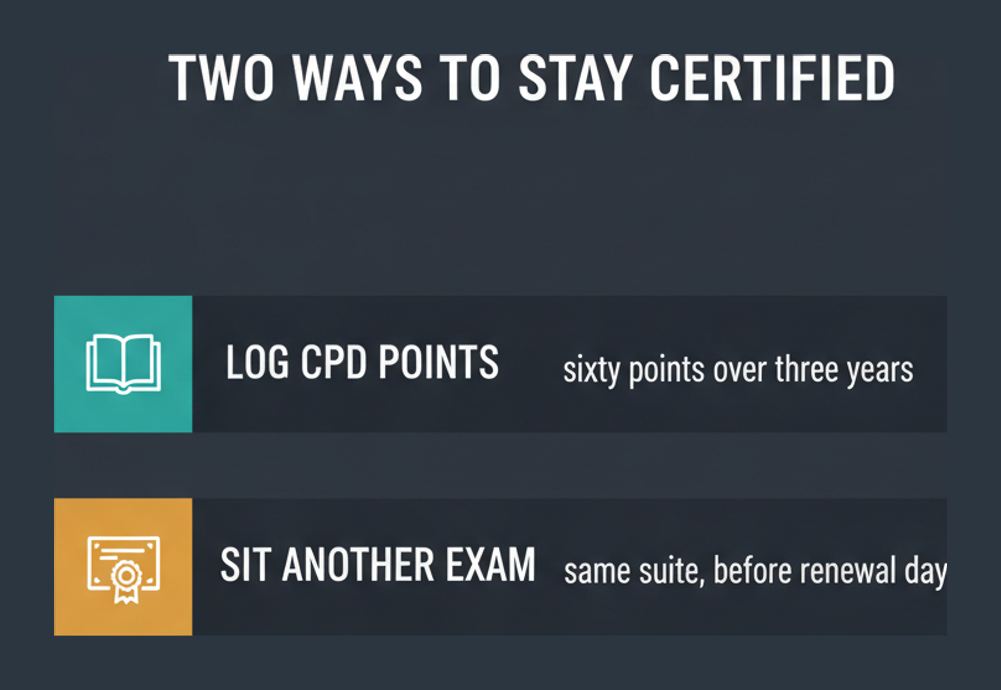
The certificate does not last forever. PeopleCert requires renewal every three years, and the standard route is to accumulate 60 CPD points through everyday professional activity and log them against your membership. The alternative route is to complete a different exam from the same product suite before your renewal date falls due.
This is the part most comparison pages leave out, and it changes the arithmetic of the decision. A credential with a recurring obligation is a different purchase from one you earn once, and it is worth knowing before you book rather than three years afterwards when a renewal notice arrives.
Which route suits which candidate
The CPD route suits somebody already working in service management, because the activities that earn points are largely things they were going to do anyway: reading, attending sessions, contributing to practice. The further-exam route suits somebody who intended to climb the ITIL ladder regardless, since the next credential renews the first one as a side effect.
The route that does not work is ignoring it. A lapsed certification is not a smaller version of a current one on a CV, and the PRINCE2 Agile Foundation credential sits in the same suite, which makes it one of the practical ways to renew while adding something genuinely new.
How should you prepare for a closed-book hour?
Preparation for ITIL 4 Foundation is short by certification standards, usually two to four weeks alongside a job, and it divides cleanly into two halves: learning one connected structure, then rehearsing recall of it at speed. Treating it as nine separate subjects is the most common way to waste that time.
- Learn the service value system first as a single diagram, so that every later topic has somewhere to attach rather than floating on its own.
- Commit the seven guiding principles to memory by name, then practise recognising each one described in a sentence that never uses its name.
- Work through the six activities of the service value chain and be able to say what each one produces, because the exam tests the flow rather than the list.
- Memorise the four dimensions and pair each with one concrete failure it would have prevented, which converts a recited list into something you can apply.
- Read the ITIL practices in groups rather than alphabetically, since the exam asks which practice fits a situation and grouping makes the distinctions visible.
- Study service level agreements and key metrics last, because they are self-contained and will still be fresh on the day.
- Sit at least two full timed papers of 40 questions in 60 minutes, closed book, to find out where your 14 marks of headroom are actually going.
What not to spend time on
Historical ITIL versions absorb a surprising amount of candidate effort and earn nothing. The exam examines ITIL 4 as it stands. Background on how the framework evolved is genuinely interesting and the documented history of ITIL explains why so much older material still circulates, but it is context rather than syllabus. The same applies to tooling: no vendor’s service desk product appears on this paper.
For the current framework itself, the ITIL service management home and the official ITIL 4 Foundation page are the two places where the specification and the certification scheme are stated by the bodies that own them.
Frequently Asked Questions
How many questions are on the ITIL 4 Foundation exam?
Forty multiple choice questions, each carrying equal weight. There is no scenario simulation, no written element and no lab component.
What is the passing score for ITIL 4 Foundation?
Sixty-five percent, which is 26 correct answers out of 40. You can lose 14 marks and still pass, though that margin disappears quickly if one topic has been under-revised.
How long is the ITIL 4 Foundation exam?
Sixty minutes, which averages 90 seconds per question. Recall questions should take far less, leaving room for the situational items that describe a scenario and ask which principle or practice applies.
Is ITIL 4 Foundation open book?
No. PeopleCert runs it closed book, so no publication, notes or summary sheet may be used. Definitions and structures have to be memorised rather than looked up.
What does the ITIL 4 Foundation exam cost?
The published exam fee is USD 463. PeopleCert also sells bundles that pair the voucher with official training materials or eLearning, which are priced separately and regionally.
Are the ITIL 4 Foundation syllabus topics weighted?
No. Nine topics are published with no percentage split, and any source claiming one has invented it. Plan for even coverage rather than trying to prioritise by marks.
Which languages is ITIL 4 Foundation available in?
Twelve: English, Chinese, Dutch, French, German, Hungarian, Italian, Japanese, Polish, Brazilian Portuguese, Spanish and Thai.
How long does ITIL 4 Foundation stay valid?
Three years. Renewal is either 60 CPD points logged through PeopleCert membership, or completing a different exam in the same product suite before the renewal date.
How long should preparation take?
Two to four weeks alongside a full-time job is typical. The syllabus is small; the work is in connecting the topics rather than in volume.
Do you need service desk experience to pass?
No, there are no prerequisites. Experience helps with the situational questions because the scenarios describe recognisable workplace problems, but the exam assumes no prior credential.
Conclusion
The specification for this exam is unusually plain, and that is exactly why it is worth reading before booking. Forty questions, 60 minutes, 26 marks to pass, closed book, nine unweighted topics and a three-year renewal obligation. Nothing there is hidden, and nothing there matches the gentle impression the word Foundation gives off.
Prepare for it as one connected structure rather than nine subjects, put disproportionate effort into the guiding principles and the service value system because everything else is described in their terms, and sit at least two full timed papers closed book before the real one. A candidate who has done that will finish inside the hour with marks to spare.
If you take one number away, take 90 seconds. It is the constraint that decides the outcome far more often than the 65 percent does.


