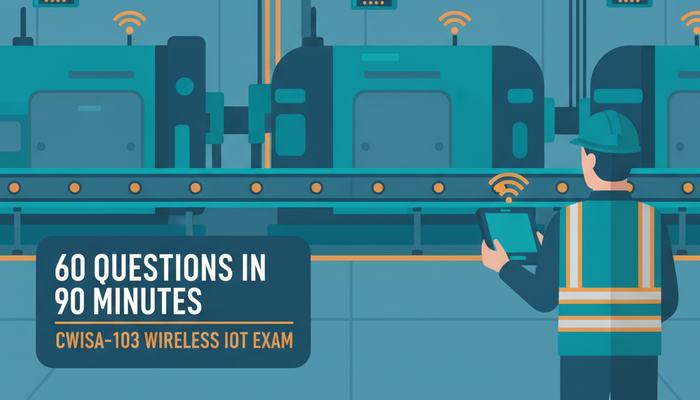
The most searched CWISA exam code is one nobody can sit any more. CWNP stopped offering CWISA-102 on 31 December 2025, yet it still pulls more search traffic every quarter than the exam that replaced it, which means a large share of the study material people find was written against a syllabus that no longer exists.
The current paper is CWISA-103, released in November 2025. The wireless IoT solutions administrator certification it awards is 60 questions in 90 minutes, scored at 70 percent, delivered through Prometric for 275 USD, and built around five domains in which planning, implementing and supporting a deployment carry 70 percent of the marks between them.
Table of Contents
- What does a wireless IoT solutions administrator actually administer?
- What are the CWISA-103 exam facts?
- Where do the marks really sit across the five domains?
- Why is so much CWISA material out of date?
- Which wireless protocols does the exam expect you to tell apart?
- Planning and implementing decide the result
- Where does CWISA sit in the CWNP scheme?
- Who should take this exam, and who should not?
- How do you prepare for 60 questions in 90 minutes?
- Frequently Asked Questions
- Conclusion
What does a wireless IoT solutions administrator actually administer?
CWISA-103 certifies that you can plan, install, support and troubleshoot wireless systems that mostly are not Wi-Fi. The syllabus covers Bluetooth and BLE, Zigbee, 802.15.4, LoRaWAN, Sigfox, cellular and location services alongside 802.11, and treats each as one option among several rather than as the default answer.
That scope is unusual, and it is the reason the credential exists. CWNP spent two decades certifying WLAN skills, where the question was almost always which 802.11 feature to use. In a building full of sensors, actuators, asset tags and gateways, the question changes: a battery-powered soil sensor reporting once an hour and a ceiling access point serving laptops are not solved by the same radio, and choosing wrongly is expensive to undo.
So the exam is a breadth paper with an operational bias. It asks what each technology is for, what the standards bodies behind them specify, how to gather requirements before choosing one, how to install and validate the result safely, and how to find the fault when a deployment misbehaves in a hospital, a factory or a farm.
What are the CWISA-103 exam facts?
CWISA-103 runs 90 minutes and contains 60 questions, with a passing score of 70 percent and a fee of 275 USD. It is delivered through Prometric and carries no published prerequisite, so anyone may register. At 90 seconds per question on average, it is a paper that rewards recognition over deliberation.
| Field | Value |
|---|---|
| Credential | CWNP Wireless IoT Solutions Administrator |
| Exam code | CWISA-103 |
| Questions | 60 |
| Duration | 90 minutes |
| Passing score | 70 percent |
| Fee | 275 USD |
| Delivery | Prometric |
| Current version | CWISA-103, released November 2025 |
| Next scheduled update | CWISA-104, 2028 |
One figure is deliberately absent from that table. CWNP does not publish a validity period for CWISA on its credential page, and no other source states one clearly, so this guide does not invent a number. Check your certification record after you pass rather than relying on a figure quoted second hand.
Where do the marks really sit across the five domains?
The five CWISA-103 domains are Wireless Technologies at 15 percent, Radio Frequency Communications at 15 percent, Planning Wireless Solutions at 20 percent, Implementing Wireless Solutions at 25 percent and Supporting Wireless Solutions at 25 percent. Implementing and Supporting together carry half the paper, which tells you plainly what the exam is about.
| Domain | Weight | Roughly how many of 60 questions |
|---|---|---|
| Wireless Technologies | 15% | 9 |
| Radio Frequency Communications | 15% | 9 |
| Planning Wireless Solutions | 20% | 12 |
| Implementing Wireless Solutions | 25% | 15 |
| Supporting Wireless Solutions | 25% | 15 |
Read the split as a warning about study habits. Candidates from a Wi-Fi background tend to over-prepare the RF domain, because it is familiar and the material is plentiful, and under-prepare the two deployment domains, where the questions are about staging, documentation, handover and fault isolation. Those two domains are worth 30 questions. RF is worth nine.
Working through items in the exam’s own format is the quickest way to find out which side of that line you are on, and a CWISA-103 practice test will expose a Planning or Supporting weakness long before the real paper does.
Why is so much CWISA material out of date?
Because the previous version only died recently and the internet has not caught up. CWNP set 31 December 2025 as the last day to sit CWISA-102, and published CWISA-103 in November 2025. Search demand still runs higher on the retired code than on the live one, so a candidate searching casually will find guides, question sets and blog posts describing an exam that cannot be booked.
The practical risk is not that the old material is wildly wrong. The two versions share a great deal, because the underlying technologies did not change overnight. The risk is at the edges: objectives that were added, terminology that moved, and emphasis that shifted toward edge compute, APIs and programmability. Those edges are exactly where a 70 percent pass mark is won or lost.
Two checks protect you. First, confirm the code on anything you study, and treat a page that never names a code as unverified. Second, read the vendor’s own objective list rather than a summary of it. CWNP publishes the current objectives as a PDF from its official CWISA page, and the 2025 objectives document is the definitive statement of what is examinable.
The good news about timing
CWNP states that the next scheduled update, CWISA-104, is not due until 2028. For a candidate that is an unusually long runway: study material bought now stays current for years, and there is no reason to rush a booking in case the syllabus shifts underneath you.
Which wireless protocols does the exam expect you to tell apart?
CWISA-103 expects working familiarity with traditional 802.11 WLANs, Wi-Fi HaLow, Bluetooth and BLE, Zigbee and other 802.15.4 protocols, LoRaWAN, Sigfox, cellular connectivity and location services such as RTLS, beaconing and geofencing. You are not asked to configure each one, but you are asked to choose correctly between them.
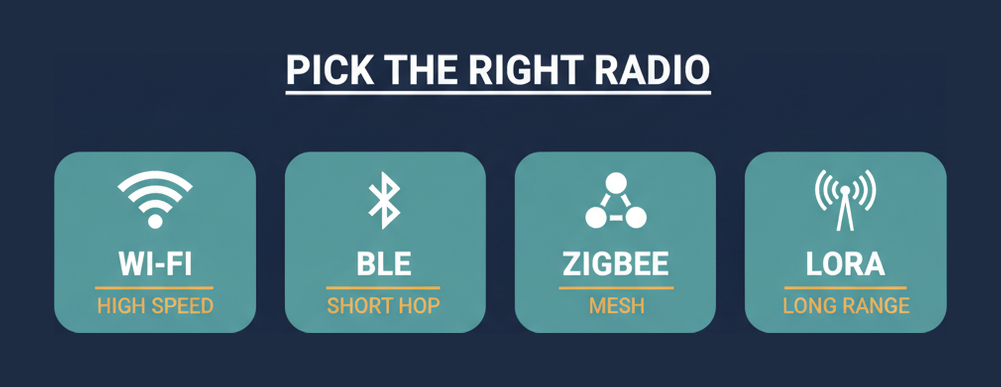
The distinctions that carry marks are practical ones: range against battery life, throughput against device density, licensed spectrum against unlicensed, and mesh against star topology. A question rarely asks what LoRaWAN is. It describes a site, a duty cycle and a power budget, and asks which technology fits.
Behind those choices sit the organisations the syllabus names explicitly, and the exam expects you to know which body governs what. The IEEE 802.11 working group writes the wireless LAN standards, including the 802.11ah amendment marketed as Wi-Fi HaLow, while the LoRa Alliance maintains the LoRaWAN specification. The Wi-Fi Alliance certifies interoperability rather than writing standards, the Bluetooth SIG and the Connectivity Standards Alliance own their own specifications, and regulators such as the FCC decide what you may transmit and at what power.
The data layer counts too
Supporting Wireless Solutions reaches into territory that surprises people arriving from a pure RF background. The objectives name MQTT, RESTful APIs, Webhooks, WebSockets and OpenConfig, and expect recognition of JSON, XML, YAML and YANG as data structures. You are also expected to know what scripting languages are typically used around these systems. None of it requires you to write code, and all of it requires you to recognise the terms in context.
Planning and implementing decide the result
Planning Wireless Solutions is worth 20 percent and Implementing Wireless Solutions 25 percent, and together they describe a project rather than a technology. The planning objectives run through requirements, constraints, technology selection and technical design; the implementing objectives run through pilot testing, configuration, staging, installation, validation and handover.
Planning questions tend to start with a constraint rather than a capability. Budget, regulation, existing infrastructure, business policy and system dependency all appear as explicit objectives, alongside stakeholder identification. The examinable skill is recognising which constraint dominates a scenario, because that is what eliminates the wrong answers.
Implementing questions are more physical than candidates expect. The objectives name mounting equipment to applicable safety requirements and building codes, configuring wired and wireless connectivity, configuring cloud connectivity where appropriate, and implementing authentication, authorisation, encryption, monitoring and onboarding for the chosen system. Then they name the part most engineers skip: documentation, staff training and a final stakeholder meeting.
Supporting Wireless Solutions closes the loop with troubleshooting and vertical context. Interference, signal strength, misconfiguration, security misconfiguration, failing hardware, firmware and driver problems and faulty installation all appear by name, and the exam frames them inside healthcare, industrial, smart city, agricultural, retail, education and large public venue deployments, where the same symptom has different causes and different consequences.
Where does CWISA sit in the CWNP scheme?
CWISA is the entry point of CWNP’s wireless IoT track, which then branches into CWICP for connectivity, CWIIP for integration and CWIDP for design, and culminates in CWISE at expert level. It is a separate ladder from the Wi-Fi track that runs CWTS, CWNA, CWAP, CWDP, CWSP and CWNE.
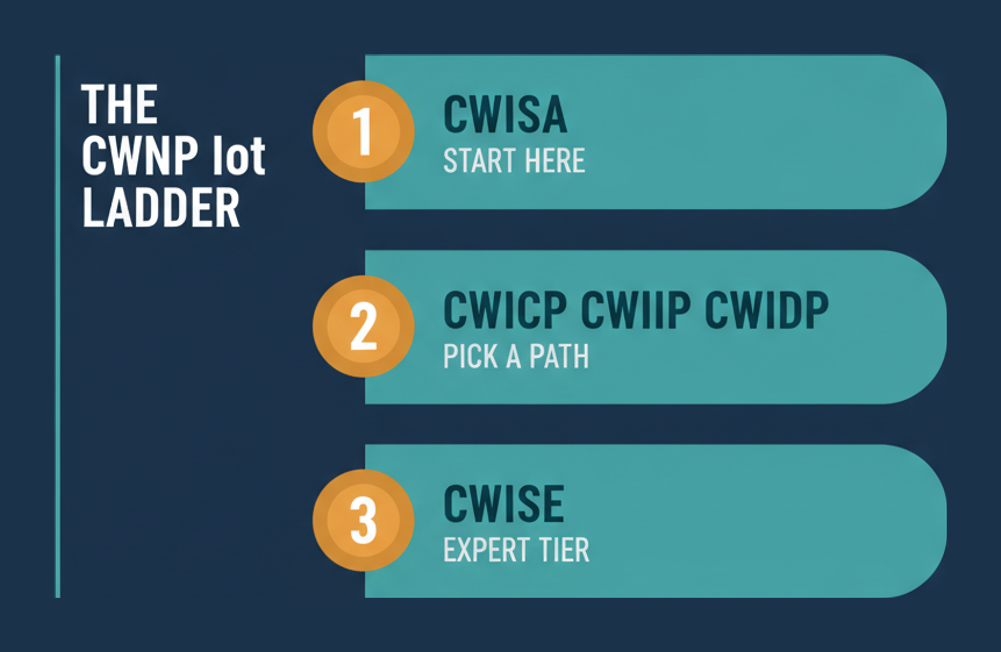
Knowing which ladder you are on matters more than it sounds. The Wi-Fi track goes deep on 802.11: analysis, design and security of wireless LANs specifically. The IoT track goes wide across the protocols an enterprise actually deploys around those LANs. Someone who wants to specialise in RF analysis should be looking at the Wi-Fi ladder, not this one.
If the connectivity layer is where your work sits, the next rung is the natural follow-on, and the CWICP-202 exam layout shows how much more specific the professional tier becomes once the administrator paper is behind you.
Who should take this exam, and who should not?
CWISA-103 suits network administrators inheriting IoT deployments, integrators and installers who are asked to specify wireless technologies, facilities and operational technology staff whose systems have quietly become networked, and Wi-Fi professionals who keep being handed projects that are not Wi-Fi. It has no prerequisite, so none of those groups needs another credential first.
It is a poor fit for two groups. Anyone whose work is purely 802.11 design or analysis will get more from the Wi-Fi ladder, where the depth is. Anyone looking for a security credential will find the coverage here deliberately broad rather than deep, since security appears as one objective inside implementation rather than as a domain of its own.
That second point is worth separating clearly, because the two subjects are easy to confuse. Securing a wireless network to an examinable standard is a different discipline with its own paper, and the CWSP-208 security professional route covers authentication architecture and attack analysis at a depth CWISA never attempts.
How do you prepare for 60 questions in 90 minutes?
Work outward from the objectives document, weight your time by domain, and rehearse under the clock. Ninety minutes for 60 questions allows 90 seconds each, which is comfortable for recall and tight for reasoning, so the goal of preparation is to convert as much of the syllabus as possible into recognition.
- Download the official objectives and turn each bullet into a question you can answer aloud. The list is the exam blueprint, and anything not on it is not examinable.
- Spend roughly half your study time on Planning, Implementing and Supporting. They are 70 percent of the paper and the least covered by general wireless material.
- Build a one-page comparison of the protocols: range, data rate, power profile, topology and typical use. Most technology questions collapse to that table.
- Learn which body owns which standard. It is cheap to memorise and it appears in the first domain.
- Read the data and API terms until they are familiar. MQTT, REST, JSON and YANG need recognition, not fluency.
- Sit a full timed set before booking, and treat anything below the mid seventies as a signal to go back to the objective list rather than to sit the exam early.
One practical note on the fee: at 275 USD a retake is not trivial, and there is no published discount for a second attempt. Passing first time is worth a fortnight of extra preparation.
Frequently Asked Questions
How many questions are on the CWISA-103 exam?
Sixty questions in 90 minutes, which works out at 90 seconds per question.
What is the passing score for CWISA-103?
Seventy percent. On a 60 question paper that means 42 correct answers.
How much does the CWISA-103 exam cost?
275 USD, delivered through Prometric. CWNP publishes no retake discount for this exam.
Is CWISA-102 still available?
No. CWNP states that the last day to take CWISA-102 was 31 December 2025. Any study material written for it describes a retired version, which is why checking the code on what you read matters.
When will CWISA-103 be replaced?
CWNP lists CWISA-104 as the next scheduled update, due in 2028. That is an unusually long runway for a wireless credential.
Are there prerequisites for the wireless IoT solutions administrator certification?
None are published. CWISA sits at the administrator tier and is designed as the entry point to the CWNP wireless IoT track, so no prior credential is required.
Is CWISA a Wi-Fi certification?
Only partly. It covers 802.11 alongside Bluetooth and BLE, Zigbee, other 802.15.4 protocols, LoRaWAN, Sigfox, cellular and location services. If you want depth in 802.11 specifically, the CWNA and CWAP route is the better fit.
Which domain should I study first?
Implementing and Supporting, at 25 percent each. They carry half the paper between them and are the least well served by general wireless reading.
Does the exam require programming?
No. It expects you to recognise MQTT, REST, Webhooks, WebSockets, OpenConfig, JSON, XML, YAML and YANG, and to know where scripting fits in an IoT deployment, but it does not ask you to write code.
How long is the certification valid?
CWNP does not publish a validity period for CWISA on its credential page, so this guide does not state one. Confirm the expiry on your own certification record once you have passed.
Conclusion
CWISA-103 is a breadth credential for people who look after wireless systems that are not only Wi-Fi. Sixty questions, 90 minutes, a 70 percent pass mark, 275 USD, and five domains in which planning, implementing and supporting a deployment carry 70 percent of the marks.
Two things decide the outcome. Study the current code, because the retired CWISA-102 still dominates search results and the material written for it misses the edges where the pass mark is decided. Then weight your preparation toward the deployment domains rather than the radio theory, however comfortable the theory feels.
Download the official objectives, build the protocol comparison table, and sit a full timed set before you book. With CWISA-104 not due until 2028, the version you prepare for now will still be the current one for a long time.


