Read the name and you assume the exam is about using artificial intelligence to do security work faster. Automated triage, AI-assisted code review, a chatbot that summarises an incident. That material is on the paper, and it is 24 percent of it.
The largest domain, at 40 percent, goes the other way. It is about securing the AI systems themselves: threat modelling a model, putting a firewall in front of a prompt, deciding who can reach the training data. The CompTIA SecAI+ certification is mostly a defending-AI credential, and the published weightings say so plainly.
Table of Contents
- What does SecAI+ actually examine?
- What are the CY0-001 exam facts?
- Domain 1: how much AI theory do you need?
- Domain 2: what does securing an AI system involve?
- Domain 3: where does AI help the defender?
- Domain 4: what does the governance domain expect?
- Who should take this exam?
- How should you prepare?
- Frequently Asked Questions
- Conclusion
What does SecAI+ actually examine?
Four domains, weighted, and the weighting is the answer. Securing AI systems takes 40 percent. AI-assisted security, the domain most people expect to dominate, takes 24 percent. Basic AI concepts take 17 percent and governance, risk and compliance take 19 percent. Defending AI outweighs using it by a clear margin.
| Domain | Weight | What it is |
|---|---|---|
| Basic AI concepts related to cybersecurity | 17% | The vocabulary and mechanics of models, training and prompts |
| Securing AI systems | 40% | Threat modelling, guardrails, gateway controls, access to models and data |
| AI-assisted security | 24% | Using AI tooling for defence, and how attackers use it too |
| AI governance, risk and compliance | 19% | Structures, roles, responsible AI, regulation |
That single number reorganises how you should prepare. Two fifths of the questions concern a class of asset most security teams did not own two years ago, and the controls involved have no equivalent on the exams you have already passed. An experienced defender will recognise most of domain 3 on sight and very little of domain 2.
It also explains who the credential is aimed at. This is not a course in prompt writing. It assumes your organisation now runs models in production, exposes them to users, and has to answer for what they do, and it tests whether you can secure and govern that. The full SecAI+ exam syllabus sets out every objective under those four headings.
What are the CY0-001 exam facts?
CY0-001 runs 60 minutes with up to 60 questions, a mix of multiple choice and performance-based items, scored on a scale of 100 to 900 with 600 required to pass. It costs 298 USD, is delivered through Pearson VUE, and is available in English and Japanese.
| Field | Value |
|---|---|
| Exam code | CY0-001 |
| Exam name | CompTIA SecAI+ |
| Questions | Maximum of 60, multiple choice and performance-based |
| Duration | 60 minutes |
| Passing score | 600 on a scale of 100 to 900 |
| Price | 298 USD |
| Delivery | Pearson VUE |
| Languages | English and Japanese |
| Launched | 17 February 2026 |
| Domains | 4, weighted 17, 40, 24 and 19 percent |
Two details in that table are worth drawing out. The question count is a maximum rather than a fixed number, and the paper mixes performance-based items with multiple choice, which CompTIA states on its official SecAI+ page. Sixty minutes for up to 60 questions is already tight at a minute each, and performance-based items take several minutes, so the practical arithmetic is worse than it looks.
The second is the launch date. SecAI+ went live on 17 February 2026, which means the beta period is over. Searches for a SecAI beta exam still circulate; there is nothing to wait for. CompTIA estimates retirement roughly three years after launch, so the credential has a normal useful life ahead of it rather than a short one.
Domain 1: how much AI theory do you need?
Enough to hold a precise conversation, and no more. Seventeen percent covers the vocabulary: the types of AI, how models are trained, how prompts are constructed, and how data is prepared. It is a grounding domain rather than a mathematical one, and nothing in it requires you to build a model.
Three groups make up the bulk of it. The first is model types, which spans generative AI, machine learning, statistical learning, transformers, deep learning, generative adversarial networks, natural language processing, and both large and small language models. The distinction between a large and a small language model matters more than it first appears, because it drives where a model runs and therefore what you can control about it.
The second is training technique: supervised, unsupervised, reinforcement and federated learning, plus model validation, fine-tuning, epochs, pruning and quantization. The third is prompt engineering, covering system and user prompts, zero-shot, one-shot and multi-shot prompting, system roles and templates. Prompt structure returns in domain 2 as a control, so learning it properly here pays twice.
Data security closes the domain: cleansing, verification, lineage, integrity, provenance, augmentation and balancing. Data lineage and provenance are the two to know cold, because both reappear in the governance domain as audit and compliance obligations.
Domain 2: what does securing an AI system involve?
Threat modelling it, wrapping it in guardrails, and controlling access to the model and its data. At 40 percent this is the largest block on the exam by a wide margin, and it is built on named public frameworks rather than on abstractions, which makes it unusually studiable from primary sources.
Threat modelling with named frameworks
The syllabus names six: the OWASP Top 10, the OWASP LLM Top 10, the OWASP Machine Learning Security Top 10, the MIT AI Risk Repository, MITRE ATLAS, and the CVE AI Working Group. Knowing which one applies to a described scenario is the examinable skill. ATLAS catalogues adversary tactics against AI systems; the OWASP lists enumerate the vulnerability classes.
Model and gateway controls
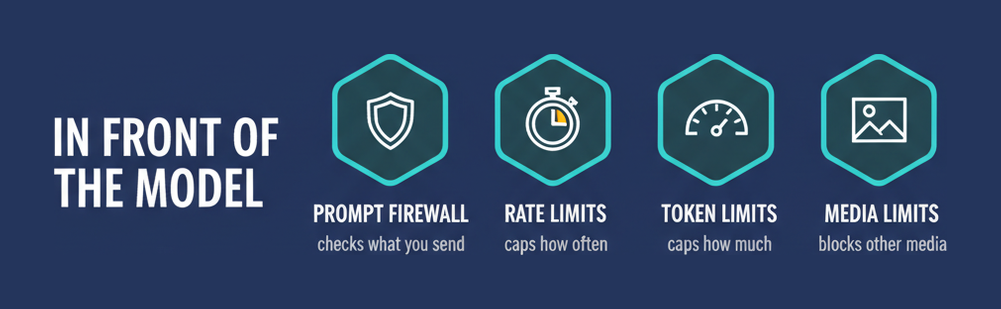
This is the material with no equivalent anywhere on Security+ or CySA+, and it is where preparation time should concentrate. Model controls cover model evaluation, guardrails and prompt templates. Gateway controls sit in front of the model and are the newer idea:
- Prompt firewalls, which inspect what is sent to a model rather than what is sent to a network
- Rate limits and token limits, which cap how much a caller can consume
- Input quotas covering data size and quantity
- Modality limits, restricting whether a caller may send images or audio as well as text
- Endpoint access controls on the interface itself
Guardrail testing and validation is examinable separately from building guardrails, and the distinction is deliberate. A guardrail nobody has tried to defeat is an assumption, not a control, so expect scenarios that ask how you would prove one works.
Access control
The domain closes on access to the model and access to the data behind it, treated as two separate problems. That separation is the point. Someone may legitimately query a model while having no business reaching the training data, and the exam expects you to control each independently.
Domain 3: where does AI help the defender?
In tooling and automation, and it helps the attacker in the same breath. Twenty-four percent splits three ways: using AI-enabled tools for security tasks, understanding how AI enables or enhances attack vectors, and automating security work. Most experienced defenders will find this the familiar half of the paper.
The tooling list covers plug-ins for development environments, browsers and the command line, plus chatbots, personal assistants and Model Context Protocol servers. The use cases run from signature matching, code quality and linting, and vulnerability analysis through to automated penetration testing, anomaly detection, pattern recognition, incident management, threat modelling, fraud detection, translation and summarisation.
The offensive half deserves equal study and usually gets less. It covers AI-generated content and deepfakes used for impersonation, misinformation and disinformation, adversarial networks, reconnaissance, social engineering, obfuscation, and automated data correlation for generating attacks, discovering attack vectors, and producing payloads, malware, honeypots and distributed denial of service traffic.
Automation closes the domain: low-code and no-code scripting, document synthesis and summarisation, incident response ticket management, change management with AI-assisted approvals and automated deployment or rollback, AI agents, and a continuous integration pipeline covering code scanning, software composition analysis, and unit, regression and model testing. Model testing inside a pipeline is the item most likely to catch out someone who prepared only on traditional application security.
Domain 4: what does the governance domain expect?
That you can describe how an organisation governs AI, name the risks that come with it, and identify which regulation applies. Nineteen percent, and it is more concrete than governance domains usually are, because the syllabus names actual instruments rather than talking about policy in general terms.
Structures come first: an AI Center of Excellence, and the policies and procedures around it. Then roles, and the list is long enough to be examinable in its own right, spanning data scientist, AI architect, machine learning engineer, platform engineer, MLOps engineer, AI security architect, AI governance engineer, AI risk analyst, AI auditor and data engineer. Learn which ones own risk decisions rather than trying to memorise every description.
Responsible AI covers fairness, reliability and safety, transparency, privacy and security, differential privacy, explainability, inclusiveness, accountability, consistency and awareness training. The risk list is more practical: introduced bias, accidental data leakage, reputational loss, model accuracy and performance, intellectual property exposure, autonomous systems, and shadow AI, which is shadow IT for people quietly using unsanctioned models.
Compliance names four external instruments: the EU AI Act, OECD standards, ISO AI standards and the NIST AI Risk Management Framework. Alongside them sit corporate policy questions: sanctioned against unsanctioned use, private against public models, sensitive data governance, third-party compliance evaluations and data sovereignty. You are not expected to recite the EU AI Act, but you are expected to know what each instrument is for.
Who should take this exam?
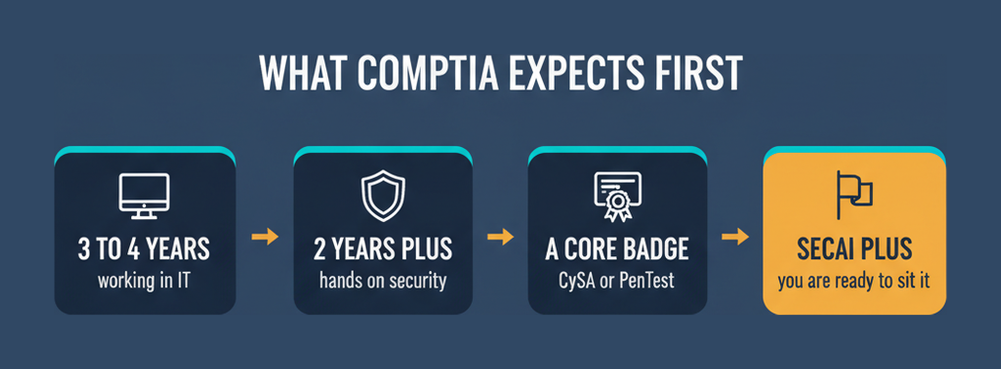
Working security practitioners whose organisations have started running AI in production. CompTIA recommends three to four years in IT and at least two years of hands-on cybersecurity, with Security+, CySA+ or PenTest+ already held or equivalent experience in place. This is not an entry point into the field.
It fits most cleanly where someone already owns defensive work and has been handed AI systems to protect: security analysts whose estate now includes model endpoints, security architects designing controls around them, and engineers asked to put a gateway in front of a model that is already live. The governance domain also makes it genuinely useful to risk and compliance staff who need the vocabulary rather than the implementation.
It fits less well if your interest is using AI tools to work faster. That is domain 3, it is a quarter of the exam, and a shorter course would serve you better. It is also a poor first certification, for the reason CompTIA states: the paper assumes the security fundamentals rather than teaching them, and the CySA+ analyst credential is one of the routes it expects you to have taken first.
One honest caveat about newness. The exam launched in February 2026, so there is little community material, few study guides and no long track record of employer recognition. That is the trade for being early, and it cuts both ways.
How should you prepare?
Spend your time in proportion to the weightings, and study domain 2 from the primary sources it names rather than from summaries of them. Forty percent of the paper sits in one domain built on public frameworks that are free to read, which is an unusually direct route from syllabus to preparation.
- Read the four domain weightings and plan your hours against them, because 40 percent in one domain is not a hint you can ignore.
- Work through the OWASP LLM Top 10 and the OWASP Machine Learning Security Top 10 directly, since the syllabus names both by title.
- Read MITRE ATLAS as a tactics catalogue and practise mapping a described attack onto it.
- Learn the gateway controls as a set, prompt firewalls, rate and token limits, input quotas and modality limits, because none of them appear on the exams you have already passed.
- Build or borrow one model endpoint and put a control in front of it, so guardrail testing is something you have done rather than read about.
- Skim the NIST AI Risk Management Framework and note what the EU AI Act, OECD and ISO standards each cover, at the level of purpose rather than clause.
- Practise performance-based items under time, since up to 60 questions in 60 minutes leaves no room to think slowly.
If your background is AI rather than security, invert that plan. Domain 1 will already be familiar and domains 2 and 4 will not, and the security reasoning behind a control is what the questions actually test. A related view of how CompTIA frames AI content appears in the DataAI exam material, which approaches the same technology from the data side.
Frequently Asked Questions
How many questions are on the CY0-001 exam?
A maximum of 60, mixing multiple choice and performance-based items, in 60 minutes.
What is the passing score for SecAI+?
Six hundred on a scale of 100 to 900. It is a scaled score, not a percentage.
How much does SecAI+ cost?
Two hundred and ninety eight US dollars. CompTIA does not publish a price on its own exam page, so confirm the current figure when you book through Pearson VUE.
Is SecAI+ about using AI or about securing AI?
Mostly securing it. The securing AI systems domain is 40 percent of the exam, while the AI-assisted security domain, which covers using AI for defensive work, is 24 percent.
Is the exam still in beta?
No. SecAI+ launched on 17 February 2026, so the beta period is over and the live exam is available.
What experience does CompTIA recommend?
Three to four years in IT and at least two years of hands-on cybersecurity, with Security+, CySA+ or PenTest+ recommended beforehand.
What are the four domains and their weightings?
Basic AI concepts related to cybersecurity at 17 percent, securing AI systems at 40 percent, AI-assisted security at 24 percent, and AI governance, risk and compliance at 19 percent.
What languages is the exam available in?
English and Japanese.
When will SecAI+ retire?
CompTIA estimates retirement about three years after launch, which places it around early 2029, though that is an estimate rather than a fixed date.
Do I need to know how to build machine learning models?
No. Domain 1 covers model types, training techniques and prompt engineering as vocabulary and mechanics, not as a development skill.
Conclusion
SecAI+ is a defending-AI credential wearing a name that suggests otherwise. Up to 60 questions in 60 minutes, 600 to pass on a 100 to 900 scale, 298 USD, and four domains in which securing AI systems alone takes 40 percent.
Plan against that number. The gateway controls, guardrail validation and model access material in domain 2 have no equivalent on the security exams you have already passed, while most of domain 3 will be recognisable from work you already do. Study the named frameworks directly, because the syllabus points at them by title and they are free to read.
Check the current price when you book, since CompTIA publishes none on its exam page, and go in expecting performance-based items rather than a pure multiple choice paper. Then work the domains in proportion to their weight, which is the clearest instruction this syllabus gives.


