This is not the dashboard exam. Nothing in it asks you to build a sheet, choose a chart or lay out an application, and a developer who has spent two years making front ends will find surprisingly little of their daily work on the paper. Qlik has a separate credential for that.
The Qlik Sense Data Architect certification sits a layer underneath, in the load script and the model it produces, and the published weightings make the point without ambiguity: data transformations and data model design take 66 percent of the exam between them. Connectivity and validation, which most candidates assume will matter, take 14.
Table of Contents
- QSDA or QSBA, which exam is yours?
- What are the QSDA exam facts?
- Where does the exam weight actually sit?
- What does the 38 percent transformations topic cover?
- What does data model design ask for?
- The three light topics, and why light is not skippable
- What does Qlik expect you to have built already?
- How should you prepare?
- Frequently Asked Questions
- Conclusion
QSDA or QSBA, which exam is yours?
QSDA is the data architect exam and QSBA is the business analyst one. The first tests how you get data into Qlik Sense and shape it; the second tests what you build on top once it is there. They are separate credentials for separate jobs, and picking the wrong one is the most expensive mistake available here.
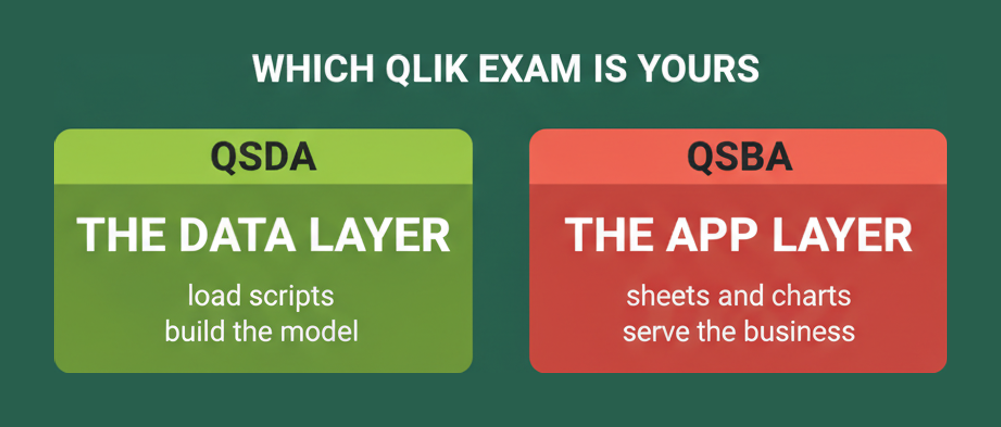
The clean test is where your work happens. If you spend your time in the data load editor, writing scripts, joining tables, deciding what the model should look like and why a chart is slow, QSDA is the exam that describes you. If you spend it in the app, choosing visualisations, building sheets and working with business users on what they want to see, the business analyst route fits better.
There is overlap in one place, and the blueprint puts it first. Twenty percent of QSDA is identifying requirements, which includes working out what business users actually need, who the stakeholders are, and what granularity the numbers should sit at. A data architect who cannot do that builds technically sound models that answer nobody’s question, so Qlik tests it before it tests any script.
Qlik lists both credentials, and several others, on its certifications overview. Read the role description rather than the title before booking anything.
What are the QSDA exam facts?
QSDA is 50 questions in 90 minutes at a 62 percent pass mark, priced at 250 USD, delivered as a proctored multiple choice exam you sit remotely. Five topics are published, all of them weighted, and the exam is platform-neutral across client-managed Qlik Sense and Qlik Cloud.
| Field | Value |
|---|---|
| Exam name | Qlik Sense Data Architect |
| Exam code | QSDA |
| Questions | 50 |
| Duration | 90 minutes |
| Passing score | 62 percent |
| Price | 250 USD |
| Delivery | Proctored, remote, machine locked down with webcam supervision |
| Platform scope | Client-managed Qlik Sense and Qlik Cloud |
| Topics | 5, weighted 20, 8, 28, 38 and 6 percent |
One number in that table is worth stating carefully. Some exam catalogues list this paper at 120 minutes. Qlik’s own exam details page gives 90, and that is the figure used throughout here. The difference is not academic: 50 questions in 90 minutes is 108 seconds each rather than 144, which is enough to change how you pace a scenario-heavy paper.
Qlik is also unusually open about how the pass mark works. It states that exam content is updated periodically, that the number and difficulty of questions may change, and that the passing score is adjusted to maintain a consistent standard. So 62 percent is not a fixed bar you can calibrate against forever; it is the current expression of a constant standard, and the standard is what you are actually preparing for.
Price is the one field Qlik does not publish on that page, so treat 250 USD as the catalogue figure and confirm it when you book.
Where does the exam weight actually sit?
In the script and the model. Data transformations is 38 percent and data model design is 28, which is 66 percent of the paper in two topics. Identify requirements takes 20 percent, data connectivity 8 and validation 6. The distribution is published by both the exam catalogue and Qlik, and the two agree exactly.
| Topic | Weight | What it is |
|---|---|---|
| Identify Requirements | 20% | Business needs, stakeholders, granularity, dimensionality, security level |
| Data Connectivity | 8% | Which sources and connectors, and how to create the connections |
| Data Model Design | 28% | Measures and attributes, model type, optimisation, efficient structures |
| Data Transformations | 38% | Building content, nulls, documentation, dates, script organisation, incremental loading |
| Validation | 6% | Testing scripts and testing data |
Read those numbers against how people usually prepare and the mismatch is obvious. Candidates tend to revise connectors, because connectors are concrete and easy to list. Connectivity is 8 percent, roughly four questions. Meanwhile the load script, which is harder to revise because it is a skill rather than a list, is nearly two fifths of the paper.
The practical instruction is to spend your time in proportion. If you have ten study sessions, six or seven belong in the script and the model, two in requirements, and the remaining one across connectivity and validation together.
What does the 38 percent transformations topic cover?
Everything that happens between a raw source and a usable model. Six objectives: building data content to requirements, handling nulls and blanks so filtering behaves, documenting load scripts, date handling, script organisation and cleansing, and the variables needed for incremental loading in the extract layer.
Incremental loading is the one to take seriously. It is named explicitly, it sits in the extract layer, and it is production work rather than exam theory: you are being asked how to load only what has changed since the last run, which means understanding what drives the decision and which variables carry the state. Anyone who has only ever done full reloads on small datasets will find this unfamiliar.
Null and blank handling earns its place for a subtler reason. The objective ties it to filtering, not to correctness, and that connection is the insight. A null that is technically harmless in the data can make a selection behave in a way a user reads as a bug, so the exam wants you to reason about the consequence in the application rather than about the value in the field.
Two objectives are about discipline rather than technique: documenting load scripts, and script organisation and cleansing. They look like filler and are not. A script nobody can follow is a maintenance liability, and Qlik has chosen to examine that directly. Qlik’s load script documentation is the reference if your habits were learned on the job rather than from the manual.
What does data model design ask for?
Four objectives across 28 percent: determining measures and attributes from each source, identifying the appropriate type of data model, optimising the model for Qlik Sense specifically, and implementing data structures efficiently. It is the judgement half of the exam, where transformations is the execution half.
The phrase doing the work is “appropriate type of data model”. You are expected to choose, with reasons, rather than to apply one shape everywhere. That means recognising when a star schema is right, when a snowflake is acceptable, when to denormalise for speed, and when the answer is to split a model rather than stretch one.
“Optimised for Qlik Sense” is deliberate too. Generic warehouse modelling instincts do not transfer cleanly, because Qlik’s associative engine rewards different choices from a relational query engine: synthetic keys and circular references are problems here that would be unremarkable elsewhere, and column cardinality affects memory in ways that matter at load time.
Requirements feed straight into this, which is why the blueprint puts them first. Granularity, aggregation level and the need for slowly changing dimensions are all named in the 20 percent requirements topic, and each is a decision that constrains the model before you write a line of script. Recognising that need early is exactly what the exam is testing.
The three light topics, and why light is not skippable
Requirements at 20 percent, connectivity at 8 and validation at 6 make up the remaining third. Only two of them are genuinely small, and treating any of them as optional is how a candidate with strong scripting skills still fails.
Requirements is not light at all, despite sitting outside the two heavy topics. Twenty percent is roughly ten questions, and its objectives are the ones least improved by technical practice: identifying stakeholders from a scenario, settling metrics and levels of granularity, and determining the appropriate level of security. These are consulting questions, and they reward having sat in the meeting rather than having read about it.
Connectivity at 8 percent is genuinely small, and it is also the easiest topic to secure. Two objectives, both concrete: which sources and connectors a situation needs, and the right way to create those connections. A single focused session covers it, and it would be careless to lose four questions to something that finite.
Validation at 6 percent is the smallest topic on the paper and the one most often left to chance. Two objectives, testing scripts and testing data, and they are worth understanding as separate activities: a script can run perfectly and still produce a model that is wrong. Three questions is not many, but at a 62 percent pass mark the margin is thin enough that three is worth having.
What does Qlik expect you to have built already?
Production applications, not practice ones. Qlik publishes a recommended experience list, and it reads as a description of a working data architect rather than a study prerequisite, which tells you how the questions will be framed.
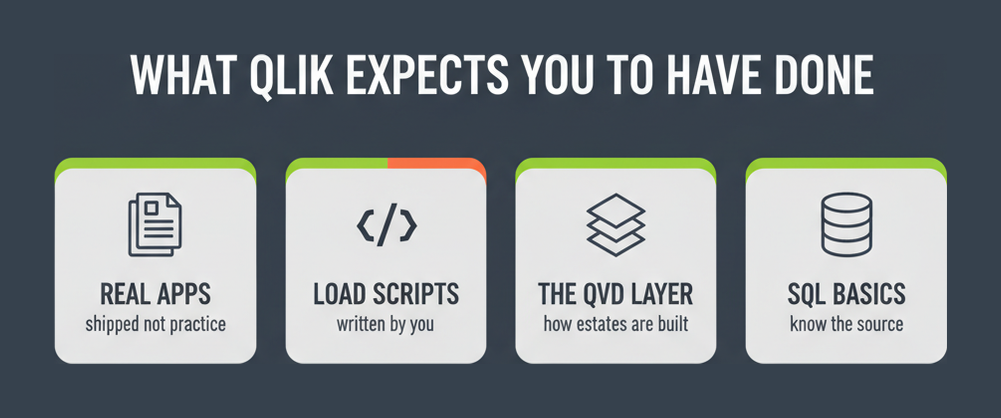
- Practical experience developing multiple production-quality Qlik Sense applications
- Ability to write Qlik Sense load scripts and validate data
- A basic understanding of extract, transform and load as a discipline
- Creating and using connectors to various data sources
- Understanding the QVD layer and the architecture of the Qlik platform
- Ability to architect data to provide optimal performance
- Familiarity with SQL and relational databases
The QVD layer entry is the one to check yourself against honestly. QVD files are Qlik’s own storage format and the layered extract, transform and load pattern built on them is how serious Qlik estates are organised. If you have never worked in a layered architecture, the incremental loading material in the transformations topic will feel abstract, because it exists to serve exactly that pattern.
The SQL entry matters for a different reason. Much of what a Qlik data architect does is decide what to push back to the source and what to do in the script, and that decision needs enough SQL to know which is cheaper. The exam is platform-neutral across client-managed and cloud deployments, so nothing here depends on where your Qlik sits. A related view of how Qlik frames a specialist credential appears in the QAIS specialist guide.
How should you prepare?
Work in the script, in proportion to the weightings, on a model you did not build. Reading about transformations does not prepare you for a paper where nearly two fifths of the questions describe a situation and ask which method is correct.
- Split your study time to match the weights, with roughly two thirds of it in transformations and model design.
- Build one layered extract, transform and load setup with a QVD layer, even a small one, so the architecture is something you have assembled.
- Implement incremental loading end to end and work out for yourself which variables carry the state between runs.
- Take a model somebody else built and find its synthetic keys and circular references, because diagnosing is closer to the exam than designing.
- Practise the requirements objectives out loud: given a scenario, name the stakeholders, the granularity and the security level.
- Spend one session on connectivity and one on validation, which is enough for 14 percent of the paper.
- Work a set of QSDA sample questions to calibrate how the script material is actually asked.
If you are coming from the application side, invert the emphasis and expect the adjustment to take longer than you plan. The front-end instincts that make a good sheet designer do not help with a slow model, and the exam is almost entirely about the second problem. An older look at the same credential is available in the site’s earlier data architect overview, useful for the role framing rather than the current figures.
Frequently Asked Questions
How many questions are on the QSDA exam?
Fifty questions in 90 minutes, which is about 108 seconds each.
What is the passing score for QSDA?
Sixty two percent. Qlik states that it adjusts the passing score as content and question difficulty change, so that the standard stays consistent.
How long is the exam, 90 or 120 minutes?
Ninety minutes. Some catalogues list 120, but Qlik’s own exam details page gives 90, and that is the figure to plan against.
What is the difference between QSDA and QSBA?
QSDA is the data architect exam, covering the load script and the data model. QSBA is the business analyst exam, covering what gets built in the application once the data is there.
What are the five topics and their weightings?
Identify requirements at 20 percent, data connectivity at 8, data model design at 28, data transformations at 38, and validation at 6.
Does the exam cover Qlik Cloud or client-managed Qlik Sense?
Both. Qlik states the exam is platform-neutral, so the content applies to either deployment.
How much does QSDA cost?
Two hundred and fifty US dollars as listed. Qlik does not publish a price on its exam details page, so confirm the figure when you book.
Is the exam proctored?
Yes. It is sat remotely with the machine locked down and webcam supervision throughout.
Do I need SQL for this exam?
Qlik lists familiarity with SQL and relational databases as recommended experience. You are not tested on writing SQL, but the modelling decisions assume you understand what the source can do.
What do I get for passing?
The Qlik Sense Data Architect certification and a digital badge issued through Credly.
Conclusion
QSDA is the script and model exam. Fifty questions in 90 minutes, 62 percent to pass, 250 USD, and five topics in which transformations and model design take 66 percent between them.
Prepare in that proportion. Incremental loading, null handling for filtering, script discipline and choosing a model type for Qlik’s engine rather than for a relational one are where the questions live, and none of them yields to revision without a keyboard. Requirements at 20 percent is the topic experience helps with most and study helps with least.
Check the duration before you plan your pacing, since the catalogue figure and Qlik’s own differ, and remember that the 62 percent bar moves with the paper by design. Then work the two heavy topics until the script is something you write rather than something you recognise.


