A strong data scientist can fail this exam without getting a single modelling question wrong. The Oracle Cloud Infrastructure 2026 Data Science Professional exam, code 1Z0-1110-26 from Oracle, spends 55 percent of its 50 questions on the platform around the notebook: configuring a tenancy, conda environments, OCI Vault, Git repositories, jobs, pipelines, autoscaling, and the Spark, Open Data and Data Labeling services next door.
Even the 45 percent domain that carries the words machine learning lifecycle is not mainly about fitting models. Of its 14 objectives, training is one line. The others cover data sources, profiling, AutoML, evaluation, model explanations, the Model Catalog, deployment, and four generative AI topics Oracle has added: ADS with OCI Generative AI, LangChain deployment, Operators and AI Quick Actions.
That is the assumption to drop before you book. Knowing pandas and scikit-learn gets you into the room. Knowing how OCI Data Science runs a model in production is what earns the OCI Data Science Professional credential. This article goes domain by domain through what the syllabus asks, what the weightings mean on a 50 question paper, and how to prepare when the platform, not the maths, is the obstacle.
Table of Contents
- What does the 1Z0-1110-26 exam look like on paper?
- Which five domains does the OCI Data Science Professional syllabus weight?
- Why is the workspace domain about conda, Vault and Git rather than models?
- What does the 45 percent machine learning lifecycle domain actually ask?
- How does MLOps show up in the exam?
- Which related OCI services make up the last 10 percent?
- Who is the OCI Data Science Professional credential written for?
- How should you prepare for 1Z0-1110-26?
- Frequently Asked Questions
- Conclusion
What does the 1Z0-1110-26 exam look like on paper?
The 1Z0-1110-26 exam has 50 multiple choice questions, a 90 minute time limit, a 68 percent passing score and a price of USD 245, which may vary by country. It is the 2026 release of the Oracle Cloud Infrastructure Data Science Professional exam and replaces the 1Z0-1110-25 code. The 1Z0-1110-24 and 1Z0-1110-23 codes are earlier releases of the same credential.
| Field | Value |
|---|---|
| Exam name | Oracle Cloud Infrastructure Data Science Professional |
| Exam code | 1Z0-1110-26 |
| Questions | 50 |
| Duration | 90 minutes |
| Passing score | 68 percent |
| Price | USD 245, may vary by country or currency |
| Format | Multiple choice |
| Recommended training | Become an OCI Data Science Professional |
The arithmetic is worth doing once. Sixty eight percent of 50 is 34, so you can miss 16 questions and still pass. Ninety minutes across 50 questions gives you 108 seconds each, which is generous for a recall item and tight for a scenario that describes a pipeline and asks what breaks it.
If you searched for 1Z0-1110-25 or 1Z0-1110-24 and landed here, you are in the right place. Oracle reissues the code every year, and the syllabus published for the current release is the one to study. The platform itself is described in Oracle’s Data Science service documentation as a fully managed, serverless platform for building, training and managing machine learning models, and that word managed is the key to how the exam is written.
Which five domains does the OCI Data Science Professional syllabus weight?
The OCI Data Science Professional syllabus has five domains. Implement end-to-end Machine Learning Lifecycle carries 45 percent, Apply MLOps Practices 20 percent, Design and set up Data Science Workspace 15 percent, and both OCI Data Science Introduction and Configuration and Use related OCI Services carry 10 percent. On a 50 question paper that is roughly 22 or 23, 10, 7 or 8, 5 and 5 questions.
| Domain | Weight | Approximate questions | What it asks you to do |
|---|---|---|---|
| OCI Data Science – Introduction & Configuration | 10% | 5 | Explain the service and the ADS SDK, configure a tenancy for Data Science |
| Design and set up Data Science Workspace | 15% | 7 or 8 | Projects, notebook sessions, conda environments, OCI Vault, Git code repositories |
| Implement end-to-end Machine Learning Lifecycle | 45% | 22 or 23 | Data to model, AutoML, evaluation, explanations, Model Catalog, deployment, generative AI integrations |
| Apply MLOps Practices | 20% | 10 | MLOps architecture, Jobs, scaling, autoscaled deployments, monitoring and logging, Pipelines |
| Use related OCI Services | 10% | 5 | Data Flow Spark applications, Open Data Service, Data Labeling |
The question counts are arithmetic from the published weights rather than a published split, so treat them as a planning guide. The shape is what matters. Add up everything that is not the lifecycle domain and you get 55 percent of the paper on configuration, workspace, operations and neighbouring services. A candidate who skips those because they feel like admin work has thrown away more than half the marks before the first modelling question.
The published sample questions show what that looks like in practice. One asks which autoscaling policy type uses CPU utilisation. Another asks the difference between a job and a job run. A third asks which algorithm OCI Vault does not support. Work through a set of 1Z0-1110-26 sample questions before you study anything, and you will see how few of them ask you to reason about a model.
Why is the workspace domain about conda, Vault and Git rather than models?
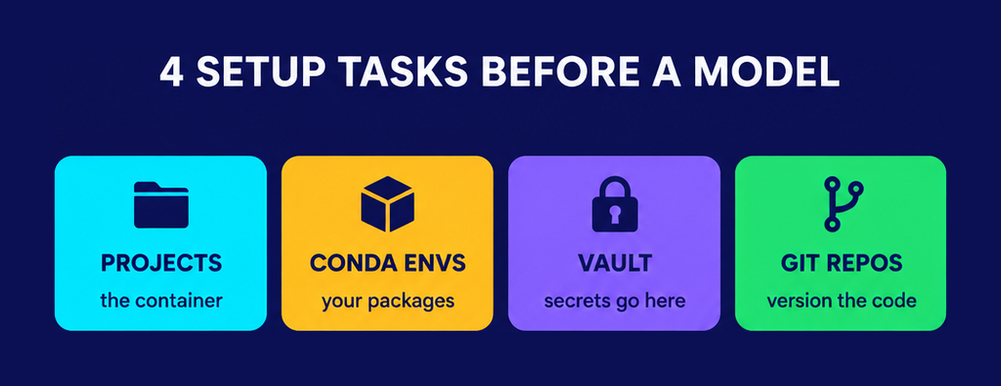
Design and set up Data Science Workspace is 15 percent of 1Z0-1110-26. It covers four things: creating and managing projects and notebook sessions, creating and managing conda environments, using OCI Vault to store credentials, and configuring source code in Code Repositories with Git. None of them involves a model, and all of them decide whether a model can be built at all.
Projects, notebook sessions and conda environments
A project is the container, and a notebook session is the compute you work in. Oracle describes the session as a JupyterLab based environment, so the interface will be familiar to anyone who has used notebooks elsewhere. If JupyterLab itself is new to you, the Project Jupyter site is the place to learn what a kernel, a cell and a notebook server are before you meet them inside OCI.
Conda environments are how a session gets its Python libraries. The exam expects you to know how to create one, activate it in a session and manage it over time, rather than installing packages ad hoc. The Accelerated Data Science SDK documentation has a whole section on working with conda packs, which tells you how central they are to the way Oracle expects the platform to be used.
Vault and Git are tested on fundamentals
The Vault objective is about keeping credentials out of notebooks. One published sample question asks which of SHA-256, RSA, AES and ECDSA is not a supported encryption algorithm in OCI Vault. The answer is SHA-256, because it is a hash function, not an encryption algorithm. That is the level of the question: understand what the service protects and what the algorithms are for.
The Git objective works the same way. A sample question describes a slow internet connection and asks which two operations would be delayed. Pushing to a remote and pulling from it are the network operations, so they slow down. Committing, staging and turning a local folder into a repository all happen on the notebook’s own storage. If you already use Git daily, this domain is a quick win.
What does the 45 percent machine learning lifecycle domain actually ask?
Implement end-to-end Machine Learning Lifecycle is the largest domain of the OCI Data Science Professional exam at 45 percent, about 22 or 23 questions. Its 14 objectives run from fetching data and profiling it, through training, AutoML, evaluation and explanations, to the Model Catalog and deployment, and finish with four generative AI topics: ADS with OCI Generative AI, LangChain, Operators and AI Quick Actions.
From data source to trained model
The first five objectives are the part a working data scientist already knows: use different data sources to fetch data, explore and prepare it, visualise and profile it, and create and train models with OCI and open source libraries. What the exam adds is the Oracle layer. The ADS SDK documentation covers authentication, conda packs, and running jobs, pipelines and model deployments locally, and those are the mechanics you are expected to recognise.
AutoML, evaluation and explanations
Three objectives sit here: create and use automated machine learning from Oracle AutoML, evaluate models, and obtain global and local model explanations. Global explanations tell you which features drive a model across all its predictions. Local explanations tell you why one particular prediction came out the way it did. Expect to be asked which kind answers which question, not to compute one.
The Model Catalog and deployment
Manage models using the Model Catalog, then deploy and invoke a cataloged model. This is the hinge of the whole exam, because everything in the MLOps domain assumes a model is already in the catalog. The sample questions probe the surrounding details: a model deployed through AI Quick Actions can be invoked through both the API and the CLI, and the outputs of a fine-tuning job land in an OCI Object Storage bucket, not in the catalog and not in the training instance’s local disk.
The generative AI edge
The last four objectives are discussion level: ADS and OCI Generative AI integration, LangChain application deployment to Data Science, Operators, and AI Quick Actions. Generative AI has its own Oracle exam, 1Z0-1127-26, so here the point is to know what each tool does and where its outputs go, not to engineer prompts. Oracle’s documentation defines AI Quick Actions as a set of actions for deploying, evaluating and fine-tuning foundation models from inside a Data Science notebook, starting from an explorer of models Oracle has tested and left unmodified.
“Today, we’re announcing the release of OCI Data Science AI Quick Actions, designed to enable anyone to easily deploy, fine-tune, and evaluate foundation models.”
The AI Quick Actions announcement is worth reading in full for exam purposes. It names the first supported models, recommends at least 100 records for a fine-tuning dataset, and explains that evaluation uses ROUGE and BERTScore. Operators, meanwhile, are the low code side of ADS: forecasting and anomaly detection driven by a configuration file rather than a training script.
How does MLOps show up in the exam?
Apply MLOps Practices is 20 percent of 1Z0-1110-26, about 10 questions. The objectives are the OCI MLOps architecture, creating and managing Jobs for custom tasks, scaling with OCI Data Science, autoscaling model deployments for inference, monitoring and logging with MLOps practices, and using Pipelines to automate the machine learning workflow. This is where a model stops being a notebook and becomes a service.
Jobs and job runs
The distinction the exam likes is simple once stated. A job is a template that describes a task, its code and its compute. A job run is a single execution of that template. You can run the same job many times with different arguments, which is how a training script becomes something scheduled rather than something a person clicks.
Pipelines and step dependencies
Oracle’s documentation describes a pipeline as a resource that defines a workflow of steps, where steps can depend on other steps and can run in sequence or in parallel as long as they form a directed acyclic graph. Each step is discrete, so one pipeline can mix different environments and even different languages. A sample question asks how to make sure data processing happens before training, and the answer is to set a dependency between the steps. The Pipelines documentation lays out the typical sequence of import, transform, train and evaluate.
Autoscaling, monitoring and logging
Autoscaling a model deployment means the inference endpoint adds or removes capacity on a metric. The sample question on this objective asks which policy type a team should configure to scale on CPU utilisation, and the answer is a predefined metric policy rather than a custom one. Know the difference between the two and when you would write your own metric.
Monitoring and logging are a discipline of their own in OCI, and the overlap with this objective is real. The OCI Observability Professional exam article on this site goes deep on the Logging and Monitoring services that a deployed model reports into. For this exam, you need the MLOps view: what to log from a job or a deployment, and how to notice that a model in production has drifted.
Who is the OCI Data Science Professional credential written for?
The OCI Data Science Professional credential is written for people who build and run machine learning on Oracle Cloud Infrastructure: data scientists working in Python and open source libraries, machine learning engineers who deploy and monitor models, and OCI engineers asked to configure a tenancy for a data science team. The syllabus says it expects some experience or exposure to OCI, not just to data science.
That last group is easy to overlook. The 10 percent Introduction and Configuration domain covers the service overview, the capabilities of the ADS SDK, and configuring a tenancy for Data Science. One sample question asks which resource types the default matching rules of the Data Science service template include, and the answer names model deployments, notebook sessions and job runs. That is an identity and policy question, and it lands on the person who owns the tenancy.
Oracle’s own description of the OCI Data Science platform sets the scope well: teams of data scientists using Python and open source tools, a JupyterLab environment, NVIDIA GPUs and distributed training for scale, and MLOps capabilities such as automated pipelines, model deployments and model monitoring. Every phrase in that sentence maps to a domain above.
The credential has been reissued every year since at least the 2023 release. This site’s earlier 1Z0-1110-23 preparation guide describes that release as a 55 question paper, and the generative AI objectives did not exist in it. The current 50 question syllabus is the one to work from, and anything written for an older code should be read with that in mind.
How should you prepare for 1Z0-1110-26?
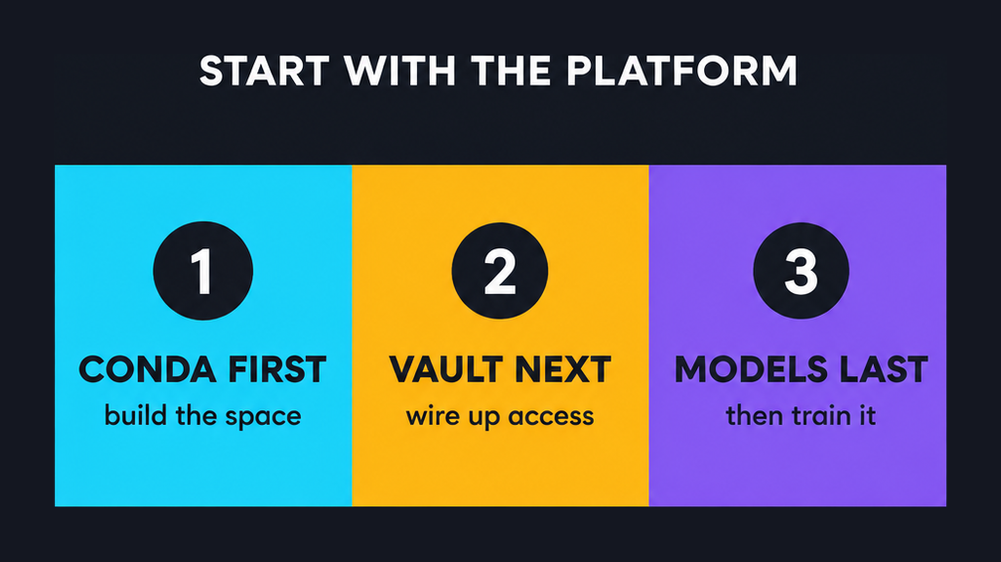
Prepare for 1Z0-1110-26 by spending your time in proportion to the weights: close to half on the machine learning lifecycle, a fifth on MLOps, and the remaining third on workspace setup, tenancy configuration and the related services. Do all of it inside a real OCI tenancy, because the exam asks what the platform does, and that is learned by using it rather than reading about it.
- Read the five domains and write the question arithmetic next to each, so you plan for roughly 22 lifecycle questions against 5 on tenancy configuration.
- Configure a tenancy for Data Science, then create a project, a notebook session and a conda environment, because the workspace and configuration domains are 25 percent of the paper and cannot be learned from a slide.
- Take one small dataset through the whole lifecycle in a notebook: fetch it, profile it, train with an open source library and with AutoML, evaluate it, generate global and local explanations, and save the model to the Model Catalog.
- Deploy that cataloged model and invoke it, then rebuild the same work as a Job and as a Pipeline with a dependency between the processing step and the training step.
- Visit the edges: connect a notebook to Data Flow, open a dataset from Open Data, label a handful of documents in Data Labeling, and open AI Quick Actions to see what a deployed foundation model looks like.
- Finish with timed sets of 50 questions in 90 minutes, and book the exam when you are comfortably above 34 correct.
Two habits pay off during that sequence. Keep a note of every OCI resource name you meet, because the exam uses the platform’s vocabulary and expects you to match it. And read the answer options as a systems engineer would, asking where an output is stored, which service is doing the work and which policy allows it, since that is how most of the platform questions are built.
Frequently Asked Questions
How many questions are on the 1Z0-1110-26 exam?
The 1Z0-1110-26 exam has 50 multiple choice questions with a 90 minute time limit, which works out at 108 seconds per question.
What is the passing score for the OCI Data Science Professional exam?
The passing score is 68 percent. On a 50 question paper that means 34 correct answers, so you can miss 16 questions and still pass.
How much does the 1Z0-1110-26 exam cost?
The exam costs USD 245. Oracle notes that the price may vary by country or by localised currency, so check the figure shown at booking.
Is 1Z0-1110-26 the same exam as 1Z0-1110-25?
They are annual releases of the same credential. 1Z0-1110-26 is the 2026 release and replaces the 1Z0-1110-25 code, with 1Z0-1110-24 and 1Z0-1110-23 before it. Study the syllabus published for the current code.
Which domain is the largest on the OCI Data Science Professional exam?
Implement end-to-end Machine Learning Lifecycle is the largest domain at 45 percent, about 22 or 23 of the 50 questions. Apply MLOps Practices is next at 20 percent.
Does the OCI Data Science Professional exam cover generative AI?
Yes, as four objectives inside the lifecycle domain: ADS and OCI Generative AI integration, LangChain application deployment, Operators, and AI Quick Actions. They are discussion level topics, not prompt engineering.
What is the difference between a job and a job run in OCI Data Science?
A job is a template that defines a task, its code and its compute. A job run is a single execution of that template, and one job can have many runs.
Where can I find OCI Data Science Professional sample questions?
DBExam publishes a free set of ten sample questions with answers for 1Z0-1110-26, covering Open Data, autoscaling, Vault, pipelines, Git, jobs, tenancy templates, Data Labeling and AI Quick Actions.
How long is the OCI Data Science Professional certification valid?
The syllabus published for 1Z0-1110-26 does not state a validity period. Confirm the current renewal terms on Oracle’s certification portal before you plan a recertification date, rather than relying on a third party figure.
Conclusion
The wrong assumption is the expensive one. Candidates who treat 1Z0-1110-26 as a modelling exam revise the part they already know and leave 55 percent of the paper to chance. The syllabus is clear that the OCI Data Science Professional credential measures whether you can set up, run and operate machine learning on the platform: tenancy, workspace, catalog, deployment, jobs, pipelines and the services at the edges.
The numbers give you the plan. Fifty questions, 90 minutes, 34 to pass, with 45 percent on the lifecycle and 20 percent on MLOps. Build one model end to end inside a real tenancy, deploy it, automate it, and visit Data Flow, Open Data and Data Labeling before exam day. Then sit the sample questions on DBExam, and book when your timed scores sit well above the pass mark.


