The last line of the SAS exam content guide for A00-231 is a note that most candidates scroll past: all 23 main objectives will be tested on every exam. There is no sampling. Whichever form you draw on the day, it reaches into PROC TRANSPOSE, macro variables, PUTLOG debugging, ODS output and every other main heading on the list, which leaves no topic that is safe to skip.
That one sentence changes how the base SAS certification should be studied. This article walks through the four content areas and the 23 objectives behind them, the 135 minute format and the 725 pass mark, what SAS means by performance-based, where the largest block of marks sits, how to get SAS software and an official practice exam without paying, where the exam fits beside the other SAS programming credentials, and a preparation order built around the note in the guide.
Table of Contents
- What does the base SAS certification exam test?
- How long is A00-231, and what score passes it?
- What does performance-based mean on A00-231?
- Manage Data: where 35 to 40 percent of the exam sits
- Why do error handling and reporting decide close results?
- Where can you practise for the base SAS certification for free?
- Is A00-231 the right SAS programming exam for you?
- How should you prepare for A00-231?
- Frequently Asked Questions
- Conclusion
What does the base SAS certification exam test?
The base SAS certification exam, A00-231, tests four content areas: Access and Create Data Structures at 20 to 25 percent, Manage Data at 35 to 40 percent, Error Handling at 15 to 20 percent, and Generate Reports and Output at 15 to 20 percent. Across them SAS lists 23 main objectives, and states that every one of the 23 appears on every exam.
The credential it leads to is the SAS Certified Specialist: Base Programming Using SAS 9.4. SAS describes the holder as someone who can read and create data files, build basic detail and summary reports with Base SAS procedures, manipulate and transform data, and find and correct both syntax errors and programming logic errors. The table below groups the 23 main objectives under their content areas, in the wording of the syllabus.
| Content area | Weight | Main objectives |
|---|---|---|
| Access and Create Data Structures | 20-25% | Create temporary and permanent SAS data sets. Investigate SAS data libraries using base SAS utility procedures. Access data. Combine SAS data sets. Create and manipulate SAS date values. Control which observations and variables in a SAS data set are processed and output. |
| Manage Data | 35-40% | Sort observations in a SAS data set. Conditionally execute SAS statements. Use assignment statements in the DATA step. Modify variable attributes using options and statements in the DATA step. Accumulate sub-totals and totals using DATA step statements. Use SAS functions to manipulate character data, numeric data, and SAS date values. Use SAS functions to convert character data to numeric and vice versa. Process data using DO LOOPS. Restructure SAS data sets with PROC TRANSPOSE. Use macro variables to simplify program maintenance. |
| Error Handling | 15-20% | Identify and resolve programming logic errors. Recognize and correct syntax errors. |
| Generate Reports and Output | 15-20% | Generate list reports using the PRINT procedure. Generate summary reports and frequency tables using base SAS procedures. Enhance reports using user-defined formats, titles, footnotes, and SAS System reporting options. Generate reports using ODS statements. Export data. |
23 main objectives, 72 expanded ones
Count the rows and the split is 6, 10, 2 and 5. Under those 23 headings the exam content guide sets out 72 expanded objectives, the individual statements, options and functions a question can be built from. SAS is precise about the difference: the 23 are guaranteed on every exam, while the 72 are given as extra explanation and define the whole domain that could be tested.
In practice the 23 are your coverage checklist and the 72 are your revision list. You cannot predict which expanded item will carry a main objective on your form, whether PROC IMPORT arrives with the GUESSINGROWS statement or with the DELIMITER statement, but you do know that importing data will be there in some shape.
How long is A00-231, and what score passes it?
A00-231 gives you 135 minutes for 40 to 45 questions, and the passing score is 725 on a scale that runs from 200 to 1,000 points. The fee is US$180, charged in US dollars in every country, and the exam is administered by SAS and Pearson VUE. It is based on SAS 9.4 M5.
| Field | Value |
|---|---|
| Exam name | SAS 9.4 Base Programming Performance-Based Exam |
| Exam code | A00-231 |
| Credential | SAS Certified Specialist: Base Programming Using SAS 9.4 |
| Questions | 40-45 |
| Duration | 135 minutes |
| Passing score | 725 / 1000 |
| Exam price | $180 (USD) |
| Registration | Pearson VUE |
| Software version | SAS 9.4 M5 |
These figures come from the AnalyticsExam syllabus page for A00-231 and match what SAS displays on its own Base Programming Specialist page, which adds the 200 to 1,000 score range and the software release. Spread evenly, 135 minutes across 45 questions is 3 minutes each, and across 40 questions a little under 3 and a half.
A scaled score, not a percentage
The 725 is a point on a 200 to 1,000 scale, so it should not be read as 72.5 percent of the questions. SAS publishes no conversion between raw answers and scaled points, and no pass rate for the exam. A practice result expressed as a percentage tells you how you did on that practice set and nothing firmer than that.
Retakes, discounts and expiry
The SAS certification FAQ allows up to five attempts at an exam in a 12 month period, with a minimum of 14 days between attempts and the fee charged each time. Once you pass, no further attempts at that exam are allowed. Students, educators and staff of degree-granting institutions can request a voucher that brings an exam to US$75, and it has to be requested before you register.
On expiry, SAS says that some of its credentials expire and that the Exam Details section of each credential page states it when one does. It adds that the absence of an expiry statement means the certificate does not currently expire. The Base Programming Specialist page carries no such statement.
What does performance-based mean on A00-231?
On A00-231, performance-based means the exam is not answered by recognition alone. SAS describes its 40 to 45 questions as multiple choice and short-answer, and its official practice exam for the same code contains performance-based projects that cannot be completed without access to SAS software. Some answers have to be produced, not picked.
That is all SAS puts in writing about the format on its public pages, and it is enough to plan around. A short-answer question has no list of options to eliminate. If the task is to work out how many observations a step writes or what value a variable holds after a BY group ends, the reliable route is to write the program, run it, read the log and the output, and enter what you find. Reading code fluently helps. Writing it under time pressure is the skill being measured.
This is also why the format of your practice matters more here than on most vendor exams. Material that only asks you to choose among four options trains half of the exam. Before you commit to a study plan, look at a set of A00-231 sample questions to see how the objectives turn into tasks, then check that whatever you practise with includes work you must do in a SAS session.
What the 135 minutes are really for
Three minutes a question sounds generous until a question needs a program. Typing a DATA step, fixing the semicolon you missed, rerunning it and reading the result takes longer than choosing an option, so the time you save on recognition questions is what pays for the ones you must run. Candidates who can write a merge or a PROC FREQ call without looking anything up have far more of the clock left for the questions that need thought.
Manage Data: where 35 to 40 percent of the exam sits
Manage Data is the largest content area of the base SAS certification exam at 35 to 40 percent, and it holds 10 of the 23 main objectives. It covers sorting, conditional logic, assignment statements, variable attributes, running totals, SAS functions, type conversion, DO loops, PROC TRANSPOSE and macro variables. Nearly all of it is DATA step work.
DATA step logic
Five of the ten objectives are about how a DATA step executes. Expect IF-THEN/ELSE with DO and END groups, assignment statements that create a variable or overwrite one, and attributes set with the RENAME= data set option and the LABEL, FORMAT and LENGTH statements. The objective on sub-totals is the one that catches people: BY statement processing with first. and last. variables, combined with the RETAIN and SUM statements. If you cannot say, for a sorted data set, when first.variable is 1 and what a retained total holds at that moment, start there.
Functions and conversion
The syllabus names its functions, which makes this the most learnable part of the area. For character data it lists SCAN, SUBSTR, TRIM, COMPRESS, UPCASE and LOWCASE. For numbers: SUM, MEAN, RAND, SMALLEST, LARGEST, ROUND and INT. For dates: MDY, TODAY, DATE and TIME to create values, YEAR, QTR, MONTH and DAY to extract parts, and INTCK, INTNX and YRDIF for intervals. A separate objective covers conversion, both the automatic kind SAS performs for you and the explicit kind with the INPUT and PUT functions.
Know which direction each conversion function works in. INPUT turns character values into numeric ones and PUT turns numeric values into character ones, and the syllabus expects you to explain what SAS does when you leave the conversion to it. Variable lists belong here too: the OF operator and the colon, hyphen and double hyphen forms.
Loops, reshaping and macro variables
The last three objectives are small and specific. DO loops appear in iterative, conditional and nested forms. PROC TRANSPOSE is tested through the VAR, ID and BY statements and the OUT=, PREFIX= and NAME= options. Macro coverage stops at macro variables: creating them with %LET, using them inside a program, and ending a macro variable name with the dot delimiter. Macro programs are not on this syllabus, so do not let a general macro course eat your study time.
Why do error handling and reporting decide close results?
Error Handling and Generate Reports and Output are each worth 15 to 20 percent of A00-231, so together they carry 30 to 40 percent of the exam, as much as Manage Data. Candidates who spend all their time on DATA step logic give away marks in two areas that are narrower, more predictable and quicker to learn.
Error handling: two objectives, one habit
Error Handling has only two main objectives, yet it carries the same weight as an area with five. The first is logic errors: using the PUTLOG statement to write a variable, a formatted value or every variable to the log, using PUTLOG inside conditional logic, and using the automatic variables the guide lists as N and ERROR, which you write in code as _N_ and _ERROR_. The second is syntax errors: misspelled keywords, unmatched quotation marks, missing semicolons and invalid options, diagnosed from the log.
Both objectives reward one habit, which is reading the log before the output. A program that runs and produces a table can still be wrong, and the note or warning that says so is in the log. Build that habit in every practice session and this area becomes the cheapest 15 to 20 percent on the exam.
Reports and output: procedures with named options
The reporting area lists its procedures and options as plainly as the functions list does. PROC PRINT with the VAR, SUM, WHERE, ID and BY statements and the NOOBS and LABEL options. PROC FREQ for one-way and two-way tables, with NLEVELS and ORDER=, and as a way to validate data. PROC MEANS with the WAYS, CLASS, VAR and OUTPUT statements. PROC UNIVARIATE for extreme and missing values. PROC FORMAT with the VALUE statement and the CNTLIN= option.
Output Delivery System questions cover the destinations and the creation of HTML, PDF, RTF, XLSX, PPTX and CSV files, with the STYLE= option for a template. Export closes the area: PROC EXPORT with the csv, jmp, tab and dlm identifiers, and the SAS/ACCESS XLSX engine for writing to Microsoft Excel. Every one of these is a short program you can type from memory after a few repetitions.
Where can you practise for the base SAS certification for free?
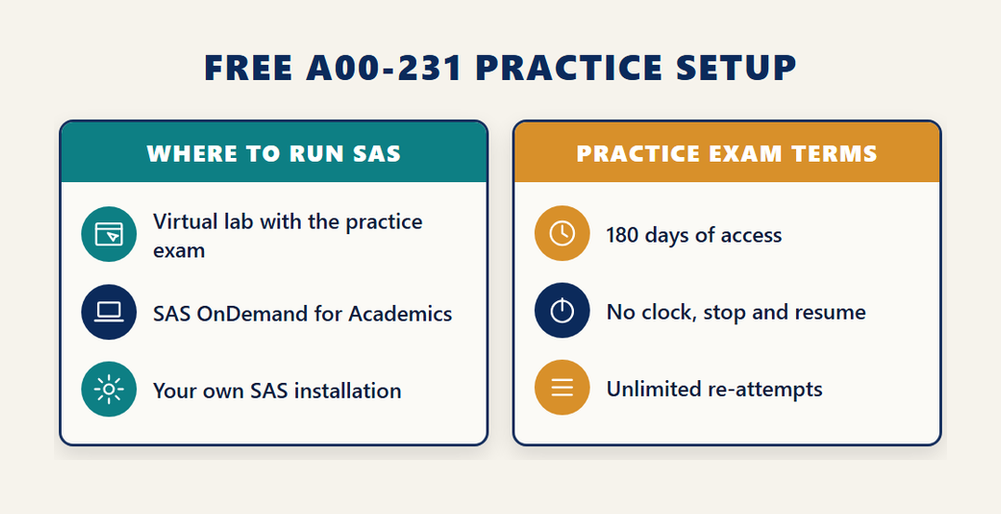
SAS offers a free practice exam for the SAS 9.4 Base Programming Performance-Based Exam, open for 180 days from activation, with no clock and unlimited re-attempts. Because it includes performance-based projects, it needs SAS software, which you can get through the virtual lab included with the practice exam, through SAS OnDemand for Academics, or from your own installation.
The details are on the page of free SAS practice exams. You choose the exam, create or sign in to a SAS profile, accept the licence agreement and begin. You can stop and resume whenever you like inside the 180 days, and the score report shows performance detail, the context for each correct answer, and every question for review.
Use the missing clock deliberately
An untimed practice exam is good for learning and poor for measuring readiness. Use the first pass slowly, with the documentation open, to find which of the 23 objectives you cannot yet do. Then time yourself on later passes with your own stopwatch set to 135 minutes, because the real exam will not wait while you look up the syntax of PROC TRANSPOSE.
Check the retake offer before you book
At the time of writing, SAS is running an offer on that page under which a candidate who schedules and sits a participating certification exam between September 29 and November 17, 2026 and does not pass gets a free retake. Terms and conditions apply and the offer covers participating exams only, so confirm that yours is included before relying on it.
Is A00-231 the right SAS programming exam for you?
A00-231 is the middle of three SAS 9.4 programming credentials: SAS Certified Associate: Programming Fundamentals Using SAS 9.4 sits below it, and SAS Certified Professional: Advanced Programming Using SAS 9.4 sits above. The base SAS certification is the one to take if you already write DATA steps and procedures and want that skill confirmed by SAS itself.
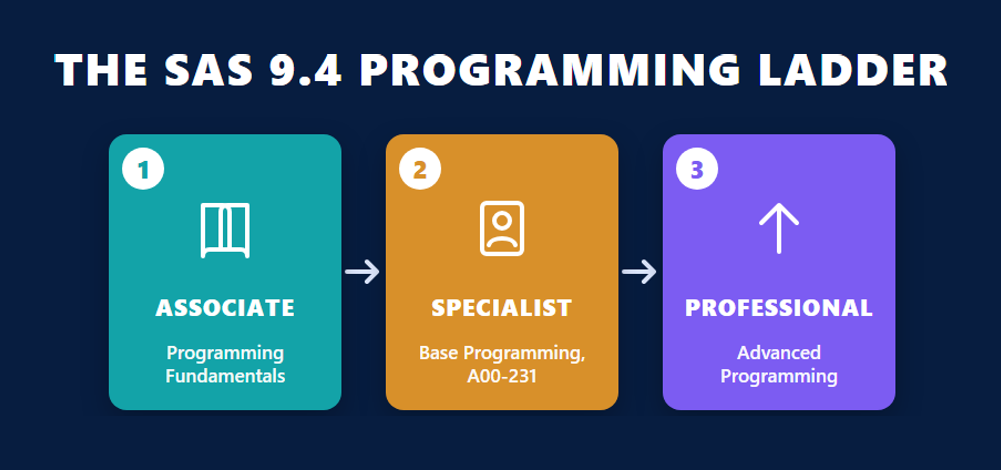
The titles tell you the order: Associate, Specialist, Professional. If you have not yet written a working program, the Associate exam is the gentler start. If merges, BY group processing and PROC FREQ are already routine for you, look at what the Professional level asks for instead. SAS also lists the Base Programming Specialist among its most popular credentials, which says something about how often it is asked for.
SAS 9.4 or SAS Viya?
SAS now runs two programming tracks. A00-231 is a SAS 9.4 exam, built on release M5, while the Viya track has its own Associate and Specialist exams. Choose by the software your employer or your target employer runs. If the programs you will maintain were written for SAS 9.4, this is the syllabus that matches them, and if you are heading towards the newer platform instead, this site’s Viya programming study guide covers the entry exam on that side.
What the credential does for a career
Kriss Harris, whose route from statistician to programmer is told in one of the SAS user stories, wanted a programming role at a pharmaceutical company and did not have the track record for it. He describes the gap this way:
“I eventually wanted to move to clinical and become a SAS programmer instead of a statistician, but I needed to learn more Base SAS, and potentially obtain the SAS Base Certification, to get there.”
That is the typical use of this credential. It is evidence, for someone moving sideways into programming, that the DATA step and the core procedures are already in hand. Clinical programming is the clearest example, since trial data is prepared to the CDISC SDTM standard and reshaping raw data into a fixed structure is exactly what sorting, merging, transposing and formatting are for. The exam does not test SDTM. It tests the tools that work is done with.
How should you prepare for A00-231?
Prepare for A00-231 by turning the 23 main objectives into a checklist, getting working SAS software on the first day, and writing a short program for every objective before you read about the next one. Give Manage Data the most hours, drill error handling and reporting until they are automatic, and finish with timed runs of 135 minutes.
- Download the exam content guide and mark each of the 23 main objectives as can do, can do slowly or cannot do, because every one of them will be on your exam.
- Set up SAS software before you study anything, through the virtual lab that comes with the free practice exam, SAS OnDemand for Academics or your own installation.
- Work through Access and Create Data Structures first, since reading, importing, combining and subsetting data is needed for every later task.
- Spend the largest share of your time on Manage Data, writing a program for each of its 10 objectives and paying particular attention to first. and last. processing with RETAIN.
- Type each named function, procedure and option from the syllabus at least once without looking it up, so that PROC TRANSPOSE, PROC FORMAT and the ODS statements cost you no thinking time.
- Break your own programs on purpose and repair them from the log, using PUTLOG to follow a value through a DATA step.
- Take the free practice exam untimed to find gaps, then repeat it against a 135 minute stopwatch until your result is steady.
The books and training named on the syllabus page are SAS Programming 1: Essentials, SAS Programming 2: Data Manipulation Techniques and the SAS Certification Review course for this exam. They follow the content areas in order, which makes them easy to map onto the checklist from step one.
One warning about older material. This exam is based on SAS 9.4 M5 and its objectives include items such as the SAS/ACCESS XLSX engine and ODS output to XLSX and PPTX. Notes written for earlier generations of the base exam can miss those and spend pages on topics that are no longer listed. For a shorter orientation on the credential itself, see this site’s earlier page on the Base Programming Specialist path, then come back to the 23.
Frequently Asked Questions
How many questions are on the base SAS certification exam?
A00-231 has 40 to 45 questions, which SAS describes as multiple choice and short-answer, and you have 135 minutes to complete them.
What is the passing score for A00-231?
The passing score is 725 on a scale from 200 to 1,000 points. It is a scaled score, not a percentage, and SAS does not publish how raw answers convert to it.
How much does the SAS base programming exam cost?
The exam fee is US$180, charged in US dollars in all countries. Students, educators and staff of degree-granting academic institutions can request a discount voucher that brings an exam to US$75.
Are all topics on the syllabus tested?
Yes at the level of main objectives. The SAS exam content guide states that all 23 main objectives will be tested on every exam, while the 72 expanded objectives define the full domain that could be tested.
Which SAS version is A00-231 based on?
SAS states that the exam is based on SAS 9.4 M5.
How many times can you retake a SAS certification exam?
SAS allows up to five attempts at an exam in a 12 month period with at least 14 days between attempts, and the fee is charged for each attempt. After a pass, no further attempts at that exam are allowed.
Does the base SAS certification expire?
SAS says a credential that expires is marked as such in the Exam Details section of its page, and that no expiry statement means the certificate does not currently expire. The Base Programming Specialist page carries no expiry statement.
Is there a free practice exam for A00-231?
Yes. SAS offers a free practice exam for the SAS 9.4 Base Programming Performance-Based Exam with 180 days of access, no clock and unlimited re-attempts. It needs SAS software for its performance-based projects.
Does A00-231 test macro programming?
Only macro variables. The syllabus covers creating them with %LET, using them in programs and the dot delimiter. Macro programs are not listed in the A00-231 objectives.
Conclusion
The base SAS certification exam is unusually open about what it will ask. Four content areas, 23 main objectives that all appear every time, and a list of named functions, procedures and options underneath them. With 40 to 45 questions in 135 minutes and 725 needed on a 200 to 1,000 scale, there is time to run code, as long as the routine programs come without effort.
Put most of your hours into Manage Data, and do not neglect the 30 to 40 percent that sits in error handling and reporting. Get SAS software running on day one, use the free practice exam first to learn and then against the clock, and check the retake rules before you book. Then work down the 23, one program at a time.


