The notebook is finished, the model beats the baseline, and the review goes well. Then someone asks three questions: how will it be retrained when the input data drifts, who finds out when endpoint latency doubles, and how does the next version reach a tenth of the traffic before it reaches all of it? That conversation, not the training run before it, is what most of the Databricks ML Professional certification is about. Model Development carries 44 percent of the exam. MLOps carries another 44 percent, and Model Deployment the last 12.
The full title is Databricks Certified Machine Learning Professional, and the current version was published on September 30, 2025. It runs 59 scored questions in 120 minutes for a $200 fee, and Databricks expects about a year of hands-on work with the platform before you sit it. This article explains what each of the three sections asks you to do, which tools in the exam guide now go by new names in the documentation, whether the credential is worth it for your role, and a preparation order that follows the weightings.
What Does the Databricks ML Professional Certification Actually Test?
The Databricks ML Professional certification tests whether you can run machine learning on Databricks at enterprise scale, not just train a model. Its three sections cover building and tuning models with SparkML, Ray, Optuna, MLflow and the Feature Store; operating them through testing, bundles, retraining and monitoring; and deploying them with rollout strategies and custom model serving.
Databricks’ own description of the candidate is specific. Someone who passes should be able to build scalable ML pipelines with SparkML, run distributed training and hyperparameter tuning, use the advanced features of MLflow, automate feature pipelines with Feature Store concepts, apply testing strategies, manage environments, automate retraining, detect drift with monitoring, and manage how new models roll out. Read that list as a job description and the weighting makes sense: more than half of it happens after a model exists.
That is the key difference from the associate level. The ML Associate exam checks that you can use the platform to explore data, engineer features and train a model. The Professional exam assumes you can already do that and asks what happens next, when the model has to be reproducible, testable, observable and replaceable without an outage.
Who the exam is written for
The guide’s recommended experience is one year of hands-on work on the Databricks platform with the topics in the exam outline. In practice that describes machine learning engineers and senior data scientists who own models in production, MLOps engineers who build the pipelines around them, and platform engineers who support data science teams on Databricks. A data scientist who has only ever handed a notebook to someone else will find the MLOps section the hardest part of the paper.
How Is the Exam Run: Questions, Time, Fee, Passing Score and Validity?
The exam has 59 scored multiple choice questions and a 120 minute time limit, and it costs $200 plus any local taxes. It is delivered online with a proctor or at a test center, in English only, with no test aids allowed. The credential is valid for 2 years, and CertFun lists the passing score as 70 percent.
| Detail | Databricks Certified Machine Learning Professional |
|---|---|
| Scored questions | 59, multiple choice |
| Unscored questions | Up to 10 may appear, not identified on the exam |
| Time limit | 120 minutes, extra time for unscored items already included |
| Registration fee | $200, plus applicable local taxes |
| Passing score | 70 percent (CertFun; Databricks does not display a figure) |
| Delivery | Online proctored or test center |
| Language | English |
| Test aids | None allowed |
| Prerequisite | None required, related training highly recommended |
| Recommended experience | One year hands-on with the exam outline on Databricks |
| Validity | 2 years, then recertify by taking the current exam |
| Exam version | Published September 30, 2025 |
The unscored items matter for pacing. If all 10 appear you are reading up to 69 questions in 120 minutes, which leaves a little over a minute and a half for each one. The items are scenario led: a team, a constraint and four plausible answers, where usually two would work and only one meets every stated requirement. Working through the ML Professional sample questions before you book is the quickest way to get used to that style, because the wrong answers are rarely absurd; they are the option that is slower, more manual or less safe.
Recertification is a full retake. The official certification page says the credential must be renewed every two years by passing the current version of the exam, so a pass in late 2026 means sitting whatever version is live in late 2028. The same page notes that any SQL in the exam follows ANSI SQL standards.
Which Tool Names Have Changed Since the Exam Guide Was Written?
Two names in the exam outline now appear differently in the Databricks documentation. Databricks Asset Bundles are documented as Declarative Automation Bundles, and the old Lakehouse Monitoring documentation now opens on the data profiling page under data quality monitoring. The exam objectives still use the original names, so learn both.
This matters more than it looks. The exam guide tells candidates to study the official documentation because it is the most current source, and the documentation has moved on from some of the guide’s wording. A candidate searching only for the old names finds older blog posts; a candidate reading only the current docs may not recognize the objective when it appears with its original wording.
Bundles
The bundles documentation describes Declarative Automation Bundles as formerly known as Databricks Asset Bundles: a way to describe Databricks resources as source files so a project can be version controlled, reviewed, tested and deployed through CI/CD. The certification page itself now uses the new name, while the objective still reads “Define and configure Databricks ML assets using DABs (Databricks Asset Bundles): model serving endpoints, MLflow experiments, ML registered models.” Same tool, same job.
Monitoring
The data profiling documentation describes the same three analysis types the exam names: time series profiles for tables with a timestamp column, inference profiles for tables that hold a model’s inputs and predictions, and snapshot profiles for everything else. It also explains the baseline table, which is how drift is measured against a known good distribution. If an objective mentions Lakehouse Monitoring, read the data profiling pages to answer it.
What Does the 44 Percent Model Development Section Expect You to Build?
Model Development is worth 44 percent and has four parts: using Spark ML, scaling and tuning, advanced MLflow usage, and advanced Feature Store concepts. Its 22 objectives are about doing familiar work at a scale where single-node tools stop working, and choosing correctly between distributed and single-node approaches.
| Sub-area | What the objectives ask |
|---|---|
| Using Spark ML | Decide when SparkML fits; build, tune with MLlib, evaluate and score SparkML pipelines; choose SparkML or a single-node model for batch, real-time or streaming inference |
| Scaling and Tuning | Scale training with SparkML and pandas Function APIs or UDFs; distributed tuning with Optuna and MLflow, and with Ray; vertical against horizontal scaling; model against data parallelism; Ray against Spark |
| Advanced MLflow Usage | Nested runs for complex experiments; logging custom metrics, parameters and artifacts programmatically; custom model objects using real-time feature engineering |
| Advanced Feature Store Concepts | Point-in-time correct lookups; automated feature pipelines with the FeatureEngineering Client; online tables through the Databricks SDK; streaming features; on-demand features with feature serving |
Spark ML is about judgement, not syntax
The first objective in the section is “Identify when SparkML is recommended based on the data, model, and use case requirements,” and that sets the tone. You should know how estimators, transformers and pipelines fit together, because the exam guide’s own sample question asks which encoding and assembly approach still works when the data grows to hundreds of millions of rows. The Apache Spark pipelines guide explains exactly that model of transformers, estimators and stages, and it is worth reading once from the project itself rather than through a summary.
Scaling and tuning has the most objectives
Seven objectives sit here, and they mix three frameworks. You need to know how Optuna trials are distributed across a cluster and logged to MLflow, how Ray does the same job, when Ray is the better choice than Spark for distributing training, and how the pandas Function API trains one model per group, such as one forecast per store. The trade-off objectives, vertical against horizontal scaling and model against data parallelism, are reasoning questions: given the model size and the data size, which approach fails first.
MLflow and the Feature Store
MLflow appears in six of the exam’s 47 objective lines, across all three sections. Here the focus is nested runs, where a parent run holds a whole search and child runs hold each configuration, and on logging custom artifacts in code. The Feature Store objectives turn on one idea above all: point-in-time correctness, so that a training row only sees feature values that existed at its timestamp. Get that wrong and the model learns from the future, which is the data leakage the objective names.
“It is inspiring to see the rapid adoption of the project. In terms of contributor count, MLflow achieved in 9 months what Apache Spark took 3 years to achieve.”
Why Is MLOps Weighted as Heavily as Model Development?
MLOps carries 44 percent because Databricks treats running a model as hard as building one. Its five parts are model lifecycle management, validation testing, environment architectures, automated retraining, and drift detection and monitoring. Ten of its 20 objectives are about monitoring alone, which makes monitoring the single largest topic on the exam.
Lifecycle and environments
The lifecycle objectives ask you to describe the architecture of pipelines that move work between environments under the deploy code strategy, and to map Databricks features to each lifecycle activity. Deploy code means the code, not a trained model artifact, is promoted from development to staging to production, and each environment trains its own model on its own data. The MLOps workflow documentation lays this architecture out stage by stage, and it is the clearest single reference for this part of the syllabus. The environment objectives then ask you to define serving endpoints, MLflow experiments and registered models in bundles, so the whole setup is reproducible across workspaces.
Testing a machine learning system
Four objectives cover testing, and they are practical. You write unit tests for individual functions in Databricks notebooks, identify which tests belong in development, test and production stages, design an integration test that runs through feature engineering, training, evaluation, deployment and inference, and weigh the ways of organizing functions and their tests. Expect questions that change one thing, such as a hyperparameter, and ask which integration tests must run again as a result.
Retraining and monitoring
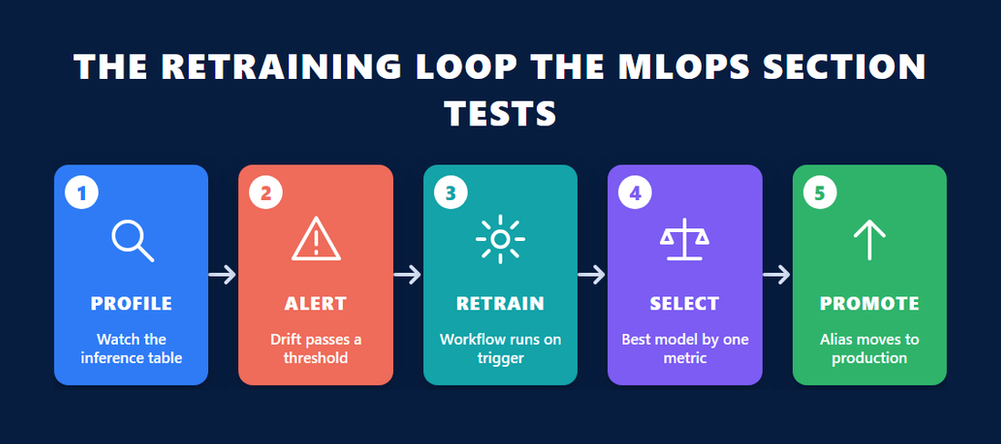
The retraining objectives connect directly to monitoring: a workflow is triggered by drift or by falling performance, and a strategy decides which retrained model wins. The monitoring objectives cover the statistical tests in the drift metrics table, choosing the right table type and feature for a use case, building a monitor on a snapshot, time series or inference table, alerting when drift crosses a threshold, comparing against a baseline or between time windows, tracking model performance over time from an inference table, custom metrics, slicing by feature, and endpoint health such as latency, request rate, error rate, CPU and memory.
The selection step is where the exam is most demanding. The right metric depends on how predictions are used. When a business acts on predicted probabilities at fixed confidence thresholds, a metric that rewards well calibrated probabilities beats one that only scores hard labels or ranking, and the guide includes exactly that kind of scenario. Know what each common metric measures, not just its name.
How Does the Model Deployment Section Test a Rollout?
Model Deployment is the smallest section at 12 percent, with five objectives in two parts. Deployment strategies asks you to compare approaches such as blue-green and canary for high traffic applications and to implement a rollout with Databricks Model Serving. Custom model serving asks you to register a custom PyFunc model in Unity Catalog and query and deploy it.
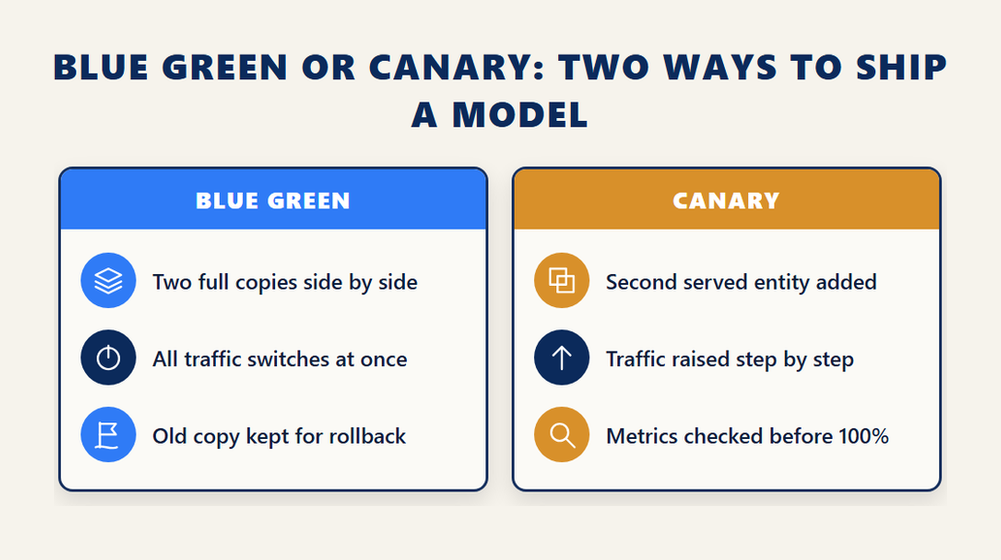
A blue-green rollout keeps two complete versions running and moves all traffic from one to the other at once, keeping the old one ready if something goes wrong. A canary rollout adds the new model alongside the old and raises its share of traffic in steps while you watch its metrics. On Model Serving the canary pattern means a second served entity on the same endpoint with a traffic split you adjust over time. For a business critical model where a bad release costs money, the safer answer is usually the gradual one, combined with scale-out for the traffic itself.
Custom PyFunc models
The custom serving objectives are about wrapping logic that a standard model flavor cannot express, such as preprocessing or real-time feature lookups, inside a PyFunc model, logging its artifacts, registering it in Unity Catalog, and then calling it. You should know the three ways to deploy one (the MLflow Deployments SDK, the REST API and the user interface) and the two ways to query it, the REST API and the MLflow Deployments SDK. The MLflow source and its documentation live in the official MLflow repository, which is useful when you want to see exactly what a deployments client does with an endpoint name and an input payload.
Is the Databricks ML Professional Certification Worth It for You?
The Databricks ML Professional certification is worth it if your work includes owning models in production on Databricks, because more than half of the exam is MLOps and deployment that the job already requires. It is weaker value if you mainly build models in notebooks and hand them on, since the paper will test skills you do not use and the credential lapses in two years.
Three questions settle it. First, does your team run machine learning on Databricks? The exam is platform specific: Feature Store, Model Serving, Unity Catalog, bundles and data profiling are Databricks features, and the knowledge transfers to other platforms only as concepts. Second, do you already deploy and monitor models? If you do, preparation is mostly closing gaps; if you do not, the MLOps section is new territory and a year of hands-on time, as the guide recommends, is realistic. Third, will you keep it current? A $200 fee every two years is modest, but each renewal is a full exam on whatever the current version is.
Professional or Associate first?
There is no prerequisite, so you can go straight to the Professional exam. The associate level still makes sense for anyone whose Databricks experience is mostly data preparation and model training, because it covers that ground without the operational load. If you are deciding between the two, the Machine Learning Associate path shows what the lower credential covers, and the gap between the two is almost exactly the MLOps and deployment material described above.
What it signals to an employer
The value of a professional level vendor credential is the specificity of its claim. This one says you can test, ship, monitor and retrain models on one named platform, which is the exact gap many hiring managers worry about when a strong data scientist moves into an engineering role. It does not replace evidence of production work, but it is a credible summary of it.
How Should You Prepare for the Exam?
Prepare in the order of the weightings and the dependencies: model development first, because MLOps assumes it, then MLOps with monitoring given the most time, then deployment. Databricks recommends two courses, Machine Learning at Scale and Advanced Machine Learning Operations, and the hands-on practice matters more than reading, since the items describe real platform behaviour.
Free Edition is enough for most of the practice. The exam guide points candidates to it and to the AI Prep Guide, which suggests a short list of hands-on tasks mapped to the objectives. Combine that with the official documentation, which Databricks calls the most current and authoritative source, and use the renamed tools under their new names while remembering the old ones.
A preparation order that follows the weightings
- Read the current exam guide end to end and mark every objective you have not done yourself on Databricks.
- Build one SparkML pipeline with an encoder, an assembler and an estimator, tune it, and score it in batch and in a stream.
- Run a distributed Optuna search and a Ray search, log both to MLflow with nested runs, and compare them in the MLflow UI.
- Create a feature table with a timestamp key, train from a point-in-time lookup, and publish features for online serving.
- Put the project in a bundle with an experiment, a registered model and a serving endpoint, and deploy it to two targets.
- Profile an inference table against a baseline, set an alert on a drift metric, and trigger a retraining job from it.
- Register a custom PyFunc model in Unity Catalog, serve it, query it through the MLflow Deployments SDK, and shift traffic to a second served entity in steps.
- Finish with timed practice, then reread the exam guide to find any objective you still have not touched.
Steps two to four cover the 44 percent development section, steps five and six the 44 percent MLOps section, and step seven the deployment section. Give step six the most time, because monitoring alone accounts for ten objectives. For a topic by topic review of this same exam from an earlier version, the ML Professional key topics page is useful background, but check every point against the current guide, since the outline was rebuilt in the September 2025 version.
On exam day
Online delivery needs the system check Databricks asks for before the exam, and nothing may be used during it. Read each scenario for its constraint words, such as minimal setup, high traffic, reproducible or real time, because those words decide between two otherwise valid answers.
Frequently Asked Questions
How many questions are on the Databricks ML Professional exam?
There are 59 scored multiple choice questions, and up to 10 unscored items may also appear. The time limit is 120 minutes, which already includes extra time for the unscored items.
What is the passing score?
CertFun lists the passing score as 70 percent. Databricks does not display a passing score on its certification page or in the exam guide.
How much does the Databricks ML Professional certification cost?
The registration fee is $200, plus any taxes required by local law. Each recertification is a new exam at the current fee.
Is the Databricks ML Professional certification worth it?
It is worth it for engineers and data scientists who run machine learning in production on Databricks, because 56 percent of the exam is MLOps and deployment. It is less useful for people who only build models in notebooks or who do not work on Databricks.
Do I need the Machine Learning Associate certification first?
No. There is no prerequisite. Databricks recommends related training and about one year of hands-on experience with the exam topics.
How long is the certification valid?
Two years. To recertify you take the current version of the exam again.
What are the three exam sections and their weights?
Model Development at 44 percent, MLOps at 44 percent, and Model Deployment at 12 percent.
Are Databricks Asset Bundles still on the exam?
Yes. The objective still names Databricks Asset Bundles, and the current documentation calls the same tool Declarative Automation Bundles. Learn both names.
Can I take the exam online?
Yes. It is delivered online with a proctor or at a test center, in English, with no test aids allowed.
Conclusion
The Databricks ML Professional certification rewards the work that starts after training. Model Development still carries 44 percent, but MLOps carries the same again and deployment adds 12, so testing, bundles, retraining, monitoring and controlled rollouts decide most of the result. The facts are simple: 59 scored questions, 120 minutes, $200, English only, a 70 percent pass mark according to CertFun, and two years of validity before a full retake. Learn the tools under both their exam guide names and their current documentation names, build every objective at least once in Free Edition, and spend the most time on monitoring. Start with the sample questions to see the scenario style, then work through the guide in the order of its weightings.


