Earning the CREST Practitioner Threat Intelligence Analyst (CPTIA) certification is a significant milestone for any cybersecurity professional. It validates your ability to collect, analyze, and interpret threat intelligence, making you a high-value asset in the fight against sophisticated cyber adversaries. However, the path to certification is rigorous. The exam doesn’t just test what you know; it tests how you apply that knowledge in practical scenarios.
Many ambitious candidates, unfortunately, stumble on their CREST CPTIA Certification journey. The pressure is high, the syllabus is broad, and the real-world stakes are even higher. This pressure can lead to critical preparation errors. But here’s the good news: these errors are entirely avoidable.
This article outlines the seven fatal mistakes that can derail your preparation. By identifying them now, you can build a more effective, efficient, and less stressful study plan to ensure your success.
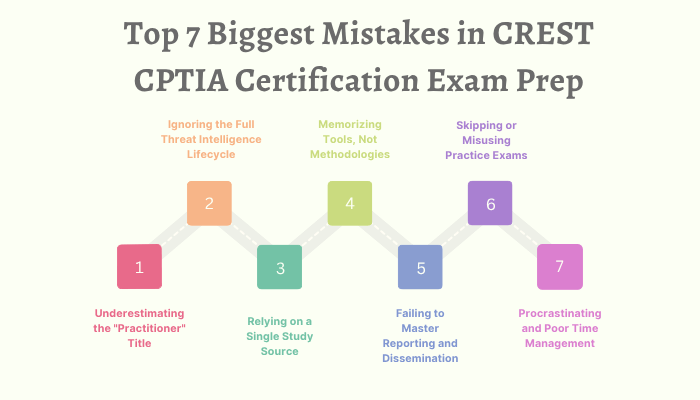
Top 7 Study Mistakes That Could Derail Your CREST CPTIA Exam Journey
1. Underestimating the “Practitioner” Title
A common error is to mistake the “Practitioner” level for “entry-level.” This is a critical misunderstanding. The CREST CPTIA Certification is not a foundational exam. It assumes a significant baseline of knowledge in IT, networking, and security principles. The same care applies further along the CREST ladder, where the red team specialist certification rewards applied judgement over recall.
The “Practitioner” label signifies that you are expected to apply knowledge, not just recall it. The exam is designed to validate that you can perform the role of a threat intelligence analyst.
How to Avoid This:
- Respect the Syllabus: Thoroughly review the official CREST CPTIA guidelines to understand the assumed knowledge.
- Assess Your Gaps: Be honest about your weaknesses. If your networking or OS fundamentals are shaky, shore them up before diving deep into CTI-specific topics.
- Think Like an Analyst: For every concept you learn, ask yourself: “How would I use this in a real investigation?”
Key Takeaway: Treat the CPTIA as a practical assessment of your analytical skills, not just a multiple-choice test of facts. The CREST CPTIA Certification Requirements are less about prerequisites and more about the expected level of operational competence.
2. Ignoring the Full Threat Intelligence Lifecycle
It’s tempting to focus on the “exciting” parts of threat intelligence, like analyzing malware or tracking APT groups. Many candidates pour hundreds of hours into analysis techniques while spending almost no time on the other, equally critical phases of the intelligence lifecycle.
The CPTIA exam covers the entire lifecycle:
- Direction: Defining intelligence requirements.
- Collection: Gathering raw data (OSINT, HUMINT, etc.).
- Processing: Converting raw data into a usable format.
- Analysis: Interpreting data and finding patterns.
- Dissemination: Reporting findings to stakeholders.
- Feedback: Refining the process based on stakeholder input.
If you neglect any of these, you’re leaving a massive gap in your knowledge.
How to Avoid This:
Allocate Study Time Evenly: Use the lifecycle as the backbone of your study plan.
- Practice Each Phase: Don’t just analyze. Practice writing intelligence requirements. Practice processing data logs. Practice writing a dissemination plan.
- Understand the Connections: See how feedback from a stakeholder (Phase 6) directly impacts new intelligence requirements (Phase 1).
Key Takeaway: A CTI analyst who can’t define requirements or disseminate findings is ineffective. Master the entire process, not just the “fun” parts.
3. Relying on a Single Study Source
The cybersecurity field, especially threat intelligence, evolves daily. No single textbook, video course, or boot camp can possibly cover the entire breadth and depth of the CREST CPTIA Certification syllabus.
Relying on one source creates blind spots. You’ll understand concepts from one perspective but may be completely lost when the exam presents them in a different context.
How to Avoid This:
- Diversify: Combine the official CREST materials with industry blogs, vendor threat reports (e.g., Mandiant, CrowdStrike), and foundational texts on intelligence analysis.
- Cross-Reference: When you learn a new concept, see how two or three different sources explain it.
- Review the Syllabus: Use the official CREST Practitioner Threat Intelligence Analyst Exam Syllabus as your master checklist, not your single textbook.
Key Takeaway: Build a web of knowledge from multiple credible sources. This protects you from the biases or gaps of any single author.
4. Memorizing Tools, Not Methodologies
Mistake: “I know what Maltego, Shodan, and Wireshark are. I’m ready for the collection module.”
Reality: The exam doesn’t care if you can list 50 OSINT tools. It cares if you understand the methodology behind data collection. It tests your grasp of structured analytical techniques (like the Diamond Model or Analysis of Competing Hypotheses), not just your ability to click buttons in a program.
How to Avoid This:
- Focus on the “Why”: Why would you use tool A over tool B in a specific scenario? What are the legal and ethical implications of your collection method?
- Practice the Process: Get hands-on. Don’t just install a tool; use it to answer a specific intelligence question from start to finish.
- Learn the Frameworks: Deeply understand structured analysis. Knowing how to think is more valuable than knowing what to use.
Key Takeaway: Tools become obsolete. Methodologies and analytical tradecraft endure. The CPTIA certification validates your tradecraft.
5. Failing to Master Reporting and Dissemination
This is the silent killer for many technically brilliant candidates. You can perform the world’s best analysis, but if you cannot communicate it clearly, concisely, and appropriately to your audience, you have failed as an intelligence analyst.
Your findings might go to a SOC analyst, a C-suite executive, or a legal team. Each audience requires a different report, tone, and level of technical detail. The CPTIA exam knows this and expects you to as well.
How to Avoid This:
- Practice Writing: Write mock reports. Write a one-paragraph BLUF (Bottom Line Up Front) summary for an executive. Then, write a detailed technical appendix for a peer.
- Study Report Formats: Learn the difference between a tactical alert, an operational report, and a strategic overview.
- Focus on Action: Good intelligence is actionable. Your reports should always answer the “So what?” question for the reader.
Key Takeaway: In threat intelligence, communication is not a “soft skill.” It is a core technical competency.
6. Skipping or Misusing Practice Exams
This mistake takes two forms:
- Skipping: Candidates feel they “aren’t ready” and put off practice exams until the very end, leaving no time to fix the weaknesses they uncover.
- Misusing: Candidates take a practice test, memorize the answers, and score 100% on the second try, giving them a false sense of confidence.
This is where pre-exam anxiety peaks. You’ve studied for weeks, but you have no objective measure of your readiness.
How to Avoid This:
- Use as a Diagnostic: Take a practice exam early on to get a baseline. It will be painful, but it will tell you exactly where to focus your study time.
- Simulate Real Conditions: Use a high-quality online practice exam platform. Take it in one sitting, with no notes.
- Analyze Your Failures: When you get a question wrong, don’t just learn the right answer. Understand why your original choice was wrong and why the correct answer is right. This is the single most effective study method.
A robust set of CREST CPTIA Certification Sample Questions is not just a review tool; it’s a primary study resource. Platforms offering full CPTIA online practice exams are invaluable for building this exam-taking endurance and identifying your gaps.
Key Takeaway: Practice exams are a compass, not a report card. Use them to find your weaknesses and build confidence under pressure.
7. Procrastinating and Poor Time Management
The CREST CPTIA Certification syllabus is broad. The “Practitioner” level implies depth. This combination is lethal for cramming. Waiting until the last few weeks to get serious is a direct path to failure.
This mistake is often driven by not knowing where to start. The volume of material is intimidating, so you put it off. This not only jeopardizes your exam but also means you’ll likely forfeit the CREST CPTIA exam cost, which is a significant investment.
How to Avoid This:
- Create a Plan: Break the syllabus down into manageable, weekly goals.
- Be Consistent: Two hours of focused study every day is infinitely more effective than a 14-hour panic session on a Saturday.
- Start Now: The best time to build your study plan was yesterday. The second-best time is right now.
Key Takeaway: The CPTIA is a marathon, not a sprint. A disciplined, consistent study plan is your key to crossing the finish line.
Your Path to CREST CPTIA Certification Success
The journey to your CREST CPTIA Certification is challenging, but it is far from impossible. The fact that you’re reading this article shows you’re serious about your preparation and committed to avoiding the pitfalls that trap others.
By steering clear of these seven fatal mistakes, you’re not just studying harder; you’re studying smarter. You are replacing anxiety with a structured plan, replacing guesswork with targeted practice, and replacing fear of failure with the confidence of a true practitioner.
You are investing in a high-demand, high-value skill set. Don’t leave your success to chance. Start your preparation on the right foot, identify your baseline, and build your confidence by exploring a structured CPTIA online practice exam to benchmark your knowledge today.


