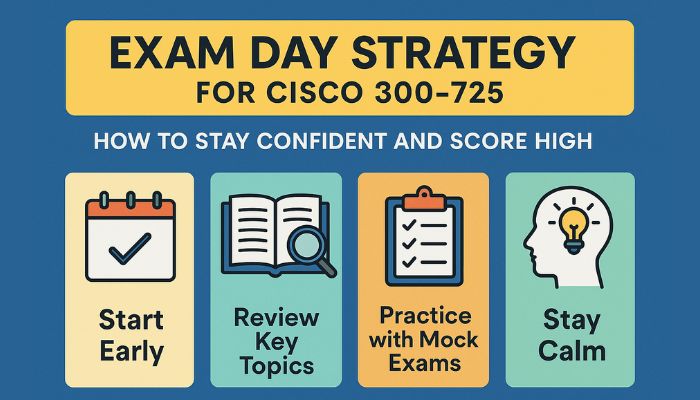
The Cisco 300-725 SWSA exam challenges even experienced security professionals because it demands more than theoretical understanding. It measures your ability to confidently configure, manage, and troubleshoot the Cisco Secure Web Appliance in real-world enterprise environments. Yet the candidates who follow a structured, proven study framework consistently score higher, finish the exam with confidence, and position themselves for advanced security roles.
This preparation guide takes you through a complete, actionable, and research-backed approach to mastering the 300-725 SWSA exam, covering the Cisco Secure Web Appliance blueprint, high-yield strategies, topic breakdown, and the study system used by top scorers. Each section is designed to reduce stress, eliminate guesswork, and help you prepare with clarity and purpose.
What the 300-725 SWSA Exam Really Measures
Cisco’s official exam page describes the test as a validation of your skills in securing web traffic, configuring policies, controlling HTTPS behavior, and protecting enterprises from malware and unacceptable use patterns.
Below is the exam’s official structure:
Exam Overview
- Exam Name: Securing the Web with Cisco Secure Web Appliance
- Exam Code: 300-725 SWSA
- Price: 300 USD
- Duration: 90 minutes
- Questions: 55–65
- Passing Score: Variable (approx. 750–850 / 1000)
Cisco 300-725 SWSA Exam Topics
- Features – 10%
- Configuration – 20%
- Proxy Services – 10%
- Authentication – 10%
- Decryption Policies for HTTPS Traffic – 10%
- Differentiated Access Policies – 10%
- Acceptable Use Control – 10%
- Malware Defense – 10%
- Reporting and Tracking – 10%
Each section requires both conceptual understanding and practical hands-on practice. That is why having a proven, structured study framework is essential for scoring high.
Why Most Candidates Struggle With The SWSA Exam
Many candidates start strong but lose momentum midway. Here are the reasons:
- They do not follow a framework-based study path.
- They treat the SWSA like a theory exam rather than a configuration-heavy security exam.
- They underestimate the detail required in HTTPS decryption and traffic access policies.
- They avoid practicing configuration scenarios until the last moment.
- They rely only on theory without using realistic practice tests.
These mistakes can be avoided with the study framework outlined below.
The Proven Study Framework for the Cisco 300-725 SWSA Exam
This framework includes seven strategic pillars used by top-performing candidates. It helps you master the syllabus in a structured way, build exam-day confidence, and avoid unpredictable performance.
1. Start With a Strong Understanding of the SWSA Exam Blueprint
Your first step should always be studying the official blueprint. Cisco provides a detailed competency list that describes exactly what you must know.
Break the blueprint into weekly learning blocks instead of reading everything at once. For example:
- Week 1: Features, interface navigation, and deployment models
- Week 2: Configuration and proxy services
- Week 3: Authentication, HTTPS decryption, access policies
- Week 4: Malware defense, acceptable use, reporting
- Week 5: Full revision + practice tests
This structure prevents overwhelm and allows focused learning.
2. Build Conceptual Clarity Before Jumping to Configurations
Many learners immediately start configuring the Web Security Appliance (WSA), but this creates confusion when foundational concepts are unclear. The right approach is to learn in layers:
Layer 1: Core Concepts
Understand how Cisco Secure Web Appliance processes traffic, applies policies, evaluates identities, and enforces acceptable use.
Layer 2: Architecture and Deployment Options
Cover explicit proxy, transparent proxy, Layer 4 traffic redirection, and integration with firewalls.
Layer 3: Traffic Flow and Policy Evaluation
Learn how identity profiles, policies, and rules are triggered based on user, device, and URL reputation. Once this foundation is strong, configuration tasks become far easier to grasp.
3. Use High-Value Resources for SWSA Learning
For accuracy, rely on a mix of official Cisco links, community expertise, and practical labs.
Suggested Trusted Resources
- Cisco Secure Web Appliance Official Exam Page
- Cisco Secure Web Appliance Configuration Guide
- Cisco Modeling Labs
- Cisco DevNet Learning Labs on security automation
- High-quality SWSA practice platforms like NWExam
Deep, hands-on practice with these resources builds a strong technical foundation.
4. Master Each Exam Domain With a Focused Approach
Here is a detailed, exam-aligned approach for each major topic.
A. Features (10 percent)
Understand WSA functionality such as URL filtering, malware scanning, DLP features, HTTPS inspection, and acceptable use controls.
Map each feature to real-life use cases for stronger retention.
B. Configuration (20 percent)
This is the largest and most critical section.
You must master:
- Initial device setup
- Interface configuration
- Network routing and DNS
- Access policies
- Update schedules
- Logging and reporting setup
Spend the most lab hours here because this topic directly influences your exam score.
C. Proxy Services (10 percent)
Focus on:
- Explicit proxy
- WCCP redirection
- PAC files
- Traffic flow decision processes
Use diagrams to memorize proxy behaviors and URL categorization logic.
D. Authentication (10 percent)
Learn:
- Active Directory integration
- LDAP
- Kerberos
- NTLM authentication
- Guest access profiles
Practice multiple authentication scenarios to avoid conceptual confusion.
E. Decryption Policies (10 percent)
This section often surprises candidates. You must understand:
- HTTPS inspection rules
- Certificate handling
- Bypass conditions
- Privacy and compliance rules
- Decryption policy hierarchy
Diagrams and flowcharts help in remembering evaluation order.
F. Traffic Access Policies & Identity Profiles (10 percent)
Study how policies are applied based on:
- User or group identity
- Device
- Location
- URL categories
- Time of day
Build a policy matrix to visualize how Cisco evaluates sequential rules.
G. Acceptable Use Control (10 percent)
Master:
- URL filtering
- Application visibility
- Reputation-based decisions
- Block/allow/monitor rules
Practice creating scenarios for departments like HR, finance, and engineering.
H. Malware Defense (10 percent)
Understand how WSA integrates with:
- Advanced Malware Protection (AMP)
- Antivirus engines
- Reputation scoring
- File analysis and sandboxing
Remember that malware defense interacts closely with acceptable use controls.
I. Reporting & Tracking (10 percent)
Focus on:
- Transaction logs
- Report types
- Real-time tracking
- Troubleshooting methods
This helps you answer scenario-based troubleshooting questions.
5. Transform Knowledge Into Skill With Daily Hands-On Practice
Reading is not enough for the SWSA exam. You need configuration-level practice to achieve a high score.
Daily Lab Routine
- Spend 60–90 minutes configuring policies.
- Work through authentication flows.
- Simulate malware and URL filtering actions.
- Adjust access rules and re-test.
- Review logs and interpret policy decisions.
If you cannot access a physical device, use:
- Cisco DevNet Sandboxes
- Virtualized lab environments
- Configuration simulators
Practice makes the exam feel predictable.
6. Use SWSA Practice Tests to Strengthen Exam Strategy
Practice tests are not just for scoring yourself; they teach exam behavior, timing, and decision-making.
Using realistic SWSA mock exams such as those available on NWExam 300-725 Practice Tests offers many benefits:
Benefits of Practice Tests
- Identify weak domains instantly
- Train your mind to select the best answer under pressure
- Understand question patterns
- Improve timing discipline
- Build exam confidence
Candidates who regularly take mock tests complete the real exam faster and with greater accuracy.
7. Structure Your Final 14 Days for Maximum Score Improvement
The last two weeks are crucial. Follow this proven revision roadmap:
- Day 1–4: Re-learn configuration, identity profiles, and authentication.
- Day 5–7: Review HTTPS decryption, traffic handling, and acceptable use.
- Day 8–10: Solve 2–3 full-length practice tests every day. Analyze the mistakes deeply.
- Day 11–12: Focus on weakest domains identified from practice tests.
- Day 13–14: Light revision of formulas, flows, and diagrams. No new topics. Only strengthening memory.
This strategy ensures exam readiness without stress or overload.
How This Framework Boosts Your Score
A structured framework eliminates randomness. It helps you:
- Learn the syllabus systematically
- Retain concepts longer
- Think clearly under exam pressure
- Make the correct choices in scenario-based questions
- Improve your score significantly
Consistent use of the blueprint, hands-on labs, and high-quality practice tests results in predictable success.
Conclusion: Your Path to Passing the 300-725 SWSA Exam
Success in the 300-725 SWSA exam is not about memorizing commands; it is about mastering how Cisco Secure Web Appliance processes and protects web traffic in real-world environments. With the study framework provided here, you gain a clear path to preparation- covering the syllabus, building deep knowledge, practicing configurations, and testing your skills through realistic mock exams.
To strengthen your preparation and score higher on exam day, use trusted resources like NWExam SWSA Practice Tests and official references from Cisco. A consistent study routine will transform stress into confidence and help you achieve the professional recognition you deserve.
FAQs
1. What is the Cisco 300-725 SWSA exam?
It is a Cisco security certification exam focused on configuring, managing, and securing web traffic using Cisco Secure Web Appliance.
2. How many questions are asked in the SWSA exam?
The exam includes 55–65 questions to be completed in 90 minutes.
3. What topics are included in the SWSA exam blueprint?
The blueprint includes features, configuration, proxy services, authentication, HTTPS decryption, access policies, acceptable use, malware defense, and reporting.
4. What is the passing score for the 300-725 exam?
Cisco uses a variable passing score around 750–850 out of 1000.
5. Are practice tests helpful for the SWSA exam?
Yes, practice tests are essential for identifying weaknesses, improving timing, and understanding exam patterns.
6. How long does it take to prepare for the exam?
Most candidates take 4–6 weeks using structured study frameworks and consistent hands-on practice.
7. Is hands-on lab practice required?
Yes. Hands-on practice is critical for configuration, HTTPS decryption, and identity policy topics.
8. Where can I find reliable SWSA practice test resources?
High-quality mock exams are available at NWExam, which offers realistic SWSA practice tests.
9. How do I study the HTTPS decryption section effectively?
Use flowcharts, diagrams, and hands-on labs to understand certificate handling and decryption policy hierarchy.
10. Does this exam help with cybersecurity career growth?
Yes. The SWSA certification enhances eligibility for roles in web security, secure appliance administration, and enterprise security operations.


