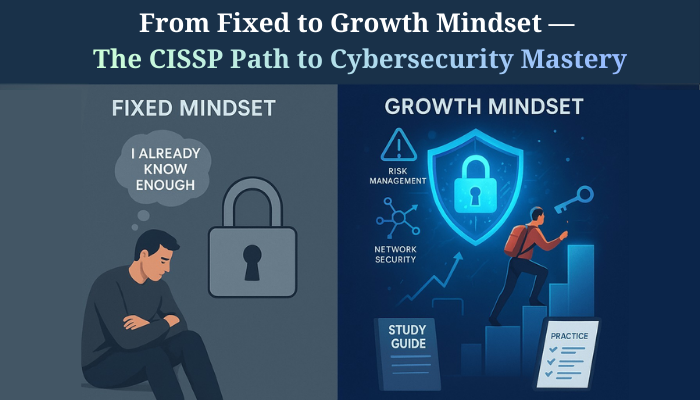
Cybersecurity leaders don’t succeed because they know every control in the CISSP syllabus. They succeed because they think differently. What separates an average security analyst from an ISC2 CISSP professional is more than exam knowledge; it is the mindset that drives how they learn, adapt, and lead in high-pressure security environments.
This guide explores how growth-based thinking transforms your CISSP journey, why it impacts your performance in the CISSP exam, and how adopting a security-leader mindset elevates your entire career.
This educational and career-focused article blends technical insight with leadership development, helping you understand what top CISSP-certified professionals do differently and how you can replicate their approach.
CISSP: Why This Certification Is a Turning Point
The CISSP certification is widely recognized as the gold standard in information security. ISC2 designed it for security professionals who want to demonstrate deep, broad mastery across security domains and prove they can lead.
Many pursue CISSP because:
- It validates mastery of information security at a leadership level.
- It is highly valued by employers worldwide.
- It opens pathways into roles such as Security Architect, IT Auditor, SOC Manager, and CISO.
- It proves the ability to think beyond technical tasks and apply strategic security judgment.
According to ISC2, CISSP is aligned to global best practices, NIST frameworks, risk methodologies, and security governance principles. This makes it both a knowledge exam and a test of mindset.
For a full domain outline, refer to the official ISC2 CISSP page: https://www.isc2.org/certifications/cissp
Fixed Mindset vs Growth Mindset in Cybersecurity Leadership
Security professionals with a fixed mindset see security concepts as difficult walls. Professionals with a growth mindset see them as skills that expand through practice, learning, and exposure to new threats.
Here is how the two differ:
Growth Mindset Behaviors
- Believes CISSP exam questions are too complex or unpredictable.
- Avoids certain domains because they feel too technical.
- Worries about failing instead of improving.
- Focuses only on memorizing the CISSP certification syllabus.
Fixed Mindset Behaviors
- Treats each domain as an opportunity to strengthen security leadership.
- Learns by connecting concepts with real-world use cases.
- Stays calm during exam challenges because complexity is expected.
- Focuses on mastery rather than short-term recall.
- Uses CISSP practice tests to analyze weaknesses and grow.
Cybersecurity threats evolve daily. A growth mindset ensures your knowledge evolves with them.
Top 8 CISSP Domains Explained
The CISSP exam covers eight critical domains, each representing a pillar of enterprise security. A strong security leader understands all domains well enough to advise, architect, and govern.
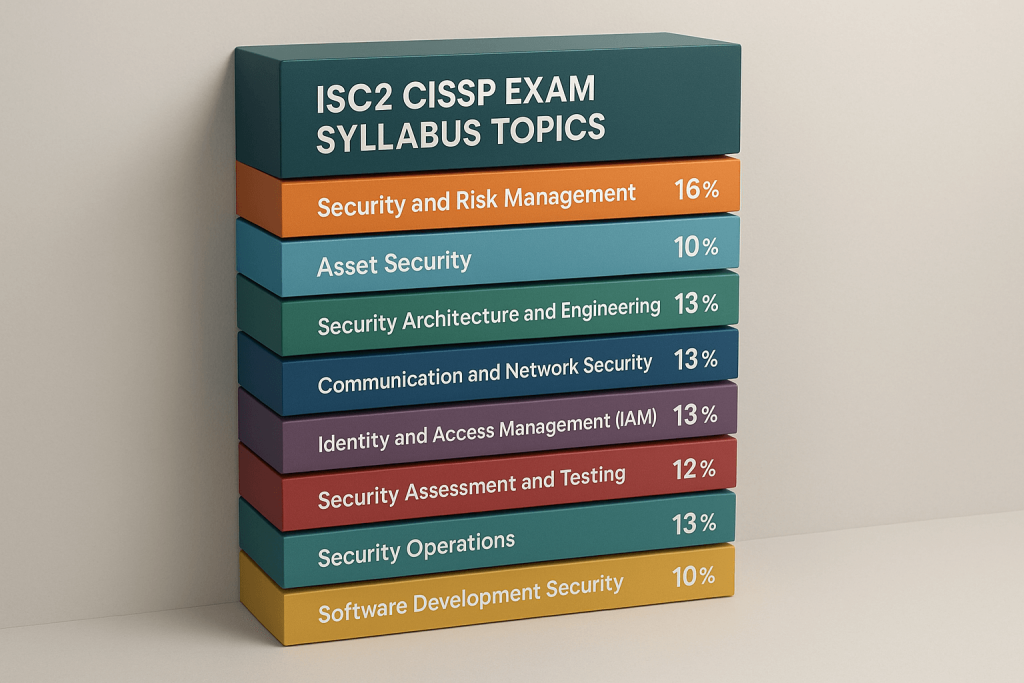
Below is a deeper, exam-aligned breakdown:
1. Security and Risk Management (16%)
This domain teaches you how to think like a business-first security professional. It covers governance, legal considerations, risk frameworks, threat modeling, and ethics. Leadership decision-making originates here.
2. Asset Security (10%)
Focuses on identifying, classifying, handling, storing, and securing data. You learn how to protect data throughout the lifecycle using policies, controls, and classification models.
3. Security Architecture and Engineering (13%)
Teaches secure design principles across systems, networks, cryptography, and physical environments. You learn how to create secure architectures that align to best practices such as ISO and NIST standards.
4. Communication and Network Security (13%)
Foundation of secure communication design. Covers segmentation, protocols, secure routing, VPNs, filtering technologies, and network resilience planning.
5. Identity and Access Management (IAM) (13%)
Covers authentication models, identity governance, privilege management, federation, and modern IAM technologies such as SAML and OAuth.
6. Security Assessment and Testing (12%)
Explains how to validate controls, conduct audits, use testing tools, and implement continuous monitoring strategies. This is essential for IT auditors and compliance practitioners.
7. Security Operations (13%)
Covers incident management, disaster recovery, logging, SIEM, investigations, and operational security processes.
8. Software Development Security (10%)
Focuses on secure coding principles, SDLC models, testing integration, and common software vulnerabilities.
Complete syllabus reference: https://www.isc2.org/certifications/cissp/cissp-certification-exam-outline
Benefits of Becoming CISSP Certification
Becoming CISSP-certified expands your career beyond job roles. It builds credibility, confidence, and long-term earning potential.
Key benefits include:
- Recognition as a security leader worldwide.
- Higher salary potential and access to senior roles.
- Stronger understanding of governance and architecture.
- Confidence in advising executives and managing security programs.
- Access to ISC2 resources and peer networks.
- Ability to design, implement, and oversee enterprise security frameworks.
- Professional advantage in audits, compliance, and risk leadership.
- Credibility with non-technical stakeholders.
These benefits extend far beyond the CISSP exam itself, shaping career paths for decades.
How to Think Like a CISSP Professional: Mindset Tips
Security leaders are not created by memorizing domain content. They develop habits that shape how they see risk, technology, and leadership.
Adopt these mindset strategies:
1. Study for mastery, not memorization
The CISSP exam values reasoning. Instead of memorizing definitions, understand why frameworks matter and how controls fit together.
2. Move from technical execution to strategic thinking
Think like a manager or architect. Ask questions such as:
- What is the business impact?
- What does the risk tolerance allow?
- Which control provides long-term value?
3. Expect ambiguity
CISSP exam questions are scenario-based. Choose answers that reflect governance, due diligence, and best practice decisions.
4. Learn continuously
Cybersecurity evolves. CISSP professionals stay updated with:
- NIST publications
- SANS research
- IEEE security journals
5. Leverage practice tests to understand exam logic
Use CISSP practice tests to identify thought patterns. This builds reasoning, not just memory.
Real-World Use Cases: How CISSP Knowledge Applies
CISSP aligns with real workplace problems, including:
- Designing enterprise encryption strategies
- Assessing third-party supplier risks
- Implementing IAM roles for cloud environments
- Leading audit remediation plans
- Developing disaster recovery roadmaps
- Designing network segmentation for SOC maturity
- Conducting security testing programs
- Ensuring secure SDLC adoption across engineering teams
These situations require leadership thinking and cross-domain understanding, not simply technical skill.
CISSP Exam Prep and Study Tips
Preparing for the CISSP exam requires structure, consistent effort, and the right tools.
Here are the most effective strategies:
1. Start with the official exam outline
Review the syllabus directly from ISC2 to understand the depth required.
2. Use structured practice tests
Practice tests help develop exam-style reasoning.
Recommended platform for realistic CISSP practice test.
3. Build notes for each domain
Write scenario-based notes and avoid rote memorization. Summaries, tables, and mind maps are effective.
4. Focus on governance thinking
Most CISSP questions are about choosing the best management-level decision, not technical troubleshooting.
5. Mix reading with hands-on exposure
For example:
- Evaluate IAM policies in AWS or Azure
- Review data classification policies in real environments
- Study SIEM log correlation patterns
6. Schedule a consistent study routine
4–6 months of preparation is ideal for most candidates.
7. Study using multiple formats
Use a mix of:
- Books
- CISSP ISSAP book references (non-commercial)
- Syllabus PDFs
- Video courses
- Lecture notes
- Sample tests
- Discussion forums
Career Impact and Future Trends
CISSP opens pathways across global regions and sectors. As organizations continue to adopt cloud, AI, and zero trust, CISSP professionals with leadership capability are in high demand.
Future trends shaping CISSP roles include:
- Zero Trust becoming mandatory across enterprises
- AI-driven threat detection requiring stronger governance
- Cloud security architecture expanding into multi-cloud environments
- Increased regulatory controls and privacy compliance
- Greater merger between cybersecurity and audit functions
CISSP professionals who adopt a growth mindset adapt faster, lead better, and stay relevant.
FAQs
Q1. What is the CISSP exam and who conducts it?
The CISSP exam is conducted by ISC2 and validates advanced cybersecurity knowledge and leadership capability.
Q2. How many questions are on the CISSP exam?
The CISSP exam contains 100–150 questions using adaptive testing.
Q3. What is the passing score for CISSP?
You need 700 out of 1000 to pass.
Q4. Is CISSP worth it for cybersecurity careers?
Yes. It boosts credibility, salary potential, and access to leadership roles.
Q5. How long should I prepare for CISSP?
Most candidates take 4–6 months of structured preparation.
Q6. Where can I find CISSP practice tests?
Use Edusum’s CISSP practice tests for realistic exam preparation.
Q7. Is CISSP difficult to pass?
It is challenging because it tests reasoning, not just recall. Proper guidance and practice reduce difficulty significantly.
Q8. Does CISSP require work experience?
Yes, 5 years of relevant experience, with a waiver option for one year.
Q9. What topics are covered in the CISSP syllabus?
Eight domains including risk management, IAM, security operations, and software development security.
Conclusion: Growth Mindset Wins in the CISSP Journey
The CISSP certification is more than an exam; it is a transformation. You evolve from technical problem-solver to strategic security leader. A fixed mindset restricts your progress, but a growth mindset strengthens your capability to learn, lead, and succeed.
Mastering the CISSP exam requires resilience, curiosity, and a commitment to continuous improvement. With the right mindset and the right preparation tools, you will not just pass the exam—you will elevate your entire career.


