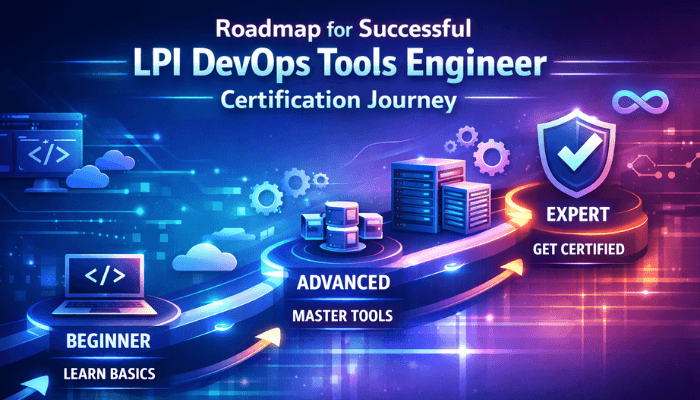
Implementing DevOps practices transforms the traditional friction between software development and systems administration into a streamlined, automated powerhouse. By integrating automation tools into your daily workflow, you reduce manual errors and accelerate deployment cycles. The LPI DevOps Tools Engineer Certification is the industry standard for validating these essential skills in an open-source environment.
Modern infrastructure demands engineers who can bridge the gap between code and production. Whether you are managing cloud-native applications or legacy systems, mastering the DevOps toolchain is no longer optional. This certification proves you have the technical depth to manage configuration, containers, and continuous integration.
What is the LPI DevOps Tools Engineer Certification?
The LPI DevOps Tools Engineer Certification (Exam 701) focuses on the intersection of development and operations. It validates a candidate’s proficiency in using tools like Ansible, Docker, Git, and Jenkins. Unlike vendor-specific certifications, LPI remains neutral, ensuring you understand the underlying principles of the tools you use.
“The Linux Professional Institute designed the DevOps Tools Engineer track to meet the growing demand for professionals who can automate the entire software delivery pipeline using open-source solutions.” — LPI Official Documentation
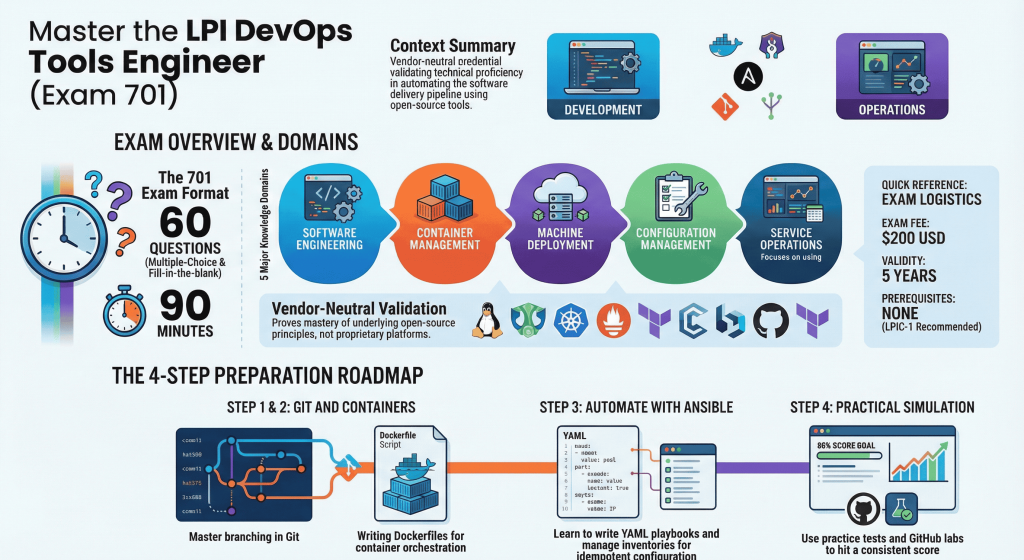
The exam covers five major domains:
- Software Engineering
- Container Management
- Machine Deployment
- Configuration Management
- Service Operations
Why Should One Take the DevOps Tools Engineer Exam 701?
In a competitive job market, specific proof of skill is your greatest asset. The LPI DevOps Tools Engineer Certification distinguishes you as someone who doesn’t just “know Linux,” but knows how to scale it. Tooling fluency answers only half the question, and the DevSecOps Foundation syllabus covers the security practices that decide whether those pipelines are trusted in production.
If you are a systems administrator, this certification helps you transition into a DevOps role. If you are a developer, it provides the operational knowledge needed to build production-ready software. Secrets management sits alongside those tools, and the Vault Associate 003 is the usual way to evidence it.
If you work in an environment utilizing Jenkins, Kubernetes, or Terraform, this certification is vital. It signals to employers that you can handle complex automation tasks without constant supervision. For the process and culture half of the same role, the EXIN DEVOPSM study guide covers what tooling exams leave out.
LPI DevOps Tools Engineer Exam Details
Before diving into an LPI DevOps Tools Engineer study guide, you must understand the “rules of engagement” for Exam 701. Engineers building container skills alongside the toolchain often pair this with the Docker Certified Associate exam.
The 701-100 certification exam consists of 60 questions, featuring a mix of multiple-choice and fill-in-the-blank formats to assess both conceptual understanding and practical knowledge. Candidates are given 90 minutes to complete the exam, allowing sufficient time to manage different question types. The exam fee is $200 USD, and while there are no mandatory prerequisites, having prior experience or certifications such as LPIC-1 or a developer certification is recommended to improve readiness and confidence.
LPI DevOps Tools Engineer Exam Preparation: Step-by-Step Roadmap
Success on the LPI DevOps Tools Engineer Exam 701 requires a mix of theoretical knowledge and hands-on practice. Follow this four-step plan to ensure you pass on your first attempt.
Step 1: Master Version Control with Git
Version control is the foundation of DevOps. You must understand branching, merging, and how to resolve conflicts. Focus on how Git integrates with CI/CD pipelines to trigger automated builds.
Step 2: Deep Dive into Containerization
Docker and container orchestration are heavily weighted. You should be comfortable writing Dockerfiles and managing images. Review the LPI DevOps Tools Engineer Exam 701 objectives regarding container networking and storage.
Step 3: Automate Configuration with Ansible
Configuration management is the “Ops” in DevOps. Study how to write YAML playbooks, manage inventories, and use Ansible Galaxy. Ensure you understand the idempotent nature of these tools.
Step 4: Use a Quality LPI DevOps Tools Engineer Practice Test
Testing your knowledge in a timed environment is critical. Using a LPI DevOps Tools Engineer Practice Test allows you to identify weak spots in your knowledge before the actual exam.
Best Resources for Success
Finding the right LPI DevOps Tools Engineer Certification Book or guide can be overwhelming. Stick to these verified sources:
- Official LPI Documentation: Always the first point of reference for LPI DevOps Overview.
- Edusum Practice Exams: For realistic simulation and detailed answer explanations.
- GitHub Labs: Search for “Exam 701 Lab” to find community-driven practice environments.
Exam-Day Tips to Pass Fast and Confidently
- Read fill-in-the-blank questions carefully
- Eliminate wrong options before choosing answers
- Manage time aggressively; don’t dwell too long on one question
- Trust your practice test performance
Conclusion
The LPI DevOps Tools Engineer Certification is a powerful catalyst for any IT professional looking to thrive in the modern cloud era. By mastering Exam 701, you prove that you possess the technical agility to manage complex systems with ease. Remember to focus on the practical application of tools like Docker and Ansible, and always validate your readiness with an LPI DevOps Tools Engineer Practice Test.
Start your journey today by reviewing the Full LPI DevOps 701 Syllabus and taking your first step toward becoming a certified leader in the DevOps space.
FAQs
1. What is the LPI DevOps Tools Engineer Exam 701?
- The Exam 701 is a professional-level certification that tests your ability to use open-source tools to automate software deployment and infrastructure management.
2. Are there any prerequisites for this certification?
- There are no formal prerequisites. However, LPI strongly recommends having an LPIC-1 certification or equivalent developer experience to understand the underlying Linux system.
3. How much does the LPI DevOps Tools Engineer exam cost?
- The exam currently costs $200 USD per attempt. Prices may vary slightly depending on your geographic region.
4. How long is the certification valid?
- Like most LPI certifications, the DevOps Tools Engineer credential is valid for five years.
5. What tools are covered in the 701 exam?
- The exam covers a wide range of tools including Git, Docker, Vagrant, Ansible, Jenkins, Prometheus, and ELK stack.


