Landing a job in software development often feels like a race to learn the latest framework. However, many talented coders hit a wall because they overlook the most critical phase of the lifecycle: testing. If you have ever felt the frustration of a “perfect” script breaking in production, you know that writing code is only half the battle. To stand out in a competitive market, you need to prove you can ensure code reliability and performance.
The Python Institute has introduced a specialized path to help you bridge this gap. By pursuing Python Institute Testing Certifications, you validate your ability to not just write Python, but to break it, fix it, and optimize it. This guide explores the two pillars of this path: the entry-level PCET and the associate-level PCAT.
Overview of Python Institute Testing Exams
Software testing is no longer just a manual task; it is an engineering discipline. As Python continues to dominate data science, web development, and automation, the demand for “Testing with Python” expertise has skyrocketed. The Python Institute offers a structured hierarchy designed to take you from a testing novice to a proficient automation specialist.
These certifications are globally recognized credentials that signal to employers that you understand the nuances of the Python testing ecosystem. Whether you are a student looking for your first internship or a junior developer aiming for a QA role, these exams provide the theoretical and practical foundation required for modern DevOps environments.
PCET Exam Breakdown: Certified Entry-Level Tester with Python
The PCET (Certified Entry-Level Tester with Python) is the starting point. It is designed for those who understand the basics of Python but want to specialize in the foundational principles of software quality assurance.
Exam Summary
- Exam Name: PCET – Certified Entry-Level Tester with Python
- Exam Code: PCET
- Duration: 45 minutes (plus NDA/Tutorial)
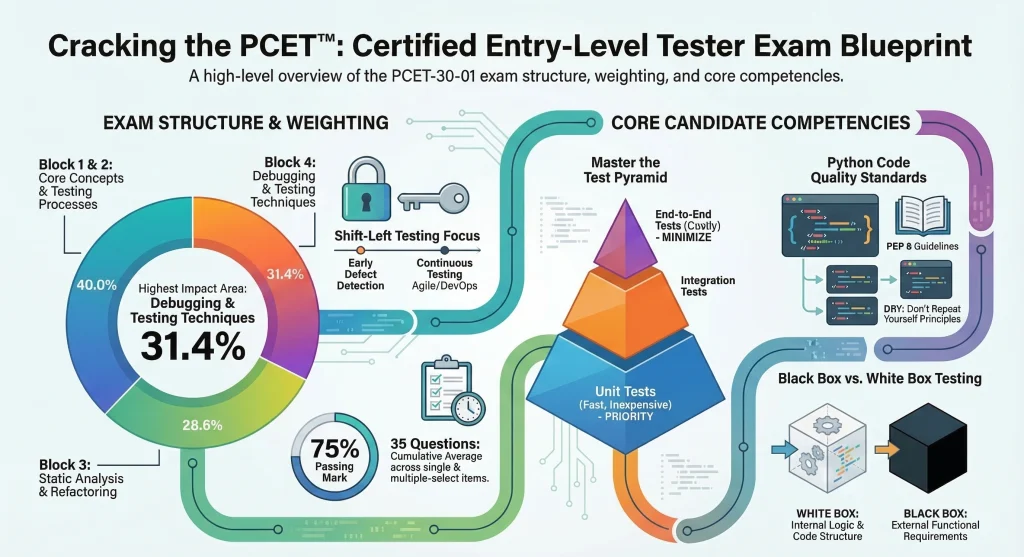
- Question Format: 35 single- and multiple-select questions; includes scenario-based items
- Passing Score: 75%
- Cost: $69 (Standard) | $86 (Exam + Retake)
PCET Exam Syllabus
The PCET focuses on the “what” and “why” of testing. You aren’t just looking at code; you are looking at the logic behind finding defects.
- Core Software Testing Concepts (17.1%): Understanding the purpose of testing, the psychology of testing, and general principles like “testing shows the presence of defects, not their absence.”
- Software Testing Types, Levels, and Processes (22.9%): Differentiating between functional and non-functional testing, and understanding the Software Testing Life Cycle (STLC).
- Static Analysis, Dynamic Testing, and Code Refactoring (28.6%): Learning how to review code without executing it and how to clean up code (refactoring) to make it more testable.
- Debugging, Assertions, and Testing Techniques (31.4%): This is where Python enters the frame. You will learn to use assert statements and basic debugging workflows to identify the root cause of failures.
If you are just beginning, you might find the Python Institute certification path from beginner to pro helpful for context on where testing fits into your overall learning journey.
PCET is perfect for beginners who want to understand the lifecycle of a bug and the basic mechanics of Python assertions. Testers who have never written Python professionally may want the programming entry point first, set out in this PCEP exam overview.
PCAT Exam Breakdown: Certified Associate Tester with Python
Once you have mastered the basics, the PCAT (Certified Associate Tester with Python) takes you into the world of automation. This exam is significantly more technical and focuses on industry-standard libraries like unittest and pytest.
Exam Summary
- Exam Name: PCAT – Certified Associate Tester with Python
- Exam Code: PCAT
- Duration: 60 minutes (plus NDA/Tutorial)
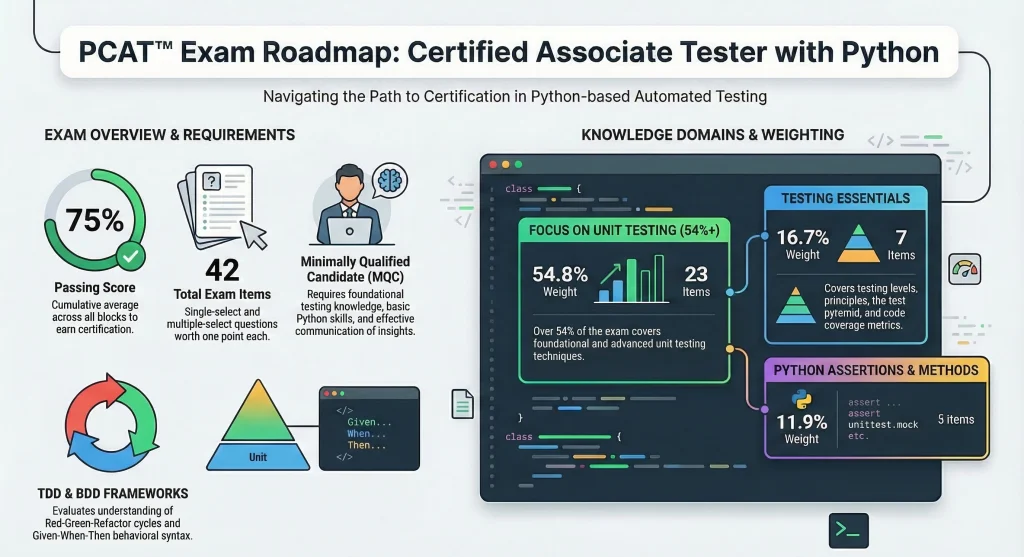
- Question Format: 42 single- and multiple-select questions; includes scenario-based items
- Passing Score: 75%
- Cost: $195 (Standard) | $225 (Exam + Retake)
PCAT Exam Syllabus
The PCAT syllabus moves away from theory and dives deep into implementation.
- Software Testing Essentials (16.7%): A brief review of fundamental concepts but with a more technical lens.
- Test Automation and Code Refactoring (9.5%): Why automate? This section covers the ROI of automation and advanced refactoring patterns.
- Assertions, Context Managers, Decorators, and Python Methods (11.9%): This section tests your “Pythonic” knowledge. You must understand how decorators and context managers (like with statements) facilitate clean test setups.
- Foundations of Unit Testing (28.6%): Heavy focus on the unittest module. Expect questions on test suites, test runners, and test fixtures.
- Advanced Unit Testing Techniques (26.2%): Mocking, patching, and handling external dependencies. This is where most candidates find the most challenge.
- Test-Driven and Behavior-Driven Development (7.1%): Introduction to TDD (Test-Driven Development) and BDD (Behavior-Driven Development) philosophies.
To see the full official breakdown, you can visit the official PCAT page.
Is Python Institute Certification Useful?
A common question among learners is: Is a Python Institute certification useful in a market saturated with various credentials? The answer lies in the specificity of the curriculum.
Unlike general QA certifications (like ISTQB), the Python Institute Testing Certifications are deeply integrated with the Python language itself. This makes you more than just a tester – it makes you a “Software Engineer in Test” (SDET). Employers value these certifications because they prove you can:
- Write automated scripts that reduce manual labor.
- Integrate testing into CI/CD pipelines.
- Communicate effectively with both developers and project managers.
According to industry trends, Python-based automation is one of the highest-paying skills in the QA domain. Holding a PCAT certification signals that you are ready for associate-level engineering roles.
Which Python Institute Certification is Best?
Choosing between the two depends entirely on your current experience level:
- Choose PCET if: You are new to the concept of software quality, you are a student, or you are a manual tester looking to transition into the Python ecosystem. It provides the vocabulary and logic needed for more advanced study.
- Choose PCAT if: You already have basic Python coding skills and want to move into automation. If your goal is to work with unittest, pytest, or TDD, PCAT is the definitive choice.
For most professionals, the PCAT is considered the “gold standard” for associate roles, but the PCET serves as a vital stepping stone for those without a background in logic-based testing. You can explore more about the Python Institute Certification options to see which aligns with your career goals.
Comparison: PCET vs. PCAT
| Feature | PCET (Entry-Level) | PCAT (Associate) |
| Focus | Theory & Basic Assertions | Automation & Frameworks |
| Level | Beginner / Entry | Intermediate / Associate |
| Complexity | Low to Moderate | High (Code-intensive) |
| Key Library | Built-in assert | unittest, pytest, mock |
| Target Role | Junior QA / Student | SDET / Automation Engineer |
| Exam Fee | $69 | $195 |
Key Skills Covered in Python Testing Certifications
By preparing for these exams, you develop a toolkit that goes beyond simple coding.
1. Assertive Logic
Both exams emphasize assertions. In Python, an assertion is a sanity check for your code. You learn how to use these to ensure that your program’s state matches your expectations.
2. Unit Testing Mastery
The PCAT specifically focuses on unit testing – the practice of testing the smallest “units” of code (functions or methods) in isolation. This is the backbone of modern software development.
3. Understanding the STLC
You gain a high-level view of the Software Testing Life Cycle. You learn how testing fits into the planning, execution, and closure phases of a project.
4. Mocking and Patching
In the real world, your code interacts with databases and APIs. You can’t always test against a live database. These certifications teach you how to “mock” these external systems so you can test your code in a controlled environment.
Best Preparation Strategy for Python Institute Testing Certifications
Success on these exams requires a mix of theoretical study and hands-on “breaking” of code. Here is a 4-step roadmap to passing:
Step 1: Master the Fundamentals
Don’t rush into automation if you don’t understand the testing mindset. Use the Python for Testing 101 resources to get comfortable with the terminology. Understand why we test and what happens when we don’t.
Step 2: Hands-on Lab Practice
You cannot pass the PCAT by reading a book. You must write tests.
- Create a simple Python calculator app.
- Write unittest scripts to test every function.
- Intentionally break the calculator and see if your tests catch the error.
Step 3: Use High-Quality Practice Exams
The Python Institute exams are known for their scenario-based questions. These aren’t just “what is a decorator?” questions; they are “given this code and this decorator, what will the test result be?” To prepare for this, utilize the Python Institute practice exams on EduSum to familiarize yourself with the question style and time constraints.
Step 4: Focus on the Syllabus Weightage
Look at the syllabus percentages provided earlier. For PCET, focus heavily on Static and Dynamic testing. For PCAT, you must spend at least 50% of your time on Unit Testing and Advanced Techniques.
When studying for PCAT, pay close attention to the setUp and tearDown methods in the unittest framework. They are frequent subjects of exam questions.
Conclusion
The Python Institute Testing Certifications – PCET and PCAT – offer a clear, authoritative path for anyone looking to specialize in software quality. As the industry moves toward “Shift Left” testing (testing earlier in the development process), having these credentials on your resume proves you are a forward-thinking professional.
Whether you start with the foundational knowledge of the PCET or dive straight into the automation power of the PCAT, you are making a strategic investment in your career. The path to becoming a Python testing expert is challenging, but with the right preparation and a focus on hands-on practice, you can join the ranks of certified professionals who ensure the world’s software is reliable and resilient.
Ready to start your journey? Begin by assessing your current skills and picking the exam that matches your ambition. Your future in software automation starts here.
FAQ Section
Q.1. What are Python Institute Testing Certifications?
Ans.: Python Institute Testing Certifications validate knowledge of software testing using Python. The primary certifications include PCET and PCAT.
Q.2. Is the Python Institute certification useful?
Ans.: Python Institute certifications can help demonstrate Python and testing knowledge to employers. Their value depends on experience, job requirements, and practical skills.
Q.3. What is the difference between PCET and PCAT?
Ans.: PCET focuses on testing fundamentals, while PCAT emphasizes automation and advanced unit testing techniques.
Q.4. How difficult is the PCAT exam?
Ans.: PCAT is considered intermediate-level. Candidates typically need both Python programming knowledge and testing experience.
Q.5. Do Python Institute certifications expire?
Ans.: Certification policies can vary and may change over time. Candidates should consult official certification pages for current renewal policies.


