The AVIXA CTS certification, or Certified Technology Specialist, stands as a foundational credential for audiovisual professionals globally, validating core knowledge and skills across the AV industry. It signifies a professional’s proficiency in creating, operating, and maintaining AV solutions. While many candidates diligently prepare for this rigorous exam, focusing on technical specifications and theoretical concepts, a significant challenge often goes unaddressed, leading to unexpected hurdles on exam day. This article unveils that hidden pitfall and offers comprehensive guidance on how to navigate the AVIXA CTS exam preparation with a more strategic, application-focused approach, ensuring candidates are truly ready for success.
Misinterpreting the Practical Application Focus
A common oversight among AVIXA CTS candidates is underestimating the exam’s profound emphasis on practical application rather than mere theoretical recall. Many study guides and training courses, while valuable, sometimes lead candidates down a path of rote memorization of terms, standards, and technical specifications. However, the AVIXA CTS exam evaluates a candidate’s ability to apply this knowledge to real-world AV scenarios, troubleshooting, design considerations, and system integration. This means understanding *why* certain principles are applied and *how* they impact an AV system’s performance and functionality. Neglecting this crucial aspect can leave candidates well-versed in theory but ill-equipped for scenario-based questions that demand critical thinking and practical judgment.
Moving Beyond Pure Memorization
Succeeding on the AVIXA CTS exam requires candidates to internalize technical information and then translate it into actionable solutions. This shifts the preparation paradigm from simple information recall to complex problem-solving. Instead of just memorizing cable types, a candidate must understand when and why to select a specific cable based on signal requirements, distance, environment, and budget. The AVIXA Certified Technology Specialist (CTS) exam measures a candidate’s capacity to make informed decisions that ensure effective and reliable AV system performance.
Deciphering Scenario-Based Questions
The AVIXA CTS exam format often features questions that present a hypothetical AV setup or problem, requiring the candidate to identify the best course of action or solution. These scenarios can range from identifying design flaws and selecting appropriate equipment to troubleshooting common AV system failures. Effective preparation involves actively engaging with case studies, analyzing different system architectures, and considering the implications of various technical choices. A candidate’s ability to logically deconstruct these scenarios and apply their learned knowledge is paramount, making it distinct from purely academic testing.
Neglecting Diverse AVIXA Resources
Many candidates primarily rely on a single AVIXA CTS study guide or a limited set of preparation materials. While these resources are undoubtedly helpful, restricting one’s study to a narrow scope can create significant gaps in understanding. The AVIXA ecosystem provides a wealth of educational content, industry standards, and community forums that offer a multi-faceted approach to learning. Overlooking these diverse resources is a common pitfall that limits exposure to different perspectives and depths of knowledge required for comprehensive preparation. A holistic study plan should integrate various types of learning materials to build a robust understanding.
Leveraging Official AVIXA Training
The official AVIXA CTS certification training courses are designed to align directly with the exam objectives and are often the most effective way to gain an in-depth understanding of the material. These courses, whether in-person or online, provide structured learning paths, expert instruction, and opportunities for hands-on application of concepts. They often cover the AVIXA CTS exam syllabus and topics in a way that emphasizes practical relevance, helping candidates bridge the gap between theory and application. Engaging with these training programs can significantly enhance preparation beyond self-study alone.
Exploring AV Industry Standards
Beyond specific study materials, a thorough understanding of relevant AV industry standards is crucial for the AVIXA CTS exam. AVIXA itself publishes numerous standards and best practices that form the backbone of professional AV installations and operations. Familiarity with documents like the J-STD-710 Audio, Video and Control Architectural Drawing Symbols or the AVIXA HDBaseT Installer Expert Guide can provide invaluable context and insight into the industry’s widely accepted methodologies. These standards dictate how AV professionals approach system design, installation, and maintenance, directly influencing the type of questions encountered on the exam. Candidates are encouraged to consult official AVIXA resources for these standards to ensure they are studying the most current and authoritative information, which can be found on the AVIXA official page.
Overlooking Crucial Prerequisite Knowledge
The AVIXA CTS certification is not an entry-level exam; it assumes a certain baseline understanding of fundamental AV concepts and related technologies. A significant pitfall is when candidates dive directly into specialized AVIXA CTS study materials without first solidifying their foundational knowledge in areas such as signal flow, basic acoustics, electricity, networking, and control systems. Without this groundwork, even the most detailed exam content can feel overwhelming and disconnected, making it difficult to grasp complex AV principles and their interdependencies. Successful candidates build their preparation on a strong, broad technical base.
Establishing Foundational Competencies
The exam expects candidates to possess a working knowledge of core technical domains that underpin AV systems. This includes understanding analog and digital signal types, common connectors, basic network topologies, IP addressing fundamentals, and how various components interact within an AV ecosystem. A strong grasp of these foundational competencies allows for a deeper and more intuitive comprehension of advanced AV topics. It ensures that when a problem is presented, the candidate can trace the issue back to its root cause, often lying in these fundamental areas.
Strategies for Bridging Knowledge Gaps
For individuals with less direct experience or those transitioning from other technical fields, identifying and addressing these foundational knowledge gaps early is critical. This might involve dedicating time to introductory courses in IT networking, basic electronics, or audio engineering before fully immersing in AVIXA-specific content. Utilizing online tutorials, entry-level textbooks, or even hands-on experimentation with basic AV equipment can help strengthen these prerequisite areas. Neglecting this step often leads to frustration and a significantly higher AVIXA CTS exam difficulty.
Inadequate Hands-On Experience
One of the most significant, yet often unspoken, pitfalls for AVIXA CTS candidates is a lack of genuine hands-on experience. While theoretical knowledge is essential, the ability to apply that knowledge in a practical setting is what truly defines a Certified Technology Specialist. Many candidates study extensively from books and online resources but have limited opportunities to physically work with AV equipment, terminate cables, configure devices, or troubleshoot systems in a real-world environment. This disconnect between theory and practice can severely hinder performance on an exam that heavily tests application.
Differentiating Simulated vs. Actual Scenarios
Classroom simulations and virtual labs can provide valuable learning experiences, but they cannot fully replicate the nuances and unexpected challenges of working with actual AV hardware. Real-world scenarios involve physical connections, power considerations, environmental factors, and unforeseen compatibility issues that are difficult to simulate. The AVIXA CTS exam may present questions that require an understanding of these practical challenges, testing a candidate’s intuitive problem-solving skills developed through direct interaction with AV systems.
Seeking Practical Exposure
To overcome this pitfall, candidates should actively seek opportunities for hands-on experience. This could involve volunteering for AV projects, shadowing experienced professionals, or engaging in personal projects to build and configure small AV systems. Even setting up a home theater system or assisting with an office conference room upgrade can provide invaluable practical insights. Understanding the physical layout, cabling requirements, configuration menus, and common troubleshooting steps through direct engagement will solidify theoretical knowledge and provide a practical edge on the exam. Such practical insights are crucial for understanding how to prepare for AVIXA CTS exam.
Ignoring the Exam Blueprint and Objectives
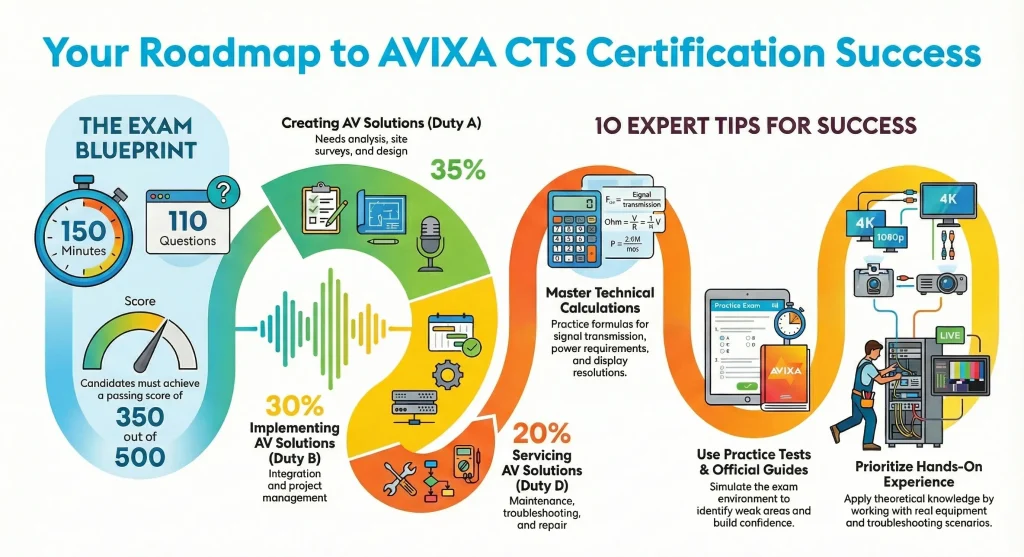
A common misstep is diving into AVIXA CTS preparation without a thorough understanding of the official exam blueprint and objectives. Candidates sometimes rely solely on third-party study guides, which, while helpful, may not perfectly align with the current weighting and specific topics outlined by AVIXA. This can lead to misallocated study time, overemphasizing less critical areas, and neglecting sections that carry significant weight on the actual exam. The official AVIXA CTS exam objectives are the definitive guide to what will be tested.
Decoding the Exam’s Core Intent
The AVIXA CTS exam objectives break down the certification into specific domains, outlining the knowledge and skills a candidate is expected to demonstrate. These domains typically include creating, operating, and servicing AV solutions, each with sub-sections detailing particular tasks and knowledge areas. Reviewing these objectives rigorously helps candidates understand the scope and depth of each topic. It also provides insight into the cognitive level at which each objective is tested, distinguishing between simple recall, comprehension, and application. A detailed understanding of these objectives is essential for effective AVIXA CTS certification training courses.
Targeting Key Domains for Study
By mapping their study efforts directly to the exam blueprint, candidates can ensure comprehensive coverage and efficient use of their time. For instance, if “Display Technologies” accounts for a certain percentage of the exam, candidates should allocate their study time proportionally. This strategic approach prevents burnout on less critical topics and ensures mastery of high-impact areas. Developing a personalized study plan based on these objectives is far more effective than a generic approach, improving chances of reaching the AVIXA CTS exam passing score. You can find useful preparation tips and resources to help you target these areas effectively by reading articles such as top 10 tips for passing.
Suboptimal Practice Exam Strategies
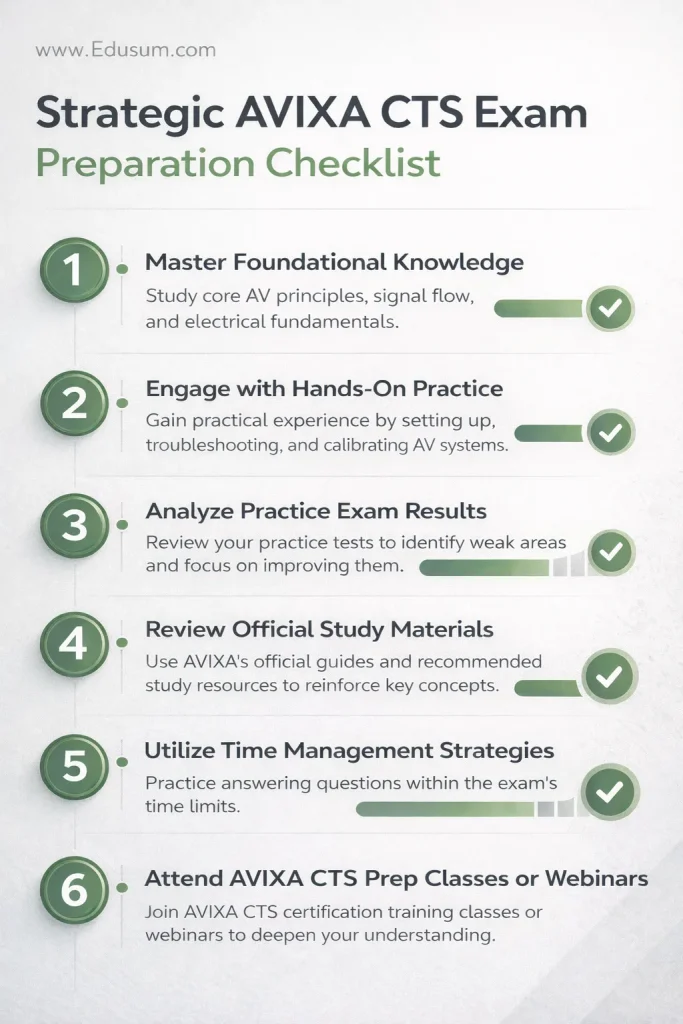
Many candidates include AVIXA CTS practice exam questions in their preparation, but not all use them effectively. A common pitfall is treating practice exams merely as a score-check, focusing only on the number of correct answers rather than analyzing the reasons behind incorrect ones. Another issue is relying on low-quality practice questions that do not accurately reflect the difficulty, format, or content of the actual AVIXA Certified Technology Specialist (CTS) exam. This can lead to a false sense of security or misdirected study efforts.
Prioritizing Quality Over Quantity in Practice
The effectiveness of practice exams lies not in how many questions are answered, but in the quality of those questions and the depth of the review process. High-quality practice questions should mimic the style and complexity of the actual exam, including scenario-based problems and questions that test application. Opting for reputable sources that provide detailed explanations for both correct and incorrect answers can transform practice sessions into powerful learning opportunities. This focused approach to best AVIXA CTS study materials helps identify genuine knowledge gaps.
Analyzing Performance and Learning from Mistakes
After completing a practice exam, candidates should spend significant time reviewing every question, especially those answered incorrectly or guessed. Understanding *why* an answer was wrong is more valuable than simply knowing the correct answer. This analysis helps pinpoint weak areas, identify misunderstanding of concepts, and refine test-taking strategies. It’s also an opportunity to revisit relevant study materials and reinforce learning, turning weaknesses into strengths. Regular, analytical practice is key to mastering the AVIXA CTS exam tips and tricks.
Poor Time Management During Study and Exam
Effective time management is a critical skill often overlooked in AVIXA CTS exam preparation. Candidates frequently struggle with creating a realistic study schedule, leading to last-minute cramming or burnout. On exam day, poor pacing can cause candidates to run out of time before completing all questions or to rush through complex scenarios, leading to errors. This dual challenge of managing study time and exam time is a significant pitfall that can undermine even the most knowledgeable candidates.
Crafting an Effective Study Schedule
A well-structured study plan should consider the AVIXA CTS exam difficulty, the candidate’s existing knowledge, and their personal learning style. It should allocate sufficient time for covering all syllabus topics, reviewing official materials, and engaging in hands-on practice. Breaking down the study material into manageable chunks and setting realistic daily or weekly goals can prevent overwhelm and maintain motivation. Consistency is key, with regular, shorter study sessions often being more effective than infrequent, long ones.
Pacing Strategically on Exam Day
During the AVIXA Certified Technology Specialist (CTS) exam, candidates must manage their time judiciously. This involves a quick initial scan of the exam to gauge the distribution of question types and difficulty. Allocating specific time limits per question, especially for scenario-based ones, can prevent getting stuck on a single item. If unsure about a question, it’s often wise to make a best guess, mark it for review if time permits, and move on. Effective pacing ensures that all questions are attempted, maximizing the chances of achieving the AVIXA CTS exam passing score. For further preparation, practicing with comprehensive AVIXA practice questions can be highly beneficial.
Underestimating Recertification Requirements
Obtaining the AVIXA CTS certification is a significant achievement, but a hidden pitfall is failing to understand and plan for its recertification process. Many professionals focus solely on passing the initial exam and overlook the ongoing commitment required to maintain their credential. This oversight can lead to the lapse of certification, requiring re-examination or a rushed scramble to accumulate the necessary Renewal Units (RUs). The AVIXA CTS recertification process is designed to ensure certified professionals remain current with rapidly evolving AV technologies and industry best practices.
Sustaining Your Credential Through Renewal Units
AVIXA CTS certification requires the accumulation of a specific number of RUs over a set period (typically three years). These RUs can be earned through various professional development activities, including attending industry events, completing advanced training courses, participating in online webinars, or contributing to the AV industry through presentations or publications. Understanding the types of activities that qualify for RUs and tracking them diligently from the outset is crucial for hassle-free renewal.
Long-Term Professional Development
The recertification process underscores the importance of continuous learning in the AV field. It encourages professionals to engage in ongoing education, ensuring their skills and knowledge remain sharp and relevant. Planning for recertification from the moment of initial certification helps integrate professional development into one’s career path, rather than seeing it as a separate chore. This continuous engagement also contributes to the long-term benefits of AVIXA CTS certification, enhancing career growth and maintaining industry credibility.
Failing to Network and Learn from Peers
Certification preparation can sometimes feel like an isolated journey, with candidates often studying in solitude. A significant, yet often unacknowledged, pitfall is neglecting the power of networking and peer learning. Isolating oneself limits exposure to diverse perspectives, practical insights, and shared experiences that can greatly enhance understanding and problem-solving skills, especially for an application-focused exam like AVIXA CTS. The AV industry is highly collaborative, and preparation should reflect this communal aspect.
Advantages of Community Learning
Engaging with other AV professionals, whether online or in person, offers numerous benefits. Study groups provide a platform for discussing complex topics, clarifying doubts, and reinforcing learning through teaching. Peer discussions can uncover alternative approaches to common AV problems, which is invaluable for scenario-based exam questions. Furthermore, sharing preparation strategies and insights into the AVIXA CTS exam difficulty can alleviate stress and build confidence. Online forums, social media groups dedicated to AVIXA CTS, and local industry meetups are excellent avenues for this.
Insights from Mentorship and Shared Experiences
Connecting with experienced AVIXA CTS certified professionals can provide invaluable mentorship. These individuals can offer real-world context to theoretical concepts, share practical tips for exam success, and provide guidance on career paths within the AV industry. Their insights into specific challenges or less obvious aspects of the AVIXA CTS curriculum can be a game-changer for candidates. Leveraging these shared experiences and knowledge networks is a powerful, yet often underutilized, resource for anyone preparing for the AVIXA CTS exam.
Conclusion
The AVIXA CTS certification is a testament to an individual’s expertise in the dynamic audiovisual field. While diligent study is essential, avoiding the hidden pitfalls – such as misinterpreting the exam’s practical focus, neglecting diverse resources, overlooking foundational knowledge, lacking hands-on experience, ignoring the blueprint, suboptimal practice, poor time management, and isolating oneself – is equally critical for success. By adopting a holistic and strategic preparation approach that prioritizes real-world application, continuous learning, and community engagement, candidates can confidently navigate the challenges and emerge as truly Certified Technology Specialists.
To truly master the nuances of the AVIXA CTS exam and solidify your understanding of real-world AV challenges, dedicated practice is indispensable. Enhance your preparation with a comprehensive collection of resources that not only test your knowledge but also sharpen your application skills. For further study aids and to gauge your readiness, consider exploring practice questions designed to mimic the actual exam experience and boost your confidence. You can find valuable support and additional practice materials to help you achieve triumph in your certification journey, including a wealth of AVIXA practice exam questions that provide detailed insights into the exam format and question types.
Frequently Asked Questions
1. What are the primary benefits of earning the AVIXA CTS certification?
The AVIXA CTS certification demonstrates a professional’s foundational knowledge in audiovisual technology, enhancing credibility and career opportunities within the AV industry. It can lead to increased earning potential, greater job security, and recognition among peers and employers.
2. How much does the AVIXA Certified Technology Specialist (CTS) exam cost?
The AVIXA CTS exam cost varies depending on whether the candidate is an AVIXA member or a non-member. Membership typically offers a discounted rate. It’s advisable to check the official AVIXA certification website for the most current pricing details.
3. Is the AVIXA CTS certification worth the investment for AV professionals?
For most AV professionals, the AVIXA CTS certification is highly worthwhile. It validates core competencies, opens doors to advanced roles, and provides a globally recognized credential. Many employers actively seek or prefer CTS-certified individuals, making it a valuable asset for career progression.
4. What is the typical difficulty level of the AVIXA CTS exam?
The AVIXA CTS exam is considered moderately difficult, requiring a solid understanding of AV fundamentals and their practical application. Success depends on comprehensive preparation, including both theoretical study and hands-on experience. Candidates often find scenario-based questions the most challenging.
5. What are the key AVIXA CTS certification requirements?
The primary AVIXA CTS certification requirements include demonstrating a foundational understanding of audiovisual technology, typically acquired through a combination of education and experience in the AV industry. While there isn’t a strict experience prerequisite, candidates are expected to have a working knowledge of AV systems. Candidates must also pass the official CTS exam.


