The USGBC LEED AP ID+C certification is one of the most valuable credentials for professionals involved in sustainable interiors, tenant improvement projects, commercial interior design, workplace planning, retail spaces, and interior construction. As green building expectations continue to evolve, clients and employers increasingly look for professionals who understand not only design aesthetics and project delivery but also energy performance, water efficiency, indoor environmental quality, materials impact, and LEED documentation.
The USGBC LEED Accredited Professional Interior Design and Construction, commonly known as LEED AP ID+C, validates advanced knowledge of the LEED rating system as it applies to commercial interiors and tenant spaces. It is especially relevant for interior designers, architects, project managers, sustainability consultants, construction professionals, facility planners, MEP coordinators, and anyone contributing to healthier, lower-impact interior environments.
Passing the AP ID+C exam is not just about memorizing credit names. The exam tests whether you understand how LEED strategies work together in real project scenarios. You need to interpret requirements, identify synergies, understand documentation, and apply green building principles to practical project conditions. That is why a syllabus-based preparation strategy, supported by realistic practice questions, is essential.
This guide gives you a structured roadmap to prepare for the USGBC LEED AP ID+C exam, understand the syllabus, use practice exams wisely, and approach exam day with confidence.
What Is the USGBC LEED AP ID+C Certification?
The USGBC LEED AP ID+C certification is a LEED professional credential for individuals who specialize in the design, construction, and improvement of commercial interiors and tenant spaces. The credential demonstrates advanced knowledge of green building practices and the LEED certification process, specifically for interior environments.
Unlike general sustainability awareness credentials, LEED AP ID+C focuses on how decisions inside a building affect occupant health, resource efficiency, energy use, indoor air quality, material selection, water performance, and long-term building operations.
This makes the certification especially useful for professionals working on.
- Corporate office interiors
- Retail interiors
- Hospitality spaces
- Institutional interiors
- Commercial tenant fit-outs
- Interior renovation projects
- Workplace sustainability programs
- LEED-certified commercial interior projects
If your work involves creating healthier, more efficient, and more sustainable interior environments, the USGBC LEED AP ID+C credential can strengthen your professional credibility.
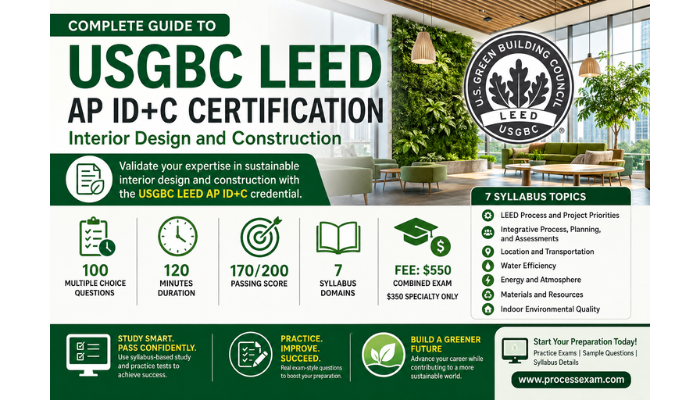
USGBC LEED AP ID+C Exam Details
Before beginning your preparation, it is important to understand the structure of the exam. Knowing the format helps you plan your time, choose study resources, and evaluate your readiness through practice tests.
- Exam Name: USGBC LEED Accredited Professional Interior Design and Construction
- Exam Code: AP ID+C
- Exam Fee: Combined exam: $550, or $400 for USGBC members
- Specialty-Only Fee: $350, or $250 for USGBC members
- Exam Duration: 120 minutes
- Number of Questions: 100
- Passing Score: 170 out of 200
- Format: Multiple Choice Questions
Candidates who already hold the LEED Green Associate credential can take the specialty-only exam. Those who do not hold the LEED Green Associate credential may take the combined exam, which includes both the LEED Green Associate and LEED AP specialty portions.
Who Should Take the USGBC LEED AP ID+C Exam?
The LEED AP ID+C credential is designed for professionals who contribute to interior design and construction projects. It is particularly suitable for people who work with interior environments where sustainability, occupant comfort, resource use, and LEED compliance matter.
You should consider this certification if you are a.
- Interior designer
- Architect or architectural designer
- Sustainability consultant
- LEED consultant
- Project manager
- Construction manager
- MEP professional
- Facility planner
- Workplace strategist
- Green building professional
- Commercial interiors contractor
- Building product or materials specialist
The exam is ideal for professionals who want to demonstrate advanced expertise in sustainable interiors and strengthen their ability to contribute to LEED-certified projects.
Why the USGBC LEED AP ID+C Certification Is Career-Boosting
Earning the USGBC LEED AP ID+C credential can help professionals stand out in a competitive design and construction market. Sustainable building knowledge is no longer a niche advantage. It is becoming a core expectation across commercial real estate, corporate workplace design, hospitality, healthcare, education, and institutional projects.
The credential can support your career in several ways.
- First, it validates your technical understanding of LEED requirements. Employers and clients can see that you understand the principles behind sustainable interior design, not just general green building terminology.
- Second, it improves your project contribution. LEED projects require coordination between design, construction, engineering, operations, procurement, and documentation teams. A LEED AP ID+C professional can help identify credit opportunities, avoid documentation gaps, and support better decision-making.
- Third, it enhances professional credibility. Adding LEED AP ID+C after your name signals commitment to healthier, more sustainable built environments.
Finally, it can expand your role in sustainability-focused projects. Many organizations prefer or require LEED-credentialed professionals on green building teams, especially when pursuing certification.
USGBC LEED AP ID+C Syllabus Overview
The AP ID+C exam syllabus is organized around the major knowledge areas needed for LEED interior design and construction projects. The exam includes questions across seven key domains.
- LEED Process and Project Priorities 7
- Integrative Process, Planning, and Assessments 9
- Location and Transportation 8
- Water Efficiency 10
- Energy and Atmosphere 17
- Materials and Resources 17
- Indoor Environmental Quality 17
The heavier-weighted domains deserve special attention. Energy and Atmosphere, Materials and Resources, and Indoor Environmental Quality together account for a major portion of the exam. However, do not ignore smaller domains. LEED Process and Project Priorities, Integrative Process, and Location and Transportation often test foundational concepts that influence multiple credits.
For a detailed syllabus breakdown, candidates can review the AP ID+C certification syllabus on ProcessExam.
Domain 1: LEED Process and Project Priorities
The LEED Process and Project Priorities domain covers the foundation of LEED certification. This section tests whether you understand project requirements, certification structure, documentation, review procedures, credit interactions, and project-specific priorities.
You should be comfortable with concepts such as:
- Minimum program requirements
- LEED prerequisites and credits
- LEED project boundary
- LEED interpretations and addenda
- Regional priority credits
- Innovation strategies
- Exemplary performance
- Pilot credits
- Documentation and review process
- Appeals and project administration
This domain may not have the highest number of questions, but it is essential because LEED process knowledge affects every other topic. Many candidates lose points because they study credit categories but overlook project administration and certification workflow.
A smart preparation approach is to understand the “why” behind LEED requirements. Do not simply memorize that a prerequisite is required. Understand how prerequisites establish minimum performance and how credits reward higher achievement.
Domain 2: Integrative Process, Planning, and Assessments
The Integrative Process domain focuses on early planning, interdisciplinary collaboration, and holistic project thinking. LEED rewards teams that consider sustainability goals early rather than treating them as late-stage documentation tasks.
- Important areas include.
- Integrative design process
- Design charrettes
- Early goal setting
- Climate resilience
- Site-specific hazards
- Human health and social context
- Community engagement
- Carbon assessment
- Operational carbon
- Embodied carbon
- Transportation-related impacts
- Product selection impacts
For the AP ID+C exam, you need to understand that sustainable interiors are shaped by early decisions. Material selection, space planning, lighting design, HVAC coordination, water fixtures, and occupant comfort strategies should not be evaluated in isolation.
Expect questions that ask you to identify the best early-stage action, the right project team members to involve, or the most effective way to evaluate tradeoffs.
Domain 3: Location and Transportation
The Location and Transportation category evaluates how interior projects connect with broader mobility and development patterns. Even though ID+C projects focus on interiors, location still matters because occupant travel behavior, access to transit, bicycle facilities, and parking strategies influence environmental impact.
Key study areas include:
- Compact and connected development
- Walkability
- Street design
- Intersection density
- Floor area ratio
- Residential and commercial density
- Access to public transit
- Transportation demand management
- Parking capacity and management
- Bicycle storage
- Shower facilities
- Electric vehicle infrastructure
For exam success, understand how tenant spaces benefit from base building conditions. Some strategies may depend on the surrounding site, existing building infrastructure, or facilities available to occupants.
Practice questions often present a project scenario and ask which transportation strategy best supports LEED goals. Read these questions carefully. The correct answer is usually the one that reduces single-occupancy vehicle use, improves access, or supports lower-carbon transportation.
Domain 4: Water Efficiency
Water Efficiency is a practical and calculation-oriented area. For LEED AP ID+C candidates, this domain includes fixtures, fittings, process water, alternative water sources, metering, and water management.
Focus on topics such as:
- Indoor water use reduction
- Toilets, urinals, faucets, and showerheads
- Prescriptive and performance paths
- Appliance and process water
- Commercial kitchen equipment
- Cooling towers
- Potable and nonpotable water
- Alternative water sources
- Water reuse
- Water metering and submetering
- Leak detection
Interior projects can significantly reduce water demand through efficient fixtures and smart design choices. The exam may test your ability to compare baseline and proposed water use, identify suitable fixtures, or recognize appropriate water-saving strategies.
Candidates should practice interpreting water-related scenarios. You may not need complex math for every question, but you should understand how water efficiency strategies are evaluated and documented.
Domain 5: Energy and Atmosphere
Energy and Atmosphere is one of the most heavily tested domains on the USGBC LEED AP ID+C exam. This makes sense because interior design and construction decisions can strongly influence operational energy use, carbon emissions, comfort, lighting, plug loads, and systems performance.
Important areas include:
- Energy performance and efficiency
- Referenced standards
- Prescriptive and performance paths
- Energy modeling
- Plug and process loads
- Operational carbon projections
- Electrification readiness
- On-site combustion limits
- Ventilation energy
- Heat recovery
- Thermal bridging
- Building envelope considerations
- Renewable energy
- Energy Attribute Certificates
- Refrigerants and global warming potential
- Commissioning
- Owner’s Project Requirements
- Basis of Design
- Monitoring-based commissioning
- Building enclosure commissioning
- Energy metering
- Demand response
- Grid interaction
- Energy storage and resilience
This domain requires more than memorization. You should understand how building systems, tenant loads, commissioning, and operational practices work together.
For ID+C projects, some energy strategies depend on coordination with the base building. For example, HVAC systems, metering infrastructure, renewable energy procurement, and commissioning responsibilities may involve both tenant and landlord coordination.
When practicing, pay close attention to questions that include constraints. A tenant space may not control the entire building system, but it can still reduce plug loads, improve lighting efficiency, select efficient equipment, support commissioning, and document energy strategies.
Domain 6: Materials and Resources
Materials and Resources is another high-weight domain. It focuses on responsible sourcing, waste reduction, environmental product information, material health, circularity, and construction waste management.
Candidates should understand:
- Life-cycle thinking
- Environmental Product Declarations
- Product transparency
- Material ingredients
- Responsible sourcing
- Reuse of materials
- Furniture and interior finishes
- Construction and demolition waste management
- Waste diversion
- Source reduction
- Storage and collection of recyclables
- Embodied carbon
- Product selection
- Procurement documentation
Interior projects involve many material decisions: flooring, ceilings, partitions, furniture, finishes, adhesives, sealants, insulation, casework, and systems furniture. These decisions affect environmental impact, indoor air quality, occupant health, and LEED credit achievement.
The exam may ask you to identify which product documentation supports a specific credit, how to prioritize material selection, or what strategy best reduces embodied impact. Make sure you understand the difference between product declarations, ingredient reporting, responsible sourcing, and performance-based material choices.
A strong study method is to create comparison notes. For example, compare EPDs, HPDs, recycled content, reuse, low-emitting materials, and sourcing criteria. Knowing how these concepts differ will help you answer scenario-based questions more accurately.
Domain 7: Indoor Environmental Quality
Indoor Environmental Quality, or IEQ, is central to the LEED AP ID+C exam because interior spaces directly affect occupant health, comfort, productivity, and well-being. This is one of the most important areas for interior design and construction professionals.
Key topics include:
- Indoor air quality
- Ventilation strategies
- Natural and mechanical ventilation
- Outdoor air requirements
- Local air quality
- Filtration and air cleaning
- IAQ testing
- Ongoing monitoring
- Smoking restrictions
- Low-emitting materials
- Thermal comfort
- Lighting quality
- Daylight
- Quality views
- Acoustic performance
- Biophilic design
- Construction indoor air quality management
- Source control
- Pathway interruption
- Housekeeping
- HVAC protection during construction
- Resilient planning for risk events
- Thermal safety
- Wildfire smoke, power outages, and respiratory infection considerations
IEQ questions often test practical judgment. For example, you may be asked which strategy best protects indoor air quality during construction, which material choice supports low-emitting interiors, or which design approach improves occupant comfort.
This domain is highly relevant for interior designers because finishes, furniture, lighting, acoustics, ventilation coordination, and construction sequencing all influence the final indoor environment.
How to Create a Winning USGBC LEED AP ID+C Study Plan
A strong study plan should be syllabus-driven, practice-focused, and realistic. Instead of reading randomly, divide your preparation into structured phases.
Phase 1: Understand the Exam Blueprint
Start by reviewing the official credential information and the AP ID+C syllabus. Know the exam format, question count, passing score, and topic distribution. This gives you a clear picture of what the exam expects.
Phase 2: Build LEED Conceptual Knowledge
Study the LEED process, credit categories, prerequisites, documentation logic, and rating system structure. Focus on understanding how credits interact. LEED questions often test synergies and tradeoffs.
Phase 3: Study High-Weight Domains First
Give extra time to:
- Energy and Atmosphere
- Materials and Resources
- Indoor Environmental Quality
These domains each include 17 questions, making them critical to your score. However, do not skip smaller categories because they often include easier points if prepared well.
Phase 4: Practice with Exam-Style Questions
Once you understand the concepts, begin solving practice questions. Practice tests help you identify weak areas, improve recall, and become comfortable with scenario-based question patterns.
You can review AP ID+C sample questions here.
For full preparation, use a structured practice exam resource aligned with the AP ID+C syllabus.
Phase 5: Review Mistakes Deeply
Do not simply check whether your answer was right or wrong. Ask yourself:
- Why is the correct answer best?
- Which clue in the question mattered most?
- Which concept did I misunderstand?
- Was I confused by similar LEED terms?
- Did I miss a project constraint?
This reflection turns practice questions into real learning.
Phase 6: Simulate the Exam
Before exam day, take timed practice exams. You have 120 minutes for 100 questions, so pacing matters. Timed practice helps you manage pressure and avoid spending too long on difficult questions.
Why Practice Tests Are Essential for AP ID+C Exam Success
Practice exams are one of the most effective preparation tools for the USGBC LEED AP ID+C exam because they help bridge the gap between knowing concepts and applying them under exam conditions.
A good practice test helps you:
- Understand the real exam pattern
- Improve time management
- Identify weak syllabus areas
- Strengthen scenario-based reasoning
- Build confidence before exam day
- Reduce anxiety through repetition
- Improve accuracy with LEED terminology
The AP ID+C exam is not purely definition-based. Many questions require you to choose the most appropriate strategy for a project situation. This is where practice becomes valuable. The more you work with scenario-based questions, the better you become at recognizing LEED logic.
ProcessExam’s AP ID+C practice exam can be used as a targeted preparation resource for candidates who want to test themselves against the syllabus and exam format.
Common Mistakes Candidates Should Avoid
Many candidates prepare hard but still struggle because they use inefficient study methods. Avoid these common mistakes.
- Memorizing Without Understanding: LEED questions often require application. Memorizing terms without understanding credit intent, documentation, or project context can lead to confusion.
- Ignoring the LEED Process: Candidates often focus on technical categories but overlook LEED administration, project boundary, review process, addenda, and interpretations. These topics matter.
- Underestimating IEQ and Materials: Indoor Environmental Quality and Materials and Resources are heavily weighted. These areas require careful study because they include many similar but distinct concepts.
- Not Practicing Timed Questions: Even well-prepared candidates can lose marks if they run out of time. Practice under timed conditions before the real exam.
- Studying Without a Syllabus Map: Always connect your study plan to the official topic areas. A syllabus-based approach prevents wasted time and improves coverage.
30-Day USGBC LEED AP ID+C Study Plan
Here is a practical 30-day plan for busy professionals.
- Days 1–3: Exam Orientation: Review exam details, credential requirements, syllabus categories, and the LEED AP ID+C exam structure. Create a study calendar.
- Days 4–7: LEED Process and Integrative Planning: Study LEED certification workflow, project priorities, documentation, integrative process, carbon assessment, climate resilience, and early planning.
- Days 8–10: Location, Transportation, and Water Efficiency: Focus on access, mobility, parking, bicycle facilities, EV readiness, indoor water use, process water, alternative water sources, metering, and leak detection.
- Days 11–16: Energy and Atmosphere: Spend extra time on energy performance, commissioning, electrification, renewable energy, refrigerants, metering, demand response, and resilience.
- Days 17–22: Materials and Resources: Study EPDs, material ingredients, responsible sourcing, waste management, reuse, embodied carbon, furniture, finishes, and procurement documentation.
- Days 23–26: Indoor Environmental Quality: Review ventilation, filtration, low-emitting materials, thermal comfort, daylight, views, acoustics, biophilic design, and construction IAQ management.
- Days 27–28: Practice Exams: Take full-length timed practice tests. Review every incorrect answer and revisit weak topics.
- Days 29–30: Final Review: Review formulas, terminology, credit intents, documentation logic, and high-weight domains. Avoid cramming new material at the last minute. Focus on confidence and clarity.
How ProcessExam Helps with USGBC LEED AP ID+C Preparation
ProcessExam provides resources designed to help candidates prepare with a structured, exam-oriented approach. For the USGBC LEED AP ID+C exam, candidates can use the syllabus page, sample questions, and practice exam to build readiness.
The key benefit of practice-based preparation is that it reveals whether you can apply concepts, not just recognize them. This is especially important for LEED AP ID+C because the exam includes project-based reasoning and domain-specific knowledge.
Useful resources include: Candidates exploring broader USGBC certification paths can also review.
Final Exam-Day Tips
On exam day, read each question carefully. LEED exam questions often include small details that change the best answer. Look for words such as “first,” “best,” “most effective,” “project team,” “tenant space,” “base building,” and “documentation.”
Use elimination when uncertain. Remove answers that are too broad, too late in the process, outside project scope, or inconsistent with LEED intent. Then compare the remaining choices based on project priorities and credit requirements.
Manage your time. With 100 questions in 120 minutes, you should avoid spending too long on a single question. Mark difficult questions and return to them later if the exam interface allows.
Most importantly, trust your preparation. If you have studied the syllabus, practiced scenario-based questions, reviewed mistakes, and taken timed exams, you will be much better prepared to pass.
Conclusion: Build Confidence with Syllabus-Based USGBC LEED AP ID+C Preparation
The USGBC LEED AP ID+C certification is a powerful credential for professionals who want to demonstrate expertise in sustainable commercial interiors and tenant spaces. The exam requires a strong understanding of LEED processes, integrated planning, transportation impacts, water efficiency, energy performance, material responsibility, and indoor environmental quality.
To pass, do not rely on memorization alone. Build conceptual clarity, study the syllabus strategically, practice with exam-style questions, and review your mistakes carefully. Focus extra time on the highest-weighted domains while maintaining balanced coverage across all topics.
With the right preparation strategy and consistent practice, you can approach the USGBC LEED AP ID+C exam with confidence and move closer to earning a credential that supports long-term career growth in sustainable design and construction.
Start your preparation with the AP ID+C practice exam here.
Frequently Asked Questions About the USGBC LEED AP ID+C Exam
What is the USGBC LEED AP ID+C certification?
The USGBC LEED AP ID+C certification is a professional credential for individuals specializing in sustainable interior design and construction. It validates advanced knowledge of LEED principles for commercial interiors and tenant spaces.
What does AP ID+C stand for?
AP ID+C stands for Accredited Professional Interior Design and Construction.
How many questions are on the AP ID+C exam?
The specialty-only AP ID+C exam includes 100 multiple-choice questions.
How long is the USGBC LEED AP ID+C exam?
The exam duration is 120 minutes.
What is the passing score for the AP ID+C exam?
The passing score is 170 out of 200.
How much does the USGBC LEED AP ID+C exam cost?
The combined exam fee is $550, or $400 for USGBC members. The specialty-only exam fee is $350, or $250 for USGBC members.
What are the most important AP ID+C syllabus topics?
The highest-weighted topics are Energy and Atmosphere, Materials and Resources, and Indoor Environmental Quality. Each of these areas includes 17 questions.
Is project experience required for LEED AP ID+C?
Project experience is strongly recommended because the exam includes applied, scenario-based knowledge. Practical experience with LEED projects can make preparation easier.
How should I prepare for the AP ID+C exam?
Use a syllabus-based study plan, review official exam information, study each domain carefully, and practice with timed exam-style questions.
Are practice exams useful for USGBC LEED AP ID+C?
Yes. Practice exams are highly useful because they help you understand question patterns, improve time management, and identify weak areas before the real exam.


