The Fortinet NSE 6 – Network Security 7.6 Support Engineer certification, identified by the exam code FCSS_NST_SE-7.6, validates a candidate’s advanced skills in troubleshooting Fortinet’s network security products, particularly FortiGate 7.6. This credential is vital for network security engineers and support professionals responsible for maintaining and optimizing Fortinet deployments. Achieving this certification demonstrates a profound understanding of system diagnostics, authentication mechanisms, security profiles, routing, and VPN configurations within a Fortinet environment. However, many candidates find themselves struggling with the FCSS_NST_SE-7.6 exam, often due to overlooked preparation strategies and common pitfalls. This article delves into the “untold truths” behind these failures, offering a cautionary yet guiding perspective to help aspirants prepare more effectively for this challenging certification.
Exam Essentials: Unpacking the FCSS_NST_SE-7.6 Assessment
Understanding the structure and requirements of the Fortinet NSE 6 – Network Security 7.6 Support Engineer exam is the first critical step toward success. This assessment is designed to rigorously test a candidate’s practical and theoretical knowledge in complex network security scenarios. Familiarity with its format helps in strategic preparation and time management during the actual test.
- Exam Name: Fortinet NSE 6 – Network Security 7.6 Support Engineer
- Exam Code: FCSS_NST_SE-7.6 Network Security Support Engineer
- Exam Price: $200 USD
- Duration: 75 minutes
- Number of Questions: The exam typically comprises between 35-45 questions.
- Passing Score: Fortinet employs a Pass / Fail system, indicating a proficiency threshold rather than a specific numeric score.
Candidates are encouraged to review the official exam objectives for the Fortinet NSE 6 – Network Security 7.6 Support Engineer by visiting the official Fortinet training page to gain comprehensive insights into the assessment’s scope.
Core Competencies: Deciphering the Network Security 7.6 Syllabus
The syllabus for the FCSS_NST_SE-7.6 exam outlines the essential domains of expertise expected from a Fortinet Network Security 7.6 Support Engineer. A thorough grasp of these topics is non-negotiable for anyone aiming to pass. The exam’s focus is on practical, real-world troubleshooting and configuration scenarios.
The key areas covered in the Fortinet NSE 6 – Network Security 7.6 Support Engineer syllabus include:
- System troubleshooting: This involves diagnosing and resolving issues related to FortiGate device operations, performance, and stability.
- Authentication: Candidates must demonstrate proficiency in troubleshooting various user authentication methods and policies, including local, LDAP, RADIUS, and SAML.
- Security profiles: Understanding and resolving problems with security profiles such as antivirus, web filtering, DNS filtering, application control, and intrusion prevention is crucial.
- Routing: The syllabus covers troubleshooting routing issues, including static routes, OSPF, BGP, and policy-based routing.
- VPN: Proficiency in diagnosing and resolving problems with both IPsec VPNs and SSL VPNs is a significant component of the exam.
Each of these topics requires more than just theoretical knowledge; candidates must be able to apply concepts to real-world FortiGate deployments, making hands-on experience indispensable.
Common Traps: Understanding Why FCSS_NST_SE-7.6 Aspirants Struggle
The journey to becoming a Fortinet NSE 6 – Network Security 7.6 Support Engineer is fraught with challenges, and many candidates repeatedly encounter similar obstacles that lead to failure. Identifying these common traps is crucial for devising a successful preparation strategy for the FCSS_NST_SE-7.6 exam.
Insufficient Practical Application
One of the most significant reasons for failing the FCSS_NST_SE-7.6 exam is a lack of practical, hands-on experience. While theoretical knowledge is foundational, the certification tests the ability to troubleshoot and configure FortiGate devices in real-world scenarios. Candidates often focus heavily on memorizing concepts without spending enough time in a lab environment to apply and solidify their understanding.
Reading textbooks or watching video lectures alone is not enough to prepare for the exam. Candidates should spend time configuring, testing, troubleshooting, and fixing FortiGate 7.6 environments through hands-on practice. The exam includes many scenario-based questions that require practical experience rather than theoretical knowledge. Regular lab practice helps build the troubleshooting skills and confidence needed to solve real-world FortiGate issues effectively.
Underestimating Exam Depth and Breadth
Many candidates underestimate the rigorous depth and breadth of the Fortinet NSE 6 – Network Security 7.6 Support Engineer exam topics. The syllabus covers several complex domains, and the questions often probe into the intricate details of each. A superficial understanding of topics like routing protocols, VPN troubleshooting, or security profile interactions is insufficient. The exam demands mastery, not just familiarity.
Candidates might feel confident after reviewing basic concepts, only to find the actual exam questions require a deep dive into logs, command-line outputs, and advanced configuration nuances. This misjudgment of the exam’s difficulty often leads to inadequate study time allocation for critical areas, resulting in poor performance.
Poor Time Management During Study and Exam
Effective time management is a cornerstone of both successful study and exam performance. Candidates often struggle with allocating sufficient time to each syllabus topic, leading to some areas being over-studied and others neglected. During the exam itself, the pressure of a 75-minute duration for 35-45 questions means that quick, accurate decision-making is essential. Hesitation or getting stuck on a single question can severely impact the ability to complete the exam.
The FCSS_NST_SE-7.6 exam requires candidates to quickly parse complex scenarios and select the most appropriate solution. A common mistake is not practicing under timed conditions, which fails to build the necessary speed and accuracy required. Preparing for certification exams requires careful planning and execution, and you can find further guidance on Fortinet certifications and preparation strategies by exploring resources available at Fortinet certification category pages.
Navigating Complexities: Mastering FortiGate 7.6 Troubleshooting
At the heart of the Fortinet NSE 6 – Network Security 7.6 Support Engineer role is the ability to effectively troubleshoot FortiGate devices. This skill is extensively tested in the FCSS_NST_SE-7.6 exam, making it a pivotal area where candidates often either excel or fall short. True mastery goes beyond knowing commands; it involves a systematic approach to problem-solving within a dynamic network environment.
To truly master FortiGate 7.6 troubleshooting, candidates must immerse themselves in diagnostic tools and methodologies. This includes understanding firewall policies, network interfaces, log analysis, and traffic flow. Practical scenarios in a lab setting, where common issues are intentionally introduced and then resolved, are invaluable. This experiential learning helps develop the intuition needed to quickly pinpoint root causes under exam conditions and in real-world support roles.
Strategic Preparation: Crafting Your FCSS_NST_SE-7.6 Study Blueprint
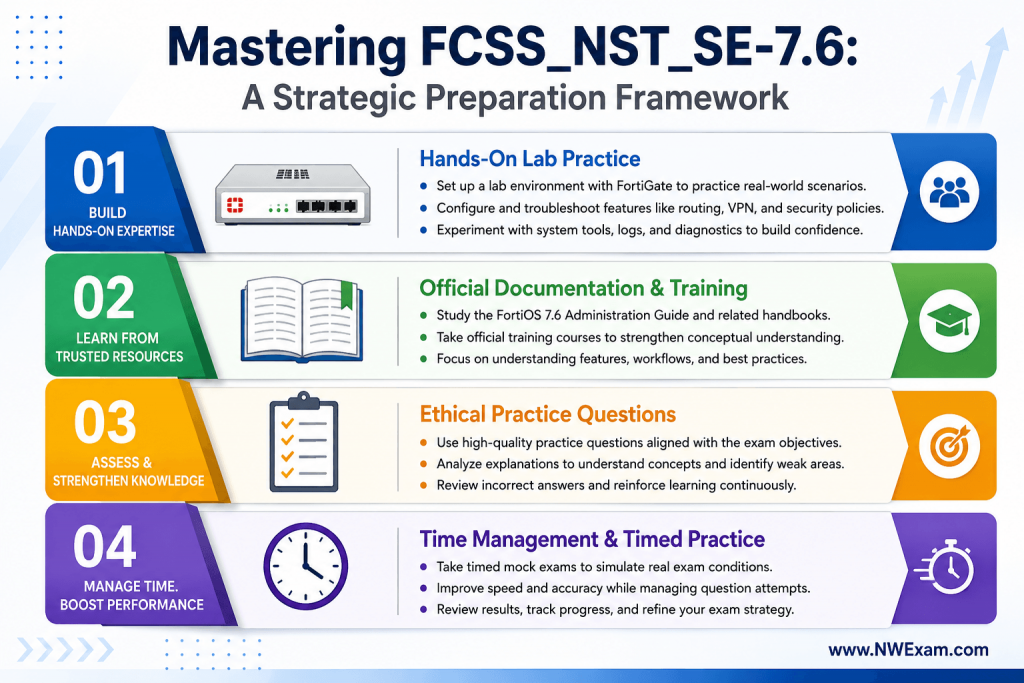
To overcome the challenges of the FCSS_NST_SE-7.6 exam, a well-structured and disciplined study blueprint is essential. Simply reading through documentation is rarely enough; a multi-faceted approach combining theoretical learning with practical application yields the best results. This strategy includes leveraging official Fortinet resources, engaging in hands-on labs, and utilizing practice questions.
Leveraging Official Fortinet Resources
Fortinet provides comprehensive training courses and documentation specifically designed for its certifications. These official materials are the most accurate and up-to-date sources for exam content. Candidates should prioritize studying the FortiGate administration and troubleshooting guides relevant to version 7.6. These resources offer deep insights into functionalities and configurations that are directly tested.
Attending Fortinet-authorized training programs, whether online or in-person, can significantly enhance understanding. These courses often include lab exercises and expert instruction that provide context and clarify complex topics, proving invaluable for preparing for the Fortinet NSE 6 – Network Security 7.6 Support Engineer certification.
Hands-On Lab Practice and Simulation
As highlighted, practical experience is paramount. Building a home lab or utilizing cloud-based FortiGate virtual machines allows candidates to experiment freely with configurations, troubleshoot common issues, and understand the real-world behavior of the device. This includes practicing complex VPN setups, intricate routing configurations, and various security profile implementations. Simulation tools can also offer valuable experience without requiring extensive hardware resources.
Utilizing Quality Practice Questions
Engaging with high-quality practice questions is an effective way to assess preparedness, identify knowledge gaps, and become familiar with the exam’s question format. Ethical practice questions, like those found on NWExam.com, offer realistic simulations of the exam experience, helping candidates gauge their readiness without relying on unethical “dumps.” These resources are designed to test understanding and application, not just recall. Candidates can find valuable Fortinet FCSS_NST_SE-7.6 sample questions to refine their preparation.
Regularly reviewing incorrect answers and understanding the underlying concepts is more beneficial than simply memorizing solutions. This iterative process strengthens weak areas and reinforces correct troubleshooting methodologies, which is crucial for the Fortinet NSE 6 – Network Security 7.6 Support Engineer exam.
Achieving Credibility: The Fortinet FCSS Certification Path
The Fortinet Certified Solution Specialist (FCSS) certification, particularly the Network Security Support Engineer designation, represents a significant achievement within the broader Fortinet certification framework. Understanding where the FCSS_NST_SE-7.6 fits into the Fortinet NSE 6 certification path clarifies its value and impact on a professional’s career trajectory. This certification is designed for those who provide expert-level support and demonstrate deep technical expertise in Fortinet solutions.
Earning the FCSS_NST_SE-7.6 certification validates both technical expertise and a commitment to professional growth in cybersecurity. It demonstrates that you have the skills needed to support and troubleshoot Fortinet network security solutions effectively. The certification can strengthen your professional credibility and make you a more valuable asset to your organization and clients. It also supports career advancement by opening opportunities for senior support, consulting, and network security architecture roles that require deep knowledge of the Fortinet security ecosystem.
Role Alignment: What the Network Security 7.6 Support Engineer Does
The Fortinet NSE 6 – Network Security 7.6 Support Engineer certification is closely aligned with the responsibilities of professionals in this specialized role. The FCSS_NST_SE-7.6 exam is designed to validate the practical skills required to diagnose, troubleshoot, and resolve complex issues in Fortinet network security environments. It ensures that certified professionals are prepared to handle real-world support challenges with confidence and efficiency.
Professionals holding this certification are typically involved in monitoring security systems, responding to incidents, performing routine maintenance, and implementing configuration changes on FortiGate devices. They are expected to have a deep understanding of network traffic analysis, log interpretation, and policy enforcement. The exam focuses on system troubleshooting, authentication, security profiles, routing, and VPN technologies. These topics reflect the core responsibilities of a Network Security 7.6 Support Engineer. Candidates must demonstrate strong problem-solving skills in real-world scenarios. They should also be able to maintain secure, reliable, and continuously protected network environments.
Candidates aiming for this certification should visualize themselves in these job roles, internalizing the practical implications of each syllabus topic. This perspective helps in understanding why certain troubleshooting steps or configuration details are critical, fostering a more profound and applicable understanding of the material.
Final Reflections: Overcoming Obstacles for FCSS_NST_SE-7.6 Success
The journey to obtaining the Fortinet NSE 6 – Network Security 7.6 Support Engineer certification is undoubtedly challenging, but the obstacles are far from insurmountable. The “untold truth” behind candidate failures often lies not in a lack of intelligence, but in a failure to recognize and adapt to the specific demands of a rigorous, hands-on technical exam like the FCSS_NST_SE-7.6. By acknowledging the common pitfalls—from insufficient practical experience to underestimating the exam’s depth—aspirants can refine their preparation strategies.
Success depends on a proactive and well-rounded preparation strategy. Spend plenty of time practicing in hands-on labs to build real-world skills. Study the official Fortinet documentation carefully to strengthen your understanding of key concepts. Use high-quality practice questions to assess your knowledge and identify weak areas. Manage your study schedule and exam time effectively to maximize your performance. The goal is not only to pass the exam but also to develop the practical troubleshooting and support skills needed to become a competent Fortinet Network Security 7.6 Support Engineer.
The Fortinet NSE 6 – Network Security 7.6 Support Engineer certification is a valuable credential that significantly boosts career prospects in the cybersecurity domain. By understanding the common pitfalls and committing to a strategic, hands-on preparation plan, you can confidently navigate the challenges of the FCSS_NST_SE-7.6 exam and achieve your certification goals.
Ready to strengthen your Fortinet expertise and accelerate your career? Explore comprehensive study resources and practice opportunities to ensure you are fully prepared for the challenges ahead. Visit Fortinet certification resources to begin your enhanced preparation today.
Frequently Asked Questions
1. What does the Fortinet FCSS_NST_SE-7.6 exam validate?
The Fortinet FCSS_NST_SE-7.6 exam, known as the Fortinet NSE 6 – Network Security 7.6 Support Engineer, validates a professional’s advanced skills in troubleshooting Fortinet’s network security products, specifically FortiGate 7.6, across various domains like system operations, authentication, security profiles, routing, and VPNs.
2. What is the recommended preparation approach for the FCSS_NST_SE-7.6?
The recommended approach begins with extensive hands-on lab practice using FortiGate 7.6. Study the official Fortinet documentation thoroughly to build a strong understanding of the exam topics. Review the official training materials to reinforce your knowledge. Use high-quality practice questions to test your skills under realistic exam conditions. Finally, identify your knowledge gaps and focus on improving them before taking the exam.
3. How much does the FCSS_NST_SE-7.6 exam cost?
The Fortinet FCSS_NST_SE-7.6 exam costs $200 USD. This fee may vary based on regional taxes or specific testing center surcharges.
4. What career benefits does Fortinet NSE 6 certification offer?
The Fortinet NSE 6 certification, significantly enhances credibility and career prospects for professionals in cybersecurity. It opens doors to senior support roles, specialized engineering positions, and consulting opportunities within organizations leveraging Fortinet technologies.
5. Is hands-on experience critical for the Fortinet NSE 6 – Network Security 7.6 Support Engineer exam?
Yes, hands-on experience is critically important. This Fortinet exam is heavily scenario-based and emphasizes practical troubleshooting. Candidates must apply their theoretical knowledge to real-world FortiGate configurations. They should also be able to diagnose and resolve network security challenges effectively.


