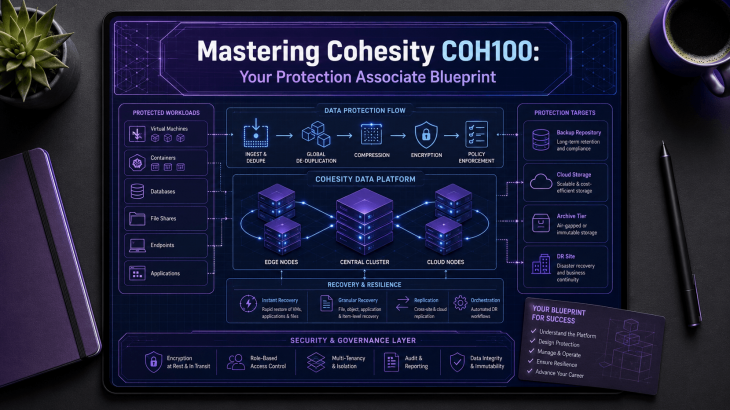
The COH100 Certification, officially known as the Cohesity Protection Associate – DataProtect, stands as a foundational credential for IT professionals aiming to validate their expertise in Cohesity’s modern data protection solutions. This certification confirms a candidate’s understanding of Cohesity DataProtect, covering essential backup and recovery operations, data management components, and monitoring within the Cohesity Data Cloud Platform. It is designed for system administrators, backup operators, and data protection specialists who manage Cohesity environments and seek to demonstrate their practical skills in safeguarding critical enterprise data. This comprehensive roadmap will guide you through the exam objectives, preparation strategies, and the valuable benefits of achieving this Cohesity Protection Associate certification.
Understanding the COH100 Certification Overview
The Cohesity Protection Associate – DataProtect (COH100) certification assesses your foundational knowledge and practical skills required to operate and manage Cohesity DataProtect solutions. Achieving this credential signifies your capability to implement backup and recovery strategies, understand core Cohesity concepts, and effectively monitor data protection operations. It is a critical step for professionals looking to enhance their career opportunities in data management and gain recognition for their expertise with a leading hyperconverged data platform.
Here’s a snapshot of what to expect:
- Exam Name: Cohesity Protection Associate – DataProtect
- Exam Code: COH100
- Exam Price: $200 USD
- Duration: 90 minutes
- Number of Questions: 70
- Passing Score: 58%
This structure ensures a comprehensive evaluation of your abilities across various domains. Preparing for this exam requires a focused approach, leveraging official resources and understanding the weightage of each topic. Explore COH100 exam information to gain further insights into the test structure and registration process.
Navigating the COH100 Syllabus Domains
A thorough understanding of the COH100 exam topics is paramount for successful preparation. The Cohesity Protection Associate DataProtect syllabus is structured to cover key areas of the Cohesity Data Cloud Platform, emphasizing data protection, recovery, and management. Each domain carries a specific weight, indicating its importance in the overall exam. Candidates should allocate their study time proportionally to these percentages. Candidates ready for the tier above can see how the COH150 multicloud exam distributes its sixty questions across the domains.
Fundamentals of the Cohesity Data Cloud Platform Concepts (13.33%)
This section delves into the core architecture and foundational principles of the Cohesity Data Cloud. It’s crucial to grasp the primary components and how they interact to provide a unified data management solution. Understanding the hyperconverged approach, scale-out architecture, and distributed file system (SpanFS) is fundamental here. Familiarize yourself with the key services and features that differentiate Cohesity’s platform from traditional data management systems. This domain sets the stage for all subsequent topics, providing the essential context for Cohesity DataProtect backup and recovery concepts.
Data Protection Fundamentals (18.33%)
This domain covers the essential concepts of data protection, focusing on how Cohesity addresses modern challenges. You need to understand various backup types, such as full, incremental, and differential, and their implications for recovery time objectives (RTO) and recovery point objectives (RPO). Key areas include data deduplication, compression, and snapshot technologies. A strong grasp of these fundamentals will help you optimize backup policies and ensure efficient storage utilization within the Cohesity environment. Learn about the principles that underpin robust data safeguarding strategies.
Protection Concepts (18.33%)
Building upon data protection fundamentals, this section specifically addresses Cohesity’s approach to protecting diverse data sources. It involves understanding how to configure protection policies, assign them to various workloads (e.g., virtual machines, databases, file shares), and manage their lifecycle. Key topics include source registration, policy creation, and scheduling. Candidates should be proficient in identifying appropriate protection settings for different applications and ensuring compliance with data retention requirements. This domain often involves practical scenarios related to safeguarding specific data types.
Recovery Concepts (21.67%)
As the most heavily weighted section, Recovery Concepts are central to the Cohesity Protection Associate certification. This domain covers all aspects of data restoration, from granular file recovery to full system bare-metal restores. You must understand different recovery methods, including instant recovery, direct mount, and various restore options for virtual machines, databases, and other protected assets. Proficiency in disaster recovery planning and execution within a Cohesity context is vital. This includes understanding failover and failback processes, and ensuring business continuity through efficient data retrieval.
Data Management Components (16.67%)
This domain explores the various components that facilitate comprehensive data management within the Cohesity platform. It includes topics like storage tiers, archival to cloud, and replication strategies. Understanding how Cohesity manages data across different storage types and locations for efficiency and compliance is key. Familiarize yourself with the roles of various Cohesity services and agents that contribute to data lifecycle management. This section also touches upon how data is ingested, stored, and made available for other services beyond simple backup and recovery.
Monitoring and Reporting (11.67%)
The final domain focuses on maintaining operational visibility and ensuring the health of the Cohesity environment. Key topics include understanding Cohesity’s monitoring tools, interpreting alerts and notifications, and generating reports on backup jobs, storage utilization, and compliance. This involves using the Cohesity UI for dashboards, logs, and audit trails. Candidates should be able to identify potential issues, troubleshoot common problems, and proactively manage the data protection infrastructure to ensure optimal performance and reliability.
Why Earn Cohesity Protection Associate Certification?
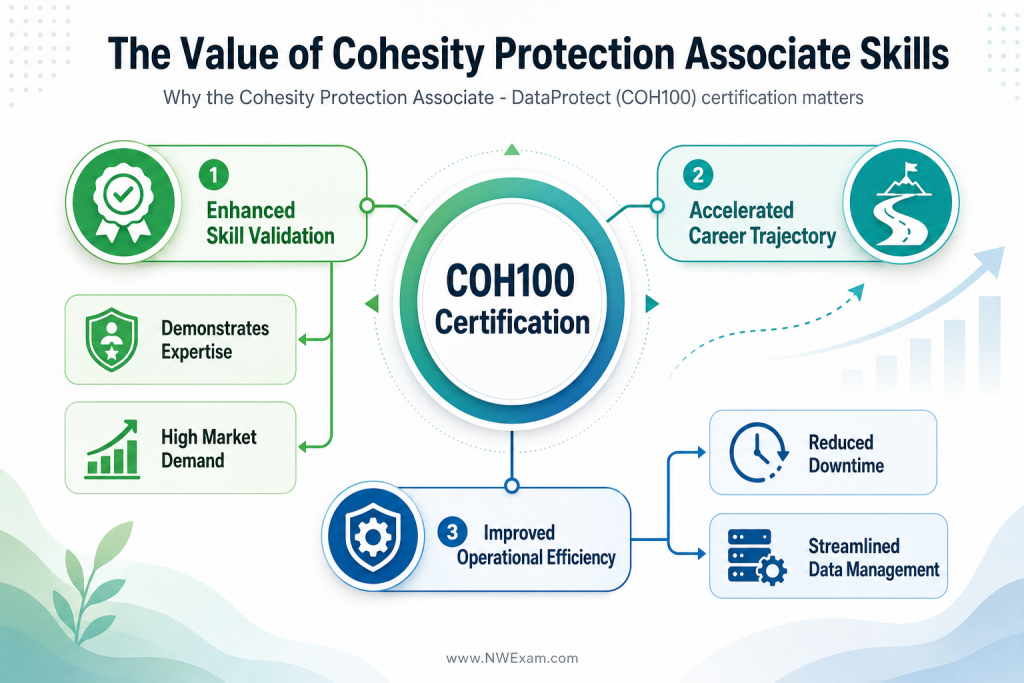
Achieving the Cohesity Protection Associate certification offers significant benefits to IT professionals and their organizations. This credential is not merely a piece of paper; it’s a testament to your practical skills in modern data management and protection. It validates your ability to safeguard critical business assets using one of the industry’s leading platforms, making you a valuable asset in today’s data-driven landscape. For professionals, it opens doors to new career opportunities and enhances their professional credibility.
Enhanced Skill Validation and Recognition
The COH100 certification explicitly validates your proficiency in Cohesity DataProtect fundamentals, protection, and recovery. In an increasingly complex IT environment, employers seek professionals who can demonstrate hands-on competence with specific technologies. This certification serves as a clear indicator of your expertise, distinguishing you from peers and confirming your capability to manage real-world data protection challenges. It showcases a commitment to professional development and mastery of cutting-edge solutions. Organizations can trust certified professionals to implement and maintain their Cohesity infrastructure effectively.
Accelerated Career Trajectory and Market Demand
Certified professionals often find themselves in higher demand and with better compensation packages. The Cohesity Protection Associate DataProtect certification can be a catalyst for career advancement, leading to roles such as Data Protection Specialist, Backup Administrator, or Cloud Infrastructure Engineer. As businesses increasingly adopt hyperconverged and cloud-native data solutions, the demand for Cohesity-skilled individuals continues to grow. This certification positions you as an expert in a critical area of IT, making you highly attractive to prospective employers. Discover how this certification can transform your career path by visiting expert certification insights.
Operational Efficiency and Risk Mitigation
For organizations, having certified Cohesity Protection Associates on staff translates directly into improved operational efficiency and reduced data loss risks. Certified professionals are equipped to optimize backup strategies, perform swift recoveries, and effectively monitor the Cohesity environment, minimizing downtime and ensuring business continuity. Their knowledge helps streamline data management workflows, reduces operational overhead, and ensures compliance with regulatory requirements. This proactive approach to data protection is invaluable in preventing costly data breaches and system failures.
Effective COH100 Exam Preparation Strategies
Approaching the COH100 exam requires a structured and consistent preparation plan. Successful candidates combine theoretical knowledge with practical experience. Begin by thoroughly reviewing the Cohesity Protection Associate DataProtect syllabus to understand the weighting of each domain. This will help you prioritize your study efforts and allocate sufficient time to more heavily weighted topics like Recovery Concepts.
Leveraging Official Cohesity Resources
The official Cohesity resources are your primary source of accurate and up-to-date information.
- Cohesity Academy: Access Cohesity Academy courses, which are specifically designed to align with the certification objectives. These courses often include hands-on labs that reinforce theoretical concepts with practical application.
- Documentation: Dive into the Cohesity DataProtect product documentation. This provides granular details on configuration, operation, and best practices. Pay close attention to sections related to backup policies, recovery procedures, and monitoring dashboards.
- Webinars and Whitepapers: Cohesity regularly hosts webinars and publishes whitepapers that offer deeper insights into their technology. These resources can provide valuable context and examples that solidify your understanding of complex topics. The official certification guide also provides crucial details on the exam structure and recommended training paths. Access the official study guide and other resources from Cohesity’s official page.
Engaging with these resources diligently will build a strong foundation for your exam success.
Hands-On Experience with Cohesity DataProtect
Theoretical knowledge alone is often insufficient for passing technical certifications. Gaining practical, hands-on experience with Cohesity DataProtect is critical. If possible, work with a Cohesity cluster in a lab environment or utilize a trial version.
Simulating Real-World Scenarios
Practice configuring protection policies for various workloads. Perform different types of recoveries, from individual files to entire virtual machines. Experiment with monitoring dashboards, generating reports, and troubleshooting common issues. The more familiar you are with the Cohesity UI and its operational workflows, the better prepared you will be for scenario-based questions in the exam. These exercises will help cement your understanding of Cohesity DataProtect backup and recovery concepts.
Strategic Use of Practice Tests
Once you have covered the syllabus and gained practical experience, incorporate practice tests into your study routine. Practice test questions are invaluable for several reasons:
- Identifying Knowledge Gaps: They help pinpoint areas where your understanding is weak, allowing you to focus your subsequent study efforts.
- Familiarity with Exam Format: Practice tests simulate the actual exam environment, helping you become comfortable with the question types and time constraints.
- Time Management: Regularly taking timed practice tests improves your ability to manage time effectively during the actual exam, ensuring you can answer all questions within the allocated duration.
Look for high-quality practice test questions that cover the Cohesity COH100 exam objectives comprehensively. While practice tests are excellent tools, remember to understand the underlying concepts rather than just memorizing answers.
Joining a Study Group or Community
Connecting with other individuals who are also preparing for the COH100 exam can provide immense benefits. Study groups offer a platform for discussing challenging topics, sharing insights, and clarifying doubts. Online forums and communities dedicated to Cohesity certifications can also be a valuable resource for asking questions and learning from others’ experiences. Collaborative learning reinforces understanding and exposes you to different perspectives on problem-solving. This communal approach fosters a supportive environment, crucial for maintaining motivation throughout your preparation journey.
Deep Dive into Cohesity Data Cloud Concepts
The Cohesity Data Cloud forms the resilient backbone of all Cohesity solutions, including DataProtect. Understanding its underlying principles and architecture is vital for anyone seeking the COH100 certification. This involves grasping how Cohesity achieves its unified, software-defined approach to data management. The platform’s ability to consolidate diverse data silos onto a single, web-scale platform is a game-changer in enterprise IT.
Understanding Hyperconverged Architecture
Cohesity’s platform is built on a hyperconverged architecture, integrating compute, storage, and data services into a single, scalable appliance or software-defined solution. This eliminates the need for disparate infrastructure components, simplifying management and reducing total cost of ownership. For the COH100 exam, focus on how this architecture delivers high availability, fault tolerance, and seamless scalability. Understand the role of nodes, clusters, and the distributed file system (SpanFS) in achieving these benefits. This foundation is key to understanding Cohesity DataProtect fundamentals.
The Role of SpanFS
SpanFS is Cohesity’s proprietary distributed file system, purpose-built for enterprise data. It provides a single, limitless pool of storage that scales linearly, ensuring high performance and data integrity. Key features of SpanFS to study include:
- Global Deduplication and Compression: How SpanFS optimizes storage by eliminating redundant data across all protected workloads.
- Snapshot Technology: How efficient, immutable snapshots are created and managed for rapid recovery and data immutability.
- Data Locality: How data is distributed across the cluster to maximize performance and resilience.
- Immutability: The WORM (Write Once, Read Many) nature of snapshots ensures data integrity against ransomware and accidental deletion.
A deep understanding of SpanFS capabilities will be tested, particularly its role in ensuring data availability and integrity within Cohesity Protection Associate DataProtect syllabus topics.
Mastering Data Protection Fundamentals
Effective data protection goes beyond simple backup; it encompasses a holistic strategy to ensure data availability, integrity, and recoverability. The COH100 exam heavily emphasizes these foundational principles, ensuring candidates can design and implement robust protection schemes. This involves understanding the nuances of different protection techniques and how they apply within the Cohesity ecosystem.
Backup Types and Their Application
The exam expects you to differentiate between various backup types and know when to apply each.
- Full Backup: Understand its scope (all selected data) and implications for storage and recovery time.
- Incremental Backup: Focus on how it captures only changed data since the last backup (of any type), offering efficiency but potentially longer recovery chains.
- Differential Backup: Learn that it backs up data changed since the last full backup, providing a balance between storage and recovery complexity.
Furthermore, grasp concepts like synthetic full backups and how Cohesity optimizes these processes to reduce backup windows and storage footprints. This knowledge is crucial for optimizing your Cohesity DataProtect training course strategies.
Policies and Schedules
Cohesity uses policies to define how and when data is protected. You should be familiar with:
- Policy Creation: How to define protection policies that include settings for frequency, retention, and archival targets.
- Schedules: Configuring backup schedules (daily, weekly, custom) and understanding their impact on RPO.
- SLAs: How to align protection policies with service level agreements (SLAs) to meet business recovery objectives.
The ability to craft and manage effective policies is a cornerstone of the Cohesity Protection Associate DataProtect syllabus.
Key Protection and Recovery Concepts
The real value of any data protection solution lies in its ability to recover data quickly and reliably when disaster strikes. The COH100 certification places significant emphasis on both protection mechanisms and, more importantly, diverse recovery strategies offered by Cohesity. Mastering these aspects demonstrates your readiness to manage critical incidents.
Configuring Robust Protection Schemes
Protection in Cohesity involves more than just setting a schedule. It requires a thoughtful approach to source registration, policy application, and understanding the nuances of various data types.
- Source Registration: Learn how to register different data sources, such as VMware vCenter, Microsoft SQL Server, or NAS shares, with the Cohesity cluster.
- Protection Jobs: Understand the lifecycle of a protection job, from initial configuration to ongoing monitoring and modification. This includes knowing how to exclude specific files or directories and manage exceptions.
- Snapshot Management: Beyond creating snapshots, delve into managing their retention, expiration, and immutability settings. Cohesity’s efficient snapshot technology is central to rapid recovery, making its management a critical skill for the exam.
These protection concepts directly tie into ensuring data availability and integrity, forming a core part of the Cohesity COH100 exam topics.
Executing Diverse Recovery Operations
The heaviest weighted section of the exam focuses on recovery, highlighting the importance of being able to restore data in various scenarios.
- Granular Recovery: Practice recovering individual files, folders, or application-specific items (e.g., individual emails from Exchange, tables from SQL).
- Instant Recovery: Understand how Cohesity can instantly power on virtual machines or mount databases directly from a snapshot on the Cohesity cluster, significantly reducing RTOs. This is a critical feature that Cohesity Protection Associate certification validates.
- Bare-Metal Recovery: While complex, grasp the concepts behind recovering entire systems or applications to new hardware or virtual environments.
- Database and Application Recovery: Specific considerations for recovering complex applications like SQL Server, Oracle, or Exchange, including point-in-time recovery options.
Proficiency in these recovery methods demonstrates a comprehensive understanding of Cohesity DataProtect backup and recovery capabilities, essential for real-world scenarios.
Working with Data Management Components
Beyond core backup and recovery, the Cohesity platform offers a suite of data management components designed to streamline operations, optimize storage, and ensure data governance. The COH100 exam covers these components to ensure you understand the broader ecosystem that supports data protection. These elements are crucial for long-term data strategy and efficient resource utilization. For additional information on broader data solutions, explore Cohesity resources.
Storage Tiers and Archival Strategies
Cohesity provides flexible storage options, enabling organizations to optimize costs and meet compliance requirements.
- Hot Tier: Understand the primary storage tier on the Cohesity cluster for frequently accessed data and recent backups, optimized for performance.
- Cold Tier/Archival: Learn how Cohesity integrates with cloud object storage (e.g., Amazon S3, Azure Blob Storage) for long-term archival. This includes configuring archival policies, understanding data movement, and managing retrieval.
- Replication: Familiarize yourself with how data can be replicated between Cohesity clusters or to the cloud for disaster recovery purposes, ensuring geographical resilience.
Effective utilization of these tiers is vital for managing data growth and ensuring efficient long-term retention strategies. These are key Cohesity DataProtect fundamentals.
Role-Based Access Control (RBAC)
Security and access control are paramount in any data management solution.
- Users and Groups: Learn how to create and manage local users and integrate with external directory services (e.g., Active Directory, LDAP).
- Roles and Permissions: Understand the predefined roles within Cohesity and how to assign specific permissions to users or groups, adhering to the principle of least privilege.
- Audit Trails: Familiarize yourself with how Cohesity logs all user activities, providing an audit trail for compliance and security monitoring.
RBAC ensures that only authorized personnel can perform specific data protection and management tasks, which is a critical aspect of Cohesity Protection Associate exam requirements.
Monitoring and Reporting in Cohesity Environments
Maintaining the health, performance, and compliance of your Cohesity DataProtect environment is crucial. The COH100 certification requires candidates to be proficient in monitoring system status, interpreting alerts, and generating comprehensive reports. This ensures proactive management and quick resolution of any potential issues, supporting a stable data protection posture.
Dashboards and Alerts
Cohesity provides intuitive dashboards that offer a consolidated view of your data protection environment.
- Operational Status: Learn to interpret key metrics displayed on the dashboard, such as cluster health, storage utilization, and job status.
- Alert Management: Understand how Cohesity generates alerts for critical events (e.g., job failures, capacity warnings). Familiarize yourself with configuring alert notifications (email, SNMP) and resolving common alert conditions.
- Log Analysis: While typically handled by support, a basic understanding of where to access logs for troubleshooting can be beneficial.
Effective monitoring allows administrators to detect and address problems before they impact business operations, a core skill validated by the benefits of Cohesity Protection Associate certification.
Generating Comprehensive Reports
Reporting is essential for compliance, capacity planning, and demonstrating the effectiveness of your data protection strategy.
- Job Reports: Generate reports on backup job success/failure rates, duration, and data transfer volumes.
- Capacity Reports: Analyze storage consumption, deduplication ratios, and trends to forecast future capacity needs.
- Compliance Reports: Create reports that demonstrate adherence to data retention policies and regulatory requirements.
- Custom Reports: Understand the flexibility to create custom reports tailored to specific organizational needs, providing a granular view of your Cohesity environment.
Proficiency in reporting ensures transparency and accountability, crucial for maintaining a well-managed data protection infrastructure, aligning with Cohesity DataProtect career opportunities.
Beyond the Exam: Applying Your COH100 Skills
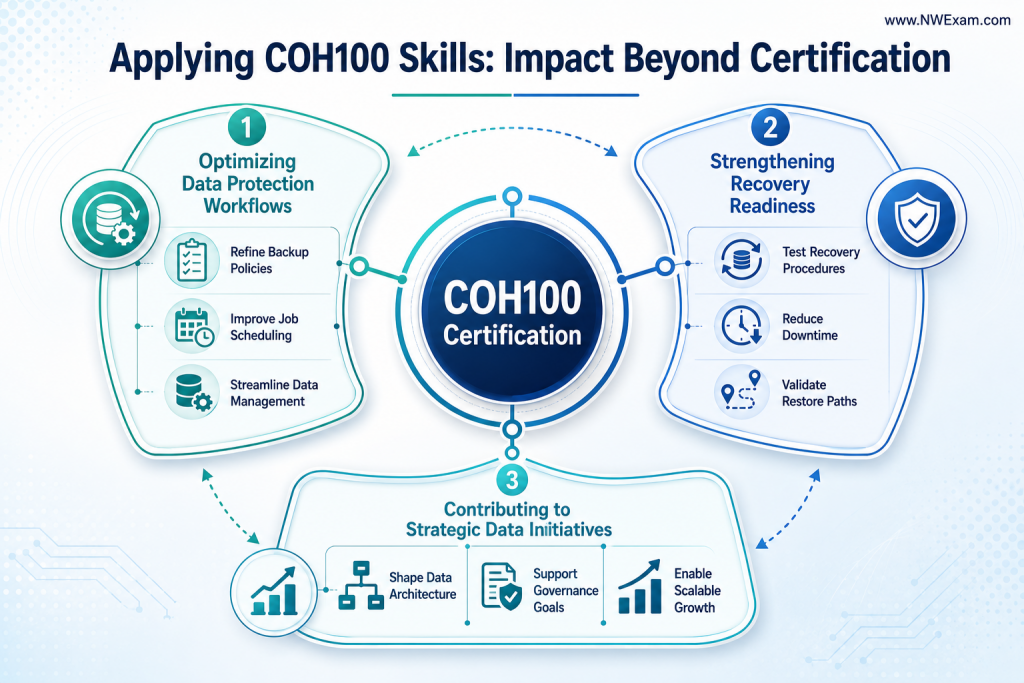
Earning your COH100 certification is a significant achievement, but it’s merely the starting point for ongoing professional growth. The knowledge and skills validated by the Cohesity Protection Associate – DataProtect credential are immediately applicable in real-world scenarios, empowering you to contribute effectively to your organization’s data strategy. Continual application and expansion of these skills are key to maximizing the value of your certification.
Optimizing Data Protection Workflows
With your COH100 expertise, you can identify areas for improvement in existing data protection workflows. This might involve refining backup schedules for better RPO/RTO, optimizing protection policies for different application tiers, or implementing more efficient archival strategies to cloud storage. Your understanding of Cohesity DataProtect fundamentals allows you to make informed decisions that enhance both performance and cost-effectiveness. Proactive optimization reduces manual effort and improves overall system reliability, delivering tangible benefits to the business.
Strengthening Data Recovery Readiness
A critical application of your certified skills involves continuously strengthening your organization’s data recovery readiness. This includes regularly testing recovery procedures, validating the integrity of backup data, and ensuring that recovery plans are well-documented and understood by the team. Your in-depth knowledge of Cohesity’s recovery capabilities, including instant recovery and granular restoration, will enable you to lead these efforts, reducing potential downtime during unforeseen events. This proactive stance ensures that the organization can respond swiftly and effectively to data loss incidents.
Contributing to Strategic Data Initiatives
The Cohesity Protection Associate certification positions you to contribute to broader strategic data initiatives within your organization. This could involve participating in cloud migration projects, ransomware defense strategies, or data governance frameworks. Your expertise in data management components, monitoring, and reporting will be invaluable in designing resilient, scalable, and secure data environments. By demonstrating your command of Cohesity solutions, you can help shape future data architecture decisions and drive innovation in how data is protected, managed, and utilized across the enterprise.
Conclusion and Next Steps
The Cohesity Protection Associate – DataProtect (COH100) certification is a powerful credential for IT professionals dedicated to mastering modern data protection. It provides a structured pathway to validate your skills in configuring, operating, and managing Cohesity’s innovative data management platform. By successfully navigating the exam objectives, from platform fundamentals to advanced recovery concepts, you not only enhance your technical proficiency but also unlock significant career growth opportunities in a rapidly evolving industry. This certification is a testament to your commitment to excellence in data safeguarding.
Embark on your journey to earn the COH100 certification with confidence. Leverage the wealth of official Cohesity resources, engage in hands-on practice, and utilize high-quality study materials to solidify your understanding. Your dedication to ethical and thorough preparation will pave the way for success, distinguishing you as a certified Cohesity expert. For further support and to find comprehensive study resources, including Cohesity COH100 sample questions and practice exams, visit reliable exam preparation materials to support your certification goals.
Frequently Asked Questions
1. What is the Cohesity Protection Associate – DataProtect (COH100) certification?
The Cohesity Protection Associate – DataProtect (COH100) certification validates an individual’s foundational knowledge and practical skills in operating and managing Cohesity DataProtect solutions, covering backup, recovery, and data management on the Cohesity Data Cloud Platform.
2. Who should pursue the COH100 certification?
This certification is ideal for system administrators, backup operators, data protection specialists, and IT professionals who work with or plan to implement Cohesity DataProtect, seeking to validate their technical expertise and advance their careers.
3. What are the primary benefits of earning the COH100 certification?
Benefits include enhanced skill validation, increased career opportunities and marketability in data protection roles, better compensation potential, and the ability to contribute to improved operational efficiency and risk mitigation for organizations utilizing Cohesity solutions.
4. How much does the COH100 exam cost, and what is its duration?
The COH100 exam costs $200 USD and has a duration of 90 minutes. It consists of 70 questions and requires a passing score of 58%.
5. What kind of preparation is recommended for the COH100 exam?
Recommended preparation includes leveraging official Cohesity Academy courses and documentation, gaining hands-on experience with Cohesity DataProtect, utilizing practice tests to identify knowledge gaps, and potentially joining study groups for collaborative learning.


