The Salesforce Tableau Consultant certification (Analytics-Con-301) stands as a pivotal credential for professionals aiming to master data visualization and analytics within the Salesforce ecosystem. This exam rigorously evaluates a candidate’s proficiency in connecting, transforming, and visualizing data using Tableau, ultimately enabling organizations to derive actionable insights. Geared towards individuals with hands-on experience in Tableau and a foundational understanding of Salesforce, this certification helps validate their ability to effectively implement and manage Tableau solutions for business intelligence needs. This comprehensive guide will equip you with essential strategies, study insights, and practical advice to successfully navigate the Analytics-Con-301 exam preparation and achieve certification.
Mastering the Analytics-Con-301 Exam Details
Understanding the structure and requirements of the Salesforce Tableau Consultant exam is the first critical step toward effective preparation. The Analytics-Con-301 exam is designed to test a broad spectrum of skills, from initial data evaluation to complex workbook design and governance. Familiarizing yourself with these foundational details allows for a targeted and efficient study plan, ensuring no key area is overlooked.
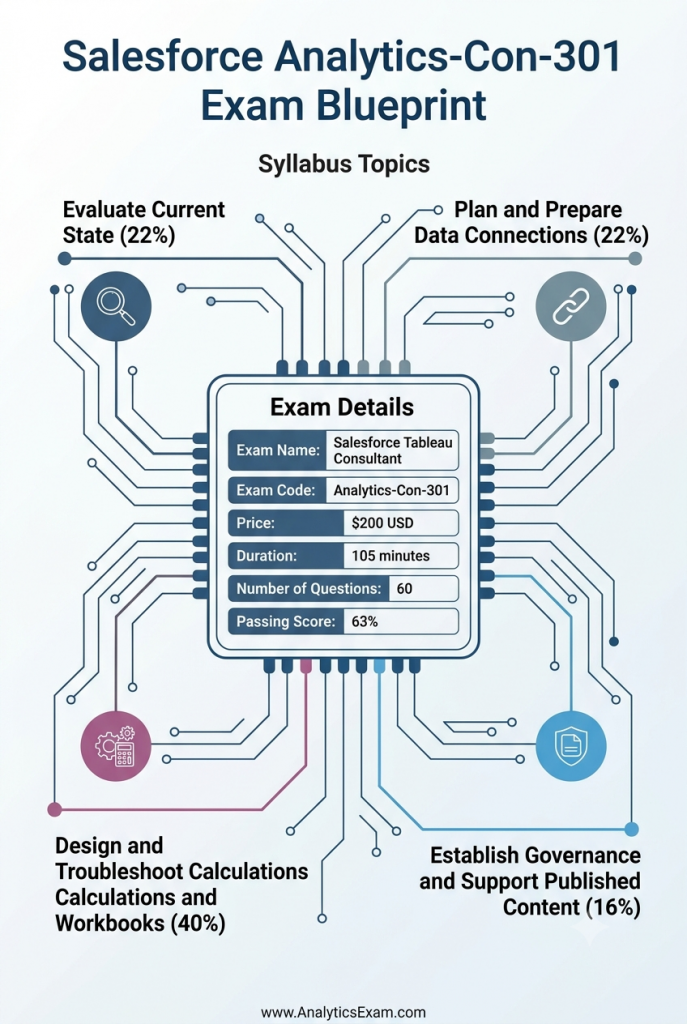
- The exam details are structured as follows:
- Exam Name: Salesforce Tableau Consultant
- Exam Code: Analytics-Con-301
- Exam Price: $200 (USD)
- Duration: 105 minutes
- Number of Questions: 60
- Passing Score: 63%
These parameters highlight the need for both speed and accuracy, emphasizing a thorough understanding of the subject matter rather than just rote memorization. Candidates should plan their time carefully during the exam to address each question effectively. For a complete understanding of the assessment criteria, refer to the official Analytics-Con-301 certification page.
Navigating the Analytics-Con-301 Syllabus Domains
The Salesforce Tableau Consultant (Analytics-Con-301) exam covers four key domains, each contributing a specific weight to your overall score. A balanced study approach across these domains is crucial for comprehensive preparation. Each section of the syllabus focuses on distinct aspects of Tableau consulting, from initial data assessment to advanced visualization techniques and ongoing content management.
Here are the primary syllabus topics and their respective weightages:
- Evaluate Current State – 22%: This section tests your ability to assess an organization’s existing data infrastructure, reporting needs, and strategic objectives. It involves understanding business requirements, identifying data sources, and evaluating the current analytics landscape to propose effective Tableau solutions.
- Plan and Prepare Data Connections – 22%: Focuses on the practical steps of connecting Tableau to various data sources. This includes choosing appropriate connection types, ensuring data integrity, performing necessary data cleaning and transformation, and optimizing data extracts for performance.
- Design and Troubleshoot Calculations and Workbooks – 40%: This is the largest and most critical domain, emphasizing your expertise in Tableau’s core functionalities. It covers creating complex calculations, designing interactive dashboards, implementing advanced visualization techniques, and troubleshooting common issues related to data display and performance within workbooks.
- Establish Governance and Support Published Content – 16%: Addresses the post-publication lifecycle of Tableau content. It includes establishing best practices for data governance, managing user access, ensuring content security, monitoring performance, and providing ongoing support for published dashboards and reports.
Successful candidates will demonstrate a robust understanding across all these areas, with a particular emphasis on the design and troubleshooting aspects.
Bridging Business and Analytics: The Salesforce Tableau Consultant’s Role
The Salesforce Tableau Consultant plays a vital role at the intersection of business strategy and data analytics. This certification solidifies a professional’s capacity to translate complex business requirements into tangible, impactful data visualizations using Tableau. Beyond technical skills, the role demands a keen understanding of how data insights drive organizational decisions and improve operational efficiency. The Analytics-Con-301 exam specifically validates these consulting capabilities, ensuring that certified individuals can effectively guide stakeholders through their data journey.
Defining Critical Tableau Consulting Skills for Analytics-Con-301
Becoming a proficient Salesforce Tableau Consultant requires a blend of technical mastery and strategic thinking. The Analytics-Con-301 exam assesses these multifaceted skills, which are crucial for success in real-world consulting scenarios. These competencies range from technical implementation to effective communication and project management within a data-driven environment.
Key skills validated by the certification include:
- Data Assessment & Requirements Gathering: The ability to conduct thorough analyses of existing data landscapes and precisely capture client needs, identifying gaps and opportunities for improvement.
- Data Modeling & Preparation: Expertise in structuring data, selecting appropriate connection methods, and performing necessary transformations to ensure data readiness for Tableau.
- Advanced Visualization Design: Skill in creating compelling, interactive dashboards that convey complex information clearly and support data-driven decision-making.
- Performance Optimization: Knowledge of how to design efficient workbooks and calculations, minimizing load times and ensuring responsive user experiences, especially with large datasets.
- Governance & Best Practices: Understanding how to establish and enforce standards for content creation, publication, and security within a Tableau Server or Cloud environment.
- Troubleshooting & Problem-Solving: Proficiency in diagnosing and resolving issues related to data connectivity, calculation errors, visualization rendering, and dashboard performance.
These skills empower consultants to deliver high-value Tableau solutions that meet specific business objectives. You can explore further documentation and support resources on common Tableau and Salesforce integration topics through the Salesforce knowledge base.
Strategic Preparation: How to Pass the Salesforce Analytics-Con-301 Exam
Passing the Salesforce Analytics-Con-301 exam requires more than just knowing Tableau; it demands a strategic approach to study and practice. A well-structured plan, incorporating diverse learning methods and realistic self-assessment, is vital. This section outlines a step-by-step methodology to maximize your chances of success, turning theory into practical readiness.
Crafting Your Study Guide for Analytics-Con-301
Developing a personalized study guide is fundamental for tackling the breadth of the Analytics-Con-301 syllabus. Begin by mapping out the exam domains and allocating study time proportionally to their weightage, with a particular focus on the “Design and Troubleshoot Calculations and Workbooks” section. Utilize official documentation and structured courses to build a solid theoretical foundation.
Consider these steps for your study guide:
1. Deconstruct the Syllabus: Break down each domain into smaller, manageable topics. For example, “Design and Troubleshoot Calculations and Workbooks” can be further segmented into calculated fields, LOD expressions, parameters, sets, filters, dashboard actions, and performance tuning.
2. Prioritize Learning Objectives: Identify specific skills or concepts that are frequently tested or carry significant weight. Focus your efforts on mastering these areas first.
3. Allocate Time Effectively: Create a study schedule that dedicates sufficient time to each domain. Ensure you revisit challenging topics regularly.
4. Integrate Practice: Don’t just read; actively apply concepts in Tableau Desktop or Tableau Cloud. Create sample dashboards, write complex calculations, and practice connecting to different data sources.
This structured approach ensures comprehensive coverage and reinforces learning through application. For a comprehensive study plan, consider consulting a dedicated exam preparation guide.
Leveraging Analytics-Con-301 Practice Questions and Sample Questions
Practice is paramount for exam success. Engaging with Analytics-Con-301 practice questions and sample questions helps you become familiar with the exam format, question types, and time constraints. These resources are invaluable for identifying knowledge gaps and refining your test-taking strategy.
Effective practice includes:
Simulated Exams: Take full-length practice exams under timed conditions to simulate the actual testing environment. This helps in managing time and reducing exam day anxiety.
- Targeted Quizzes: Use quizzes focused on specific syllabus domains to reinforce your understanding of particular topics. This is especially useful for areas where you feel less confident.
- Reviewing Explanations: After completing practice questions, thoroughly review the explanations for both correct and incorrect answers. Understand *why* an answer is correct or incorrect, rather than just memorizing it.
- Diverse Question Types: Ensure your practice materials include a variety of multiple-choice, multiple-response, and scenario-based questions to cover all potential exam formats.
Regular practice not only builds confidence but also enhances your ability to quickly analyze questions and select the best response. Many reputable platforms offer quality practice tests for your Salesforce Tableau Consultant exam preparation.
Beyond the Books: Practical Application and Hands-On Experience
While theoretical knowledge is crucial, practical application of Tableau skills is indispensable for passing the Analytics-Con-301 exam. The certification emphasizes real-world consulting capabilities, making hands-on experience a powerful study tool. This involves actively working with data, building complex visualizations, and troubleshooting common issues.
To gain this practical edge:
1. Work on Personal Projects: Create your own Tableau projects using publicly available datasets. Experiment with different chart types, calculations, and dashboard layouts.
2. Replicate Business Scenarios: Challenge yourself to solve common business problems using Tableau. For instance, analyze sales trends, customer behavior, or operational efficiency.
3. Engage with Tableau Community: Participate in online forums, Tableau Public, or local user groups. Review others’ work, ask questions, and contribute your own insights. This exposes you to diverse approaches and problem-solving techniques.
4. Seek Mentorship: If possible, connect with experienced Tableau consultants. Their insights and practical advice can provide valuable context and accelerate your learning.
This immersive approach ensures that your theoretical knowledge is firmly grounded in practical application, making you a more effective and competent Salesforce Tableau Consultant.
Recognizing the Benefits of Salesforce Tableau Consultant Certification
Obtaining the Salesforce Tableau Consultant certification is more than just adding a badge to your resume; it’s an investment in your professional future. This credential signifies a deep understanding of Tableau and its application within a business context, offering a multitude of benefits ranging from career advancement to enhanced earning potential. The value of the Analytics-Con-301 certification is recognized across various industries, validating a crucial skill set in today’s data-driven world.
Advancing Your Career and Salary Potential
The demand for skilled data professionals, particularly those proficient in Tableau, continues to grow exponentially. The Salesforce Tableau Consultant certification directly addresses this demand by validating a specialized skill set. This can lead to significant career opportunities and improved compensation.
Key career advantages include:
- Increased Job Opportunities: Many organizations actively seek certified Tableau professionals to fill critical data analytics and consulting roles.
- Higher Earning Potential: Certified professionals often command higher salaries due to their validated expertise and the value they bring to data insights. The Salesforce Tableau Consultant salary can see a notable increase post-certification.
- Enhanced Credibility: The certification acts as a recognized benchmark of your skills, distinguishing you in a competitive job market.
- Career Progression: It opens doors to more senior roles, such as Lead Tableau Consultant, Data Architect, or Analytics Manager, by demonstrating your readiness for greater responsibility.
This credential helps articulate your commitment to professional development and mastery of a highly sought-after tool. Exploring the broader Salesforce certification ecosystem at theTrailhead Academy overview can further highlight potential career paths.
Industry Recognition and Expertise Validation
The Salesforce Tableau Consultant certification is a testament to an individual’s practical expertise in leveraging Tableau for impactful data solutions. This industry recognition is invaluable, confirming that a certified professional meets high standards of technical proficiency and strategic understanding. It signifies an individual’s capability to deliver real business value through data.
Validation includes:
- Standardized Skill Measurement: The exam ensures that all certified professionals meet a consistent, industry-approved standard of competence.
- Trust and Confidence: Employers and clients gain confidence in your abilities, knowing that your skills have been rigorously tested and validated by Salesforce.
- Staying Current: Pursuing and maintaining this certification encourages continuous learning and keeps professionals updated with the latest Tableau features and best practices.
- Specialized Expertise: It highlights your specialized knowledge in Tableau consulting, a niche area within the broader data analytics field.
Ultimately, the certification enhances your professional reputation and establishes you as a credible expert in Tableau implementation and strategy.
Effective Study Resources for Analytics-Con-301 Exam Preparation
Selecting the right study resources is paramount for efficient and effective preparation for the Salesforce Analytics-Con-301 exam. With a plethora of options available, identifying reliable and comprehensive materials can significantly impact your study journey. Focus on resources that provide both theoretical depth and practical application opportunities, aligning closely with the exam syllabus.
Utilizing the Official Salesforce Tableau Consultant Exam Guide
The official Salesforce Tableau Consultant exam guide is the most authoritative resource for your Analytics-Con-301 preparation. It provides detailed information on exam objectives, recommended knowledge areas, and sometimes even practice questions or case studies. This guide should be your primary reference, outlining exactly what you need to know to succeed.
Key benefits of the official guide include:
- Accuracy: Directly from the exam vendor, ensuring all information is correct and up-to-date.
- Syllabus Alignment: Maps out the specific topics and subtopics covered in each exam domain, helping you focus your study.
- Learning Objectives: Clearly defines what skills and knowledge are expected from a certified professional.
- Recommended Prerequisites: Guides you on any foundational knowledge or experience that would be beneficial before attempting the exam.
Always start your preparation by thoroughly reviewing this official documentation to establish a clear roadmap for your study efforts.
Supplementary Learning Platforms and Materials
While official guides are indispensable, supplementing your study with diverse learning platforms and materials can provide different perspectives and reinforce understanding. These resources can offer alternative explanations, additional practice scenarios, and a broader context for Tableau consulting skills.
Consider incorporating:
- Online Courses: Platforms like Coursera, Udemy, and Pluralsight often offer specialized courses on Tableau Desktop, Server, and advanced analytics, many of which align with the Analytics-Con-301 syllabus.
- Tableau Public & Blogs: Explore dashboards created by others on Tableau Public to understand design best practices. Follow prominent Tableau blogs and community forums for tips, tricks, and discussions on complex scenarios.
- Books & Whitepapers: In-depth books on Tableau can provide comprehensive coverage of specific features and advanced techniques. Whitepapers from Salesforce or Tableau can offer insights into industry best practices and strategic implementations.
- Video Tutorials: Visual learners benefit greatly from video tutorials that walk through concepts step-by-step, demonstrating how to apply Tableau features effectively.
By combining these resources, you can build a robust knowledge base and solidify your understanding across all facets of the Salesforce Tableau Consultant exam.
Charting Your Path: Tableau Consultant Certification Path with Salesforce
The Tableau Consultant certification is an integral part of a broader professional development trajectory within the Salesforce ecosystem. Understanding this larger pathway helps candidates position their Analytics-Con-301 efforts within a context of continuous learning and career growth. This certification is often a stepping stone, building upon prior Tableau experience and opening doors to further specialized credentials.
Prerequisites and Recommended Experience for Analytics-Con-301
While Salesforce generally has flexible prerequisites for its certifications, the Tableau Consultant (Analytics-Con-301) exam is designed for individuals with a certain level of practical experience. It is not an entry-level certification but rather targets those who have already spent time working with Tableau in a professional capacity.
Recommended experience includes:
- Significant Tableau Experience: Candidates should have substantial hands-on experience in developing and deploying Tableau solutions, ideally for at least one year.
- Data Fluency: A strong understanding of various data sources, data preparation techniques, and data modeling concepts is essential.
- Consulting Acumen: Experience in gathering requirements, understanding business needs, and translating them into analytical solutions is highly beneficial.
- Foundational Analytics Knowledge: A solid grasp of core analytical concepts, metrics, and visualization principles.
These recommendations ensure that candidates are not just theoretically prepared but also possess the practical expertise to pass the exam and excel in the role.
Maintaining Your Salesforce Tableau Consultant Certification
Salesforce certifications, including the Tableau Consultant credential, often require periodic maintenance to ensure that certified professionals remain current with the latest platform updates and features. This commitment to continuous learning safeguards the value of the certification and ensures your skills remain relevant in a rapidly evolving technological landscape.
Maintenance typically involves:
- Release Exams: Passing a shorter, online “maintenance exam” aligned with major Salesforce or Tableau releases, usually annually.
- Trailhead Modules: Completing specific Trailhead modules that cover new features or updates relevant to the certification.
It is crucial to stay informed about the maintenance policy for the Analytics-Con-301 certification by regularly checking the official Salesforce certification website. Proactive engagement with these updates ensures your credential remains active and valuable throughout your career.
Conquering Challenges: Analytics-Con-301 Exam Strategies
The Salesforce Analytics-Con-301 exam can present various challenges, from managing time effectively to tackling complex technical questions. Anticipating these hurdles and equipping yourself with proactive strategies is key to a smooth exam experience. Effective problem-solving and a calm demeanor under pressure are as important as technical knowledge.
Time Management Strategies for the Tableau Consultant Exam
With 60 questions to answer in 105 minutes, efficient time management is critical for the Analytics-Con-301 exam. Rushing through questions or getting stuck on a single difficult item can quickly deplete your allocated time. Developing a strategic approach to pacing yourself ensures you have sufficient opportunity to address every question.
Consider these time management tips:
- Allocate per Question: Roughly 1.75 minutes per question. If a question is taking significantly longer, make an educated guess, flag it, and move on.
- “First Pass” Strategy: Go through all questions, answering those you know immediately. This builds confidence and ensures you don’t miss easier points.
- Review Flagged Questions: Use any remaining time to revisit flagged questions. Often, other questions may provide context or clues that help with previously skipped items.
- Practice Pacing: During your Analytics-Con-301 practice questions, always time yourself. This helps build an internal clock and improves your ability to gauge how long each question type typically takes.
Mastering time management prevents “time traps” and allows you to approach the exam with a controlled and strategic mindset.
Tackling Complex Design and Troubleshooting Scenarios
The “Design and Troubleshoot Calculations and Workbooks” domain carries the highest weight on the Analytics-Con-301 exam, making it a critical area for focused preparation. Questions in this section often involve complex scenarios requiring an understanding of advanced Tableau features and problem-solving methodologies.
Strategies for this challenging domain include:
- Deep Dive into Calculations: Master calculated fields, table calculations, Level of Detail (LOD) expressions, and parameters. Understand their order of operations and when to use each effectively.
- Scenario-Based Practice: Work through diverse, real-world scenarios. How would you optimize a slow dashboard? How would you create a specific custom visualization? What causes common data blending issues?
- Understand Troubleshooting Workflows: Learn systematic approaches to diagnosing problems in Tableau, whether it’s related to data connectivity, calculation logic, or rendering performance.
- Review Performance Best Practices: Familiarize yourself with techniques for optimizing workbook and data source performance, as these are often tested in troubleshooting contexts.
By building a strong conceptual and practical foundation in these areas, you can confidently approach even the most intricate design and troubleshooting questions.
Final Readiness Check: Is Salesforce Tableau Consultant Certification Worth It?
As you near the culmination of your preparation, it’s natural to reflect on the value of your efforts. The question, “Is Salesforce Tableau Consultant certification worth it?” resonates with many candidates. The answer, unequivocally, is yes. In an economy increasingly driven by data, possessing a credential like the Analytics-Con-301 distinguishes you as a highly capable professional ready to deliver significant business impact.
The certification’s worth is multifaceted:
- Market Relevance: Tableau skills are in high demand across industries, and this certification validates a consultant-level proficiency that few possess.
- Career Trajectory: It positions you for advanced roles, increased responsibilities, and better compensation.
- Knowledge Depth: The rigorous preparation ensures a comprehensive understanding of Tableau, far beyond basic usage, covering strategic implementation and governance.
- Employer Confidence: It provides a tangible measure of your expertise, giving employers confidence in your ability to manage and execute complex data analytics projects.
Investing in the Salesforce Tableau Consultant certification is an investment in a robust, future-proof skill set that will continue to yield dividends throughout your professional journey.
Successfully achieving the Salesforce Tableau Consultant (Analytics-Con-301) certification is a testament to your dedication and expertise in a vital field. By meticulously following a structured study plan, engaging with practice questions, and embracing hands-on experience, you can confidently navigate the exam and emerge as a certified professional. This credential not only enhances your technical capabilities but also elevates your career prospects, solidifying your role as a valuable data strategist. Embrace these hidden strategies, commit to your preparation, and unlock a world of opportunities in data analytics. To further enhance your exam readiness, you may also consider downloading this detailed preparation resource.
Frequently Asked Questions
1. What does the Salesforce Tableau Consultant certification (Analytics-Con-301) validate?
The Salesforce Tableau Consultant certification (Analytics-Con-301) validates a professional’s expertise in designing, implementing, and managing data visualization solutions using Tableau within the Salesforce ecosystem. It confirms the ability to translate business requirements into effective data insights.
2. Who should pursue the Analytics-Con-301 certification?
This certification is ideal for data analysts, business intelligence developers, and consultants who have significant hands-on experience with Tableau and a foundational understanding of Salesforce. It is designed for those looking to formalize their expertise and advance their careers in data analytics consulting.
3. How long is the Salesforce Tableau Consultant certification valid?
Salesforce certifications, including the Tableau Consultant credential, typically require periodic maintenance through release exams or specific Trailhead modules. This ensures certified professionals remain current with the latest platform updates and features, often on an annual basis.
4. What is the best way to prepare for the Analytics-Con-301 exam?
Effective preparation involves a multi-faceted approach: thoroughly reviewing the official syllabus, utilizing high-quality study guides and practice questions, gaining extensive hands-on experience with Tableau, and engaging with the Tableau and Salesforce communities. Prioritizing domains based on weightage is also beneficial.
5. What are the career benefits of becoming a Salesforce Tableau Consultant?
Becoming a Salesforce Tableau Consultant offers numerous career benefits, including increased job opportunities, higher earning potential, enhanced professional credibility, and clearer pathways to senior data analytics and consulting roles. It validates a highly sought-after skill set in the modern data-driven economy.


