
The SAS A00-240 exam, officially known as SAS Statistical Business Analysis Using SAS 9: Regression and Modeling, validates a candidate’s proficiency in applying statistical methods and regression analysis techniques within the SAS 9 environment. This advanced certification is designed for experienced data analysts, statisticians, and business intelligence professionals who leverage SAS for complex data analysis, model building, and deriving actionable insights. This comprehensive guide aims to illuminate critical preparation areas, clarify the exam’s significance, and outline effective strategies to navigate the certification journey, ensuring candidates are thoroughly prepared to identify and address any potential knowledge gaps before attempting the A00-240.
Validating Statistical Business Acumen with A00-240
The A00-240 certification serves as a benchmark for professionals capable of performing statistical business analysis using SAS 9. It signifies a deep understanding of regression modeling, including various forms of linear and logistic regression, and the ability to interpret model outputs to inform business decisions. Achieving this credential demonstrates an individual’s expertise in translating complex data into strategic insights, a highly valued skill in today’s data-driven landscape. This validation extends beyond mere software proficiency, encompassing the analytical thought process required for effective statistical inference.
Candidates for this exam typically possess a solid foundation in statistical theory and practical experience applying these theories using SAS. They understand how to prepare data for modeling, select appropriate regression techniques, assess model performance, and communicate findings clearly to both technical and non-technical stakeholders. The certification confirms not just the ability to run SAS procedures, but to critically evaluate and deploy statistical models for real-world business problems. It underscores a professional’s commitment to rigorous, evidence-based decision-making.
The Role of SAS in Regression Analysis
SAS has long been a powerful tool for statistical analysis, offering a robust environment for data manipulation, statistical modeling, and reporting. For the A00-240 exam, proficiency in SAS 9 is paramount, specifically its capabilities for regression modeling. This includes navigating the SAS interface, writing efficient data steps, and executing various statistical procedures. Candidates must be comfortable with the syntax and options available for procedures like PROC REG, PROC GLM, PROC LOGISTIC, and others pertinent to regression analysis.
Beyond basic execution, the exam often tests the nuanced understanding of procedure outputs, diagnostic plots, and the underlying assumptions of different regression models. Professionals are expected to diagnose common issues like multicollinearity, heteroscedasticity, and outliers, and apply appropriate remedies or alternative modeling strategies. This deep dive into SAS’s analytical prowess ensures that certified individuals can competently and confidently perform advanced statistical analysis in diverse business contexts.
Cultivating an Effective A00-240 Study Strategy
Successful preparation for the A00-240 exam demands a structured and disciplined approach. Given the advanced nature of statistical business analysis, rote memorization is insufficient; true understanding of concepts and their application is key. A comprehensive study plan should integrate theoretical knowledge with extensive practical application using SAS software. This combination ensures that candidates not only recall definitions but can also implement and interpret statistical models effectively.
Begin by reviewing foundational statistical principles, particularly those related to hypothesis testing, confidence intervals, and different probability distributions. These form the bedrock of regression analysis. Subsequently, delve into the specifics of various regression models, their assumptions, and appropriate use cases. Practical exercises, including coding examples and interpreting SAS output, should be a central component of your daily study routine.
Structuring Your Learning Path
A well-defined learning path is crucial for tackling an exam of this caliber. Start by identifying your current strengths and weaknesses in statistical modeling and SAS programming. This initial assessment helps in allocating study time efficiently, focusing more on areas that require improvement. Many candidates benefit from creating a weekly study schedule, breaking down complex topics into manageable segments. This prevents overwhelm and promotes consistent progress.
Consider utilizing a blend of learning resources, including official SAS documentation, textbooks on regression analysis, and online courses. Engage with practice problems that simulate real-world data analysis scenarios, forcing you to apply theoretical knowledge to practical situations. Regularly review your understanding through self-quizzes and discussions with peers. For those seeking structured guidance, SAS offers dedicated training that can significantly bolster preparation. For more detailed preparation strategies, consider visiting this expert guide on SAS Statistical Business Analysis.
Mastering SAS 9 Regression Modeling Concepts
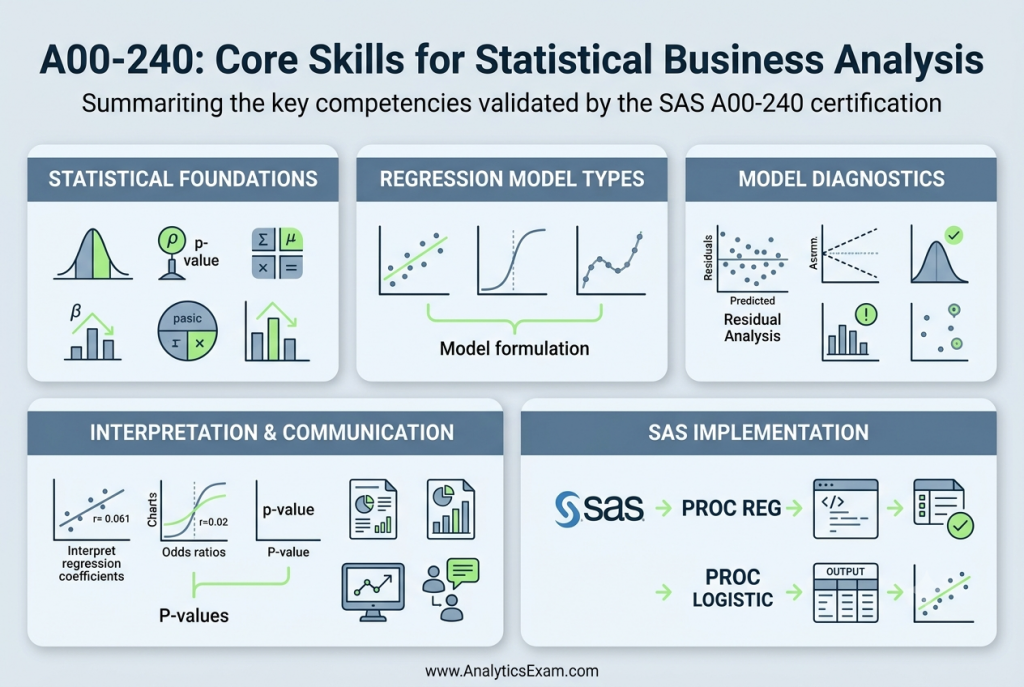
The core of the A00-240 exam revolves around a comprehensive understanding of regression modeling using SAS 9. This isn’t limited to knowing how to run a single PROC statement; it involves a nuanced appreciation of model selection, validation, and interpretation. Candidates must grasp the differences between various regression types and when to apply each. This includes:
- Understanding Simple Linear Regression: Assumptions, interpretation of coefficients, R-squared, and residual analysis.
- Exploring Multiple Linear Regression: Dealing with multiple predictors, interaction terms, confounding, and variable selection techniques.
- Delving into Logistic Regression: When to use it for binary outcomes, odds ratios interpretation, and model fit statistics for classification.
- Addressing Model Diagnostics: Identifying and managing outliers, influential observations, multicollinearity, and heteroscedasticity.
- Evaluating Model Performance: Concepts like AIC, BIC, validation data, and cross-validation methods.
A deep dive into each of these areas, coupled with hands-on practice in SAS, will build the confidence required for the exam.
Ethical Preparation for SAS Certification Success
Maintaining exam integrity is paramount in the certification process, not only for the individual candidate but for the entire professional community. SAS, like other leading certification bodies, strongly emphasizes ethical conduct throughout the preparation and examination phases. Engaging in unethical practices, such as using “brain dumps” or unauthorized exam materials, undermines the value of the certification and can lead to severe penalties, including revocation of credentials and being banned from future exams.
Candidates are encouraged to rely on official SAS study materials, authorized training courses, and legitimate practice questions that reflect the true spirit of the exam. Ethical preparation ensures that the skills validated by the A00-240 certification are genuinely earned and reflect a candidate’s true capabilities. It also upholds the professional standards expected within the analytics community. For comprehensive information on maintaining exam integrity, refer to the official SAS exam integrity policies.
Avoiding Exam Blind Spots
Identifying and addressing exam blind spots is a critical component of successful preparation. These blind spots often arise from over-reliance on familiar topics, neglecting areas perceived as less important, or a lack of exposure to diverse problem-solving scenarios. A truly expert preparation strategy involves actively seeking out these weaker areas and dedicating focused effort to them. This proactive approach ensures a balanced and robust understanding of all potential exam topics.
Blind spots can be conceptual, where the underlying statistical theory is not fully grasped, or practical, where applying a concept in SAS proves challenging. Techniques to uncover these include:
- Regular self-assessment using diverse question types.
- Reviewing incorrect answers from practice tests to understand the root cause of errors.
- Seeking feedback from mentors or study groups on areas of uncertainty.
- Experimenting with SAS code for various scenarios, including edge cases and exceptions.
By systematically addressing these weak points, candidates can build a more resilient knowledge base.
Leveraging Practice Questions for A00-240 Mastery
Practice questions are an indispensable tool for A00-240 exam preparation, offering numerous benefits beyond mere content review. They serve as a powerful diagnostic instrument, helping candidates gauge their understanding, identify knowledge gaps, and become familiar with the exam’s format and question styles. Consistent engagement with high-quality practice questions significantly enhances retention and builds confidence, crucial elements for success in a challenging certification.
The value of practice questions lies not just in answering them correctly, but in understanding the rationale behind each answer, both right and wrong. This process reinforces correct concepts and clarifies misunderstandings. It also helps in developing time management skills, as candidates learn to pace themselves under simulated exam conditions. Regularly working through practice scenarios prepares you for the cognitive demands of the actual test, reducing anxiety on exam day.
Maximizing Your Practice Test Investment
To truly benefit from practice questions, approach them strategically. Treat each practice test as a learning opportunity, not just a score-keeping exercise. After completing a practice session, dedicate ample time to a thorough review of all questions, especially those you answered incorrectly or found challenging. Analyze why a particular option was correct and why others were incorrect.
Focus on understanding the underlying statistical concepts and SAS procedures that each question tests. If a topic consistently causes trouble, return to your study materials for a deeper review. Additionally, consider using practice tests that provide detailed explanations for each answer. Such resources are invaluable for consolidating learning and solidifying your comprehension. For advanced practice questions and detailed preparation, explore resources like those found at AnalyticsExam’s A00-240 premium practice tests.
Navigating the SAS Statistical Modeling Certification Path
The A00-240 certification is a significant milestone within the broader SAS certification framework, particularly for those specializing in statistical modeling and business analysis. Understanding where this exam fits into the overall SAS professional development roadmap can help candidates plan their long-term career growth. It often builds upon foundational SAS programming skills and serves as a prerequisite or complementary credential for more specialized analytics roles. That framework also covers platform operations, which are assessed by the A00-451 administrator exam.
Achieving the A00-240 demonstrates a mastery of regression analysis, a core competency in many advanced analytics positions. This can open doors to roles such as Lead Data Scientist, Senior Statistical Analyst, or Business Intelligence Consultant. The SAS certification path provides a structured approach to skill acquisition, ensuring professionals are equipped with industry-recognized expertise. Exploring the full range of certifications can help identify next steps for continued professional development.
The Broader Impact of SAS Certifications
SAS certifications hold substantial weight in the analytics industry, signaling to employers that an individual possesses validated skills in a widely used and respected analytical platform. Beyond the immediate career benefits, holding a SAS certification fosters a culture of continuous learning and professional excellence. It ensures that practitioners remain current with industry best practices and the evolving capabilities of SAS software.
A certified professional contributes significantly to an organization’s analytical capabilities, bringing proven expertise in data-driven decision-making. This translates into more reliable insights, better model performance, and ultimately, a stronger competitive advantage for businesses. The commitment to earning certifications like A00-240 reflects a professional’s dedication to quality and impact in the field of statistical analysis. For more on the comprehensive benefits, visit the official SAS certification website.
Choosing Optimal Resources for A00-240 Exam Prep
Selecting the right study materials is a cornerstone of effective A00-240 preparation. With a multitude of resources available, candidates must discern which ones align best with the exam’s objectives and their individual learning styles. Optimal resources provide comprehensive coverage, offer practical examples, and include opportunities for self-assessment. A balanced approach often involves combining official vendor resources with supplemental materials.
Prioritize official SAS guides and documentation, as these are directly aligned with the exam’s content and the software’s functionality. Textbooks focusing specifically on regression analysis and statistical modeling, particularly those that integrate SAS examples, can offer deeper theoretical understanding. Online forums and study groups can provide peer support and clarify challenging concepts. The goal is to build a robust library of materials that supports both conceptual learning and practical application.
Leveraging SAS Training and Preparation Tools
SAS offers a range of training and preparation tools specifically designed to help candidates succeed in their certification exams. These resources often include structured courses, e-learning modules, and practice exams developed by SAS experts. Enrolling in official training can provide a guided learning experience, access to experienced instructors, and hands-on labs that reinforce theoretical knowledge. Such structured programs are invaluable for ensuring comprehensive coverage of complex topics.
Beyond formal training, utilize other SAS-provided tools like SAS documentation and sample code libraries. These resources are excellent for reference and for practicing syntax and procedures. Many successful candidates also leverage the SAS Global Forum proceedings and other community resources for advanced tips and real-world application examples. Integrating these official and community-driven resources into your study plan can significantly enhance your preparedness. For official training options, refer to SAS training and exam preparation resources.
Understanding Statistical Business Analysis in SAS 9
Statistical business analysis, as evaluated by the A00-240 exam, transcends mere data processing; it’s about transforming raw data into strategic insights that drive business value. This involves a cyclical process of understanding business problems, framing them statistically, collecting and preparing data, building and validating models, and finally, communicating actionable recommendations. SAS 9 provides the powerful environment to execute each stage of this analytical lifecycle effectively.
The certification emphasizes not just the technical prowess in using SAS procedures, but the critical thinking required to apply them appropriately in a business context. This means knowing how to select the right variables, interpret statistical significance in terms of business impact, and critically evaluate model limitations. It’s about bridging the gap between complex statistical outputs and clear, concise business language, ensuring that insights are both robust and usable.
The Business Imperative for Regression Modeling
Regression modeling is a cornerstone of predictive analytics and causal inference, making it an indispensable tool for business analysis. Organizations use regression to forecast sales, predict customer churn, assess the impact of marketing campaigns, understand risk factors, and optimize operational efficiencies. The A00-240 exam prepares candidates to harness these capabilities, translating statistical relationships into tangible business improvements.
For instance, understanding how to build a logistic regression model to predict loan default rates empowers financial institutions to manage risk more effectively. Similarly, a multiple linear regression model can help retailers understand which factors influence product demand, leading to better inventory management and pricing strategies. The exam challenges candidates to think about the business implications of their statistical work, solidifying their role as strategic analytical partners.
Prioritizing Continuous Skill Development After A00-240
Earning the A00-240 certification is a testament to significant analytical expertise, but it also marks a new beginning for continuous professional growth. The field of data science and analytics is constantly evolving, with new methodologies, algorithms, and software features emerging regularly. To maintain relevance and maximize career potential, certified professionals must commit to ongoing learning and skill refinement. This proactive approach ensures that one’s expertise remains cutting-edge and adaptable.
After passing the A00-240, consider delving into more specialized areas of SAS analytics, such as machine learning, time series analysis, or advanced data mining techniques. Explore other SAS certifications that align with your career aspirations or industry focus. Participating in professional communities, attending webinars, and reading industry publications are excellent ways to stay informed and connected. The journey of a statistical business analyst is one of perpetual discovery and learning.
The Broader Analytical Landscape
While the A00-240 focuses on SAS 9, a well-rounded statistical business analyst should also be aware of the broader analytical landscape. This includes understanding the principles behind other analytical tools and languages, even if not directly using them. A holistic perspective enhances problem-solving abilities and facilitates collaboration with professionals using different technologies. The core statistical concepts learned for the A00-240 are universally applicable, forming a strong foundation for any analytical endeavor.
Furthermore, developing soft skills such as communication, storytelling with data, and critical thinking remains crucial. These skills complement technical expertise, enabling analysts to effectively translate complex statistical findings into actionable business strategies. The A00-240 certification is a powerful credential, and continuous investment in both technical and interpersonal skills will ensure a long and impactful career in statistical business analysis. For specific SAS exam information or general testing services, visit Pearson VUE for SA. A global network like AnalyticsExam also provides resources to prepare for a range of industry certifications, which you can find more information about at this external resource.
Conclusion
The SAS A00-240 certification offers a robust validation of a professional’s expertise in statistical business analysis using SAS 9, focusing heavily on regression and modeling techniques. Success requires a dedicated and ethical approach to preparation, emphasizing a deep understanding of statistical theory, hands-on SAS application, and strategic use of practice resources. By meticulously addressing potential knowledge gaps and cultivating a comprehensive study plan, candidates can confidently approach the exam, solidify their analytical capabilities, and unlock significant career opportunities.
Embark on your preparation journey with a clear strategy and the right resources. Dive into the intricacies of regression modeling, practice extensively with SAS 9, and continuously assess your progress to refine your understanding. This certification is more than a credential; it is a testament to your ability to drive business value through sophisticated statistical analysis.
Ready to enhance your statistical business analysis skills and prepare for the A00-240 exam? Explore a wealth of preparation materials and practice tests designed to clarify complex concepts and reinforce your readiness. Visit AnalyticsExam.com for A00-240 resources and take the definitive step towards becoming a SAS Certified Statistical Business Analyst.
Frequently Asked Questions
What skills does the SAS A00-240 certification validate?
- The SAS A00-240 certification validates a professional’s ability to perform statistical business analysis using SAS 9, specifically focusing on regression and modeling techniques. It confirms expertise in applying statistical methods to solve business problems, interpret model outputs, and derive actionable insights.
Who should consider taking the SAS A00-240 exam?
- The A00-240 exam is ideal for experienced data analysts, statisticians, and business intelligence professionals who regularly use SAS 9 for complex data analysis, statistical modeling, and generating business insights. Candidates should have a strong background in statistical theory and practical SAS experience.
How difficult is the A00-240 exam?
- The A00-240 exam is considered advanced due to its focus on complex statistical modeling and the application of these concepts within SAS 9. Its difficulty typically reflects the need for both theoretical understanding and practical implementation skills. Preparation requires significant dedication and hands-on practice.
What are the benefits of becoming SAS A00-240 certified?
- Becoming SAS A00-240 certified enhances career prospects by validating specialized skills in a highly sought-after analytical platform. It can lead to advanced roles such as Senior Statistical Analyst or Data Scientist, demonstrate commitment to professional development, and increase earning potential within the analytics industry.
What is the best way to prepare for the SAS A00-240 exam?
- The best preparation involves a combination of official SAS training, comprehensive study guides, hands-on practice with SAS 9 software, and extensive use of high-quality practice questions. Focusing on understanding core statistical concepts and their practical application is crucial for success.


