
The Confluent Certified Developer for Apache Kafka (CCDAK) exam is a rigorous validation of a developer’s proficiency in building and deploying applications that interact with Apache Kafka. This certification, offered by Confluent, assesses a candidate’s practical skills in developing, testing, and monitoring Kafka-based applications. It is specifically designed for developers, architects, and engineers who work extensively with Apache Kafka and seek to formally recognize their ability to implement event streaming solutions effectively. This comprehensive guide details the exam structure, content areas, and offers advanced strategies employed by top developers to prepare for and successfully pass the CCDAK exam, ensuring a solid foundation in Apache Kafka development.
Decoding the Confluent CCDAK Certification Exam
The Confluent Certified Developer for Apache Kafka (CCDAK) certification confirms a developer’s expertise in working with Apache Kafka. This credential validates essential skills required for constructing, deploying, and observing robust Kafka applications. Understanding the foundational elements of the exam is the first strategic step towards effective preparation. The CCDAK exam is structured to rigorously test practical knowledge rather than just theoretical understanding.
The key details for this certification examination are as follows:
- Exam Name: Confluent Certified Developer for Apache Kafka
- Exam Code: CCDAK
- Exam Price: $150 USD
- Duration: 90 minutes
- Number of Questions: 60
- Passing Score: Pass / Fail
Candidates should familiarize themselves with these parameters to manage their study time and exam day expectations effectively. This foundational knowledge provides the blueprint for strategic preparation and focuses efforts where they yield the greatest impact. For a more detailed syllabus breakdown, refer to the official Confluent Certified Developer for Apache Kafka exam syllabus.
Navigating the CCDAK Exam Content Outline
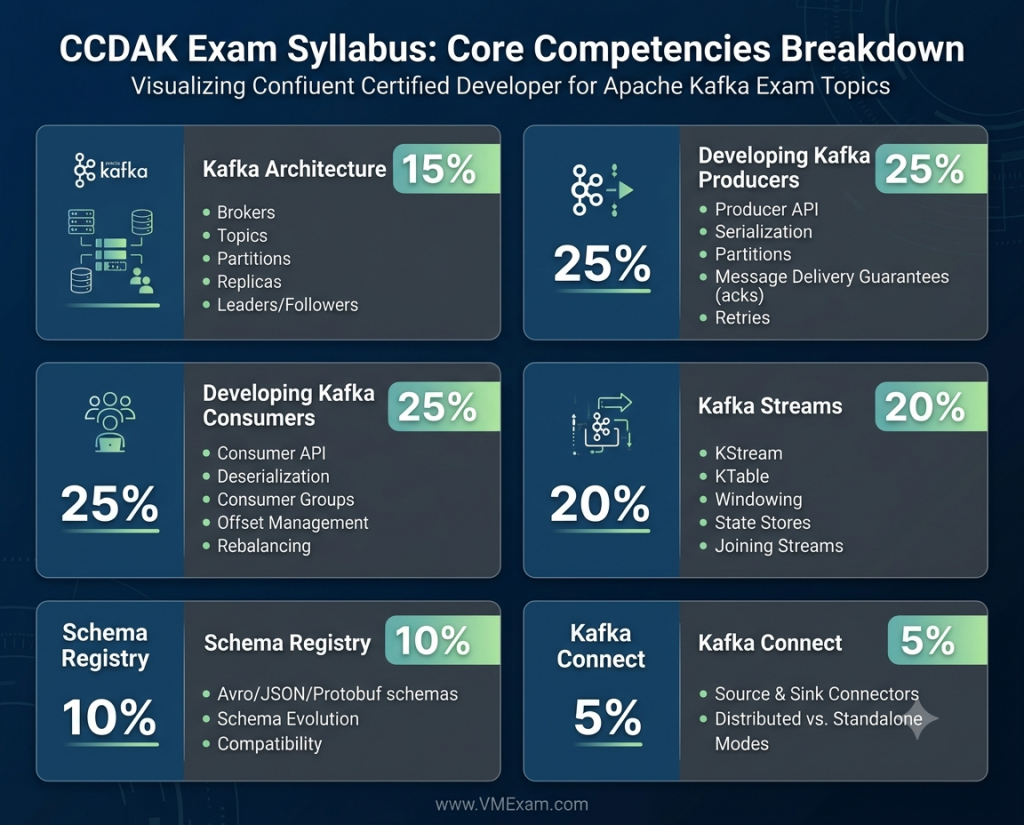
A thorough understanding of the CCDAK exam content outline is crucial for any developer aiming for certification. The syllabus categorizes topics by their percentage weight, guiding candidates on where to allocate their study efforts. Each domain represents critical aspects of Apache Kafka application development, from core concepts to advanced stream processing and operational concerns. Familiarity with official Confluent learning paths is often helpful here.
The CCDAK exam syllabus is broken down into the following key domains:
- Apache Kafka® Fundamentals – 23%: This section covers the core concepts of Kafka, including topics, partitions, brokers, producers, consumers, and offsets. Understanding the distributed nature of Kafka and its message delivery semantics is essential. Candidates need to grasp how Kafka ensures durability, scalability, and high throughput, which are critical for robust event streaming architectures.
- Apache Kafka® Application Development – 28%: This domain focuses on building applications that interact with Kafka. It delves into the practical implementation of producers to send messages and consumers to receive them. Key areas include message serialization and deserialization, error handling strategies, and configuring clients for optimal performance and reliability. Developing applications for Apache Kafka event streams requires a deep understanding of these client-side interactions.
- Apache Kafka® Streams – 12%: Kafka Streams is a client-side library for building sophisticated stream processing applications. This section evaluates knowledge of KStreams and KTables, stateful processing, windowing, and aggregations. Candidates should be able to design and implement real-time data processing pipelines that leverage Kafka Streams’ capabilities for transforming and analyzing data in motion. A solid grasp of Kafka Streams fundamentals is paramount.
- Kafka Connect – 15%: Kafka Connect is a framework for streaming data between Apache Kafka and other data systems. This topic covers source connectors for ingesting data into Kafka, sink connectors for exporting data out of Kafka, and single message transformations (SMTs). Understanding how to deploy and manage Connect clusters, as well as developing custom connectors, is part of this section. The Kafka Connect introductory course can provide valuable foundational knowledge here.
- Application Testing – 8%: Ensuring the reliability and correctness of Kafka applications is vital. This domain focuses on testing methodologies for Kafka components, including unit testing for producers, consumers, and Kafka Streams applications, as well as integration testing with a real Kafka cluster. Proficiency in designing test cases that cover various scenarios, such as error conditions and message processing logic, is assessed. Concepts from microservices architecture principles often integrate with these testing paradigms.
- Application Observability – 13%: Monitoring and troubleshooting Kafka applications in production are critical operational skills. This section covers metrics, logging, and tracing for Kafka clients and applications. Candidates should know how to configure and interpret application-level metrics, effectively use logging frameworks for diagnostics, and implement tracing for end-to-end visibility in complex event-driven systems. Identifying performance bottlenecks and resolving common issues are key capabilities tested here.
These syllabus areas collectively ensure that a certified developer possesses a comprehensive skill set for building and maintaining robust Apache Kafka solutions. To gain deeper insight into what to expect on exam day, consult Confluent’s official exam blueprint.
Devising an Effective CCDAK Exam Preparation Strategy
Successful preparation for the CCDAK exam goes beyond rote memorization; it demands a strategic approach blending theoretical knowledge with extensive hands-on experience. Top developers leverage a structured study plan, immersing themselves in both core Kafka concepts and advanced application development patterns. This section outlines key strategies to build a robust foundation and optimize your readiness for the certification.
Engaging with Official Confluent Resources
Confluent provides a wealth of official resources specifically designed to support candidates in their CCDAK exam journey. These materials are invaluable as they directly align with the exam objectives and content. Starting with official documentation and recommended training courses ensures you cover all the necessary topics comprehensively and accurately.
Key official resources include:
- Confluent Documentation: The official Apache Kafka and Confluent Platform documentation are authoritative sources for in-depth information on every aspect of Kafka, Kafka Streams, and Kafka Connect. Regularly consulting these documents clarifies concepts and provides practical examples.
- Confluent Developer Training: Confluent offers dedicated Confluent developer training programs, which are structured courses tailored to equip developers with the skills needed for the certification. These courses often include hands-on labs and expert instruction.
- Confluent Community Resources: Engage with the Confluent community through forums, blogs, and webinars. These platforms offer opportunities to learn from others, ask questions, and stay updated on best practices and common challenges in Kafka development. This community engagement also reinforces understanding of event modeling practices, which are critical for robust design.
Leveraging these resources systematically helps build a strong conceptual framework and practical understanding, which are essential for tackling the exam’s scenario-based questions.
Mastering Practical Kafka Development
Theory alone is insufficient for the CCDAK exam, which emphasizes practical application. Hands-on coding experience with Apache Kafka is indispensable. Setting up a local Kafka environment and building various producer, consumer, and stream processing applications allows you to solidify theoretical knowledge through direct implementation.
Practical application areas to focus on include:
- Producer and Consumer APIs: Implement producers with different configurations (acknowledgments, retries, batching) and consumers with various group management strategies, offset commits, and error handling mechanisms. Experiment with different serialization formats like Avro or Protobuf.
- Kafka Streams Applications: Develop complex stream processing topologies using KStreams and KTables. Practice stateful operations, windowing functions (tumbling, hopping, sliding), and joining different streams and tables. Understand how to handle late-arriving data and out-of-order events.
- Kafka Connect Customization: Learn to deploy and manage Kafka Connect clusters. Experiment with existing source and sink connectors, and crucially, understand how to configure Single Message Transformations (SMTs) to reshape data. Ideally, attempt to build a simple custom connector to grasp the underlying API.
- Application Testing and Observability: Integrate unit tests for your Kafka client code using embedded Kafka brokers or testing utilities. Implement comprehensive logging, expose metrics using libraries like Micrometer or Prometheus client libraries, and understand how to trace message flow across services.
This direct engagement with code reinforces learning and builds intuition for common Kafka development challenges, preparing you for the practical scenarios often encountered in the exam.
Applying Effective Study Techniques
Beyond raw content absorption, effective study techniques enhance retention and recall, crucial for a time-constrained exam. Top developers employ methods that actively engage with the material rather than passively reading.
Consider these techniques:
- Active Recall: Instead of re-reading notes, test yourself frequently. Use flashcards, self-quizzing, or try to explain concepts aloud without looking at your study materials. This strengthens memory retrieval pathways.
- Spaced Repetition: Review topics at increasing intervals over time. This technique optimizes memory retention by revisiting information just as you’re about to forget it, making long-term recall more efficient.
- Mind Mapping and Conceptual Diagrams: Visually organize complex Kafka concepts, their relationships, and data flows. This helps in understanding the interconnectedness of different components and processing stages within a Kafka ecosystem.
- Scenario-Based Problem Solving: Work through potential exam scenarios. For example, “How would you design a consumer group for high availability?” or “What strategy would you use to handle message reprocessing?” This approach directly addresses the exam’s practical nature.
Integrating these study methods into your routine helps consolidate knowledge and build confidence in your ability to apply concepts under pressure.
Leveraging Practice Questions and Mock Exams
One of the most effective strategies for any certification exam is to practice with questions that mimic the actual exam format and difficulty. This helps in familiarizing yourself with the question styles, identifying knowledge gaps, and improving time management. Resources offering practice questions provide a crucial benchmark for your readiness. For comprehensive practice questions, platforms like VMExam.com offer a valuable resource to gauge your understanding and identify areas needing further study. Engaging with these resources regularly helps refine your approach to complex problems.
Navigating Exam Day Logistics for CCDAK Success
Beyond preparation, success on exam day hinges on effective logistics and a calm mindset. Understanding the administrative requirements and having a clear strategy for the actual test can significantly boost performance.
Key considerations for exam day include:
- Technical Setup Check: If taking a remote proctored exam, ensure your internet connection, webcam, and microphone are fully functional and meet the requirements. Perform system checks well in advance to avoid last-minute stress.
- Time Management: With 60 questions in 90 minutes, pacing is critical. Allocate approximately 1.5 minutes per question. If a question is particularly challenging, flag it and move on, returning to it if time permits.
- Reading Questions Carefully: Many questions may contain subtle nuances or tricky wording. Read each question and all answer choices thoroughly before making a selection. Pay attention to keywords like “most,” “least,” “always,” or “never.”
- Elimination Strategy: If unsure of the correct answer, try to eliminate obviously incorrect options first. This increases your chances of selecting the right answer, even if you’re not entirely confident.
A well-rested mind and a structured approach to the exam environment itself are just as vital as the knowledge you’ve acquired.
The Professional Value of CCDAK Certification
Attaining the Confluent Certified Developer for Apache Kafka (CCDAK) certification is more than just passing an exam; it’s a strategic move that significantly enhances a developer’s professional profile and career trajectory. In today’s data-driven world, expertise in event streaming platforms like Kafka is highly sought after. This certification serves as a tangible benchmark of a developer’s competence, opening doors to advanced roles and opportunities.
Validating Core Kafka Development Skills
The CCDAK certification provides objective validation of a developer’s ability to design, build, and maintain robust applications on Apache Kafka. It assures employers that the certified individual possesses a foundational understanding of Kafka’s architecture and can implement client-side applications efficiently. This includes proficiency in message handling, data serialization, error management, and interacting with Kafka Streams and Kafka Connect. The practical emphasis of the exam means that certified professionals are not just theoretically aware but are capable of applying these concepts in real-world scenarios. This reduces hiring risk for organizations and streamlines the onboarding process for new team members, as their skills are pre-verified.
Boosting Career Opportunities in Data Streaming
As more companies adopt event-driven architectures and embrace real-time data processing, the demand for skilled Kafka developers continues to grow. Holding the CCDAK certification positions professionals as experts in this critical area, making them highly attractive to organizations building scalable, resilient, and high-performance data pipelines. This can lead to promotions, new job offers, and opportunities to work on cutting-edge projects involving big data, microservices, and real-time analytics. The certification demonstrates a commitment to professional development and mastery of a technology central to modern data infrastructure. It also signals an understanding of event-driven design concepts, a key skill for advanced roles.
Recognizing Expertise in a Competitive Landscape
In a competitive job market, certifications like CCDAK serve as a differentiator, signaling to potential employers and clients that an individual has gone the extra mile to formalize their expertise. It separates a developer with casual Kafka experience from one who has demonstrated a comprehensive understanding through a standardized assessment. This recognition can translate into higher earning potential and greater influence within development teams, as certified individuals are often seen as go-to experts for Kafka-related challenges. The certification fosters a culture of continuous learning and excellence, crucial for staying relevant in the rapidly evolving technology landscape. For further insights into the benefits, explore the official certification page.
Understanding CCDAK Exam Difficulty and Requirements
Approaching the Confluent Certified Developer for Apache Kafka (CCDAK) exam requires a realistic perspective on its difficulty and the prerequisites involved. While it is a challenging certification, it is achievable with dedicated preparation and practical experience. Understanding the typical background of successful candidates and the common hurdles faced can help tailor your study plan effectively.
Prerequisite Knowledge for Kafka Developers
The CCDAK exam assumes a certain level of foundational knowledge and experience with Apache Kafka and related technologies. Candidates are expected to have:
- Core Java Development Skills: While Kafka clients are available in multiple languages, the exam often implicitly expects familiarity with Java for code examples and conceptual understanding, as much of the Kafka ecosystem is built on Java.
- Experience with Kafka Clients: Practical experience writing Kafka producers and consumers, including handling message serialization/deserialization, error scenarios, and configuring client properties.
- Understanding of Kafka Ecosystem Components: Familiarity with Kafka Streams and Kafka Connect is essential, including their APIs, common use cases, and deployment considerations.
- Basic Linux/Command Line Proficiency: Ability to interact with Kafka clusters via command-line tools for administrative tasks and monitoring.
Distributed Systems Concepts: A general understanding of distributed computing principles, fault tolerance, and consistency models, as Kafka is a distributed system.
Meeting these prerequisites is crucial for tackling the exam content without feeling overwhelmed. The CCDAK is designed to test a practical developer, not a beginner.
Common Challenges Faced by Candidates
Even experienced developers can find the CCDAK exam challenging due to its breadth and focus on practical application. Common difficulties include:
- Breadth of Topics: The exam covers a wide range of Kafka components, from core fundamentals to advanced streaming and integration. Keeping track of all concepts and their nuances can be demanding.
- Scenario-Based Questions: Many questions are scenario-based, requiring candidates to apply their knowledge to solve specific problems or choose the best approach in a given context, rather than simply recalling facts.
- Attention to Detail: Minor configuration details or API differences can often be the key to selecting the correct answer. Missing these details can lead to incorrect choices.
- Time Pressure: 60 questions in 90 minutes means quick decision-making is necessary. Candidates must be able to recall information and process scenarios efficiently under pressure.
Acknowledging these challenges allows candidates to focus their preparation on not just knowing the answers, but understanding the “why” and “how” behind them, and practicing under timed conditions.
The Confluent Certified Developer for Apache Kafka certification is a significant milestone for any developer working with event streaming. By adopting the strategic approaches discussed – from meticulously studying the syllabus and leveraging official resources to gaining extensive hands-on experience and practicing with mock exams – developers can significantly increase their chances of success. The CCDAK credential not only validates critical technical skills but also positions professionals for advanced opportunities in the evolving landscape of data-driven architectures. Embrace this challenge with a well-planned strategy, and you will unlock new levels of proficiency and career growth in the world of Apache Kafka.
To embark on your certification journey and truly master Apache Kafka development, begin by exploring comprehensive study materials and hands-on labs. Diligent practice and a deep dive into event-driven design concepts will solidify your understanding and prepare you for the real-world application of Kafka. Commit to a structured preparation path, utilizing all available resources, and your efforts will culminate in achieving this valuable certification.
Frequently Asked Questions
1. What does the Confluent Certified Developer for Apache Kafka (CCDAK) exam validate?
- The CCDAK exam validates a developer’s ability to build, deploy, and monitor applications that interact with Apache Kafka, including using Kafka producers, consumers, Kafka Streams, and Kafka Connect.
2. How long is the CCDAK exam and how many questions does it contain?
- The CCDAK exam has a duration of 90 minutes and consists of 60 questions, requiring efficient time management and quick problem-solving skills.
3. What are the main syllabus topics covered in the CCDAK exam?
- The primary syllabus topics include Apache Kafka Fundamentals, Apache Kafka Application Development, Apache Kafka Streams, Kafka Connect, Application Testing, and Application Observability.
4. Is the CCDAK exam difficult, and what are the prerequisites?
- The CCDAK exam is considered challenging due to its practical focus and breadth. Prerequisites typically include strong Java development skills, practical experience with Kafka clients, and an understanding of distributed systems.


