Table of Contents
- What Is the Certified Blockchain Security Professional Certification?
- Who Should Earn the CBSP Certification?
- What Does the CBSP Exam Format Look Like?
- Which Domains Does the CBSP Syllabus Cover?
- How Does the CBSP Approach Smart Contract Security?
- Which Blockchain Attacks and Vulnerabilities Does the CBSP Test?
- How Do You Assess Blockchain Risk for Business Deployments?
- How Should You Prepare for the CBSP Exam?
- What Career Doors Does the CBSP Open?
- Frequently Asked Questions
- Conclusion
What Is the Certified Blockchain Security Professional Certification?
The Certified Blockchain Security Professional (CBSP) is a vendor-neutral credential from the Blockchain Training Alliance that confirms you understand how blockchain systems are attacked and defended. It covers consensus security, smart contract auditing, network and system vulnerabilities, and secure enterprise deployment, proving you can protect distributed ledgers rather than simply describe how they work.
Unlike broad blockchain-awareness credentials, the CBSP focuses squarely on defense. It sits alongside other Blockchain Training Alliance tracks documented on the official BTA certifications catalog, but it is the only one dedicated to security engineering, threat analysis, and risk mitigation across public and permissioned networks.
Who Should Earn the CBSP Certification?
The CBSP suits security professionals, blockchain developers, auditors, and enterprise architects who need to defend distributed ledger systems in production. If your role touches smart contract review, node hardening, wallet key management, or blockchain risk assessment, the CBSP gives you a structured, testable framework for the skills employers increasingly expect from Web3 and enterprise blockchain teams.
- Security analysts and engineers moving into Web3 or crypto-asset protection roles
- Smart contract developers who want to write and review code that resists exploitation
- Penetration testers and auditors extending their scope to on-chain systems
- Solution architects designing permissioned ledgers for regulated industries
There are no formal prerequisites, but a working grasp of cryptography basics and at least one blockchain platform makes the material far easier to absorb.
What Does the CBSP Exam Format Look Like?
The CBSP exam contains 70 questions and gives you 90 minutes to complete them, with a passing threshold of 70 percent. Registration costs 275 USD through the Blockchain Training Alliance. The table below summarizes every confirmed exam parameter so you can plan pacing, roughly 77 seconds per question, and budget before you book a seat.
| Exam Attribute | Detail |
|---|---|
| Exam Code | CBSP |
| Exam Name | Certified Blockchain Security Professional |
| Number of Questions | 70 |
| Duration | 90 minutes |
| Passing Score | 70% |
| Exam Cost | 275 USD |
| Domains Covered | 12 |
Because the pass mark is a firm 70 percent, you can miss roughly 21 questions and still pass, but weak coverage of any single domain adds up fast. Working through a realistic CBSP practice test under timed conditions is the fastest way to expose the domains where you lose points.
Which Domains Does the CBSP Syllabus Cover?
The CBSP syllabus is organized into twelve official domains that move from blockchain security fundamentals through consensus, smart contracts, risk, and attack analysis. The Blockchain Training Alliance does not publish percentage weightings for these domains, so treat every one as exam-relevant. The table below lists all twelve exactly as they appear on the official syllabus.
| # | Official CBSP Domain |
|---|---|
| 1 | Fundamental Blockchain Security |
| 2 | Consensus in the Blockchain |
| 3 | Advanced Blockchain Security Mechanisms |
| 4 | Smart Contract Security |
| 5 | Blockchain Risk Assessment |
| 6 | Basic Blockchain Security |
| 7 | Blockchain for Business |
| 8 | Securely Implementing Business Blockchains |
| 9 | Network-Level Vulnerabilities and Attacks |
| 10 | System-Level Vulnerabilities and Attacks |
| 11 | Smart Contract Vulnerabilities and Attacks |
| 12 | Security of Alternative DLT Architectures |
Notice that four domains deal directly with cryptography, consensus, and advanced mechanisms, while three center on business implementation. That spread tells you the CBSP rewards candidates who can bridge deep technical defense with practical enterprise deployment, not specialists who know only one side.
How Does the CBSP Approach Smart Contract Security?
Smart contract security is one of the heaviest themes on the CBSP, spanning both the Smart Contract Security domain and the Smart Contract Vulnerabilities and Attacks domain. The exam expects you to recognize insecure patterns such as reentrancy, integer overflow, unchecked external calls, and flawed access control, then apply the review and testing practices that keep on-chain code from being drained.
Common Smart Contract Weaknesses You Must Recognize
- Reentrancy – an external call that lets an attacker re-enter a function before state updates finalize
- Integer overflow and underflow – arithmetic that wraps around and corrupts balances
- Broken access control – missing owner or role checks on privileged functions
- Unchecked return values – external calls whose failure is silently ignored
- Front-running – transaction ordering abuse in the public mempool
The CBSP maps closely to industry references such as the OWASP Smart Contract Top 10, so studying those categories alongside secure coding guidance builds directly transferable exam knowledge. Reviewing real audit findings is far more effective than memorizing definitions.
Which Blockchain Attacks and Vulnerabilities Does the CBSP Test?
The CBSP tests attacks at three layers: consensus, network, and system. You need to explain how a 51 percent attack rewrites history, how eclipse and Sybil attacks isolate nodes, and how key mismanagement or a compromised host undermines an otherwise sound protocol. The goal is to reason about a threat across the whole stack, not just the ledger.
Attack Categories on the Exam
| Layer | Representative Attacks |
|---|---|
| Consensus | 51 percent attacks, selfish mining, long-range attacks |
| Network | Eclipse attacks, Sybil attacks, routing and partition attacks |
| System | Private key theft, wallet compromise, malicious node hosts |
| Application | Smart contract exploits, oracle manipulation, front-running |
Foundational secure-design guidance from Ethereum reinforces these categories. The Ethereum smart contract security documentation walks through defensive patterns that map cleanly onto the vulnerabilities the CBSP asks you to identify and remediate.
How Do You Assess Blockchain Risk for Business Deployments?
Blockchain Risk Assessment and the two business-focused domains ask CBSP candidates to weigh security against real deployment constraints. You should be able to compare public and permissioned models, evaluate governance and key-custody choices, and match a consensus mechanism to an organization’s threat tolerance. The exam frames security as an engineering trade-off, not an absolute.
A structured framework helps here. NIST’s foundational overview, NIST IR 8202, defines blockchain properties and limitations in language that aligns with how the CBSP expects you to describe risk. Pair that vocabulary with a repeatable checklist covering the areas below.
- Confidentiality needs versus transparent, immutable ledgers
- Key management, custody, and recovery procedures
- Consensus choice and its 51 percent resistance profile
- Smart contract upgrade paths and emergency stop mechanisms
- Regulatory, privacy, and data-retention obligations
For a deeper view of how architects balance these trade-offs at design time, the Certified Blockchain Solution Architect path complements the defensive focus of the CBSP.
How Should You Prepare for the CBSP Exam?
Preparing for the CBSP works best when you combine the official study material with hands-on practice and timed question sets. Because the exam spans twelve domains without published weightings, a balanced plan that touches every area beats deep specialization. Aim for four to six weeks of steady study if you already work in security or blockchain development.
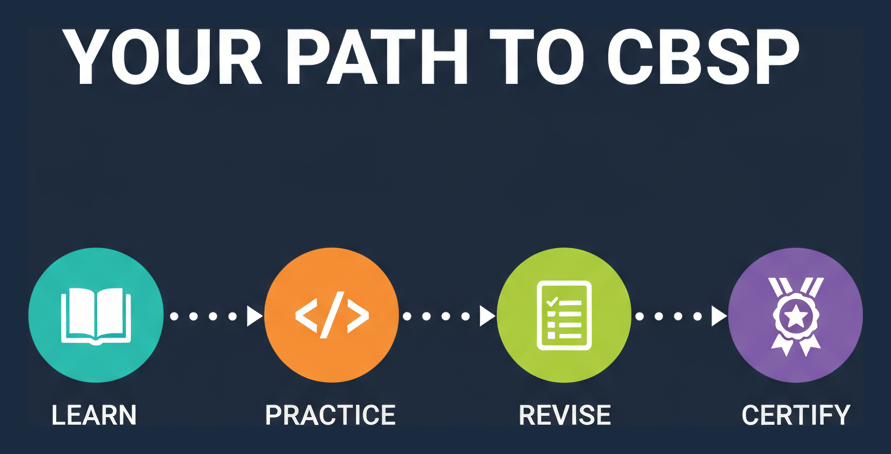
A Practical Four-Step Study Plan
- Map the domains – build a checklist from all twelve official domains and rate your confidence in each.
- Study defensively – for every concept, note the attack, the impact, and the mitigation.
- Practice on real code – audit sample smart contracts and reproduce classic vulnerabilities in a test environment.
- Simulate the exam – take full timed practice tests and review every miss until the reason is clear.
Developers who want to strengthen the coding side of their preparation often review the Ethereum blockchain developer credential first, since fluency in Solidity and contract design makes the CBSP security material much easier to internalize.
What Career Doors Does the CBSP Open?
The CBSP signals that you can secure production blockchain systems, a scarce and well-paid skill set. Certified professionals move into roles such as blockchain security engineer, smart contract auditor, Web3 security consultant, and DLT risk analyst. As enterprises and DeFi protocols expand, demand for defenders who understand on-chain threats continues to outpace the available talent pool.
- Blockchain security engineer – hardening nodes, wallets, and infrastructure
- Smart contract auditor – reviewing code before and after deployment
- Web3 security consultant – advising protocols and enterprises on risk
- DLT risk and compliance analyst – aligning deployments with governance and regulation
Because the credential is vendor-neutral, it travels across public chains, permissioned ledgers, and alternative DLT architectures, giving you flexibility as the market shifts between platforms.
Frequently Asked Questions
Is the CBSP exam hard to pass?
The CBSP is moderately challenging. Its 70 percent pass mark and twelve-domain scope reward broad, defensive knowledge. Candidates with security or blockchain development experience usually find four to six weeks of focused study sufficient.
Are there prerequisites for the CBSP?
No formal prerequisites are required. However, a working understanding of cryptography fundamentals and hands-on time with at least one blockchain platform make the material significantly easier to master.
How many questions are on the CBSP exam?
The CBSP exam has 70 questions and a 90-minute time limit, which leaves roughly 77 seconds per question. Timed practice helps you build the pacing needed to finish comfortably.
What score do I need to pass the CBSP?
You need 70 percent to pass. That means you can miss around 21 questions, but weak coverage across several domains can quickly push you below the threshold.
How much does the CBSP exam cost?
Registration for the CBSP costs 275 USD through the Blockchain Training Alliance. Budget separately for study resources and practice tests when planning your preparation.
Does the CBSP focus on smart contract security?
Yes. Two of the twelve domains cover smart contract security and smart contract vulnerabilities, so recognizing patterns like reentrancy and broken access control is essential to passing.
Is the CBSP vendor-neutral?
Yes. The CBSP is platform-agnostic and covers public, permissioned, and alternative DLT architectures, so the skills apply across Ethereum, Hyperledger, and other blockchain environments.
How long is the CBSP certification valid?
The Blockchain Training Alliance issues the CBSP as a professional credential. Because blockchain security evolves quickly, keeping your practical knowledge current is more valuable than the certificate date alone.
What jobs can the CBSP help me get?
The CBSP supports roles such as blockchain security engineer, smart contract auditor, Web3 security consultant, and DLT risk analyst, all of which are in growing demand as blockchain adoption expands.
Conclusion
The Certified Blockchain Security Professional proves you can do more than describe a blockchain, you can defend one. With 70 questions across twelve domains covering consensus, smart contracts, network and system attacks, and enterprise risk, the CBSP builds a complete, practical security skill set that employers actively seek. Study every domain, practice on real code, and rehearse under timed conditions rather than chasing a single specialty. If you are ready to turn blockchain security knowledge into a recognized credential, map the twelve domains today, work through timed practice questions, and book your CBSP exam once you consistently clear the 70 percent mark. Your next role in Web3 security starts with that decision.


