Table of Contents
- What does a ServiceNow Vulnerability Response specialist actually do?
- Which domains and format does the CIS-VR exam use?
- How do you set up Vulnerability Response in ServiceNow?
- How does vulnerability data get into ServiceNow?
- How do you manage vulnerable items with groups and remediation rules?
- How does ServiceNow calculate vulnerability risk and priority?
- How is Vulnerability Response automated end to end?
- What do Vulnerability Response dashboards and reports reveal?
- How should you prepare for the CIS-VR exam?
- What career paths open up with these skills?
- Frequently asked questions
- Conclusion
What does a ServiceNow Vulnerability Response specialist actually do?
A ServiceNow Vulnerability Response specialist configures the platform so security findings flow from scanners into structured, owned remediation work. The CIS-VR credential validates that you can install and set up the Vulnerability Response application, connect data sources, define grouping and assignment logic, and automate close-out. It is an implementation role, sitting between security analysts who triage risk and IT teams who apply the fixes.
In day-to-day terms, the specialist owns the plumbing that makes vulnerability management repeatable. That includes mapping vulnerable items to configuration items in the CMDB, tuning which findings become tasks, and ensuring dashboards give the CISO an honest view of exposure. The work is equal parts security judgment and ServiceNow platform craft.
“We’re seeing a growing need for security departments to enable better collaboration and drive security outcomes across the enterprise.”
That collaboration mandate is exactly what the CIS-VR role delivers: a shared workspace where security defines priority and IT executes remediation against agreed targets.
Which domains and format does the CIS-VR exam use?
The CIS-VR exam measures whether you can implement Vulnerability Response on a live instance across five weighted domains. Before building a study plan, it helps to see the format and the objective spread side by side, because the weightings tell you where to invest time. Getting data in and configuring the core application together account for half the exam.
Exam format at a glance
| Attribute | Detail |
|---|---|
| Exam name | ServiceNow Certified Implementation Specialist – Vulnerability Response |
| Exam code | CIS-VR |
| Number of questions | 45 |
| Duration | 90 Minutes |
| Passing score | Pass / Fail |
| Exam fee | USD $450 |
Domain weightings
| Domain | Weighting |
|---|---|
| Vulnerability Response Applications and Modules | 25% |
| Getting Data into Vulnerability Response | 25% |
| Tools to Manage Vulnerability Response | 23% |
| Automating Vulnerability Response | 20% |
| Vulnerability Response Dashboards and Reports | 7% |
Working through scenario-style CIS-VR practice questions early is the fastest way to gauge how these weightings translate into question difficulty.
How do you set up Vulnerability Response in ServiceNow?
Setting up Vulnerability Response in ServiceNow starts with the Security Operations foundation, then activation of the Vulnerability Response plugin and its supporting modules. The CIS-VR exam devotes 25 percent to Vulnerability Response Applications and Modules, so you must know how the application is structured, what container and application coverage adds, and where each module lives on the platform.
The Applications and Modules domain covers ServiceNow Security Operations, an introduction to Vulnerability Response, how it runs on the Now Platform, and both Application Vulnerability Response and Container Vulnerability Response. Understanding these boundaries matters because each variant ingests different data and serves a different audience.
- Security Operations foundation – shared tables, roles, and the SecOps data model that Vulnerability Response builds on.
- Core Vulnerability Response – the base application handling infrastructure vulnerabilities and vulnerable items.
- Application Vulnerability Response – unites DevOps and security to prioritize findings from SAST, DAST, and SCA scans.
- Container Vulnerability Response – identifies and prioritizes vulnerable container images for cloud-native workloads.
ServiceNow positions this as a single workflow layer over your existing tools; the vendor’s Vulnerability Response platform page frames it as unifying findings from any scanner or cloud into one enterprise process. On the exam, expect questions on which module handles which finding type.
How does vulnerability data get into ServiceNow?
Vulnerability data enters ServiceNow through scanner integrations that import findings and map them to configuration items in the CMDB. This is the Getting Data into Vulnerability Response domain, weighted at 25 percent alongside the core application. The CIS-VR exam expects you to distinguish vulnerabilities from vulnerable items and to configure enrichment so every finding carries the context needed for prioritization.
Core data concepts
A vulnerability is a defined weakness, often tied to a CVE record, while a vulnerable item (VI) is that weakness detected on a specific asset. ServiceNow pulls third-party library data from sources such as the National Vulnerability Database and correlates scanner detections against your CMDB so each VI links to a real configuration item and its owner.
Integration and enrichment
The domain covers integrations with vulnerability scanners and other data sources, application and container integrations, and solution and enrichment management. Common connectors include Qualys, Tenable, and Rapid7, with third-party patch and solution data enriching each finding. ServiceNow’s Security Operations documentation details how scanner integrations, lookup rules, and CMDB mapping fit together. Weak CMDB data is the most common cause of misassigned tasks, so enrichment quality directly drives remediation accuracy.
How do you manage vulnerable items with groups and remediation rules?
You manage vulnerable items in ServiceNow by grouping related findings and applying rules that classify, assign, and schedule remediation. The Tools to Manage Vulnerability Response domain carries 23 percent of the CIS-VR exam, covering vulnerability workspaces plus the rule engines that turn thousands of raw VIs into a manageable queue of owned, targeted work.
Vulnerability groups collapse many vulnerable items into a single record so teams remediate by campaign rather than one finding at a time. Rules then decide what happens to each item as it arrives.
- Classification rules – tag and categorize incoming vulnerable items automatically.
- Assignment rules – route items to the correct remediation group based on asset or ownership.
- Remediation task rules – determine when and how remediation tasks are created.
- Remediation target rules – set the due dates and SLAs a finding must be fixed within.
- Vulnerability calculators – adjust risk and priority using organizational context.
The IT Remediation Workspace gives fixers a focused view, while security-facing workspaces support triage. Expect exam scenarios that ask which rule type produces a given outcome, so practice reading a requirement and naming the correct rule.
How does ServiceNow calculate vulnerability risk and priority?
ServiceNow calculates risk through vulnerability calculators that combine finding severity, asset criticality, and organizational context into a risk score and remediation priority. The CIS-VR exam tests this under both the tools and automation domains, because scoring is what lets teams work the most dangerous findings first instead of chasing raw CVSS numbers across every asset.
Calculator groups apply conditions in order, letting you weight business-critical systems higher or downgrade isolated assets. This context-driven model reflects where the industry has moved.
“It leaves you open for attackers to target the medium- and low-ranking vulnerabilities.”
That warning is the case for risk-based prioritization: severity alone misses exploitable medium findings on exposed assets. In ServiceNow, calculators and remediation target rules encode that judgment so priority reflects real exposure, and the resulting scores feed SLAs, assignment, and dashboards consistently across the instance.
How is Vulnerability Response automated end to end?
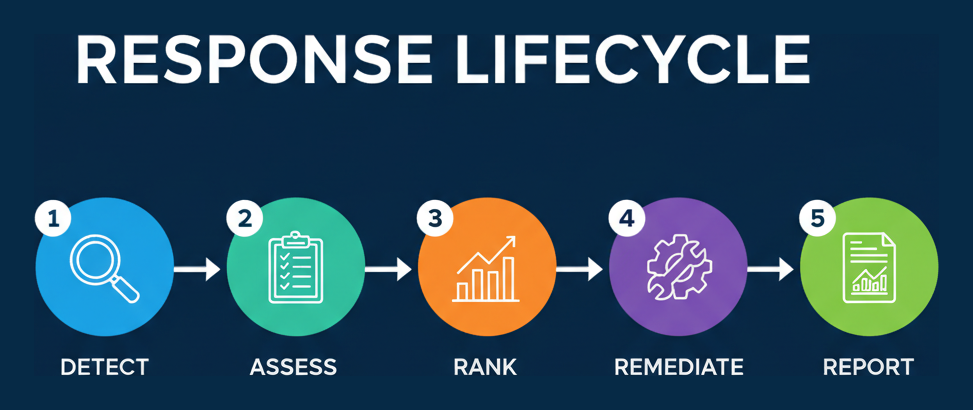
Vulnerability Response is automated in ServiceNow through workflows, flow designer logic, and rules that move findings from detection to close-out without manual handoffs. The Automating Vulnerability Response domain is 20 percent of the CIS-VR exam and covers exception handling, false positives, process automation, and how a vulnerable item is formally closed once remediated or accepted.
Exceptions and false positives
Not every finding gets patched. Some are risk-accepted through an exception, others are confirmed false positives. ServiceNow routes exceptions through an approval process, often integrating with Governance, Risk, and Compliance so accepted risk is documented rather than silently ignored.
Workflows and close-out
Workflows drive tasks through their lifecycle, trigger notifications, and update state as remediation progresses. Vulnerability close-out confirms a fix, revalidates on the next scan, and reopens the item automatically if the weakness reappears. This closed loop, from ingestion to verified closure, is the heart of what a CIS-VR specialist builds and what the exam repeatedly probes.
What do Vulnerability Response dashboards and reports reveal?
Dashboards and reports in Vulnerability Response reveal exposure trends, remediation velocity, and SLA compliance to both operators and executives. This domain is the smallest at 7 percent of the CIS-VR exam, yet it is where the platform proves its value, translating thousands of vulnerable items into metrics that leadership can act on and analysts can steer by.
The domain covers data visualization through dashboards and reporting plus Performance Analytics for trend data over time. Where standard reports show current state, Performance Analytics captures scored snapshots so teams can see whether the backlog is shrinking and whether targets are being met.
- Operational dashboards – open vulnerable items, aging, and assignment load for remediation teams.
- Executive views – overall exposure and SLA adherence for the CISO and security leadership.
- Performance Analytics – time-series trends that show remediation progress and forecast risk.
How should you prepare for the CIS-VR exam?
Preparing for the CIS-VR exam works best when you combine hands-on instance practice with objective-mapped study. Because the exam rewards implementation knowledge over memorization, the strongest candidates build a working Vulnerability Response configuration in a Personal Developer Instance and study each domain against what they actually configured. A structured plan keeps the five weighted domains in proportion.
- Start with the blueprint. Review the official objectives and weightings, then rank domains by exam share.
- Build in a developer instance. Activate Vulnerability Response, import sample data, and configure groups, rules, and calculators yourself.
- Ground yourself in the platform. If ServiceNow is new to you, revisit ServiceNow platform fundamentals before diving into SecOps specifics.
- Drill with scenarios. Test recall with realistic questions and revisit any domain where you score low.
- Confirm the objectives. Cross-check your coverage against the official exam blueprint before booking.
Candidates moving across the Security Operations suite often pair this with the Risk and Compliance exam, since exception handling touches GRC directly.
What career paths open up with these skills?
ServiceNow Vulnerability Response skills open doors into SecOps engineering, security automation, and platform implementation consulting. The CIS-VR credential signals that you can operationalize vulnerability management on an enterprise platform, a capability in demand as organizations consolidate scanning, ticketing, and remediation into unified workflows rather than disconnected spreadsheets and email threads.
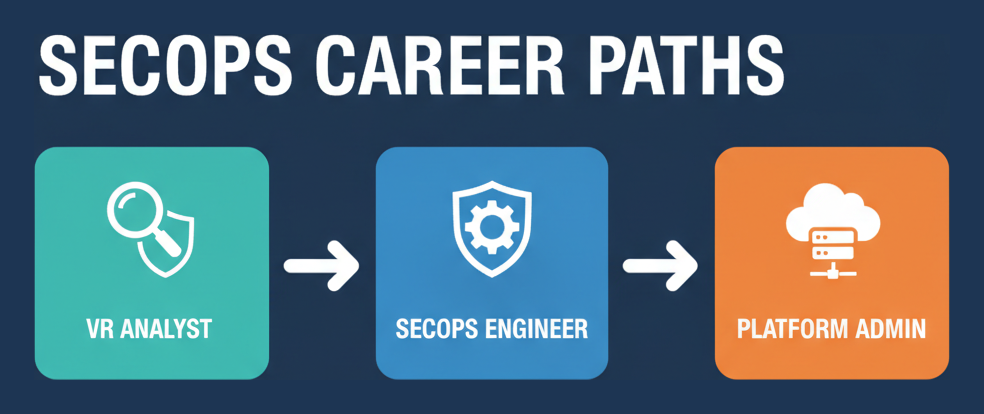
Because the role bridges security and IT, it leads in several directions depending on where you lean.
- Security Operations Engineer – owns SecOps tooling, integrations, and automation across the security stack.
- ServiceNow SecOps Consultant – implements Vulnerability Response and related modules for multiple clients.
- Vulnerability Management Lead – runs the remediation program and reports exposure to leadership.
- Platform Administrator with security focus – extends broad ServiceNow administration into security modules.
Pairing CIS-VR with adjacent Security Operations or GRC credentials builds a profile that enterprises struggle to hire, which keeps this skill set well compensated and mobile.
Frequently asked questions
What is the CIS-VR certification?
CIS-VR is the ServiceNow Certified Implementation Specialist – Vulnerability Response credential. It validates that you can install, configure, and maintain the Vulnerability Response application, including data integrations, grouping and remediation rules, automation, and reporting.
How many questions are on the CIS-VR exam?
The CIS-VR exam has 45 questions and a duration of 90 minutes. Results are reported on a Pass or Fail basis rather than a numeric percentage.
How much does the CIS-VR exam cost?
The exam fee is USD $450. Budget separately for study time and a developer instance, both of which are free to use for hands-on practice.
What are the main CIS-VR exam domains?
The five domains are Vulnerability Response Applications and Modules, Getting Data into Vulnerability Response, Tools to Manage Vulnerability Response, Automating Vulnerability Response, and Vulnerability Response Dashboards and Reports.
Which domain carries the most weight?
Two domains tie for the highest weight at 25 percent each: Vulnerability Response Applications and Modules, and Getting Data into Vulnerability Response. Together they cover half the exam.
Do I need coding experience for CIS-VR?
Deep coding is not required, but comfort with ServiceNow configuration, scripting basics, and flow logic helps, especially for the automation domain covering workflows, exceptions, and close-out.
What is the difference between a vulnerability and a vulnerable item?
A vulnerability is a defined weakness, often tied to a CVE. A vulnerable item is that weakness detected on a specific asset in your environment, linked to a configuration item in the CMDB.
Which scanners integrate with ServiceNow Vulnerability Response?
ServiceNow integrates with major scanners including Qualys, Tenable, and Rapid7, and it enriches findings using third-party data sources such as the National Vulnerability Database.
How should I practice for the exam?
Build a Vulnerability Response configuration in a Personal Developer Instance, then rehearse with scenario-based questions. Hands-on configuration of rules, groups, and calculators mirrors how the exam frames its questions.
Is CIS-VR worth it for a career in security operations?
Yes. It validates a practical, in-demand skill set that combines security judgment with ServiceNow implementation, supporting roles in SecOps engineering, consulting, and vulnerability management leadership.
Conclusion
ServiceNow Vulnerability Response turns scanner noise into owned, tracked, and verified remediation, and the CIS-VR certification proves you can build that machine end to end. The exam rewards implementers: people who have activated the application, mapped scanner data to the CMDB, tuned grouping and remediation rules, encoded risk-based priority, and closed the loop with automation and dashboards. Treat the five weighted domains as a build checklist rather than a reading list, practice in a live developer instance, and validate your coverage against the official objectives before you book. Start configuring today, drill with realistic scenario questions, and walk into the exam having already done the work it tests.


