The Certificate of Cloud Security Knowledge (CCSK) is a vendor-neutral credential from the Cloud Security Alliance (CSA) that measures how well you understand securing data, workloads, and identities across public cloud platforms. Unlike product-specific badges, it proves you grasp the concepts that carry across AWS, Azure, Google Cloud, and hybrid estates. Employers read the CCSK as a signal that a candidate can reason about shared responsibility, governance, and cloud-native controls rather than memorize one provider’s console.
This guide walks through what the exam covers, how it is scored, which domains sit on the syllabus, and how to build a preparation plan that sticks. You will also see how the CCSK compares with role-based credentials and where it fits in a cloud security career. Every exam specification here comes straight from the official CSA syllabus, so you can plan with numbers you can trust.
Table of Contents
- What Does the CCSK Certification Actually Prove?
- How Is the CCSK Exam Structured?
- Which Domains Does the CCSK Syllabus Cover?
- Who Should Earn the CCSK Certification?
- How Do You Prepare for the CCSK Exam?
- CCSK vs CCSP: Which Cloud Security Credential Fits You?
- What Career Opportunities Follow the CCSK?
- Frequently Asked Questions
- Conclusion
What Does the CCSK Certification Actually Prove?
The CCSK certification proves that you understand cloud security as a discipline, not as a single vendor’s toolset. It validates knowledge of the CSA Security Guidance and the shared responsibility model, showing that you can identify who secures what across infrastructure, platform, and software services. Because it is provider-agnostic, the credential travels with you regardless of which cloud your next employer runs. The same organisation extends that thinking into architecture in the CCZT zero trust certification.
That breadth is the point. A cloud engineer who holds the CCSK can walk into an AWS shop, an Azure shop, or a multi-cloud environment and apply the same core reasoning about governance, identity, and data protection. The exam rewards conceptual fluency over button-clicking. The CSA maintains the credential through its official CCSK education program. Protecting the credentials behind those environments is a discipline of its own, and a secrets management credential proves it directly.
Real cloud security knowledge shows up in the decisions people make under pressure. The CCSK builds a shared vocabulary so that architects, auditors, and developers describe risk the same way. That common language is what turns scattered controls into a coherent security posture, grounded in established practices for cloud computing security.
How Is the CCSK Exam Structured?
The CCSK exam is a 60-question, online, open-book test that you complete in 120 minutes and pass with a score of 80% or higher. It costs $445 USD and is taken through the Cloud Security Alliance rather than a physical test center. Because it is open-book, questions probe your ability to locate and apply guidance quickly, not just recall facts.
Working through a set of realistic items early helps you gauge the wording style and depth before exam day. A focused run of CCSK practice questions shows how the exam frames scenarios and where your gaps sit.
| Exam Attribute | Detail |
|---|---|
| Exam name | CSA Certificate of Cloud Security Knowledge (CCSK Foundation) |
| Exam code | CCSK |
| Number of questions | 60 |
| Duration | 120 minutes |
| Passing score | 80% |
| Exam price | $445 USD |
| Format | Online, open-book |
The open-book format is generous, but the 80% threshold is not. Candidates who lean on the clock to search for every answer usually run short on time, so genuine familiarity with the material still matters.
Which Domains Does the CCSK Syllabus Cover?
The CCSK syllabus spans twelve sections that move from foundational cloud concepts through governance, technical controls, and incident response. Each section carries a set of objectives that mirror how modern cloud security teams actually organize their work, from identity design to workload hardening. The breadth is deliberate, giving you a complete map of the cloud security landscape.
Here is the full domain map straight from the official syllabus, with the key objectives inside each section:
| Section | Key Objectives |
|---|---|
| Cloud Computing Concepts & Architectures | Defining cloud computing, cloud computing models, cloud security scope and responsibilities |
| Cloud Governance | Cloud governance, the governance hierarchy, cloud security frameworks, policies |
| Risk, Audit and Compliance | Cloud risk management, compliance and audit, GRC tools and technologies |
| Organization Management | Organization hierarchy models, managing security within a provider, hybrid and multi-cloud considerations |
| Identity and Access Management | How IAM differs in the cloud, fundamental terms, federation, strong authentication and authorization |
| Security Monitoring | Cloud monitoring, posture management, telemetry sources, collection architectures, AI for monitoring |
| Infrastructure & Networking | Infrastructure security, network fundamentals, secure architectures, infrastructure as code, zero trust, SASE |
| Cloud Workload Security | Securing virtual machines, containers, serverless and function as a service, and AI workloads |
| Data Security | Cloud storage primer, encryption at rest, data security posture management, object storage, data security for AI |
| Application Security | Secure development lifecycle, architecture’s role, IAM and application security, DevOps and DevSecOps |
| Incident Response & Resilience | Incident response, preparation, detection and analysis, containment and recovery, post-incident analysis |
| Related Technologies & Strategies | Zero trust, artificial intelligence |
Notice how recent additions, such as securing AI workloads and data security for artificial intelligence, reflect where cloud risk is heading. The syllabus rewards candidates who connect classic controls to these emerging patterns.
Who Should Earn the CCSK Certification?
The CCSK suits security engineers, cloud architects, compliance analysts, DevOps practitioners, and IT auditors who need a shared foundation in cloud security knowledge. It fits professionals moving from traditional infrastructure into cloud roles, and it helps developers who want to build securely rather than bolt controls on afterward. No formal prerequisites apply, so motivated newcomers can also pursue it.
The credential is especially useful for teams standardizing how they talk about risk. When architects, auditors, and engineers share the same reference points, security reviews move faster and disputes shrink.
- Cloud and security engineers hardening live environments
- Architects designing multi-cloud or hybrid platforms
- GRC, audit, and compliance staff assessing cloud controls
- DevOps and DevSecOps practitioners embedding security in pipelines
- Career changers entering cloud security from adjacent IT roles
If your work touches how an organization adopts or governs the cloud, the CCSK gives you a defensible baseline. For a broader look at the journey, this walkthrough on cloud security mastery adds helpful context.
How Do You Prepare for the CCSK Exam?
Preparing for the CCSK means studying the CSA Security Guidance and the Cloud Controls Matrix, then testing your recall against realistic questions. Most candidates give themselves four to six weeks, spending the first half reading the guidance domain by domain and the second half drilling scenarios. Because the exam is open-book, building a fast reference index of the guidance pays off on exam day.
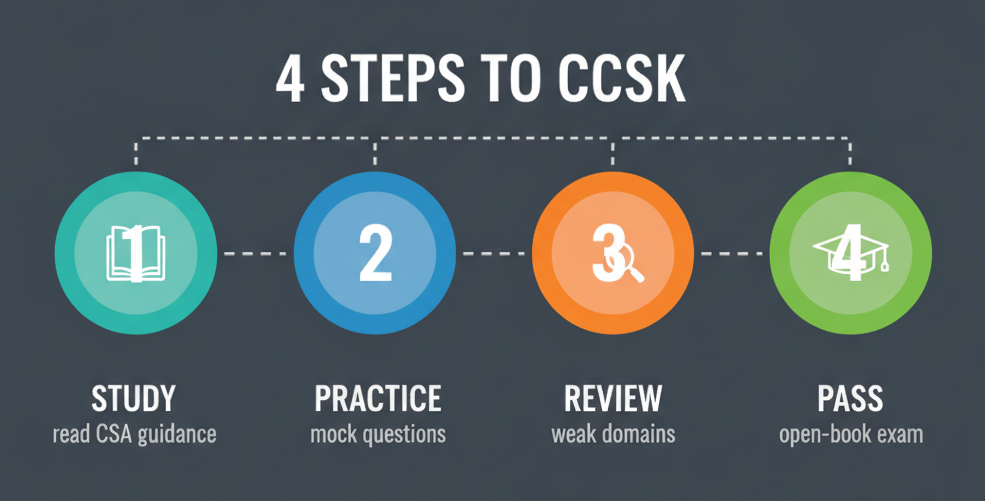
A structured sequence keeps preparation from drifting:
- Read the CSA Security Guidance once end to end to map the twelve domains.
- Reread each domain and take notes you can search quickly during the open-book exam.
- Study the Cloud Controls Matrix to see how objectives map to concrete controls.
- Work practice scenarios and review every wrong answer against the guidance.
- Sit a timed mock run to confirm you can clear 80% inside 120 minutes.
How Long Should You Study Each Week?
Around six to eight focused hours a week is realistic for working professionals. Candidates who already run cloud workloads often need less on the technical domains but more on governance and compliance, which reward careful reading over hands-on familiarity.
A disciplined study plan closes the gap between reading and recall. This step-by-step CCSK study plan breaks the process into weekly milestones you can follow.
CCSK vs CCSP: Which Cloud Security Credential Fits You?
The CCSK and the CCSP both certify cloud security knowledge, but they serve different stages of a career. The CCSK is a foundation-level, open-book exam with no experience requirement, ideal for building or proving conceptual fluency. The CCSP, offered by ISC2, is an advanced credential that requires years of experience and covers architecture and operations in greater depth.
Many professionals earn the CCSK first, then progress to the CCSP once they have hands-on experience. The two credentials complement rather than compete, since CSA guidance underpins parts of both.
| Factor | CCSK | CCSP |
|---|---|---|
| Provider | Cloud Security Alliance | ISC2 |
| Level | Foundation | Advanced |
| Experience required | None | Five years IT, three in security |
| Format | Open-book, online | Proctored, closed-book |
| Best for | Building core knowledge | Validating senior expertise |
Choose the CCSK when you want a fast, affordable way to prove cloud security fundamentals. Reach for the CCSP when you already carry the experience and want a senior-level stamp.
What Career Opportunities Follow the CCSK?
The CCSK opens doors to cloud security engineer, cloud architect, security analyst, and GRC roles where employers want proof of vendor-neutral cloud security knowledge. Because demand for cloud security talent keeps outpacing supply, the credential helps candidates stand out early in the hiring process, especially when paired with hands-on platform experience. It also strengthens the case for internal moves into security teams.
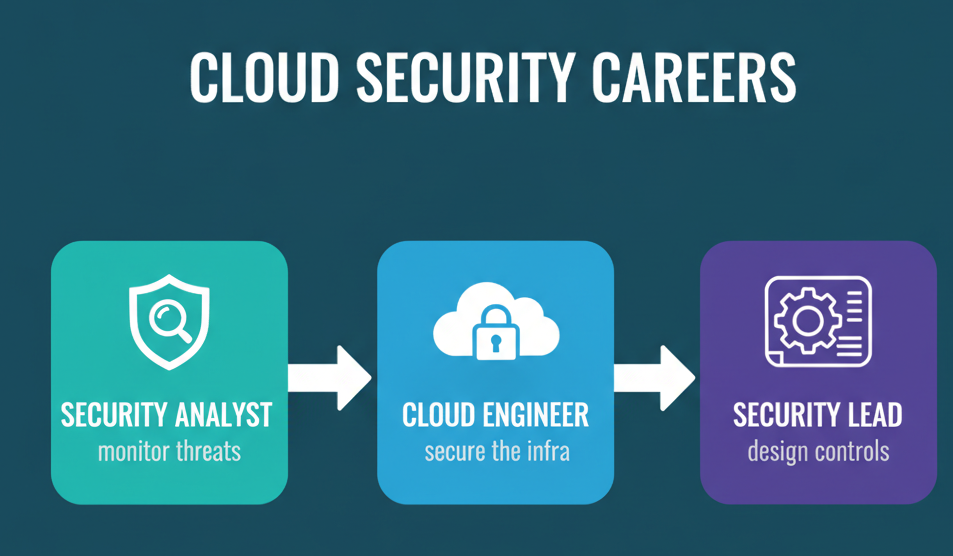
Cloud security roles consistently rank among the better-paid specialties in IT, and the CCSK is often listed as a preferred qualification on job postings. It signals that you can contribute to security conversations from day one.
- Cloud Security Engineer
- Cloud Security Architect
- Security and Compliance Analyst
- DevSecOps Engineer
- Governance, Risk, and Compliance Specialist
Pairing the CCSK with practical experience on a major cloud platform makes for a compelling profile. The certification proves you understand the theory; your projects prove you can apply it.
Frequently Asked Questions
What is the CCSK certification?
The CCSK is the Certificate of Cloud Security Knowledge from the Cloud Security Alliance. It is a vendor-neutral, foundation-level credential that validates your understanding of securing cloud environments across governance, identity, data, and workload domains.
How many questions are on the CCSK exam?
The CCSK exam contains 60 questions. You have 120 minutes to complete it, and you must score at least 80% to pass. The test is delivered online in an open-book format through the Cloud Security Alliance.
How much does the CCSK exam cost?
The CCSK exam costs $445 USD. That fee typically includes exam attempts, and the credential does not expire, so there are no recurring renewal charges once you pass.
Is the CCSK exam open-book?
Yes, the CCSK is an open-book, online exam. You may reference the CSA Security Guidance during the test, but the 120-minute limit means you still need strong familiarity with the material to finish in time.
Do I need experience to take the CCSK?
No formal experience or prerequisites are required for the CCSK. It is designed as a foundation credential, so newcomers to cloud security and seasoned professionals can both sit the exam without meeting an experience threshold.
What is the passing score for the CCSK?
You need 80% to pass the CCSK exam. Because the passing bar is high, candidates should treat the open-book format as a support rather than a shortcut and prepare thoroughly across all twelve domains.
How long does it take to prepare for the CCSK?
Most candidates prepare in four to six weeks, studying six to eight hours per week. Those with existing cloud experience may move faster through technical domains but should invest extra time in governance and compliance topics.
Which is better, CCSK or CCSP?
Neither is strictly better; they suit different stages. The CCSK is a foundation credential with no experience requirement, while the CCSP is an advanced ISC2 certification requiring years of experience. Many professionals earn the CCSK first.
Does the CCSK certification expire?
No, the CCSK does not expire and requires no continuing education credits. However, staying current with evolving CSA guidance is wise, since cloud security practices and the syllabus itself continue to change.
Conclusion
The CCSK remains one of the most accessible ways to prove genuine cloud security knowledge without committing to a single vendor. With 60 questions, a 120-minute window, an 80% passing bar, and twelve domains spanning governance to AI workload security, it gives you a complete map of the field and a credential that hiring managers recognize. Its open-book format lowers the barrier to entry while the high pass threshold keeps it credible.
If you are ready to test your readiness, work through a realistic question set, review each domain against the official guidance, and schedule your exam once you consistently clear 80%. Reviewing the exam’s format and objectives is the logical next step toward earning the credential with confidence.


