This guide walks the six domains in weighting order, names the SPL commands the blueprint calls out explicitly, explains what Risk Based Alerting actually means in Enterprise Security, and sets out a preparation sequence built around where the marks genuinely are rather than around what is comfortable to revise.
What Does the SPLK-5001 Exam Actually Test?
SPLK-5001 leads to the Splunk Certified Cybersecurity Defense Analyst credential. It tests whether you can work a security operations centre shift using Splunk analytics, across six domains covering the cyber landscape, attack types, defensive data sources, investigation and risk, search language, and threat hunting. The paper is 66 questions in 75 minutes and costs $130.
Splunk positions the credential deliberately. It is not the administrator track and it is not the engineer track. It is aimed at the person sitting in the queue, triaging notables and deciding what deserves escalation. Analysts comparing SIEM platforms before committing to a track often weigh it against the IBM QRadar analyst exam, which tests the same investigative habits on a different toolset.
“Validate your skills to start as a SOC analyst using Splunk analytics, threat-hunting, risk-based alerting and industry best practices.”
That sentence is worth reading twice, because two of the four things it names are conceptual rather than product-specific. Threat hunting and industry best practices are assessed as knowledge, not as button-clicking. Candidates who prepare only inside a Splunk instance walk into roughly a third of a paper they have not studied.
There is no mandatory prerequisite certification. You can book SPLK-5001 without holding the Core User or Power User credentials first, although the search-language domain assumes you already write SPL comfortably.
How Are the 66 Questions Split Across the Six Domains?
The SPLK-5001 blueprint runs six domains. Four carry twenty percent each and two carry ten percent each. That means eighty percent of the exam is spread evenly across attack knowledge, data sources and SIEM practice, investigation and risk, and SPL. On 66 questions, twenty percent is roughly thirteen questions, and ten percent is roughly seven.
| Domain | Weight | Approximate questions |
|---|---|---|
| Threat and Attack Types, Motivations, and Tactics | 20% | 13 |
| Defenses, Data Sources, and SIEM Best Practices | 20% | 13 |
| Investigation, Event Handling, Correlation, and Risk | 20% | 13 |
| SPL and Efficient Searching | 20% | 13 |
| The Cyber Landscape, Frameworks, and Standards | 10% | 7 |
| Threat Hunting and Remediation | 10% | 7 |
The flat shape has a practical consequence. On an exam where one domain dominates, you can gamble on that domain and scrape through. Here you cannot. Dropping an entire twenty percent block costs you thirteen marks against a pass mark of seven hundred out of a thousand, and no amount of strength elsewhere reliably covers that.
It also means revision time should be split fairly evenly rather than by comfort. Most candidates arrive strong on SPL and weak on the two ten-percent conceptual domains, then spend their study time on SPL because it feels productive.
Which SPL Commands Does the Blueprint Name by Name?
The SPL and Efficient Searching domain is worth twenty percent and, unusually, the blueprint names the exact commands. It lists TSTATS, TRANSACTION, FIRST and LAST, REX, EVAL, FOREACH, LOOKUP and MAKERESULTS, and asks you to explain how each is used in security analysis. That is a closed list, which makes it the most efficiently revisable part of the exam.
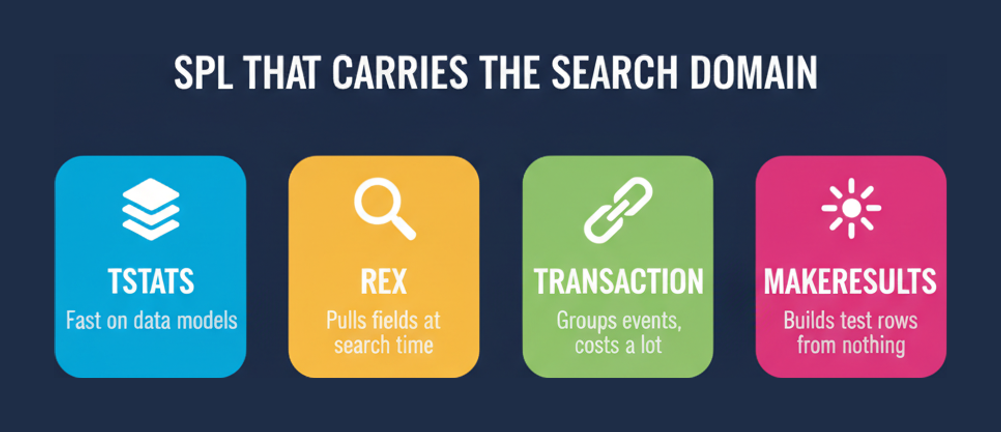
The four that carry the most weight in practice
- TSTATS runs against accelerated data models rather than raw events, which is why it is the command Enterprise Security leans on for speed. Knowing why it is fast matters as much as knowing the syntax.
- REX extracts fields at search time with a regular expression. In a SOC context it is what you reach for when a source type has not been normalised into the Common Information Model.
- TRANSACTION groups related events into a single unit. The exam cares that you know it is expensive and that stats-based alternatives usually beat it.
- MAKERESULTS generates rows out of nothing, which sounds academic until you need to test a lookup or seed a correlation search without touching production data.
Efficiency is examined, not just correctness
The objective is not simply to write a search that returns the right answer. Splunk asks for best practices for composing efficient searches: filtering early, avoiding wildcards at the start of a term, preferring stats over transaction, and letting accelerated data models do the heavy lifting. Expect scenarios where several searches would all work and one is clearly cheaper.
The domain also points at where to find reusable content, naming Enterprise Security’s own library, Splunk Security Essentials and Splunk Lantern as sources of SPL you should not be writing from scratch. Because the command list is closed, timed drilling pays off quickly here, and a run through SPLK-5001 sample questions will show within an hour whether your search habits match what the blueprint rewards.
What Does Risk Based Alerting Mean in Enterprise Security?
Risk Based Alerting is the model where individually low-value detections attach risk scores to an object, such as a user or a host, and an alert fires only once accumulated risk crosses a threshold. SPLK-5001 puts it inside the Investigation, Event Handling, Correlation, and Risk domain, worth twenty percent, and expects you to explain the framework rather than merely recognise the phrase.
The vocabulary the blueprint expects
Six terms are called out explicitly, and each has a precise meaning in Enterprise Security documentation:
- Notable Event – the record created when a correlation search fires.
- Risk Notable – a notable raised because accumulated risk crossed a threshold, rather than because one detection matched.
- Risk Object – the entity the risk is attached to, typically a user, host or other asset.
- Contributing Events – the individual detections that added score to that object.
- Adaptive Response Action – the automated or semi-automated action fired from a notable.
- SPL – the search language underneath all of it.
Investigation stages and analyst metrics
The same domain asks for the five basic stages of investigation as Splunk defines them, and for analyst performance metrics including mean time to respond and dwell time. It also asks you to assign event dispositions correctly, which is the part candidates underestimate. Disposition is a judgement call the exam expects you to make consistently, not a lookup.
Underneath all of this sits the Common Information Model. Correlation searches, data model acceleration and the asset and identity frameworks only work when data is normalised, and the CIM documentation is where the field names being tested are defined.
How Much of SPLK-5001 Is Threat Knowledge Rather Than Splunk?
Thirty percent of SPLK-5001 tests security knowledge that has nothing to do with the Splunk product. The Threat and Attack Types domain is worth twenty percent and the Cyber Landscape, Frameworks, and Standards domain a further ten. Together they cover attack vectors, threat intelligence tiers, SOC structure and the frameworks the industry runs on.
The definitions you are expected to hold
The blueprint lists the terms outright: supply chain attack, ransomware, registry, exfiltration, social engineering, denial of service and distributed denial of service, bot and botnet, command and control, zero trust, account takeover, business email compromise, threat actor, advanced persistent threat and adversary. These are short-answer definitions, and they are free marks for anyone who revises them.
Tactics, techniques and procedures get their own objective, which is where the MITRE ATT&CK knowledge base earns its place on the reading list. The exam wants you to know how TTPs are regarded in the industry, and ATT&CK is the vocabulary that industry actually uses.
Roles, standards and annotations
The ten-percent landscape domain asks you to summarise how a typical SOC is organised and what belongs to the analyst, the engineer and the architect. It also asks about confidentiality, integrity and availability and about basic risk management, plus how Splunk maps common controls and frameworks into its own content. Annotations in Enterprise Security are the mechanism for that mapping, and the blueprint calls them out by name. Of those frameworks, the NIST Cybersecurity Framework is the one candidates meet most often in Splunk content, so it is worth knowing its five functions by name.
What Does SPLK-5001 Cost and What Score Do You Need to Pass?
SPLK-5001 costs $130 USD per attempt and is scheduled through Pearson VUE. The pass mark is 700 on a scale to 1000, delivered across 66 multiple choice questions in 75 minutes. That works out at roughly sixty-eight seconds a question, which is comfortable for definition items and tight for scenario items that describe a full investigation.
| Detail | Value |
|---|---|
| Exam name | Splunk Certified Cybersecurity Defense Analyst |
| Exam code | SPLK-5001 |
| Questions | 66, multiple choice |
| Duration | 75 minutes |
| Passing score | 700 / 1000 |
| Price | $130 USD per attempt |
| Delivery | Pearson VUE |
A scaled score is not a percentage, so do not translate 700 into “seventy percent of questions correct”. Scaled scoring adjusts for the difficulty of the particular form you sit. In practice the safest way to read it is that a comfortable pass needs genuine coverage of all six domains rather than a strong performance in four.
Analyst or Engineer: Which Splunk Security Exam Fits You?
Splunk runs two security-analyst-facing credentials, and candidates regularly book the wrong one. SPLK-5001 validates working a queue: triage, investigation, risk notables and hunting. The Cybersecurity Defense Engineer exam validates building the thing the analyst works in: detections, data onboarding and content development. The split is consumer against builder.
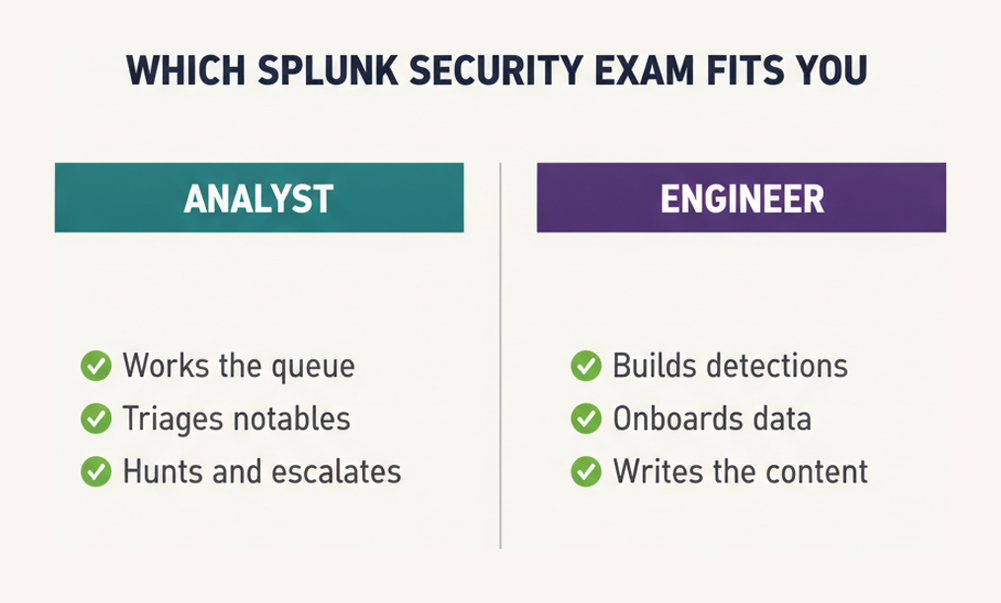
How to choose in one question
Ask what you were doing last Tuesday. If you spent it deciding whether a notable was real, SPLK-5001 describes your job. If you spent it writing the correlation search that produced the notable, the engineer exam does. Neither is a prerequisite for the other, and there is no requirement to hold the analyst credential before attempting the engineer one.
If the answer is genuinely both, take the analyst exam first. It is cheaper, shorter, and the investigation vocabulary it drills is assumed rather than taught by the engineer blueprint. Full track detail for both credentials, including the current learning paths, lives on the Splunk certification track page.
If you are still weighing the two, the SPLK-5001 exam summary is a fast refresher on the format and scoring before you commit a booking fee.
How Should You Sequence Your Preparation?
The efficient order for SPLK-5001 is to close the conceptual gaps first, then drill SPL, then rehearse investigations end to end. That order works because the two conceptual domains are the fastest thirty percent to secure, while the investigation domain is the slowest to build and benefits from having the vocabulary already in place.
- Learn the named threat definitions cold, because the blueprint lists them explicitly and they are the cheapest marks on the paper.
- Map the SOC roles and the frameworks Splunk incorporates, so the ten-percent landscape domain stops being guesswork.
- Drill the eight named SPL commands one at a time in a real instance, writing a security use case for each rather than memorising syntax.
- Rebuild a Common Information Model mental map by tracing one source type from raw event to accelerated data model to correlation search.
- Work the Risk Based Alerting chain forwards and backwards, from contributing events through risk object to risk notable and adaptive response.
- Run timed practice at roughly sixty-eight seconds a question so scenario items stop feeling long.
- Finish on threat hunting, which is only ten percent but rewards the understanding everything before it has built.
Study time varies with SOC background more than with Splunk background. Analysts already running shifts commonly report four to six weeks of evening study. Someone strong in Splunk but new to security operations should plan longer, because the thirty percent that is pure security knowledge is the part that does not transfer.
When you are into the final fortnight, the write-up on first-attempt pass tactics covers the exam-day habits that separate a comfortable pass from a narrow one.
Frequently Asked Questions
How many questions are on the SPLK-5001 exam?
SPLK-5001 contains 66 multiple choice questions and you get 75 minutes to answer them. That is roughly sixty-eight seconds per question. Definition items go quickly, so the time pressure comes from the scenario questions that describe a full investigation and ask what an analyst should do next.
What score do you need to pass SPLK-5001?
The passing score is 700 on a scale to 1000. Because the score is scaled rather than a raw percentage, it adjusts for the difficulty of the specific exam form you sit. Treat it as needing solid coverage of all six domains rather than as a fixed number of correct answers.
How much does the SPLK-5001 exam cost?
The exam costs $130 USD per attempt and is booked through Pearson VUE. That is the same fee for a test centre seat or an online proctored session. If you fail, a retake is charged at the full price again, so the sample questions are worth working before you book.
Is there a prerequisite for the Splunk Certified Cybersecurity Defense Analyst exam?
No certification is mandatory before SPLK-5001. Splunk does not require the Core User or Power User credentials first. The SPL domain does assume you already write searches comfortably, so candidates with no search-language background usually start there regardless of formal requirements.
Which domain carries the most marks in SPLK-5001?
No single domain dominates. Four domains carry twenty percent each: threat and attack types, defenses and data sources, investigation and risk, and SPL. The remaining two, cyber landscape and threat hunting, carry ten percent each. That flat shape means weak coverage anywhere is expensive.
How much Splunk product knowledge does SPLK-5001 actually need?
Around seventy percent of the blueprint touches Splunk directly, through Enterprise Security, the Common Information Model, data models and SPL. The other thirty percent is general security knowledge covering threat definitions, SOC structure, frameworks and risk management, which candidates from a pure platform background often overlook.
What is a risk notable in Splunk Enterprise Security?
A risk notable is raised when accumulated risk score on an object crosses a threshold, rather than when one detection matches. The individual detections that added score are the contributing events, and the user or host they attach to is the risk object. SPLK-5001 tests all three terms.
Should I take the analyst exam or the Defense Engineer exam first?
Take the analyst exam first if you work a queue rather than build detections. SPLK-5001 is shorter, cheaper and drills the investigation vocabulary the engineer blueprint assumes you already hold. Neither credential is a formal prerequisite for the other, so the choice is about your day job.
How long does it take to prepare for SPLK-5001?
Analysts already working SOC shifts commonly report four to six weeks of evening study. Candidates strong in Splunk but new to security operations should plan longer, because the thirty percent of the blueprint that is pure security knowledge does not transfer from platform experience.
Which SPL commands appear in the SPLK-5001 blueprint?
The blueprint names TSTATS, TRANSACTION, FIRST and LAST, REX, EVAL, FOREACH, LOOKUP and MAKERESULTS. It also asks for best practices in composing efficient searches, so knowing when not to use TRANSACTION matters as much as knowing its syntax.
Conclusion
SPLK-5001 rewards breadth rather than depth. Four twenty-percent domains and two ten-percent domains leave nowhere to hide, and the thirty percent that tests security knowledge instead of Splunk knowledge is where confident platform users lose marks. The blueprint helps more than most: it names the SPL commands, it names the Enterprise Security terms, and it names the threat definitions, which turns a large syllabus into a finite checklist.
Close the conceptual gaps first, drill the eight named commands in a live instance, and rehearse the risk-notable chain until you can walk it in both directions. When the domains stop producing surprises, timed practice items are the fastest way to confirm you are ready to book.


