CSQE is the exam code for the ASQ Certified Software Quality Engineer, and it is the only widely recognised credential that treats software quality as an engineering discipline rather than a testing job. Most engineers who look it up never book it, and the reason is not the exam. It is the application. ASQ asks for eight years of on-the-job experience in the body of knowledge before you are allowed to sit down, and some of that time has to have been spent in a decision-making position. Education buys back one to five years of that. Nothing else does.
The exam itself is 175 questions in 270 minutes, 160 of them scored, open book with bound references only, and the pass mark is 550 on a 750-point scale. This guide works through the eligibility maths first, then the seven domains and where the marks actually sit, what an open book policy does and does not let you carry in, the real cost including the fees nobody mentions, and what the credential asks of you every three years afterwards.
Who Can Actually Sit the CSQE Exam?
ASQ requires eight years of on-the-job experience across one or more areas of the CSQE body of knowledge, and part of that time must have been spent in a decision-making role. A completed qualification waives some of it: a trade or technical diploma removes one year, an associate degree two, a bachelor’s degree four, and a master’s or doctorate five. Only one waiver may be claimed.
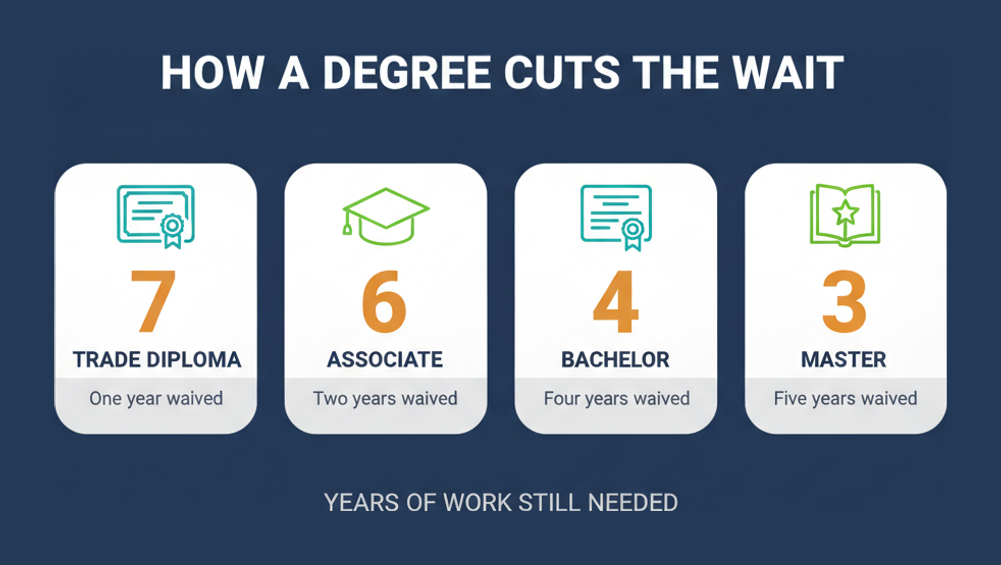
That single rule filters more people out of the CSQE certification than the exam ever will. A software engineer with a bachelor’s degree still needs four years of relevant work before the application is accepted, and a self-taught engineer with no formal qualification needs the full eight.
What counts as decision-making
ASQ is specific that the qualifying years must sit in a position where you make decisions rather than execute someone else’s. In practice that means owning a test strategy, signing off a release, running a quality management system, or holding the authority to stop a build going out. Time spent writing test cases to a plan somebody else wrote is harder to defend on the application form.
Read the requirement carefully before you pay, because ASQ reviews the application before it lets you book. If your experience does not hold up, the fee comes back minus a $130 processing charge, which is an expensive way to find out.
The route most people miss
If you already hold an ASQ credential, the experience you used to qualify for it carries across. ASQ names five that count: quality auditor, reliability engineer, supplier quality professional, quality engineer and quality manager. Anyone who came into software from a manufacturing or process quality background is often eligible on paper without realising it. The full eligibility and waiver rules sit on the ASQ credential page, and they are worth checking against your own history before you assume you are years away.
What Does the CSQE Body of Knowledge Cover?
The CSQE body of knowledge has seven domains and publishes an exact question count for each rather than a percentage. Those counts total 160, which is the scored portion of the exam. The domains run from general knowledge and quality management through engineering processes, project management, metrics, verification and validation, and configuration management.
| Domain | Area | Scored questions |
|---|---|---|
| I | General Knowledge | 16 |
| II | Software Quality Management | 27 |
| III | System and Software Engineering Processes | 32 |
| IV | Project Management | 16 |
| V | Software Metrics and Analysis | 21 |
| VI | Software Verification and Validation | 32 |
| VII | Software Configuration Management | 16 |
Why the standards domain matters more than its size suggests
General Knowledge is only 16 questions, but one of its five sub-areas asks you to define and describe ISO 9000 and 27000, NIST Special Publication 800-53, IEEE software standards and the CMMI assessment models. That is four separate frameworks inside a single objective, and each is a large document in its own right.
You are not expected to implement them. The verb ASQ attaches is “understand”, which means recognising what each one governs and where it applies. The IEEE 730 standard is the one closest to the exam’s own subject, since it defines the software quality assurance process itself.
“This standard applies to the development and maintenance of critical software; for example, where failure could impact safety or cause large financial or social losses.”
The security control framework in the same objective sits at the other end of the scale. NIST SP 800-53 is a control catalogue rather than a process standard, and CSQE reaches it through the security requirements and software security risk objectives in domains III and IV rather than through general knowledge alone.
The compliance content people underestimate
Domain I also names EU GDPR, China’s data protection laws, HIPAA and US rules covering personally identifiable information, alongside copyright, trademark, intellectual property and product liability. Add the ASQ code of ethics and you have a legal and regulatory block that has nothing to do with code. Engineers preparing purely on technique routinely lose marks here.
Why Do Two Domains Carry Twice the Weight of the Others?
Software Verification and Validation and System and Software Engineering Processes carry 32 scored questions each. Together they are 64 of 160, so two domains out of seven decide 40 percent of the exam. Both are also the widest by sub-topic count, which means the density of marks per page of study is roughly even across them.
What sits inside verification and validation
The V&V domain breaks into four parts, and one of them is disproportionately large. Test planning and design alone holds ten named objectives: test strategies, test plans, test designs, software tests, tests of external products, test coverage specifications, code coverage techniques, test environments, test tools and test data management. Theory, reviews and inspections, and test execution documents make up the rest.
Ten objectives inside one sub-area is the single densest cluster in the blueprint. If you are short on preparation time, this is where the return is highest. Working timed sets against the real question style is the fastest way to find which of the ten you are weakest on, and the CSQE practice sets are built around the same seven-domain split so the gaps map straight back to the blueprint.
What sits inside engineering processes
Domain III covers the lifecycle models first, and it names four explicitly: waterfall, incremental and iterative, agile, and DevOps. Systems architecture and cloud computing models each get their own sub-area. Then requirements engineering opens out into nine objectives covering product, data, quality, compliance, security, derived and non-functional requirements plus elicitation methods and evaluation.
Requirements management adds change management and bidirectional traceability. Software analysis, design and development covers design methods, quality attributes, reuse and tooling. Maintenance management closes the domain with maintenance types, strategy and customer feedback. It is the most modern-feeling part of the blueprint, and the DevOps and cloud objectives are the ones that date fastest.
How Does an Open Book Exam Change How You Prepare?
Every ASQ examination is open book, CSQE included. You bring your own reference materials, and they must be bound and stay bound for the whole sitting. Bound means stitched, glued, or held by fasteners that pass through every page: ring binders, spiral binders, plastic snap binders, brads and screw posts all qualify. Loose notes do not.
This changes the shape of preparation more than most candidates expect. Memorising definitions becomes a poor use of time, because a definition you can look up in fifteen seconds is not what the exam is testing. Recognising which model or technique a scenario calls for is what earns marks, and no reference book will do that for you.
What to actually build
- A tabbed, indexed copy of the CSQE handbook, because an unindexed reference costs more time than it saves at ninety seconds per question.
- A single bound sheet of the seven domains with their question counts, so you can pace yourself against the real distribution.
- Comparison tables for the things that are easy to confuse under pressure: the four cost of quality categories, DMAIC against PDCA, the audit types, and the maintenance types.
- Formula and metric references for domain V, where terminology precision matters and recall is unreliable.
The practical conditions are worth knowing in advance too. A basic scientific calculator appears on screen, and test centre staff can hand you a physical one if you prefer. Scratch paper and pencils are provided, and you need government-issued photo identification with a signature. ASQ’s testing guidance covers the full centre rules, including the thirty-minute early arrival that catches people out.
Two delivery formats, two different exams
The computer-based version is 175 questions in four and a half hours, of which 160 count. The paper-based version is 160 questions in four hours. Both are offered in English only. The computer version gives you slightly more time per scored question, which is a small but real argument for choosing it if both are available where you are.
What Does CSQE Cost and How Is It Scored?
CSQE costs $550 for non-members and $450 for ASQ members, a $100 difference that is close to the price of membership itself. A retake is $350. The pass mark is 550 out of 750 on a scaled score, so the raw number of correct answers does not translate directly into a percentage you can calculate in the room.
| Detail | Value |
|---|---|
| Exam name | ASQ Certified Software Quality Engineer |
| Exam code | CSQE |
| Questions | 175, of which 160 are scored |
| Duration | 270 minutes |
| Format | Multiple choice, open book |
| Passing score | 550 out of 750 |
| Fee, ASQ member | $450 |
| Fee, non-member | $550 |
| Retake fee | $350 |
The fifteen unscored questions
Fifteen of the 175 items do not count toward your result. They are trial questions being validated for future exams, and they are not marked as such. You cannot identify them, so the only sensible approach is to answer every question as though it counts. The practical effect is on pacing: you have 270 minutes for 175 items, which is roughly 92 seconds each.
The fees that are easy to miss
Rescheduling costs $130 and has to happen at least five days before the appointment. Turning up late means you do not sit and you lose the fee outright. If ASQ reviews your application and decides your experience does not meet the requirement, the refund is also reduced by $130. A failed computer-based attempt brings a performance summary by email within three to five working days, and the reduced retake rate stays open for two years from that attempt.
CSQE Against the Other ASQ Quality Credentials
ASQ runs a wide catalogue of quality certifications, and several of them overlap CSQE’s material without covering software specifically. Certified Quality Engineer, Certified Quality Auditor and Certified Manager of Quality share the management, audit and metrics content. What CSQE adds is the entire engineering, verification and configuration management half of the blueprint.
Which one fits which job
If your work is software delivery, CSQE is the direct fit and no other ASQ credential covers requirements engineering, test design or configuration control at this depth. If you audit rather than build, the auditor credential is closer. If you manage quality across a mixed portfolio where software is one product among several, the general quality engineering route covers more of your day.
The overlap has a practical benefit. Because experience used to qualify for those credentials also counts toward CSQE, an existing ASQ holder is often eligible immediately. A broader look at the ASQ certification catalogue makes the overlaps easier to see than reading each body of knowledge in isolation.
Where CSQE sits against software-specific alternatives
Testing certifications cover verification and validation in more procedural detail but stop there. CSQE is deliberately broader: it expects you to connect a defect trend to a process change, to a cost of quality category, and to a corrective action procedure. That breadth is why the credential reads as an engineering qualification rather than a testing one, and it is also why the eight-year experience requirement is defensible.
How Should You Work Through 160 Scored Questions?
The efficient order is to secure the two 32-question domains first, then the 27-question management domain, then the three smaller ones, and to leave general knowledge until last because much of it is reference material you can carry into the room. Even coverage beats depth in a favourite area when the pass mark sits at 550 of 750.
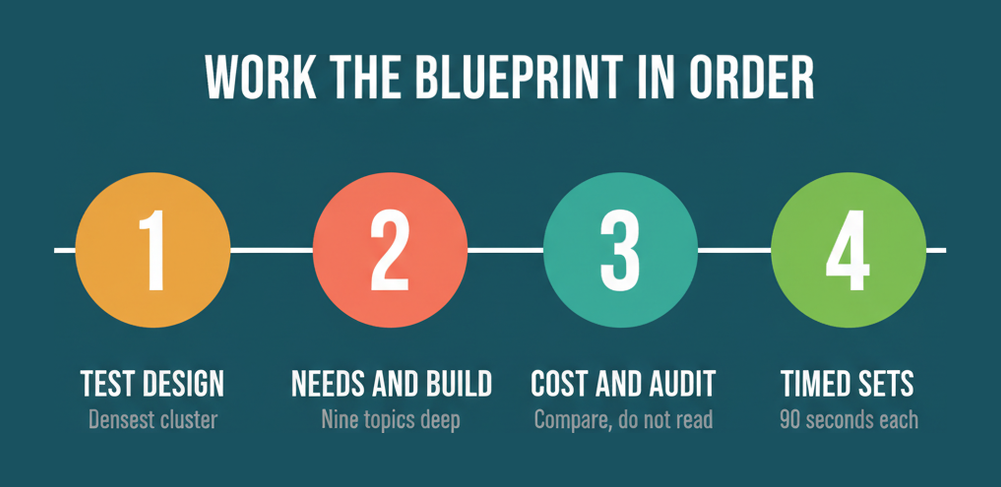
- Start with software verification and validation, and inside it with the ten test planning and design objectives, since that is the densest single cluster in the blueprint.
- Move to system and software engineering processes, treating requirements engineering as its own study block because nine of the domain’s objectives sit there.
- Work software quality management next, learning the four cost of quality categories and the DMAIC and PDCA models as comparison tables rather than prose.
- Cover metrics and analysis with a focus on terminology precision, because domain V rewards using the right word for the right measure more than it rewards calculation.
- Take project management and configuration management together, since risk management and change control are the same discipline applied to different objects.
- Read the general knowledge domain last, building your bound reference as you go rather than trying to memorise the four frameworks it names.
- Finish with full-length timed practice at roughly ninety seconds a question, checking coverage across all seven domains rather than accuracy in your strongest one.
Candidates coming from a testing background usually find domains II and IV the hardest, because quality management systems and programme reviews are unfamiliar rather than difficult. Candidates coming from quality management find the reverse. Plan around which half of the blueprint is genuinely new to you rather than around a fixed number of weeks.
What Happens Once You Pass?
CSQE has to be recertified every three years, and the requirement is 18 recertification units earned through professional development, training, volunteering or mentoring. You can recertify by journal or by taking the exam again. Let it lapse and you must stop using the acronym immediately, and after a year the credential expires entirely.
The grace period and what it costs you
There is a 60-day grace period after the recertification date during which journal recertification is still open. Miss that and the only route back is the exam. Miss that for a further year and the certification is gone, and you reapply from the beginning, eligibility check included. It is an unusually firm regime, and it exists for a reason.
“In accordance with ISO 17024 Standards for Conformity Assessment, recertification conditions shall ensure that there is impartial evaluation to confirm the continuing competence of the certified person.”
What the credential is actually worth day to day
CSQE does not open doors on its own, and anyone selling it as a salary lever is overstating it. What it does reliably is settle the question of whether a quality role in a software organisation is a real engineering position, which matters in regulated industries, in safety-related development, and anywhere a customer audit can arrive without notice. Candidates weighing that up will find the practical side covered in more depth in this look at stepping up to CSQE.
All recertification activity has to map back to at least one area of the body of knowledge, which is a quietly useful constraint. It means the three-year cycle pushes you back through the same seven domains rather than letting you drift into whatever training your employer happened to buy.
Frequently Asked Questions
How many questions are on the CSQE exam?
The computer-based CSQE exam has 175 questions and runs for 270 minutes. Only 160 of those questions are scored; the other 15 are unmarked trial items being validated for future exams. A paper-based version exists with 160 questions in four hours.
What is the CSQE passing score?
You need 550 out of 750 on a scaled score. Because the scale is not a straight percentage of correct answers, you cannot reliably calculate your position during the exam. Treat every question as scored and aim for even coverage across all seven domains.
How much does the CSQE certification cost?
The exam fee is $550 for non-members and $450 for ASQ members, with retakes at $350. Rescheduling an appointment costs $130, and an application rejected on eligibility grounds is refunded minus a $130 processing fee. Membership pays for itself on the first attempt.
What experience do you need for CSQE?
Eight years of on-the-job experience across the body of knowledge, some of it in a decision-making position. Education waives part of it: one year for a trade diploma, two for an associate degree, four for a bachelor’s degree, five for a master’s or doctorate. Only one waiver counts.
Is the CSQE exam open book?
Yes. Every ASQ exam is open book. You supply your own reference materials and they must be bound and remain bound throughout, which rules out loose notes. An indexed, tabbed handbook is worth far more than an unmarked one at roughly ninety seconds per question.
Which CSQE domains carry the most questions?
System and Software Engineering Processes and Software Verification and Validation carry 32 scored questions each, making them 64 of the 160 marks between them. Software Quality Management follows at 27. The remaining four domains hold 16 to 21 questions apiece.
How long does CSQE certification last?
Three years. Recertification requires 18 recertification units earned through professional development, training, volunteering or mentoring, and can be completed by journal or by re-sitting the exam. A 60-day grace period follows the deadline, after which only the exam route remains open.
Does CSQE require an ASQ membership?
No, membership is optional. Non-members pay $550 rather than $450, so the $100 difference is close to the cost of joining. Membership also carries across to other ASQ credentials, which matters if you are likely to sit more than one.
Can experience from another ASQ certification count toward CSQE?
Yes. Experience used to qualify as a quality auditor, reliability engineer, supplier quality professional, quality engineer or quality manager also applies to the software quality engineer requirement. Anyone who moved into software from process or manufacturing quality is often eligible already.
Is CSQE a testing certification?
No. Verification and validation is one domain of seven, worth 32 of 160 marks. The rest covers quality management systems, engineering processes, project management, metrics and configuration management. It is an engineering credential that includes testing rather than a testing credential.
Conclusion
The CSQE certification is unusual in asking more of you before the exam than during it. Eight years of qualifying experience, reduced by at most five through education, is a genuine barrier, and it is the first thing to check rather than the last. Once you clear it, the exam rewards breadth: seven domains, 160 scored questions, and a pass mark that leaves no room for writing off a whole area.
The open book format is the detail that most changes how you should prepare. Build an indexed, bound reference rather than trying to hold four compliance frameworks in your head, and spend the saved time on the two 32-question domains that decide 40 percent of the result. Once the blueprint is familiar, timed practice across all seven domains is the quickest way to find the gaps that would cost you the marks you cannot afford.


