Picture an Oracle Exadata rack sitting inside a Microsoft datacentre, running an Autonomous Database that a Google Cloud application queries over a private link. That is not a thought experiment. It is the working environment the Oracle Cloud Infrastructure 2025 Multicloud Architect Professional exam, code 1Z0-1151-25, is built to test, and half its marks sit in exactly that territory.
The exam runs 50 questions in 90 minutes, costs $245 USD, and asks for 68 percent to pass. What makes it unusual among Oracle credentials is where the weight falls. Only 10 percent covers multicloud as a concept. The other 90 percent is hands-on: federating identity, wiring interconnects, and provisioning Oracle databases inside two rival clouds. This guide works through each of the five domains, what they genuinely ask for, and how to prepare when two thirds of the syllabus lives outside Oracle’s own console.
What Does an OCI Multicloud Architect Actually Do?
An OCI multicloud architect designs and runs Oracle workloads that span Oracle Cloud Infrastructure and at least one other public cloud. In practice that means federating identity between providers, building private network paths between them, and placing Oracle database services physically inside Azure or Google Cloud regions so applications there can reach them at local latency.
The job exists because a large share of enterprise data still lives in Oracle databases while a large share of new application development happens elsewhere. Moving one to match the other is expensive and slow. Running both, connected properly, has become the pragmatic answer, and Oracle built a certification track around the people who make that work.
Why the role is not just networking
It would be easy to read the syllabus as a connectivity exam. It is not. Connectivity is 20 percent. The larger share goes to provisioning and operating database services in someone else’s datacentre, which brings in onboarding flows, subscription linkage, resource placement, and disaster recovery design. You need the network knowledge, but it is the entry fee rather than the subject.
Oracle’s own multicloud portfolio page sets out the services this exam covers and how they are positioned against single-cloud deployment.
Where Do the Marks Sit Across the Five Domains?
Five domains carry published weightings. Implement Oracle Database@Azure is the heaviest at 30 percent. Core OCI Services Overview, Configure Multicloud Connection Options and Implement Oracle Database@Google Cloud each carry 20 percent. Introduction to Multicloud, the only conceptual domain, is worth 10 percent. Half the paper is therefore about running Oracle databases inside another provider’s cloud.
| Domain | Weight | Approximate questions |
|---|---|---|
| Implement Oracle Database@Azure | 30% | 15 |
| Core OCI Services Overview | 20% | 10 |
| Configure Multicloud Connection Options | 20% | 10 |
| Implement Oracle Database@Google Cloud | 20% | 10 |
| Introduction to Multicloud | 10% | 5 |
The arithmetic is worth doing. At 68 percent you can afford to lose 16 questions. Drop the whole Database@Azure domain and you have already lost 15 of them, which leaves almost no room anywhere else. There is no version of a pass that skips the Azure material.
The one domain you can afford to skim
Introduction to Multicloud carries five questions and asks only that you explain multicloud, its benefits, and common use cases in OCI. It rewards vocabulary rather than practice. Read it once properly, and spend the time you save on provisioning.
What Is the 1Z0-1151-25 Exam Format?
1Z0-1151-25 is a 50 question multiple choice paper with a 90 minute limit, a 68 percent passing score, and a $245 USD price that varies by country and local currency. That works out at 108 seconds per question, which is comfortable by Oracle professional standards and leaves room to reason through a scenario rather than recall a fact.
| Specification | Value |
|---|---|
| Exam code | 1Z0-1151-25 |
| Full name | Oracle Cloud Infrastructure 2025 Multicloud Architect Professional |
| Questions | 50 |
| Duration | 90 minutes |
| Passing score | 68% |
| Price | USD $245 |
| Format | Multiple choice |
A 68 percent cut on 50 questions means 34 correct answers. That is a genuinely professional bar, but it is not the 80 percent some Oracle specialist exams demand. The generous clock is the more useful signal: Oracle expects scenario questions here, not definitions. Working through the domain-by-domain 1Z0-1151-25 practice questions is the fastest way to find out whether your reading has turned into judgement.
Which Core OCI Services Does the Exam Assume You Know?
Three areas, and they are named individually rather than left vague. You must federate OCI Identity Domains with external identity providers, implement and manage Virtual Cloud Network components, and administer OCI database services including Base Databases, Autonomous Databases and HeatWave. Twenty percent of the paper sits here, and none of it is multicloud-specific.
This domain is where candidates coming from an Azure or Google background lose marks. The multicloud material is new to everybody, so it levels the field. Core OCI is not new to an OCI engineer, and the exam assumes that baseline without teaching it.
Identity federation is the piece that matters most
Federating OCI Identity Domains with an external identity provider is the first thing you do in any real multicloud build, and it is the first objective listed. Expect questions on the trust relationship, attribute mapping, and what actually happens to a user’s OCI authorisation when the external provider is the source of truth.
What the database line really covers
- Base Database Service – the customer-managed option, where you retain control of the VM and the patching cycle
- Autonomous Database – self-patching and self-tuning, and the service most often referenced in the multicloud domains
- HeatWave – the MySQL analytics engine, included here because it is offered as a multicloud service too
How Much Networking Is in the Connectivity Domain?
Enough to matter, and it splits three ways. You configure general OCI connectivity through Site-to-Site VPN and FastConnect, then implement Oracle Interconnect for Azure and Oracle Interconnect for Google Cloud as named, separate objectives. Twenty percent of the paper depends on knowing which of those three paths a given scenario calls for.
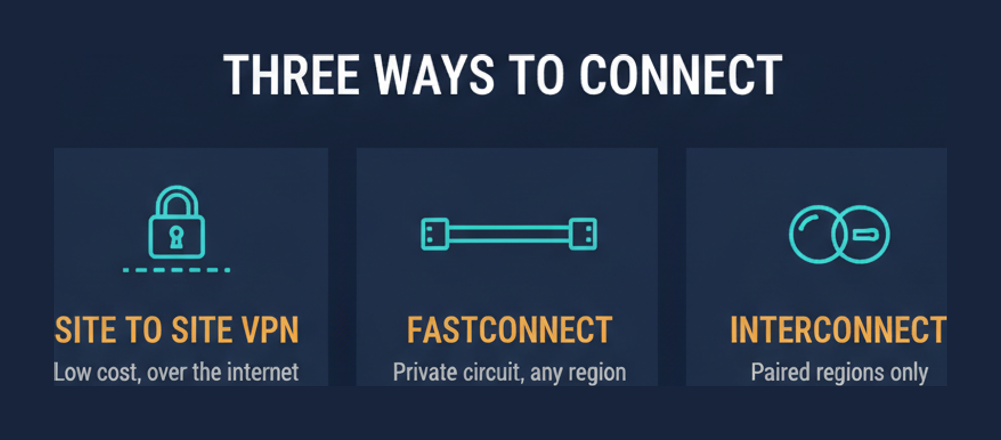
The distinction the exam keeps returning to is between a general-purpose private circuit and a purpose-built interconnect. FastConnect gives you a dedicated link into OCI from anywhere. The Interconnect products are pre-provisioned partnerships that pair an OCI region with a specific partner-cloud region, which removes the circuit ordering work but constrains where you can land.
Where scenario questions bite
- A workload needs a private path and the two cloud regions are paired. The Interconnect is the right answer, and choosing FastConnect costs you the mark.
- The regions are not paired. FastConnect through a partner is the answer, and reaching for the Interconnect is wrong.
- The requirement is low volume, tolerant of internet transit, and cost-sensitive. Site-to-Site VPN is correct even though it is the least impressive option.
What Is Oracle Database@Azure, and Why Is It Worth 30 Percent?
Oracle Database@Azure places Oracle-managed database hardware physically inside Microsoft Azure datacentres, so an Azure application reaches an Oracle Exadata or Autonomous Database at local network latency. Microsoft documents it as a service bought through the Azure Marketplace and operated by Oracle. It is the single heaviest domain on 1Z0-1151-25 at 30 percent, roughly 15 questions.
Three objectives sit under it, and they map to the lifecycle of a real deployment: explain the architecture and onboarding, provision the service, and configure high availability and disaster recovery. The onboarding half is where the marks hide, because it is procedural rather than technical.
“For the first time, the AI and converged database capabilities of Oracle Database 23ai as well as all the automation and tools of Oracle Autonomous Database and Oracle Exadata Database Service are fully integrated with Google Cloud. This new service combines all of the benefits of OCI database services with Google Cloud services for a seamless multicloud experience, which was unthinkable in the cloud space just a few years ago.”
The onboarding chain candidates underestimate
Getting to a running database involves linking an Azure subscription to an OCI tenancy, accepting the marketplace offer, delegating a subnet, and establishing the identity mapping between the two clouds. Every one of those steps has a failure mode, and failure modes are exactly what a scenario question is built from. Read the architecture in Microsoft’s own documentation as well as Oracle’s, because the exam describes both sides of the boundary.
High availability across a boundary
Disaster recovery design is the third objective and the one that separates a professional-level answer from an associate-level one. The question is rarely which technology to use. It is where the standby belongs, what the failover does to the Azure-side application, and which parts of the configuration survive a region loss.
How Does the Google Cloud Half Differ From the Azure Half?
Structurally it is the same idea and ten points lighter. Oracle Database@Google Cloud is worth 20 percent against Azure’s 30, and its three objectives cover architecture, onboarding and configuration, then provisioning and managing resources. The difference the exam cares about is the operational surface: Google Cloud’s console, its project and IAM model, and its own private connectivity.
Do not assume the Azure knowledge transfers cleanly. The two services were built with the same intent but different partner platforms, and the exam tests the partner-side detail. Where Azure uses subscriptions and delegated subnets, Google Cloud uses projects and its own networking constructs, and a question will name the right one.
“Oracle and Google Cloud have extended their multicloud strategy with this partnership, and customers can now take advantage of the automation in Oracle Autonomous Database and the performance of Exadata on OCI running in Google datacenters. As a result, customers can combine data from Oracle databases with Google Cloud services like Gemini foundation models and the Vertex AI development platform to develop and run a new generation of cloud native applications.”
One notable asymmetry: the Azure domain names high availability and disaster recovery as its own objective, and the Google Cloud domain does not. Resilience questions on the Google side arrive folded into resource management instead, so they are easy to miss when you revise by objective title. Google’s Oracle Database documentation is the reference for that platform-side detail.
Should You Sit the Associate Exam First?
Not necessarily. Oracle offers a multicloud architect credential at associate level as well, and search data shows candidates comparing the two before booking. The professional exam does not list the associate as a prerequisite, so the decision comes down to whether you already hold working knowledge of OCI identity, networking and database services.
If you do, go straight to 1Z0-1151-25. The 20 percent Core OCI Services domain is the only part the associate would prepare you for, and you already have it. If OCI itself is new to you, the professional paper will punish that gap in a way no amount of multicloud reading fixes.
A useful self-test
Ask yourself whether you could federate an OCI Identity Domain with an external provider without documentation open, and whether you could explain the difference between a Base Database and an Autonomous Database to a colleague. Two confident yeses mean the professional exam is the right target. The OCI Networking Professional guide covers the VCN territory this exam assumes rather than teaches.
How Should You Prepare for a 68 Percent Cut Score?
Weight your study to match the paper. Half of 1Z0-1151-25 is Oracle Database@Azure and Oracle Database@Google Cloud, so half your preparation belongs there, and most of that should be spent inside the consoles rather than reading about them. The conceptual domain needs one careful pass and no more.
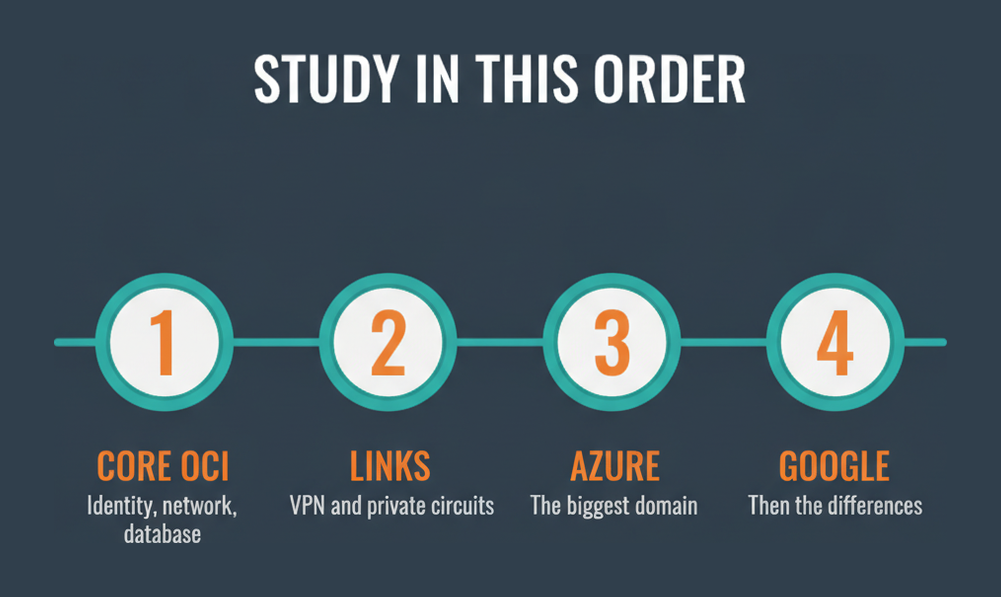
- Read the Introduction to Multicloud objectives once and move on. Five questions do not justify more.
- Audit your Core OCI knowledge against the three named areas: identity federation, VCN components, and the three database services. Close any gap here first, because everything later assumes it.
- Build a Site-to-Site VPN and read the FastConnect provisioning flow end to end, so the connectivity choices become instinct rather than recall.
- Walk the full Oracle Database@Azure onboarding chain in a trial subscription, including the subscription linkage and subnet delegation, because the procedural steps are where the 30 percent domain scores you.
- Repeat the same walkthrough on Google Cloud, paying attention to what is different rather than what is the same, since the exam tests the partner-side detail.
- Finish on disaster recovery design across a cloud boundary, which is the highest-value single objective on the paper and the one most often skipped.
Database performance knowledge pays off in the Core OCI domain too, since administering Autonomous and Base Database services is an examined objective rather than background. The Oracle database tuning walkthrough covers that ground at a useful depth.
Which Roles Does This Credential Actually Serve?
Cloud architects, database architects and platform engineers at organisations running Oracle databases alongside Azure or Google Cloud workloads. The credential is narrow by design. It does not make you an Azure architect or a Google Cloud architect, and it is not a general Oracle Cloud credential either. It certifies the seam between them.
That narrowness is the point. Multicloud, as the industry defines it, means using services from more than one public cloud provider in a single architecture, and the shortage is in people who can operate the join rather than either side alone. The concept is covered well in the multicloud reference overview if you want the vendor-neutral framing that domain 1 expects.
Where it fits in a certification path
It sits alongside the other OCI professional credentials rather than above them. Someone holding the networking or architect professional certification adds genuinely new coverage with this one. Someone holding no OCI certification at all should treat it as a specialisation to reach for second, not first.
Frequently Asked Questions
How many questions are on the 1Z0-1151-25 exam?
Fifty, with a 90 minute limit. That is 108 seconds per question, which is generous for an Oracle professional paper and reflects the scenario style rather than straight recall.
What is the passing score for 1Z0-1151-25?
Sixty-eight percent, which means 34 of the 50 questions correct. You can afford to lose 16, but the Azure domain alone accounts for roughly 15 of them, so it cannot be skipped.
How much does the OCI Multicloud Architect Professional exam cost?
USD $245, with the price varying by country and local currency. That is standard for an Oracle professional-level certification exam.
Which domain carries the most marks?
Implement Oracle Database@Azure at 30 percent. Core OCI Services, Configure Multicloud Connection Options and Implement Oracle Database@Google Cloud each carry 20 percent, and Introduction to Multicloud carries 10.
Do you need Azure or Google Cloud experience to pass?
Some familiarity helps, because half the syllabus involves working inside those consoles. You are not tested on Azure or Google Cloud services generally, only on the Oracle database services running within them.
What is the difference between FastConnect and Oracle Interconnect?
FastConnect is a general dedicated connection into OCI from any location. Oracle Interconnect is a pre-provisioned partnership pairing specific OCI and partner-cloud regions, which removes circuit ordering but limits where you can land.
Is the associate multicloud exam a prerequisite?
No. The professional exam lists no prerequisite. The associate is worth taking first only if Oracle Cloud Infrastructure itself is unfamiliar, since 20 percent of the professional paper assumes that baseline.
Does the exam cover HeatWave?
Yes. HeatWave is named alongside Base Databases and Autonomous Databases in the Core OCI Services domain, so the MySQL analytics service is examinable rather than optional background.
How long does preparation usually take?
For an engineer already fluent in OCI, several weeks of console time across both partner clouds is realistic. Without that OCI baseline, expect considerably longer, because the Core OCI domain is assumed rather than taught.
Is Oracle Database@Azure the same as running Oracle on an Azure VM?
No. It is Oracle-managed database hardware sited inside Azure datacentres and bought through the Azure Marketplace, not a database you install and operate yourself on a virtual machine.
Conclusion
1Z0-1151-25 is a narrow, practical credential that certifies one specific competence: running Oracle database services inside somebody else’s cloud and connecting them properly. Half its marks live in the two partner-cloud domains, a fifth assumes Core OCI knowledge it never teaches, and only a tenth rewards concepts.
Prepare it in the consoles rather than on paper, give the Azure domain the largest share of your time, and treat the Google Cloud material as a separate platform rather than a variation on the same theme. When the onboarding chains feel routine and the connectivity choices arrive without hesitation, check your judgement against the money site’s scenario questions before booking the 90 minutes.


